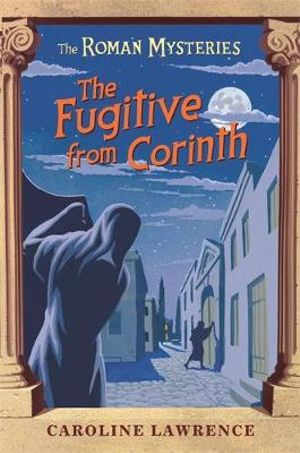
(10+) The four friends, met in numerous other tales, Flavia, Jonathon, Nubia and Lupus, are appalled when they discover their tutor, Aristo, bending over Flavia's father's body, covered with blood. Everyone assumes the young man is guilty and he is taken away by the authorities while the children send for help with Pater, who seems to be still breathing. By the time the doctor comes and pronounces him alive but with amnesia, Aristo has escaped and so the four are after him. Their adventures take them along the road to Corinth where they meet a variety of people, most of whom are willing to help them find the murderer.
One in the The Roman Mysteries series, these stories have broad appeal to the upper primary, lower secondary student with a penchant for crime and ancient times. The amount of information about Ancient Greece and Rome that the author fits into the pages is astonishing, and the maps at the front of the book serve the reader well. Exciting and absorbing, the four main characters are most attractive, the author presenting them not as historical figures from the past, but flesh and blood children with fears and foibles, as they travel along an unknown road. Fran Knight
Wombat and fox: summer in the city by Terry Denton
Allen and Unwin, 2007 (Age 6-9) With Fox's fur falling out in clumps, and Wombat so hot he feels he is melting, the friends decide that something must be done. Wombat takes the bull by the horns and books them a seaside holiday. They must catch the bus, and being novices, let many busses go by before they realise that any one of them would take them to the beach. But when they get on the bus they find that another of their friends, Crocodile is headed in the same direction. Trusting Wombat's stomach solves many of their problems, but they find that one thing is there to ruin their holiday, the Five Monkeys.
The running battle between the friends and the monkeys ends harmoniously when all at sea, the penguins come to their aid. This amusing and well illustrated little tale will please the newly reading kids of lower primary age. Fran Knight
The Plague by Clem Martini
Bloomsbury,
2006
(11+)In this remarkably imaginative tale, Kyp has been left
alone after a devastating plague has overtaken the bird population. He
wakes to find the Chooser murdered by another crow, Kym kidnapped by
humans and his family decimated. Determined to find Kym, he sets out on
a perilous journey, picking up strays, orphans and outcasts on the way.
After marvelling at the author's ability to invent a multitude of names
starting with K, it wasn't too difficult to sort out characters as
Martini drew a convincing portrait of each different bird, giving the
reader in-depth insights into different personalities. Kyp faces the
challenges of being a leader and the daunting task of protecting his
ragged flock against humans and a renegade crow who has spread a
Messianic message to convince other crows to join him.
This is not just a fascinating story about crows but a convincing
portrait of a plague overtaking the bird population. A look at the
human population from the viewpoint of the crows is remarkable. There
is plenty of fast paced action in this book, but underpinning it are
themes of responsibility, redemption and family to give the reader much
food for thought.
The second book in The Crow
Chronicles, it can be happily read as a stand-alone. I found it
very hard to put down, and look forward to reading others in the series.
Pat Pledger
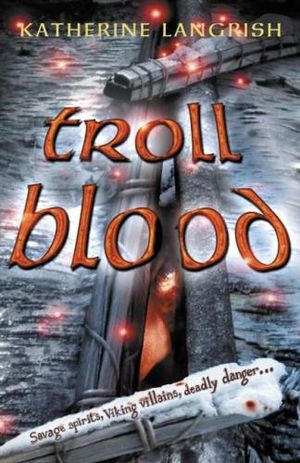
Troll Blood by Katherine Langrish
(11+) The third in the Troll series, Troll Blood can be read alone. The story is one of adventure, cold blooded murder and justice. Norse mythology and Native American mythology play an important part in the tale as Katherine Langrish tries to get into the minds of both groups of people and see life through their eyes. The story emerges from the belief that Norsemen sailed to North America, or Vinland, and settled there. The voyage across the Atlantic must have taken great courage and strong leadership to undertake and survive (I would have like to have known more about this … how did they keep their food dry in an open boat, and where did the water come from?) The characters are well drawn. There is Gunnar, the leader, his son, the handsome smiling Harald, Peer the self doubting inexperienced lad and Hilde, who seeks adventure and a life away form the drudgery of a northern winter. There are problems however; Gunnar, Harald and some of the crew have a dreadful secret that threatens them all. This is a story that can be read at several levels. An adventure story, it can also be a starting point for looking at the mythologies of the Norse and Native American, as well as looking at the sociological aspects of how we treat others (eg bullying, indigenous peoples, understanding of those different from ourselves) It is an interesting read, made more so because it is not Anglo-Celtic in its mythology, nor in its fantasy, although I wouldn't class the book as fantasy. Mark Knight
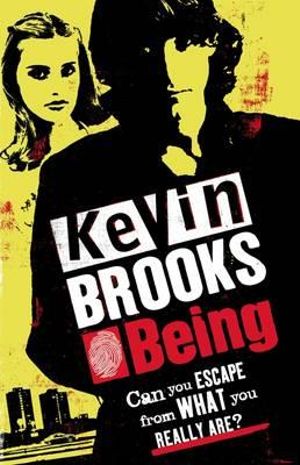
Being by Kevin Brooks
Penguin, 2008. (13+) In hospital for a routine operation for a suspected ulcer, Robert wakes up during the procedure, and alarmingly finds that he is in the basement, and the opening in his stomach has revealed not flesh and blood, but different coloured strands of wire, mechanical things where his organs should be. Men in the room are not hospital attendants but people with guns, giving orders, and he grabs one of the guns and escapes. Later in a hotel room, he cuts into himself to check what he saw. He cannot explain to himself what has happened, but simply and instinctively knows he must flee.
An exciting, fast paced action thriller, Being will have a ready audience. Robert is a smart character, taking all sorts of risks to get out of London to a place of safety. Boys particularly will thrill with his near miss adventures as he keeps one step ahead of the unknown Ryan, the commanding man with the gun in the hospital basement.
I found some of the introspection a little wearing, but the readers will love it as they identify with Robert, alone and having to piece together what he knows to work out what he is. I was eagerly looking forward to answers at the end of the book, but there wasn't one. An interesting slant on the amazing number of series books now being written, and which I assumed this would be. Fran Knight
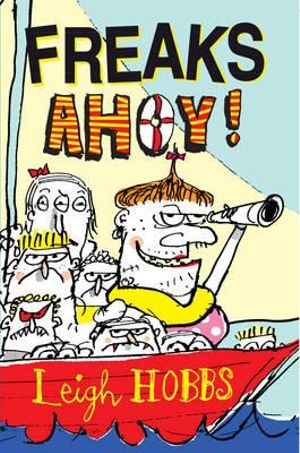
Freaks ahoy by Leigh Hobbs
Allen & Unwin, 2007. ISBN: 9781741149838. (Age:6-10)
In his own inimitable fashion, Leigh Hobbs has penned a sequel to the very funny 4F for Freaks. In this novel for younger readers, Miss Schnorkel takes the class on a sea trip, and when she has a nap, One-Eyed Eileen, now realizing that she is Miss Corker in disguise, tries to get the mask off her face. The class goes on a rampage, undermining the poor group of teachers on long service leave, but when order is restored, Miss Schnorkel organizes the class to play games which emphasise the value of sharing and caring.
Classes will love to read about the antics of this fabled class, and have fun thinking up further adventures for them. The book, containing the most entertaining drawings to illustrate the text, has wide appeal to the newly effective reader.
Fran Knight
Surviving Antarctica: Reality TV 2083 by Andrea White
Recommended.
(11+) A compulsive thriller set in 2083, this historical science fiction book will sure to be a winner with readers who like their adventure spiced with a bit of history. In this future world, nobody goes to school – instead they watch EduTV. When they turn 14, only the rich can afford to go on to high school and university, and the poor scrabble for any type of work from the few jobs available. Five teenagers, Andrew, Polly, Robert, Billy, and Grace, hope to have their fortunes reversed when they are selected to be contestants on a reality TV show, Antarctic Survivor, where they will enact Scott's ill-fated trip to the South Pole in 1912. White has written a nail biting, exciting story. The suspense of whether the 14-year-olds will be able to survive as they face blizzards, crevasses, frostbite and lack of food is quite rivetting. She cleverly intertwines information about Scott's expedition taken from diaries and letters with the reality TV adventures that face her five protagonists. At the same time she depicts a chilling future, where TV has become an obsession and the evil Secretary of Entertainment has the power to implant digital cameras in her contestants' eyes and insist that they face extreme danger to ensure that the ratings are good. The teen characters are well developed and readers will warm to them as they sympathise with their weaknesses and cheer on their strengths and courage. Members of the production crew are also well portrayed and the author explores how difficult it is for them to be brave and help the contestants when threatened by the authorities. This is a compelling read, exciting and well researched. Pat Pledger
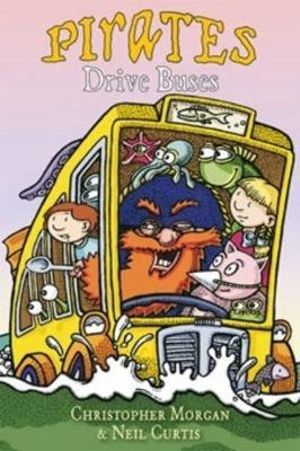
Pirates drive buses by Christopher Morgan and Neil Curtis
Allen & Unwin, 2007. ISBN: 9781741751468. (Age:6-10)
A sequel to Pirates eat Porridge, Pirates drives Buses has the same kids in another strangely funny situation, that of being picked up by a pirate who takes them on a bus ride. The other passengers are an assortment of fishy animals and together the occupants of the bus get up to an array of strange and wonderful things. Searching for his ship, the SS You Beauty, the pirate, who is never named, drives the bus straight into the sea.
Full of life and humour, this book, so beautifully illustrated by Neil Curtis, will have kids laughing out loud. Aimed at the newly arrived chapter book reader, kids will revel in the word concoctions and play on words that litter every page. Fran Knight
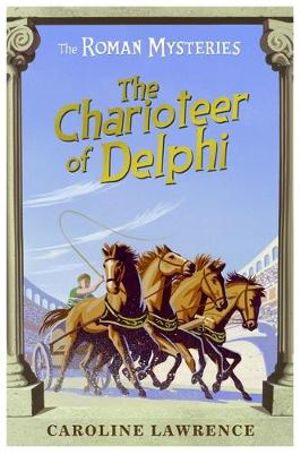
The Charioteer of Delphi by Caroline Lawrence (The Roman Mysteries)
(Age 10+) Filled with the sights and sounds of Ancient Rome, this series of books by Caroline Lawrence will entrance the reader of historical fiction, as the four protagonists find all sorts of crimes to uncover and solve. Presently being screened on the ABC, the series is enthralling.
In The Charioteer of Delphi, the group is involved with the kidnapping of the lead horse destined for the coming events at Circus Maximus. A huge reward has been posted for its return, and the four venture to Rome to join the throng of searchers. Flavia and her companions, Nubia, Jonathan and Lupis, join their new friend, the young charioteer, Scopas. Together they search for the horse, uncovering a mesh of intertwined intrigue.
What better way to learn about Ancient Rome than through a series of stories such as these. Every page is filled with new words and descriptions, the settings are authentic and entrancing, the detail convincing. This books, as do all the others, contains a series of maps to allow the reader to know exactly where the story is set, and a very detailed glossary at the end helps those novices for whom the words used need some reference. With this story too is a short description of the chariot races in Ancient Rome, leading the reader to historical records as well as modern films such as Ben-Hur. (The author does not stint in telling of the brutality and bloodthirsty nature of these races.) Fran Knight
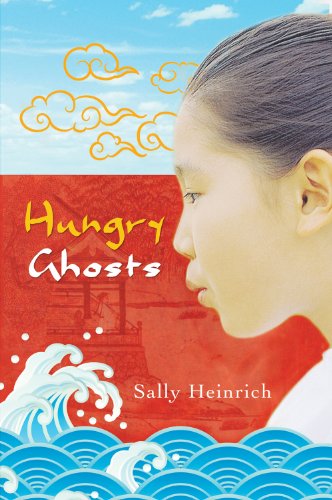
"Once again the gates of hell had been flung open and the spirits were free to wander the earth". Sarah had been putting out offerings for the Festival of the Hungry Ghosts when she started hearing voices. It was difficult enough putting up with the taunts of some of her school mates about Chinese superstitions, but having a ghost haunt her was just too much.
This is a compelling story about Sarah who is trying to fit into Australian society as her father wanted, while continuing to adhere to Chinese customs to satisfy her mother. The relationships in the books are warm and satisfying, particularly Sarah's companionship with her father and her growing friendship with Michael. Her portrayal of the ghost girl, Pei, is both chilling and heart wrenching.
Heinrich has cleverly devised a story that will interest her readers, while providing lots of information about Chinese customs and the history of Chinese immigration to Australia.
A highly readable and thought-provoking story, Hungry Ghosts should appeal to upper primary and lower secondary students.
Pat Pledger
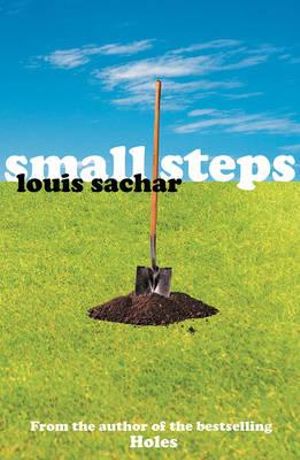
Small steps by Louis Sacher
Bloomsbury, 2007. ISBN: 9780747583455. (Age:11+)
Armpit, released from Camp Green Lake detention centre, where he dug holes for the warden, is advised by his counselor to take small steps if he wants to avoid being one of the 78% of African Americans who return to jail after their release. Determined not to be another statistic, Armpit enrolls at school, and takes a part time job. But he reckons without his Camp Green Lake acquaintance, X-Ray, who turns up offering Armpit the chance to make money.
Readers will instantly know that Armpit will not make a good choice, but he is such a strongly drawn character, that readers will wish that he succeeds. In this exciting adventure story, Armpit's good nature comes to the fore, as he befriends the disabled girl next door, is attracted to a girl in his class whose friends scare her off, as he deals with his friend, X-Ray and his schemes. A very likeable and funny read about the boys who once inhabited the world of Holes, Small steps is easy to read with lots of twists and turns, as Armpit befriends a singer whose manager wants her dead.
Fran Knight
My swordhand is singing by Marcus Sedgwick
Orion Children's Books (11+) A fantasy thriller that had me hooked from the start, My swordhand is singing is a most original look at vampires and the dread they engender. Tomas and his son, Peter are itinerant, moving from one village to another in search of work as wood cutters, always avoiding company and friendship. But Chust is different; the small village adheres to old customs, designed to keep away the vampires, it shows a meanness to strangers, it is isolated and inward looking. Just the place for vampires to feed. Peter is growing up and attracts the attention of a young woman, Agnes, while Tomas spends much of his time getting drunk. But there is a fear abroad which captures the imagination of the village. A wife is convinced that her dead husband returns to her each night, Agnes is chosen as the bride of a man who has died, and when gypsies call on Peter's father to bring out his sword, tension spills over. A breathtaking and imaginative telling of a vampire story, this novel is infused with a plethora of stories gleaned from tales, myths and legends from Europe's forest regions, where people lived their lives in dark and gloomy places, where implausible things happened and were transformed into terrifying stories by scared peoples trying to make sense of it all. I couldn't put it down, and this book will easily find readers amongst all ages in high schools. Fran Knight
Nick & Nora's infinite playlist by Rachel Cohn & David Levithan
Allen & Unwin, 2007 (15+) Catching sight of his ex-girlfriend on the arm of another guy at the club where his band is playing, Nick asks the girl near him to be his girlfriend for the next five minutes. Norah's answer is to pull his face down to hers. They begin a roller coaster ride through clubs, punk bands, music playlists and falling in and out of love, all taking place in the space of a night. Told in alternating chapters by Nick, written by David Levithan and Norah, related by Rachel Cohn, this is a compulsive story that drags you along through New York's music and club scene. Fabulous dialogue, vivid characters and some very funny scenes make for a memorable read. The strong language in the book may put off some adults but the authenticity of the conversations and the band's lyrics will really appeal to teenagers. The plot and setting should also ensure that this is a book that won't sit on the library shelf. Pat Pledger
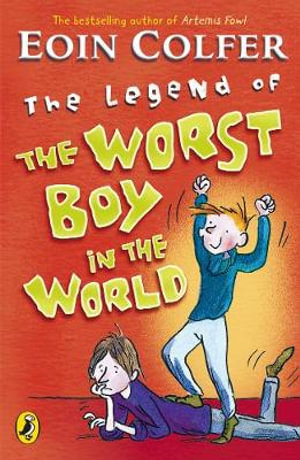
The legend of the worst boy in the world by Eoin Colfer
Penguin, London, 2007 (8+) The sight of Will dressed in his rabbit pyjamas strolling down the new road, walking straight along the line in the middle, but unaware that this new road meets the old road is enough to make the reader call out. Fortunately mum is on the run, chasing her 2 year old Will, but he thinks it is a game, so he runs faster. How all of this is involved in a story about a boy talking to his grandfather each weekend, trying to offload some of his worries is a very funny take on families and how they intersect. Fran Knight
Have 'they' finally caught up with Willow? A paranoid survivor of political protests, Willow has always believed that 'they' were out to get her. Now she has disappeared and Sarah is determined to find out what has happened to her. Sent to live with her father and his new family, Sarah has a battle on her hands to find her aunt and save her home.
Told in alternative voices, that of Willow and Sarah the narrator, this thriller takes the reader back to university days in the 1970's in Sydney and gives an insight into hippy culture, anti-nuclear demonstrations and conscription. The author uses a diary format to unfold Willow's story. Her encounters with political activists and drugs are quite compelling and the characterisation of the evil chemist student who pushes drugs and the hippy students is very believable. Sarah's trials of fitting in with her 'stepmonster' and having to babysit constantly add a believable everyday dimension to the story. Sarah is a feisty, loving character and the reader empathises with her dilemmas.
This is a suspenseful read suitable for teens who like mystery and suspense.