ABC
Books, 2007
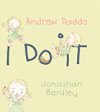
(Age Junior primary) Applauding the teetering steps to independence, I
do it, shows a young unnamed child pushing father aside in her
attempts
to emulate him and do things for herself. She can brush her teeth, put
sauce on her sausages, and get some milk, even though some is spilt,
and so on.
A charming repetitive rhythm is introduced which carries on through the
book. But halfway through it abruptly stops as dad says no. Instead of
the child saying I do it, she is shown how to do things and gives help
to her father at something more difficult. The last page shows her not
saying I do it, in response to being asked for a kiss, but telling dad,
You do it. So the events are neatly resolved and turned around.
This is a slight but sympathetic look at a child's endeavours to do
something for herself, despite the consequences. This book will appeal
to pre school aged children and is well suited to a child care facility
or kindergarten. Bentley's illustrations will delight the reader
as they tell a back story, showing things not in the text, adding a
different level of meaning for the reader to look at, ponder and enjoy.
Fran Knight
Georgiana by Libby Hathorn
Hachette Livre, 2008.
Set in the early years of the Western Australian colony, this is the
most amazing story of one woman and her attempts to make herself a
home. She not only helped her husband, Captain Molloy, set up a house
near Augusta on Western Australia's southern coast, but she planted a
garden using the seeds brought out from England, as well as those sent
to her by friends, but also saw the beauty in the flowers around her,
planting them in her garden, mixing the native flowers with those she
planted, and so developing a world wide interest in the flowers of this
new land.
Georgiana Molloy was no ordinary woman, following her husband to a new
country, she was curious, inquisitive, welcoming. She not only
developed an interest in the plants, but accepted the indigenous
people, asking them questions, meeting them, unafraid. Religious
to the point of fervour, she set up a prayer meeting on her front
verandah, ensuring all those who worked for her husband and neighbours,
attended. She made plans to build a church. Always dismayed at the lack
of servants, many of whom took up land grants of their own, she
accepted what she could around her.
Libby Hathorn's extensive research and refinement of this incredible
story has produced a book that is accessible to all. Telling of the
hardships and privations of the early settlers, their fears and
restrictions, it also tells of a young woman, determined to make the
best of the situation, marveling at the freedom the country offered
her, and incredulous at the array of flowering plants. For students of
Australian history, this book will fill in the background of the
academic history books, for students looking at indigenous issues, or
those applying to women in the early years of Australia, or those who
just want a good read, then this will fit the bill.
Fran Knight
Love Divided by Vanessa St Clair
Piccadilly Press, 2008
When I first started this I thought it was going to be
a girly,
gossipy, teenage 'Bridget Jones' read - rather in the
vein of sub-Cathy Hopins/Louise Rennison- a frothy read for young
teens. I was initially a bit taken
aback by the over use of the word 'crap' and 'crappy' as well as 'piss'
and
'pissed off' . However it soon develops into the story of a summer
romance - a first great love for both 16 year old protagonist Lucy
and 18 year old Mally, whose Bangladeshi
family place increasing pressure on their son to succeed in
his application for Cambridge. Can their love survive across the
religious and social barriers they face? The intense
feelings experienced by teenagers - with the pressure of exams in the
background, is skilfully portrayed, and, in the tradition of all great
love stories, the couple are ultimately separated but with
memories of a summer of love and a very special relationship that will
stay with both of them for ever.. Part of a series of 'Love Stories'
published by Piccaddilly
Press.
Laura Taylor
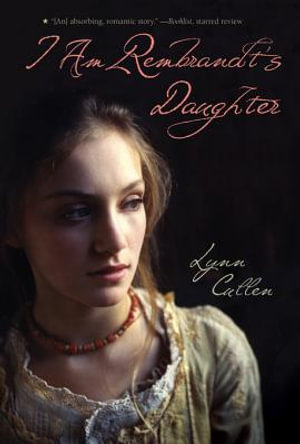
I am Rembrandt's daughter by Lynn Cullen
Bloomsbury, 2008.
(Age 12-15) The painter Rembrandt van Rijn has lost popularity and is
living in poverty and disgrace in Amsterdam. Cornelia, the daughter of
one of his models, remembers life as it was when her mother was alive
and when Titus, his son by Saskia, also lived at home before his
marriage into the wealthy merchant class. Abandoned by their patrons
and frowned at by the respectable, Cornelia tries to sell paintings and
help her irascible old father. She plays in the studio as a child and
understands colour and form, but is allowed only to model, never to
paint. The fragility of life at that time is clearly shown when the
plague sweeps through the city, the poorer areas particularly
suffering.
The action moves back and forward in time, allowing the development of
a quite complex and unbelievable plot twist. The sounds, sights and
smells of life in seventeenth Amsterdam are captured quite vividly in
this lively story. The language is in places clumsy and anachronistic
but generally works well, and for those unfamiliar with Dutch names
there is a character list.
The novel is capitalising on the interest in Dutch painters and has a
list of Rembrandt's paintings. It would be particularly enjoyable for
readers aged 12-16 years who are interested in Rembrandt.
Jennifer Hamilton
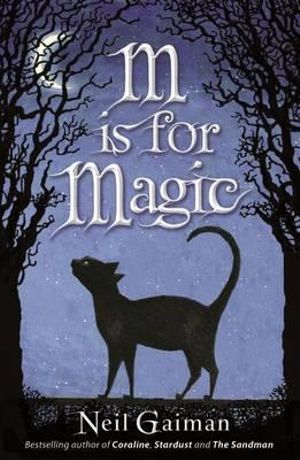
M is for Magic by Neil Gaiman
Bloomsbury 2008. (Age 13+) Eleven short stories ranging from the whimsical to the very scary make up this collection by master storyteller Neil Gaiman. The frightening ones remained with me long after I finished reading them. Their ambiguous endings demand that the readers use their imagination, which is often richer than the written word, to decide what could have occurred. What really happened to the Runt, a friendless, young boy who ran away and met a ghost in the dark? What would happen when the Black Cat finally could not fight the devil and keep the evil away? Other stories like the one where the hardboiled detective is hired by Jill Dumpty to investigate Humpty's fall, were laced with humour and word play and were fun to read.
The collection concluded with the poem, Instructions. Here is its conclusion:
'When you reach the little house, the place your journey started, you will recognize it, although it will seem much smaller than you remember.'
Readers will indeed find that their world has grown larger after reading these stories. Pat Pledger
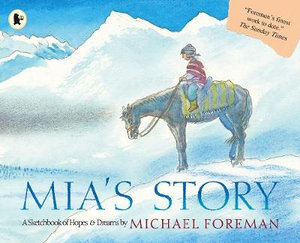
Mia's Story by Michael Foreman
Walker Books 2007
(Ages 5-7) The sketches Foreman did on his travels through Chile are
incorporated into this story of hope amongst the waste outside the city
of Santiago. Foreman met Manuel, who with his fellow villagers,
harvested the wasteland near their village and recycled it for sale to
the city where it came from. Far from being a story of despair,
Foreman's illustrations and the story he tells makes it a story of the
future.
One day Mia's father brings her a puppy which he found alone in the
city. But one day, Poco disappears, and Mia climbs onto her horse and
together they go into the mountains on their search. Here they discover
a field of flowers, and Mia carefully takes a clump, roots and all,
back to her home. Planting them, they multiply quickly until they have
spread over the village. She puts some of the plants into pots and goes
with her father to the city to sell them. Eventually she and her father
just sell the flowers, as the business becomes so successful, and they
eagerly await the time when they can build a house form brick.
Foreman has taken a simple tale and told it well, surrounding the story
with illustrations redolent of the background of the country of Chile.
The story of hope and looking forward will have wide appeal, especially
adding to our readers' knowledge of how other children live.
Fran Knight
The pumpkin eater from Pondicherry by Bruce Atherton and Ben Redlich
Lothian Children's Books. Hachette Livre, 2008
(Age 5+) The humour in this wacky picture book will appeal to children
and adults alike and it is a great book to read aloud. When a monster,
who loves to eat pumpkins, raids the veggie garden, it is time to do
something about it!
Bruce Atherton's rhyming story is lots of fun and finishes with an
explosive fart. Ben Redlich's drawings are truly imaginative and add to
the humour.
This would be a good book for emerging readers who would enjoy the
poetry and rhythm of the story. Older reluctant readers should get a
kick out the illustrations and shortness of the tale.
Pat Pledger
The ghost's child by Sonya Hartnett
Viking 2007
Finding a small boy in her living room one afternoon, Matilda offers
him a cup of tea, and together they talk about her life. She is
ingenuous, open and honest about the love of her life, Feather, who she
met by accident one day on the beach. Her father had taken her around
the world in search of the most beautiful thing, and she found it in
Feather. When he left, searching for his own stillness, she was
distraught and building a boat went off in search of him to ask him why
he had left her.
But the west wind told her that life is for going, not stopping, and so
after seeing Feather, and realizing that he had found what he wanted to
do, she took stock of her life and made something more useful of it,
learning to be a doctor and helping the unsighted. Now towards the end
of her life, she knows her last voyage is near.
Hartnett offers us the most extraordinary writing, disarming in its
perceived simplicity, evoking the most tender and terrible of emotions,
leading the reader to question the most basic of life's values, asking
us to ponder what life is about, why we are here and if love is all
there is. And all the while offering us an intriguing story, with the
most beguiling of characters.
Fran Knight
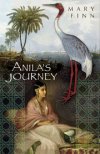
Anila's journey by Mary Finn
Walker Books, 2008
(Age 12+) Anila's Irish father is missing, but believing he will return
to her, refuses to go to Madras with her guardians, the Hickeys, who
have cared for her since the death of her Bengali mother. By staying in
Calcutta her father will find her. But she must make a living and so
takes her letter of introduction and her portfolio of bird paintings to
Mr Walker at the Asiatick Society headquarters, for he has advertised
for a draughtsman to accompany him on a trip along the Ganges.
The sights, sounds and smells of India during the first days of the
nineteenth century are recalled in detail in this surprising book.
Alternate chapters show Anila's early years, and present events as she
journeys down the Ganges. There is a mystery as well as a loved
childhood to consider, a secretive man on board the boat and a child
found tied up in a courtyard. Many times I was reminded of Kipling's
Kim, as I languidly floated along the river with this odd assortment of
people, looking at India through the eyes of a young girl with an Irish
father and Bengali mother, as well as those of an Englishman
disenchanted with the results of colonisation.
A delightful book, with an engaging story and wonderfully unusual and
diverse characters, this novel will suit the more discriminating reader
from upper primary to adult, who will revel in the most delicious of
writing.
Fran Knight
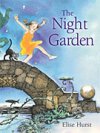
The Night Garden by Elise Hurst
ABC
Books, 2007
(Age Junior primary) I was reminded of two classics, Tom Brown,
Rose and the Midnight Cat, and Where the Wild Things are,
as I read
this new tale, of a girl who after painting a magical garden on her
window, wakes to go down into the garden, now magically brought to
life. The garden is an adventure playground with trees all misshapen
and curved, hedges the shape of kindly monsters and strange dancing
animals to play with.
Along with her cat, Strange, her imagination has no bounds as she
plays, skips, jumps and runs through the place, until tired she returns
to her bed to sleep. The illustrations are appealingly old fashioned in
their execution, and will have some appeal to the younger reader as
they look into the pictures trying to find different shapes and
characters. Aimed at the pre school and kindergarten, The Night
Garden
can be read aloud.
Fran Knight
Comment: Shortlisted CBCA 2008 - Early Childhood
Pat Pledger
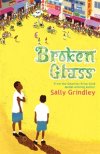
Broken Glass by Sally Grindley
Bloomsbury, 2008. ISBN 9780747586159
(Age 10-14) Desperately unhappy at the sight of his father hitting his
mother, after his father has lost both his job and his own
claustrophobic mother, Suresh decides that he and his brother, Sandeep
are in the way. He thinks that his parents will do better without two
extra mouths to feed and so the two boys run away, hoping to gain
employment in the city. Their life in the village where they know
everyone and are looked out for, is over.
There follows a sometimes harrowing story of the two young boys' lives
in the streets in India, mingling with other street dwellers, avoiding
the police, having their few possessions stolen, trying to keep one
step ahead of the man to whom they sell the broken glass they collect.
At times the story is light, as the boys play cricket with other street
kids, or go to the concert the others arrange, or make friends with
people who give them food. But the whole is bleak and miserable as the
reader comes to see that these two boys are only two of thousands in
the city.
An upbeat end to the story did not for me, temper the bleakness of the
background, but kids in middle school will empathise with Suresh and
his brother as they try to make their way in life. And it's great to
see a book set in India.
Fran Knight
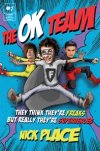
The OK Team by Nick Place
Allen
and Unwin; ISBN 9781741751864; 2008; p/b; 251pp
(Age Upper Primary/Lower Secondary) The funny and very silly adventure
story of a group of adolescents who are thrown together because they
all have a super power. Most of them are only low-grade superheroes who
are still learning to use their powers and so they end up in some very
unusual and often ridiculous situations. The stories are interspersed
with emails, advertising banners, photos and other illustrations so the
reader can look at the characters and their situations in a variety of
formats.
Sue Johnston, Marden Education Centre Library
Comment: There is a site for the book, which is recommended for boys,
with teacher
notes and activities.
Pat Pledger
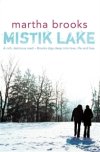
Mistik Lake by Martha Brooks
Allen and Unwin, 2008
(Age 13+) A generation before, Odella's mother was the sole survivor of
a car crash through the ice on Mistik Lake. Now the whole story comes
to a climax, after Odella's mother is killed in Iceland, following her
abandonment of her family, and Odella meets the son of her aunt's
childhood friend, Violet. All are connected by the childhoods at Mistik
Lake and the dream of flying fish. The characters in this engrossing
story live in or near Winnipeg, and some are the descendants of
Icelandic people who migrated to Canada in the mid nineteenth century.
Some of their strength and life values seep through to the new
generations.
Odella takes the role of her mother after she leaves and so is bound up
with the family, but meeting Jimmy makes her aware that she has a life
to lead as well. Living with him one summer at Mistik Lake brings the
story to a resolution as she learns of her past and why her mother was
so disturbed. An absorbing story redolent of the cold raw lives in
Canada's interior and suffused with the Icelandic heritage, Mistik
Lake
will absorb the attentions of older female readers, and its brevity
will be most attractive to those who want a thin book.
Fran Knight
Comment: Mistik Lake won the Canadian Library Association Young
Adult Book of the Year. It is a totally engrossing book with
wonderful characters and the lakeside setting is beautiful. Highly
recommended.
Pat Pledger
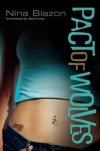
A pact of wolves by Nina Blazon
Allen & Unwin, 2008.
(Age 13+) For readers who like horror with a difference, this is
a compelling story that has murder, witchcraft, a secret society and a
terrifying beastly creature to keep the tense action alive. Blanka
arrives at the Europa International School where she is confronted by
the Wolves, a society of students who prowl the school and seem to take
an instant dislike to her. When she stumbles over a body at the bottom
of the stairs she is convinced it was murder, and is determined to
uncover the truth. With the help of the enigmatic Nicholas, Blanka
investigates and discovers disturbing and frightening things about the
school.
Blanka is an independent girl who rejects the other students' overtures
of friendship and seems unable to forgive what she sees as her parents'
transgressions. Her lack of trust adds to the suspense in the story as
the reader is not sure whether any of the other characters are
trustworthy.
Blazon, an award winning German author, has combined an unusual blend
of mystery and horror with some medieval facts thrown in. Her prologue
where she describes the mysterious It prowling the corridors, is a
tantalising start to a book that was difficult to put down. She keeps
up the momentum with plot twists and turns that culminate in a tense if
inconclusive finale. The chilling atmosphere of the school with its
rumours of witchcraft and torture provide a powerful background to the
murder mystery.
Pat Pledger
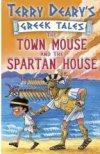
The town mouse and the Spartan house by Terry Deary
Allen and Unwin, 2007 ISBN 0713682213
(Age 7-10) Just mention Terry Deary, and all kids know that he is
the author of some of the best historical books around. Never left long
on the shelves, the Horrible Histories are borrowed with gusto. With
titles such as The Vile Victorians and The Gorgeous Georgians, the
books are immensely popular and give kids a glimpse into the past.
Luckily he has now turned his startling mind to books for the middle
primary reader, and they are just as good. The town mouse and Spartan
house is one of the series called Greek Tales, set in Athens, Greece in
430 BC. In The town mouse, the hero, Darius must flee. Both of his
parents have died, and the city is besieged by Spartan forces, bent on
Athen's total destruction. His uncle is a Spartan general and so he
tries to enlist his help to get out of Athens, now also under the
threat of plague.
The general has no time for this scrawny looking lad, and he is sent to
be a helot. But when the general becomes ill, it is Darius, the son of
a doctor who comes to his aid, saving his life.
A funny look at the difference between Athens and Sparta, the tale also
has a moral, It is better to eat beans and bacon in peace, than cakes
and ale in fear, which is proved through the story. Children in middle
primary school will love to read about Darius, a strong willed young
boy caught up in war. Along the way they will learn a great deal of
information about Athens and Sparta, told with economy and humour by
this wonderful storyteller.
Each story is complete in itself, and with chapters and funny
illustrations, will encourage newly successful readers to keep reading
with confidence.
Fran Knight