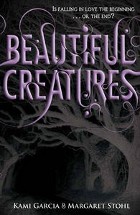
Beautiful creatures by Kami Garcia and Margaret Stohl
Penguin, 2010. ISBN 9780141326085. Beautiful darkness. Penguin, 2010. ISBN 9780141326092.
(Age 13+) Recommended for lovers of paranormal romance. Ethan Wate
lives in the Deep South town of Gatlin and he can't wait to leave it -
until Lena Duchannes comes to town. Lena is surrounded by mystery. She
lives with the town's recluse, Macon Ravenwood, in a sinister mansion,
and seems to have strange powers. Ethan is convinced she is the source
of his nightmares and the strange song about the sixteenth moon and the
sixteenth year when the Book will take what has been promised.
Beautiful darkness follows on after a cliff-hanger of an ending.
The series captured my attention from the beginning as it is told in
the first person by Ethan Wate, rather than the main female character.
Ethan is a typical teen who plays sport, gets on with his peers, but
secretly reads books and dreams of a wider world. He has been touched
by disaster, his mother dying in an accident and his father locking
himself away in his study to mourn. Lena too is an interesting
character, who longs to be accepted as normal in the school, but finds
that her powers keep her an outcast at school.
The most enjoyable part of the books for me, was the description of
small town life in America's south. I was fascinated by the
descriptions of the American Civil war, the re-enactment of battles and
most of all the way people lived in Gatlin. Ethan's aunts are described
in a touching but humorous way, and Ammy, the Wate's housekeeper, who
is obsessed with crosswords, is a joy to read about.
Needless to say, there is plenty of Gothic suspense and romance, and
although both books are long (over 500 pages each), the action and the
character development kept me reading to the end. Both books are sure
to appeal to readers who enjoyed the Twilight series or Shiver
by
Maggie Stiefvater. References to To Kill a Mocking Bird and
other
literature abound and may lead readers to explore those books as well.
Pat Pledger
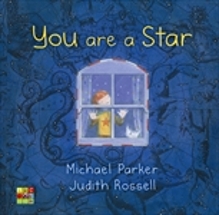
You are a star by Michael Parker and Judith Rossell
ABC Books, 2010. ISBN 9780733325397.
(Age 4-8) Recommended. A young child takes a trip out of this world
into the vast universe and learns how the stars and Earth was formed,
as well as discovering that we are all made of stars.
A book that appeals to the imagination You are a star carries
the
reader on a flight of exploration into the stars. Although much of it
is based on scientific fact, the text and illustrations give a
wonderful insight into the life of stars, their vastness and their
origins.
Both boys and girls will identify with the young child, who could be of
either sex. Clad in pyjamas with a star on the front, the child is
pictured pressing against a window looking at the night sky, and then
is shown soaring through the night sky. The illustrations could be a
stimulus for reader to wonder what it would be like to explore the
universe and to enjoy the thought of being a star. The fascinating end
papers show the mythological creatures that are associated with the
stars, such as Taurus and Aries, and will appeal to older children.
The text is simple and would make a good bedtime story or one to read
aloud. Containing joy and wonderment, this story is an original way of
introducing children to space.
Pat Pledger
From those wonderful folks who gave you Pearl Harbor. Frontline dispatches from the advertising war by Jerry Della Femina
ed. Charles Sopkin. Text Publishing, 2010.
(Age: Year 12+) This book, originally published in 1971 as a look at
the advertising world in New York, has been re-released following the
success of the television series Mad men, based in part on it.
Non-fiction, the book reveals the changes in the industry in New York,
from so conservative that, as the author was told, 'people of his kind'
would not be employed on ethnic grounds, to an industry where the
copywriters were frequently high on drugs, did not start work until
late in the day and the sexual revolution of the sixties was clearly
happening.
The themes covered include the precariousness of the work,
even experienced advertisers spending months unemployed at times. The
author also reveals the need for intelligence, as well as the
industry's reputation for glamour and in fact frequently the lack of
glamour. Censorship is an important issue; as an advertiser the author
is usually against it. He also demonstrates the relationships between
the various branches in an agency, and how this can malfunction.
The
book provides insights into how businesses work and how personalities
are important; it has some discussion of the ethics of advertising and
censorship but does not examine the methodology or techniques. The
author's voice is distinctively from New York, his anecdotes are lively
and humorous, and the book moves along at a good pace. Though probably
of limited use for most students for curriculum purposes, it is an
enjoyable and informative read.
Jenny Hamilton
The Uninvited by Tim Wynne-Jones
Walker Books, 2010.
(Ages 14 plus) A complex set of circumstances conspire to ensure
an extended dysfunctional (but strangely loving) family end up meeting
through the vagaries of a wonderfully eccentric dad.
Mimi, an out of luck, mini-cooper driving New Yorker, attempts to erase
an undesirable ex-lover from her mind by heading up to her father's
'undisclosed' holiday retreat in Ontario.
Adventures abound as Mimi discovers Jackson Page, living 'illegally' in
the cabin (suggested by her dad as an antedote for recovering from a
failed relationship.)
As Mimi and Jackson develop a smouldering friendship and sympathetic
understanding of each other's past and future needs, Cramer, a local
resident with issues of his own, spies and interferes (with strangely
quirky logic) into their lives, eerily taking a fancy to Mimi.
The intricately woven relationships unfold, enabling 25 years of
history
to link the main three protagonists and solve many unanswered questions.
The creepy nature of some characters and settings ensure this book is
an entertaining but engaging read right until the end as does the
desire to find out the character connections that permeate the plot!
Deirdre Murphy
Ninth Grade Slays by Heather Brewer
Penguin, 2010. ISBN 978 0 14 320515 9.
Highly recommended. The second book in The Chronicles of Vladimir
Tod - Ninth Grade Slays, continues to follow the life of
Vladimir, his friend Henry and the trials of high school, particularly
when you are a little different! Vladimir has discovered girls, in
particular Meredith and is trying to work up the courage to talk to
her. His uncle Otis continues to write sharing knowledge with Vladimir
about his telepathy and how best to develop it. School begins and
trouble starts: photographers following him, grades slipping. A
trip to Siberian to study under one of his father's friends helps
Vladimir to hone his skills but on his return he must cope with a
vampire attack and confront the slayer hired to kill him.
This well written series is filled with intrigue, danger, search for
identity, friendship and life experiences and despite the market being
inundated with 'vampire' stories this stands out as one worth reading.
Tracy Glover
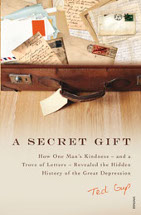
A secret gift by Ted Gup
Sub-title: How one man's kindness - and a trove of letters -
revealed the hidden history of the Great Depression
Random House Australia, 2010. ISBN 9781741669442.
(Age 14+) On 18th December 1933, an advertisement appeared in the local
paper of a small town in Ohio. It offered gifts of money for Christmas
to 'men or families' in exchange for information about the difficulties
they were facing. The advertisement was signed 'B. Virdot', a name
unknown in the community. The letters poured in. They documented the
bitter harvest of the Depression - unemployment, hunger, illness and
separation.
Seventy-five years later, reporter Ted Gup found the letters in a
suitcase in his mother's attic. The mysterious philanthropist was his
grandfather. The seasoned journalist realised that he had discovered a
window into the lives of those who suffered the greatest financial
collapse of the twentieth century. He was also prompted to find out
more about his grandfather and why he had been moved to help his
community.
Although this book reveals life in small town America in the 1930s, it
tells a universal tale about migration, hard work and the desperation
of people who are thrown into poverty through no fault of their own.
The author reflects on relationships, family secrets and the emotional,
physical and social toll of chronic unemployment. He also sees
parallels between the Great Depression and the recent Global Financial
Crisis. A collection of black and white photographs includes 'then and
now' portraits of some of the town's inhabitants.
By researching the personal circumstances of each letter writer and
interspersing his findings with discoveries about his own family, Ted
Gup has written a gentle but thought-provoking book. Although many
younger readers might find the material fascinating and inspiring, the
author has written his account for an adult audience. His clear,
concise writing is the work of a consummate journalist accustomed to
communicating with readers of the Washington Post and the New York
Times. A secret gift is a story which will reward anyone interested in
the
courage of so-called 'ordinary' people in times of hardship.
Elizabeth Bor
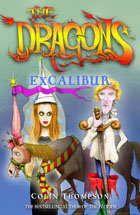
The Dragons - Excalibur by Colin Thompson
Random House, 2010. ISBN 978 1 74166382 2.
This is the second book in The Dragon series and follows on
from the
first. After a mistaken identity the real King Arthur has taken over
the rule of the Kingdom and optimism spreads throughout Camelot.
However Brat and Blot have other plans. They are not happy about the
way King Arthur is ruling and plot an overthrow. When word reaches the
palace, of Brat and Blot's plans, Morgan le Fey, Sir Lancelot and a
vampire attempt to save the kingdom.
This series is written as a send up of ancient times. The language is
obscure at times and the undertone and setting have limited appeal. The
book has an interesting format with footnotes and illustrations
scattered throughout to make sense of the story.
Tracy Glover
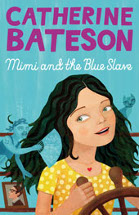
Mimi and the Blue Slave by Catherine Bateson
Woolshed Press, 2010. ISBN: 978 1 86471 994 9
(Ages 9+) Recommended. Mimi is part of a fairly normal, happy family
until her father's death suddenly tears them apart. The story opens two
days before the funeral, when Mimi has been struck down with the flu.
Her mother has the support of her sisters, Ann who is somewhat proper
and judgmental and Marita who is rather more alternative. Mimi must
instead rely on her imaginary pirate friend, Ableth, for guidance and
help. Following the funeral Mimi and her mum leave on a holiday which
is meant to help them both but fails to achieve its purpose. On their
return home, grief affects her mother badly and Mimi buries her own
grief to try and keep the household and the antique business running.
New friendships are forged with Fergus, the boy from the organic fruit
and vegetable shop and various people her parents have long known from
the antique trade and gradually life begins to improve again.
This is a brilliant story of change, grief, friendship, loyalty
throughout the process of dealing with the death of someone close. It
is imbued with warmth and humour as the personalities of the two aunts
balance the serious side of the book. Bateson manages to focus on the
tough issues in such a way as to make them accessible to younger
readers, providing a sense of hope to any who may have had the
misfortune to have experienced such things in their own lives.
Jo Schenkel
6 by Karen Tayleur
Black dog books. ISBN 978 174203155 2.
An amazingly confronting story of six young people in their last year
of school. The voices of the characters seem so realistic and so true,
especially to parents who have been through year twelve! Sarah is
the clever girl but longs to be admired and sought after by Finn, a
first footy team member and very good looking. We hear the
stories of the other five but it is mostly Sarah's story. The little
ditties at the beginning of each chapter are intriguing, encouraging
the reader to find out more.
Year twelve is a roller coaster ride for many students and so each
person's story contributes to the whole. It's the usual scenario
of who loves whom and how does this work and if it doesn't, then how
devastating life becomes! What is so compelling about this year
twelve drama is that the resolution is unexpected, thankfully! A very
cleverly written story involving death, alcohol and cars. Parents and
teachers sometimes worry about stories for year twelves, but this has
all the elements of a disaster with an intriguing ending for
discussion, and with the characters able to move into the next phase of
their lives and having a little more understanding of the others in
their group.
Well recommended for Middle and Senior Students
Sue Nosworthy
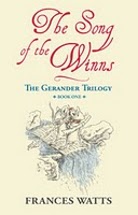
The Song of the Winns by Frances Watts
The Gerander Trilogy, Book. HarperCollins, 2010. ISBN: 978 0 7333 2786
5.
Highly recommended. Since their parents were killed in an accident,
three mice, siblings Alex, Alistair and Alice, have lived with their
Aunt and Uncle. Their 'ordinary' existence ceases when Alistair is
kidnapped. Whilst Alistair finds himself unceremoniously dumped on top
of Tibby Rose in a far off place and develops a friendship with her,
Alex and Alice decide to embark on their own adventure to find and
retrieve their brother.
Tibby and Alistair share an uncommon trait; they are both ginger mice,
a fact which has not been a problem while they have been safe within
the midst of their families. It is, however, this fact that leads them
into dangerous situations and causes them to run away to what they hope
is safety. Both pairs of mice try to understand why they are being
followed and explain the mystery and adventure in which they have found
themselves, as they battle the dilemma of who can be trusted.
As the first book in this trilogy, The Song of the Winns provides new
and interesting characters, setting and a plot with sufficient interest
and excitement to make one wish to continue reading the next book
immediately. It brought to mind Mrs Frisby and the Rats of NIMH, which
I read many years ago, as both series revolve around intelligent
rodents and have the potential to become classic texts. This series has
the capacity to become didactic with regard to war and prejudice due to
race and colour but hopefully will not overshadow the entertaining
nature of the tale of friendship, courage and adventure.
Jo Schenkel
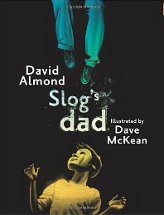
Slog's Dad by David Almond
Illustrated by Dave McKean. Walker Books, 2010. ISBN 978 1 4063 22903.
Highly recommended. This is one of those rare books that will give you
goose bumps as you read, a book that makes you weep quietly to yourself
- a book that you read knowing that you are in the hands of a skilled
writer. Slog's dad has died. First he had a black spot on his toe, so
his foot was amputated, and then his leg and sitting in front of his
house he joked with passers by. But then another spot appeared on his
remaining leg. But when that leg was removed as well, he became quiet.
The years of smoking and working on the rubbish trucks came to an end.
He no longer joked with passers by, but kept to his room, with his wife
waiting upon him. But he promised Slog that he would come back in the
spring. The illustrations reiterate the story of the man losing his
legs, showing a boy playing with a paper cut out of a man, taking one
leg and then the other from the paper.
So when Slog sees a man in the park, he is ecstatic. Hus friend, Dave
is not so sure, and butts in offering alternative explanations for this
man, asking him questions that only Slog's dad would know how to
answer. But despite this, Slog is convinced that he has seen his dad
once again, and so says goodbye.
A bare story with few words, but what words! Each one resonates with
meaning and empathy for the boy who has lost his father. In between the
words are pages of incredible illustrations, designed, as with the
words, to grasp at your throat, pulling the reader into the story of
the boy accepting his father's death.
Fran Knight
Henry V by William Shakespeare, retold by Robert Swindells
A and C Black, 2010. ISBN 978 1 40812398 6.
A retelling of Shakespeare's Henry V in 94 pages makes the play more
accessible to a wider audience. All of the main characters are there,
Henry V, Bedford, Gloucester, Archbishop of Canterbury as well as the
French king and his entourage, and even the lower orders, Pistol, a
dying Falstaff and Num. The play opens with Henry V deciding with his
advisers that their only option is to go to war with France. Act
2 sees the army in France, and the dialogue between the lower orders,
Num Pistol and Bardolph easily parallels the lives of some of Henry's
men. Act three sees the two armies the night before the Battle of
Agincourt and we see Henry V strolling incognito amongst his men,
gauging what they are feeling and encouraging their participation. Act
four details the awful battle and statistics are given towards the end
of this act to underscore the impressive defeat of the French army. Act
five sees the mopping up of the campaign, and Henry V returning to
France to marry the French king's sister, Katherine.
Those reading the original will be well served by reading this
shortened modern retelling. A list of characters at the start of the
play will aid the readers, and each act is prefaced by one of the
important speeches from the play. Comments by Swindells at the end
reiterate the power of Shakespeare's language in this play, and he
quotes two of the major speeches which will resonate with many.
This amazing adaptation is one of the series, Shakespeare Today,
published
by A and C Black.
Fran Knight
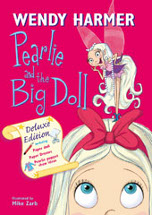
Pearlie and the Big Doll by Wendy Harmer
Random House, 2010. (Deluxe edition). ISBN: 978 1864718218.
When cleaning the park one evening, Pearlie the Park Fairy discovers a
lost doll which has been left behind by a visitor. Because the Dolly
seems so sad to have lost her Little Girl, Pearlie enlists the help of
all the park animals to give a wonderful concert to try and make Dolly
happy. As the show occurs with the boot scooting Duck Family, Silky and
Sulky the trapeze artist spiders, four acrobatic frogs, Brush and Sugar
the singing possums, the rats, Scrag and Mr Flea, Dolly stops crying
and begins to enjoy the performance.
Aimed at beginner readers, this series is perfectly targeted at young
girls. The hot pink endpapers, glimmering cover and stylised art work,
in addition to the paper doll which can be dressed in several different
outfits, should make this a very appealing read and activity book for
such an audience. During the concert, the rats, who have 'brushed their
fur and cleaned their teeth', present some 'I say, I say' jokes and
provide the type of humour bound to appeal to the young reader, showing
that Harmer knows her audience well. Given that Pearlie has now been
taken on by Nickelodeon as an animated cartoon series, the books will
undoubtedly continue to gain even further popularity.
Jo Schenkel, Pilgrim School
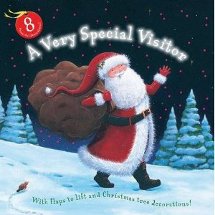
A very special visitor by Rebecca Geelings
Ill. by Karen Sapp. Egmont, 2010. ISBN 9781405256193.
(Age 2-4) In this book about the magic of Christmas, there is a journey
through many things that make Christmas special. Snow has covered
everything, a church bell chimes and happy people sing carols. But best
of all there is a very special visitor to delight everyone.
This board book contains flaps to lift which young children will enjoy.
The flaps are cleverly hidden among the illustrations by Karen Sapp,
and may provide a fascinating challenge for toddlers when they first
listen to the book The last two pages have flaps containing Christmas
tree decorations, which are lifted out of the book to place on the
Christmas tree. I think that could be a very enjoyable Christmas
activity for parent and child.
Pat Pledger
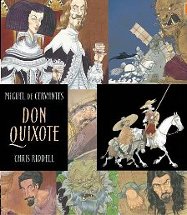
Miguel de Cervantes Don Quixote retold by Martin Jenkins
Ill. by Chris Riddell. Walker Books 2010. ISBN 9781406324303.
(Age 11+) When we remark that someone is 'tilting at windmills'
and behaving in a 'quixotic' fashion, we are harking back to one of the
most influential stories ever told - Don Quixote. The central
character, a retired Spanish gentleman living in La Mancha, becomes so
obsessed with old-fashioned tales of chivalry that he decides to live
out his dream of becoming a knight who performs brave deeds. Wearing a
home-made suit of armour and riding on his bony horse, Rocinante, he
sets out on his quest. His fantasy is so complete that he mistakes bad
food for good, an inn for a castle and windmills for giants. Quixote's
'Squire', the trusty and realistic Sancho Panza, is a perfect foil for
his deluded master.
Cervantes lived in an era when the certainties of mediaeval life were
being replaced by a spirit of enquiry. The hero's journey into fantasy
then return to reality is regarded as the forerunner of the modern
novel which traces a character's emotional
development.
Chris Riddell's animated, cartoon-like pictures reveal the
idiosyncrasies of a passing parade of characters. Pen and ink drawings,
wrapped around text boxes, are interspersed with occasional full-page
colour illustrations which make the old hero and his companion look
both noble and ridiculous.
Curiously, while the illustrator has written an introduction to the
work, the author has not. This is an opportunity missed. Young readers
might welcome an overview of early 17th century Spanish culture and a
glossary to explain terms like 'Basque' and 'Moor'. Occasional lapses
in syntax prevent the story from flowing smoothly but the retelling is
largely successful.
Martin Jenkins won the Kate Greenaway Medal for his retelling of
Gulliver's travels. His adaptation of Don Quixote is a
worthy attempt,
attractively presented, to bring another classic within the reach of a
younger audience.
Elizabeth Bor