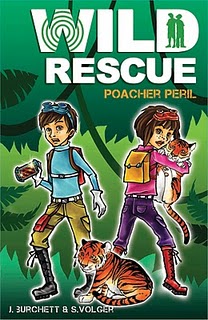
Wild Rescue - Poacher Peril by J. Burchett and S. Vogler
Hardie Grant Egmont, 2011. Fancy receiving an eyeball in the mail? An
unusual birthday present for sure!
In the first few pages of Wild Rescue - Poacher Peril our main
characters, twins Zoe and Ben, have already been presented with their
first mystery. They have received a puzzling message (and an eyeball)
from their
godfather; someone they thought had gone missing.
The twins are enlisted into a secret organisation called Wild.
They are
a group of environmentalists who help animals all over the world and it
is run by their godfather. Zoe and Ben's first mission is travel to
Sumatra and help keep a tiger and her cubs safe from poachers. Their
job is to
discover who the poachers are and inform the authorities. Along the
way, their courage is tested as they try and save the tigers from a
trap and they
learn that not everything should be judged by its appearance.
The language used by the authors is descriptive, making it interesting
for readers aged 10+. The events move quickly, are full of adventure
and any young reader - girl or boy - will enjoy trying to solve the
mystery of
who the poachers are. It is also full of messages concerning looking
after
the environment and animals and the illustrations, though in black and
white, are detailed and show you who the characters are.
Kylie Kempster
Last Sacrifice by Richelle Mead
Vampire Academy. Penguin, 2010. ISBN 978-1921518904.
(Age 12+) Last Sacrifice is the final book in the Vampire
Academy
series. In this book Rose must prove she is innocent when she is
accused of killing Queen Tatiana. When her friends break her out of
prison she has to stay as far from the court as possible and not get
caught by the other guardians while her friends and parents
find enough evidence to prove she is innocent. So along with Dimitri
and Alchemist Sydney they set out to find the missing Dragomir, the one
Tatiana mentioned in the note she left for Rose and who almost no one
know exists. In their journey to find the missing Dragomir they bring
back Dimitri's Srtigoi past, work with Robert Doru and Victor Daskov
and convince Lissa to run for queen.
I really liked this book. It was definitely a great ending to a great
series. I would recommend that people read this book especially if
you've read the series.
Tahlia Kennewell (student)
No safe place by Deborah Ellis
Allen and Unwin, 2011. ISBN 978 1742374709.
(Ages 12+) Highly recommended. Refugees. The picture of Abdul standing
on
the edge of Calais watching backpackers, oblivious to anyone else,
showing their passports and getting on a ferry for England, secure in
the knowledge that they have that privilege, stayed with me for the
whole of this tense read. Other images rose up in my mind, but that one
of the huge gulf between the two worlds that exists today, that of non
refugees and refugees, remains with me.
As Abdul bravely claims a place on a boat leaving French soil the
stories of the other passengers on that tiny boat are revealed. Once
out in the channel, the boat owner turns on the refugees but they throw
him overboard. Struggling to survive they wash up against a pleasure
cruiser and in a strange turn of events take over the cruiser and head
north west, knowing they will hit either England or Ireland. When they
do they are helped by a young girl, oblivious to the political
machinations behind these four children seeking a better life for
themselves.
Their stories are harrowing, made up of a range of stories Ellis has
heard while researching this book, revealing for our very sheltered
readers what children of their age must contend with, things many of us
will never see. From the orphaned Chesley, holding on to an image
of his mother through a series of Russian boys' homes before ending up
in an army cadet school, to Rosalia, taken by her uncle's friend to
Germany where they think she will be employed as a maid, to the nephew
of the boat owner, Jonah, told that he is useless and a burden and
finally Abdul, the main character of the story, holding a myriad of
stories within him of unjustified persecution, loss and despair, this
novel will firstly engender disbelief and then sympathy from its
readers.
Ellis' fight for human rights, particularly for children scarred by
war, forms a powerful sub text to this novel, and along with the multi
award winning Parvana series, will be promoted within schools as part
of a literature study of books about our contemporary world, or as a
class text, and all students will follow Abdul's story with pleasure
and empathy.
Fran Knight
Sudden death by Nick Hale
Striker series. Egmont, 2010. ISBN 9781405249508.
(Age 13+) Jake Bastin is the son of a soccer legend called Steve
Bastin. Steve retired from soccer when he tore tendons in his leg. He
became a coach and he travelled all over the world with his teams.
Jake's parents wanted Jake to stay in one city, so he stayed with his
mother after his parents divorced. But when Jake finally goes to London
to live with his father, Steve is offered a position as the coach of a
soccer team owned by a shady Russian oil billionaire. Steve doesn't
want to take Jake to Russia, especially after the talent scout that
offered him the job died under suspicious circumstances right in front
of his eyes. Jake managed to convince his father to bring him with to
Russia even though his Steve thinks it is far too dangerous. This is
proved when the pilots of the private plane are both shot and all seems
to be lost.
This is a well written book, and I really enjoy action/mystery stories,
but not soccer. Even if you don't like soccer, the book doesn't have
that much soccer in it, you could even imagine it with a different
sport. I recommend this book to people who enjoy a bit of mystery and
action.
Gareth Peer(Student)
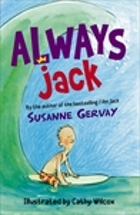
Always Jack by Susanne Gervay
Harper Collins, 2010. ISBN 9780732290207. Always Jack is a wonderful story involving a modern, blended
family -
step
dad, mum, kids and nanna. Along with the problems of everyday life
(like mum
getting married again) they are facing breast cancer.
The author, Susanne Gervay, writes from the perspective of Jack, the
oldest
child who is still in primary school. He is an inventor, a cook, a good
friend and a great big brother. He looks after his nanna, is always
telling
jokes and helps everyone in his family. Understanding events from his
perspective will be appealing to independent readers (12+) as it is a
language they understand. Any child going through similar events such
as
nanna moving in, mum getting remarried or gaining step brothers will
also
understand what Jack is going through. If any parents read this book,
they
will want a son like Jack! I know I wish mine would do the cooking!
Yes, you will need a tissue at one point - breaking the news of breast
cancer to your children would be one of the hardest things a parent
ever has
to do but Susanne Gervay tackles it in a thoughtful and positive way.
You
realise that this independent and strong minded boy still needs his
mum. The
heart-warming part is how the family comes together and helps each
other
through and how they are willing to sacrifice other things as long as
their
mum is OK.
Kylie Kempster
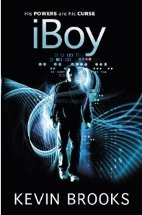
iBoy by Kevin Brooks
Penguin, 2011. ISBN 978 0141326108.
(Ages 14+) Speculative Fiction. Recommended. Tom and Lucy's lives are
shattered one day by two incidents that are linked, although neither
realise it at the time. The Crow Estate is a rough place to grow up.
The tower blocks are the homes of two rival gangs which operate as a
law unto themselves.
When an iphone is thrown from the 30th floor of a tower block and hits
Tom on the head it almost kills him. When Ben, Lucy's brother is beaten
up and Lucy gang raped in their flat, Lucy withdraws from life numbed
and taumatised by the experience. As Tom recovers weird things begin to
happen in his brain. He is able to link with electronic networks around
him; he can access the net, text, sent emails, hack into data bases and
listen in to mobile phone conversations at will.
Through this network he learns of Lucy's rape and discovers the
perpetrators through the video footage he can access. His anger and
desire for revenge lead him to take on a different persona: a kind of
super hero he labels iBoy. As his understanding and control of his new
power increases he understands how powerful he can be.
But there is also a moral dilemma. How should he use this power? If he
uses this power for revenge and payback isn't he acting in the same way
as a gang member? If he has this power exactly who and how should he
help and who should he exclude?
Kevin Brooks knows how to manipulate his readers. The story, even given
the outlandish premise, invites you to put yourself in Tom's place. The
moral outrage at what has been done and the inability of anyone to do
anything about it urges Tom to use his powers to crush the gangs, but
the consequences of such actions tend to be put at the back of your
mind.
A great read with plenty of violent action, information and food for
thought.
Mark Knight
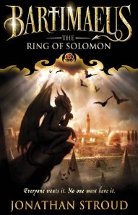
Bartimaeus - The Ring of Solomon by Jonathon Stroud
Doubleday, 2010. ISBN 9780385619165.
Recommended for readers of 10 years or older. Bartimaeus - the djinni
with attitude is back in a fourth book of the series, a prequel, only
to be enslaved to King Solomon and kept in line by the awesome powers
Solomon's ring brings across the realm. That doesn't stop him trying
everything to be free of Solomon, and does nothing to curb his endless
insolence and wise cracking. When a girl assassin is sent to kill King
Solomon and take the ring for her queen, Bartimaeus manages to
interfere and things get interesting.
This is a great story well told, with twists and turns. Crackling one
liners keep the book at an energetic pace, and there's an unexpected
twist in the tale.
Highly entertaining and very un put-downable, the book stands by itself
and you don't need to have read the other books in the series to
thoroughly enjoy this one.
Dean K.
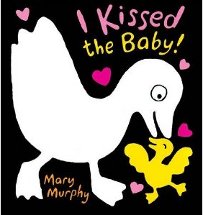
I kissed the baby by Mary Murphy
Walker, 2011 (c2003). ISBN 97814063299964.
(0-4) Recommended. A re-issue of an old favourite, I kissed the baby
tells of the joy that the farm animals have when a new baby arrives.
There is much excitement and talk about the new baby. 'Did you see the
baby?' asks one animal. 'Did you tickle the baby?' asks another, and so
on until finally the little mouse asks the duck if she has kissed the
baby, and the reader finally sees just what the baby looks like.
Perfect to read aloud to very young children or to siblings, who have a
new arrival in the house, this story captures beautifully the thrill
surrounding a new baby. Murphy gives the listener lots of opportunity
to have fun, singing, feeding, and tickling the baby until it finally
appears after getting a huge kiss. The rhythm in the story and the
repetitive nature of the text are sure to appeal to young children.
The simple illustrations are done primarily in black and white, which
is ideal for young eyes. However the book never appears to be dull, as
Murphy has used strips of vibrant colour on the edges of her pages as
well as on the print.
Large pictures combined with strong emotion make this a joy to read.
Pat Pledger
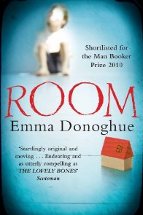
Room: A novel by Emma Donoghue
Picador, 2010. ISBN 9780330519014.
(Age 15-Adult) Recommended. Jack seems to be a typical 5 year-old. He
watches TV and plays games with his mother. He is bright and energetic,
curious and intelligent. But his life is far from ordinary. He is
enclosed in a room that measures 12 feet by 12 feet, seeing only his Ma
and a frightening night time visitor, Old Nick.
Initially the disturbing aspects of this book put me off. I didn't
really want to read about sexual abuse and the difficult life of a
young child. However when it was chosen by my book group and also
featured as one of the 10 books written for adults that have special
appeal to young adults in the ALA 2011 Alex
Awards, as well as being on the Man Booker Prize list, I
decided to try it . Right from the first page the voice of Jack, the
narrator, drew me in and I found that I couldn't put it down. His
descriptions of life in the Room, where he has given names to all the
objects like Bed and Wardrobe and Floor, because these are his world,
are fascinating and give a whole new perspective to everyday things. He
thinks that the things he sees on TV are imaginary and his naive
descriptions of the lengths that his mother goes to, to protect him
from Old Nick, are heart rending.
What I found particularly moving was Jack's description of Ma. She is a
survivor, determined that Jack grows up as creative and intelligent as
she can under horrific circumstances. She is such a young and
defenceless woman but somehow she manages to give her son a life that
is interesting and challenging even though they are both captives.
I can imagine that many teens would find this book fascinating. Those
who liked the child's voice in The boy in the striped pyjamas
by John
Boyne or the young girl's narration in The lovely bones by
Alice Sebold
will find this original story equally as compelling.
Pat Pledger
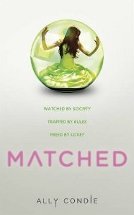
Matched by Ally Condie
Penguin, 2010. ISBN 9780141333052
(Age: 14+) Highly recommended. Cassia has just turned 17 and in her
society that means she is now ready to be matched, on her birthday. The
officials in her society decide everything that happens, who you love,
when you will get married, how many children you have and when, where
you will work for your whole life and when you die. When Cassia is
matched she believes that he truly is her perfect match, but then she
starts to fall in love with someone else.
I love this book! For anyone who loves a good romance novel this
is a
must read, it takes priority over Twilight for me, and I'm Twilight
obsessed.
A beautiful love story that truly captivates you, I guarantee that you
will get lost in this book. I was torn between the two male characters;
I wanted both of them to live happily with Cassia. I was hanging on
every word that Ally Condie wrote, mesmerized by the sentences that
were formed.
I really truly hope that you will love this book as much as I have.
Taylor Oxenham(Student,14)
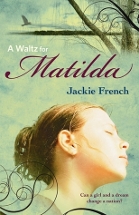
A waltz for Matilda by Jackie French
HarperCollins, 2010. ISBN 9780732290214.
(Age 11+) Recommended. At the turn of the last century Australian women
lobbied for the right to vote, depression and drought caused widespread
unemployment and young men enlisted to fight in the Boer War. Trade
unions engaged in strikes, notably in the wool industry. Racism against
Chinese, Pacific Islander and indigenous people cast a shadow over the
colonies as they moved towards Federation.
Jackie French has woven these events into the story of Matilda
O'Halloran, who leaves the city after her mother's death to be reunited
briefly with her father before taking responsibility for his sheep
property. She develops from a determined 12 year-old factory worker
into a self-assured young woman.
The troubles and achievements of the era are an integral part of
Matilda's story. Her life is intertwined with those of a squatter,
striking shearers, indigenous and Chinese people and women campaigning
for female suffrage. She is directly linked to the creation of the song
'Waltzing Matilda'. At a deeper level, Matilda wonders about the
secrets in her family history and we discover, with her, that some of
these secrets are also part of our nation's history.
Behind the apparently effortless integration of narrative and character
development, there is evidence of considerable research and an
intuitive understanding of daily life in the past. The personal
journeys of all the characters, men and women, contribute to the
storyline, ensuring that the novel will have wide appeal.
The narrative is told in the third person but we hear Matilda's voice
in her letters. Some of her attitudes are unconventional for the time
but she is good-hearted and her independent thinking is convincing. The
author has prefaced the book with an apology for the use of racist
terms no longer in common use and provided endnotes which explain the
controversies of the era. A waltz for Matilda is an engaging, well-crafted work of
historical
fiction. It is also an insight into a formative period in Australian
history and into the way in which history is revealed to us.
Elizabeth Bor
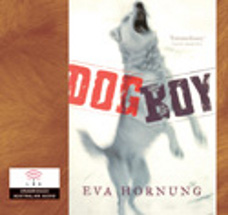
Dog boy by Eva Hornung
Read by Bruce Kerr. Louis Braille Audio, 2010. 9 CD's, 10 hours. Text
Publishing Company, 2009.
Highly recommended. Abandoned by his mother
and uncle, Romochka eats everything he finds
in the apartment, until spurred on by hunger and loneliness he
ventures outside, a place his mother warned him never to go alone.
Avoiding strangers, another of his mother's rules, he is taken by a
dog to her lair, and in so doing becomes one of the cubs, suckled,
protected and trained by her. This extraordinary story of the dog's
life lived by this small boy is absorbing, as Horning details how the
boy becomes one of the pack, living in the basement of an old church,
hunting in a pack at night, fending off strangers and developing the
skills to stay alive. He cannot emulate their sight, smell and
hearing skills, but he can use his hands, fashion tools and weapons
and so be of assistance in a different way. And they protect him in
their stead, seeing him as a member of the pack, fighting together,
sharing their food and protecting each other in time of need. At
times he is caught, once by authorities and another by a group of
boys intent on torture and death. His pack comes to his rescue. The
puppy, another boy brought to the lair by the female dog, is caught
by the authorities and in trying to find out if he is alright,
Romochka is taken to a children's home, and eventually comes into
direct contact with its director. Here is a different sort of
nurture, one which is clinical, watchful, with a mind to publish the
results for the further funding of the impoverished home.
Hornung has vastly added to the literature about children raised
with animals, the story is one that has always captured people's
interest and this tale is riveting. Engrossing, intelligent and
informative, the story makes the reader think about ideas; ideas
about our basic needs, about survival and what it is to be human.
Along the way she delights the reader with insights into the
behaviour of animals and what makes them take in a boy to nurture and
defend. And humour abounds in the clinical observations of the
psychiatrists trying to twist new meanings into what they are seeing,
finding a new area of research or twisting known ideas around the
boy's behaviour.
Set in Moscow after Perestroika, the background feels like war, but
is set in an area of Moscow built up and then abandoned; redolent of
hunger and lack of civilisation, while the all encompassing cold
during winter is keenly felt. The vivid setting impels the reader to
sympathise with the boy and
his pack as they roam the streets, scavenging food from all sorts of
places, sometimes grabbing shopping from strangers, sometimes given
food by a sympathetic cook, often crawling over the mountain of
rubbish.
The reader, Bruce Kerr tells this story with a deliberately paced
strong voice, reminiscent of early ABC TV news readers. His steady
thrum is just right, betraying no idea of where the book is set,
focusing our attention on the events surrounding the child's
survival. He varies his voice for the boy's words, and of those he
meets along his journey, but in the main this calm steady voice
underscores the brutality of what is going on.
(The book has deservedly won accolades: Winner, Fiction category,
Prime Minister's Literary Awards, 2010: Shortlisted, Vance Palmer
Prize for Fiction, Victorian Premier's Literary Awards 2009:
Shortlisted, ASL Gold Medal, 2010: Shortlisted, Literary Fiction Book
of the Year, ABIA, 2010.)
Fran Knight
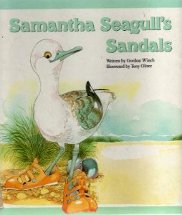
Samantha Seagull's sandals by Gordon Winch
Ill. by Tony
Oliver.
New Frontier Publishing, 2010. ISBN 978 19210425091.
(Ages 4+) Recommended. First published in 1985, and republished most
years since then, this
new edition will be a treat for teachers and librarians now able to
replace the tattered old copies in their schools. A marvelous book to
use when talking to children about competition, difference, fashion,
growing up and friendship, this story of Samantha has resonance with
all children.
Samantha desperately wants to be different, and so buys shoes to
wear on the beach. But each pair of shoes she buys causes problems
for her going about her everyday activities, and so she must exchange
them. The high heels sink in the sand, the rubber boots fill with
water, the slipper's pompoms get soaked and lose their oomph. Each
time, her legs and face become redder with shame and embarrassment,
but all the while, her best friend, Simon comes to her rescue.
The repetitive nature of the lines will encourage younger readers as
they predict what the other seagulls will say and the humour of the
situation will cause much laughter amongst all who read the book. The
resolution is a neat resolve to the situation, informing the readers
of the difference between younger and older silver gulls. A
delightful book, with luminous shimmering illustrations, redolent of
a day at the beach, this story will have wide appeal.
Fran Knight
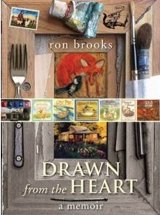
Drawn from the heart, a memoir by Ron Brooks
Allen and Unwin, 2010. ISBN 978 1 742371559.
All ages. Autobiography. Highly recommended. Some books are impossible
to put down. This is one. The frank and lucid telling of events in his
life as an illustrator is mesmerizing, as Brooks makes the slog of
finding a niche for himself in the publishing industry a fascinating
insight into the unseen backdrop to the books we read. Having always
loved John Brown Rose and the midnight cat, I was fascinated to see the
first drawings and read of the places which gave Brooks his inspiration
for the setting. Living with his grandparents when he went to a local
school to study art, the sense of that house comes through many of the
stories, John Brown being just one.
The struggles Brooks made to study art are fascinating in themselves,
as art was seen as a Cinderella subject and so he had to fight to be
able to study on his chosen field. Going on to college meant, as for
many people in the 60's and 70's, doing a teaching course to be able to
study art, and so parallel teaching with freelance art work. Picking up
work where he could, Brooks was in the right place meeting several
people who would mentor him through the early years while establishing
himself. Haworth Bartram of Childerset, Jenny Wagner, Pat Thomas of
Macmillan, Albert Ullin of The Little Bookroom, Peter Pavey amongst
many others were members of his network.
Not only are we lucky enough to get snippets of each story, thus
rekindling time spent with old friends, but Brooks goes into details
about his choices for his illustrative techniques and reprises the
absolutely engrossing reasons behind each decision made. It impels the
reader to grab hold of one of the finished books and relish it all over
again, but this time with greater insight from Brooks' writing. Some
first draft illustrations too are reproduced showing not only the range
of this man's abilities but the thought processes her went through in
illustrating a new book. Some of the criticisms of his work are also
included, showing that not all was rosy in the work that he did, and I
laughed out loud at the reviews reproduced from English, American and
German reviewers about John Brown, Rose and the Midnight Cat.
A treat for all, this will not only inform those in the field, and
endear those already in love with his work, but will create a new
audience eager to search out his illustrations for themselves. The only
thing I missed was an index.
Fran Knight
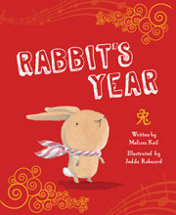
Rabbit's year by Melissa Keil
Ill. by Jedda Robaard. Black dog books, 2011. ISBN 978 1742031750.
Feeling sad and alone, Rabbit plays a tune on his cello. He would love
a friend but is too shy to join the other animals as they play their
instruments. But he loves music; he is creative and loves doing
creative things, but in playing his cello, he finds that other animals
join him, finding that they are drawn to the beautiful sounds. First
Dog finds the player, then Sheep follows the sound, then Pig wants to
join the trio, and on and on until all the animals of the Chinese
Zodiac join together to make beautiful music together.
A simple tale of friendship and working together, of music and its
power, form the subtext of this book outlining the 12 animals that
make up the Zodiac.
At the end is a double page spread containing an outline of the 12
animals, with a brief description and a list of the years in which
those animals take centre stage.
The main character will please younger readers and introduce them to
the 2011 Year of the Rabbit, as well as informing them of the Chinese
Zodiac and what it means. The line and water colour drawings are most
appealing to younger readers.
Fran Knight