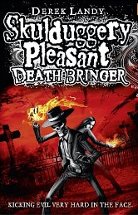
Skulduggery Pleasant: Death Bringer by Derek Landy
HarperCollins, 2011. ISBN: 978 0 00 732604 4.
In this book, the sixth adventure of Skulduggery and Valkyrie, the
heroes' quest to overcome evil and defeat the Necromancers
continues. A new candidate has arisen for the title of Death
Bringer, freeing Valkyrie from this responsibility. Melancholia St
Clair has been chosen to fulfill this role instead. Vandameer Craven
has begun to experiment on her with the aim of creating his own
Death Bringer. The scars and symbols which he has carved all over
her body in the preceding months are designed to assist her during
The Surge, as her powers are developed. Unfortunately, Valkyrie and
Skulduggery cannot escape being dangerously involved, as several new
secrets, with serious consequences, are revealed. A significant
event is the meeting with the Jitter Girls, leading to the emergence
of Darquesse, the part of Valkyrie which seems to emerge as a
defence mechanism when she is being threatened.
Landy has created a fascinating bunch of characters, many of whom
have two sides, with good and evil existing as distinctive parts
within them. These facets do battle with one another as situations
arise and demand resolution. Throughout the series, the characters
grow, change and develop. The suave and confident nature of
Skulduggery Pleasant seems to be adopted by his charge, Stephanie,
as she changes into the more mature and independent Valkyrie. She
takes her responsibilities seriously and learns to predict the
consequences of events and actions as she battles to save the world.
Despite the dark characters and plot, Landy injects many humorous
comments into this series to lighten events. Comparisons between the
characters from Twilight and those in Landy's own books would appeal
to the readers who would never be caught reading such titles! With
the double spaced print, this is an accessible title for more mature
readers from upper primary through to those in secondary school.
Jo Schenkel
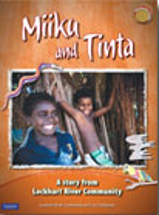
Miiku and Tinta: A story from Umpila Country by Liz Thompson
Pearson Education, 2011. ISBN 9781442546936.
Miiku and Tinta comes from the Sharing Our Stories series of 14
books on indigenous culture. Each book shares a traditional story
from a different indigenous community. These stories describe in
detail the different traditions, cultural practices and creation
beliefs of each community.
Miiku and Tinta is a creation story shared by the Umpila community
in Lockhart River, located north of Cairns in Queensland. Along with
the story, the book includes information about the Lockhart River
community, information about the story from two storytellers as well
as perspectives and information shared by children and elders in the
community. Photographs of the contributors help the reader to
connect more readily with the people and the culture from which the
story of Miiku and Tinta originates. The story itself is illustrated
with pictures drawn by children from the community which really
helps to bring the story into a context that students in my year 5
class could relate to. At the bottom of most of the pages is a
glossary which helps with understanding as you read.
As a Read aloud, this book provides the opportunity for rich
discussion about the traditions, beliefs and customs from
Umpila Country. At the back of the book, the inclusion of the story
written in Umpila language adds a worthwhile point of interest. I
would recommend this book as a good tool for teaching research
skills incorporating visual literacies as part of units centred on
indigenous culture.
Matt Eldridge
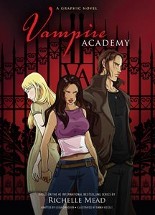
Vampire Academy: a graphic novel text by Richelle Mead
Adapted by Leigh Dragoon. Ill. by Emma Vieceli. Penguin, 2011.
(Senior students) This is a graphic adaptation of the first of six
books in the popular young adult Vampire Academy series
introducing Lissa, the blonde Moroi vampire princess with special
powers and Rose, her Dhampir best friend and guardian. The story
opens with the two runaways from the academy for young vampires
being captured and returned to school where most of the action is
centred. Evil forces there are trying to capture Lissa to use her
special powers and turn her into one of the Strigoi, vampires that
never die. Not being familiar with the original series I had some
difficulty following some parts of the story and recognising some of
the characters, but it is clear that friendship, loyalty, intimacy
and sexual tension are at its heart. I was surprised by the language
in the episode where some boys claim to have had sex with Rose who
they describe as a 'blood whore' and by the graphic almost-sex scene
between Rose and Dimitri. This manga style graphic adaptation,
featuring many close-ups, suits the moody characters and the story
moves along at a good pace while text, mainly direct speech, is kept
to a minimum.
'As an introduction to the series, or an extra dimension for those
already addicted, this is bound to be a popular choice but the
content, (including Lissa's self-harming) puts this book firmly in
the older reader category.
Sue Speck
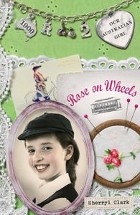
Rose on wheels by Sherryl Clark
Ill. by Lucia Masciullo. Our Australian Girl (series). Penguin,
2011. ISBN 978 0 14 330537 1
(Ages: 9+) Australian history. Rose is still in a quandary.
Her mother insists that she be tutored at home. While Rose would
love to go to school to learn about the wider world, her mother is
certain that the art of needlework, good manners and deportment are
all that a young girl needs, but daily, Rose has the example of her
Aunt Alice, a modern young woman, voicing her rights as a woman in
the year of the Federation of Australia, wanting change and the
right to vote. Now at school, she is learning just how far behind
she is compared to the other girls in her class, and if it wasn't
for her new friend, Abigail and her aunt, she would have fallen even
further behind. The subjects are all new and exciting, the freedom
exquisite, and she also wants to play cricket.
The second in the quartet of stories making up those about Rose, in
the series, Our Australian Girl, sees Rose, a young girl at the time
of Federation in 1901, striving to be heard. It is the old against
the new, as she learns lots about the nation when going with her
aunt to her place of work, a poor school nearby as well as the Votes
for Women campaign meetings in the city.
The young girl is well drawn and will garner fans as they read of
her challenges in this time of change.
Fran Knight
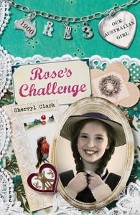
Rose's challenge by Sherryl Clark
Ill. by Lucia Masciullo. Our Australian Girl (series). Penguin,
2011. ISBN 978 0 14 330538 1
(Ages: 9+) Australian history. In this the third book in the
four about Rose, a Federation girl in the midst of the celebrations
for the new Commonwealth of Australia in 1901, Rose is practicing
her skills learnt at school, particularly writing with a pen and ink
(not, I might add a later twentieth century fountain pen featured on
the cover). Rose has excelled herself at her beloved cricket. Able
to bowl out many of the more experienced players at school, she is
picked for the school team to play another girl's school later in
the term. But her mother is seriously ill, showing the prevalence of
disease at this time, and she cannot tell her. At the same
time, women are expecting that the new parliament will grant votes
for women as one of its first bills, and so tensions mount as Aunt
Alice and the campaigners get into full swing with debates about
voting. Clark cleverly shows both sides of the argument put forward
at the time and Rose and her father and Aunt Alice are involved in a
riot at one of the debates.
One of the stories about the engaging Rose in the series, Our
Australian Girl, like the others in this informative series, gives
the reader a neat overview of the times and the issues prevalent at
the moment our nation became one.
A great introduction to the history of the period, these will give
an informative background to the work being done in the classroom to
satisfy the new History curriculum.
Fran Knight
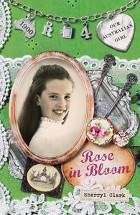
Rose in bloom by Sherryl Clark
Ill. by Lucia Masciullo. Our Australian Girl (series).
Penguin, 2011. ISBN 978 0 14 330539 1.
(Ages: 9+) Australian history. In this the last in the quartet
of books concerning Rose, a young girl struggling to be free of the
restrictions on young women of her age at the time of Federation
in 1901, she has secured a place in the school cricket team. But she
cannot tell her parents, and so hides the invitation that the school
sends out to the parents of the girls in the team, to watch their
team's efforts against another girl's school. Rose, unused to the
longer skirt her mother makes her wear, tumbles down the stairs
injuring her ankle only weeks before the big match. A likeable
character, Rose will have the sympathy of the readership behind her
as they too struggle with her dilemma. Readers will understand from
these short, easy to read series just how different the lives of
girls were at the turn of the twentieth century, and marvel at just
how our society has progressed since then.
The Rose series of books within the series, Our Australian Girl,
will like the others attract a wide and loyal readership as the mid
primary people read of girls their age in various dates in our past.
All books are supported by a website that
the readers will love to explore.
Fran Knight
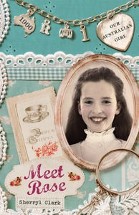
Meet Rose by Sherryl Clark
Ill. by Lucia Masciullo. Our Australian Girl (series). Penguin,
2011. ISBN 978 0 14 330536 1.
(Ages: 9+) Australian history. Rose, a young girl who lives
well in Melbourne at the turn of the twentieth century, longs to go
to school. She has been tutored at home by a succession of
governesses in needlecraft, etiquette and manners. And she would
love to play cricket, having practised a little with her brother
when mother was not at home. When her aunt Alice comes to stay, she
has some very forward thinking ideas about how a young woman should
live, espousing the ideas of the Suffragists, and votes for woman
campaign. Rose's mother is appalled. She baulks at the idea
that Rose be tutored by Alice, preferring instead a horrendous
governess who wields a whip. Rose seizes the opportunity when mother
is in town, to don her brother's clothes, and ride into Bourke
Street to talk to her father. While her excursion does not play out
exactly as she had hoped, her father supports her aim, skillfully
allowing his wife to think it her idea that Rose be enrolled at the
local Girls' School.
The first in the quartet of books about Rose, living in Melbourne in
1900, the story reveals much about the clash between the old and the
new that was apparent at the time. Many women were demanding change,
South Australia had already granted votes for women, and other
states pushed for change in line with Federation.
The set is part of the series, Our Australian Girl, putting young
women in various dates in our history, so showing through the eyes
of these young girls what life was like in Australia at the time.
And all in time for the new Australian Curriculum with its emphasis
on Australian History, these will be well used in primary schools.
Fran Knight
Popular by Gareth Russell
Penguin, 2011. ISBN 9780141334530.
(Age 14+) I think the book Popular by Gareth Russell was a great
book. The main characters in the book are Meredith Harper, Imogen
Dawson, Cameron Matthews, Kerry Davison and there was another girl,
Catherine O'Rourke but she wasn't in the story as much as the
others. The story I think is focusing on bullying, peer pressure and
many other things! The book is mainly about Meredith, Imogen,
Cameron and Kerry being the most popular and most gorgeous people in
the school. They go around being mean and cold towards pretty much
everybody, even poor Catherine who is in their group. Only the
'A-listers' are worth talking to, but even the most popular people
in the school have problems and secrets. The age group for this book
I think would be 14+.
Stacey Lamps (Student)
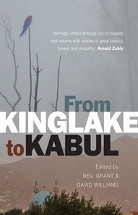
From Kinglake to Kabul edited by Neil Grant and David Williams
Allen and Unwin, 2011. ISBN 9781742375304.
(Age: 12+) Neil Grant was a writer in residence at a small secondary
school when devastating bushfires swept through Kinglake and many
towns in regional Victoria. In the aftermath of the Black Saturday
tragedy contact was established with the International School of
Kabul and students were invited to share their stories. Suffering is
universal and Grant compiles the experiences of students connected
by the tragedy of war and bushfires.
The book is an interactive experience. Students from Kinglake and
Kabul respond to the experiences of each other. Loss,
grief, fear and insecurity are themes explored by the children who
contribute their personal stories. There is a juxtaposition. The
children of Kinglake have endured a one off unanticipated horrifying
trauma. There has been loss of life and property but there is a
great sense of community support. By contrast, the students in
Kabul have endured long term warfare and chaos. Trust and friendship
are variable.
Containing many short stories, this book is ideal for classroom
discussion. It does not need to be read sequentially. This book has
relevance from many perspectives including historical, social, moral
and personal.
Grant's voice is interspersed between the stories of students and
sometimes it is hard to distinguish where one voice ends and his
begins. A little more editing may have been in order. Despite
this, the book is a wonderful stimulus for class discussion of these
contemporary issues.
Tina Cain
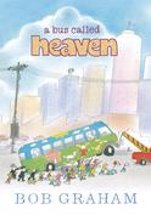
A bus called Heaven by Bob Graham
Walker Books, 2011. ISBN 1 4063 3419 7
(Ages 5+) Highly recommended. Picture book. Finding a bus called
Heaven left in their street is the impetus for many of the
neighbourhood to come together to make it into a community centre.
People who have rarely spoken, club together to clean it out and add
carpets, games and furniture for all to use. Boys found using spray
cans on the bus at night are invited back the next day to paint the
bus. One family shows their slides while others set up market stalls
in the busy street nearby. All is cooperative and neighbourly until
one day a council worker comes long with his tow truck and takes the
bus away to a place where it will be recycled.
The community is distraught, but one young girl, Stella, points out
the baby birds about to hatch in a nest in the engine, and
challenges the council worker to a game of table football.
With another story of people taking matters into their own hands,
Bob Graham masterly lets us think this is a simple story, but it is
much more. There are overlays of city life, of the mix of cultures
in cities, living side by side. There are hints of loneliness and
isolation, of communities coming together, of people taking action
where they see a wrong, of idealism and hope for the future. Bob
Graham's books make me smile, sometimes even laugh out loud, but
always make me hold a thought about the future of our world being
safe in the hands of children.
And of course, his recognisable illustrations give a marvellous
recreation of a city with its telegraph lines and endless traffic,
with isolated pockets of people living in small houses sandwiched
between factories and office towers. The strong colours of the
people and the bus stand out against the grey blue wash of the
buildings that surround their lives.
Never didactic or preachy, Bob Graham's stories revolve around the
ordinary, the everyday. The people who inhabit his stories are
instantly recognised by the reader as most like themselves, going
about their lives as best they can.
Fran Knight
Dark mist rising by Anna Kendall
(Soulvine Moore Chronicles: Book Two). Gollanz, 2011. ISBN:
9780575094314.
(Age: 16+) Roger Kilbourne is a hisaf; one of few people who have
the ability to cross over into the Country of the Dead. This gift,
or curse as Roger thinks it to be, has always been exploited; by his
uncle, his queen and the dark arts of the feared Soulviners. But
those days are behind him and Roger intends to live a normal life.
But all is not well in the Country of the Dead. The Queendom is on
the edge of war with invading savages and forces in both realms want
Roger dead.
The reader can easily be forgiven for feeling unconvinced upon
opening this book. The first few chapters are hastily written in an
attempt to provide newcomers to the series an idea of all that
happened in the previous book. The scenes are either too short or
too long, the interactions between characters brief and dull, and
the dialogue fails to engage the reader.
However once the tedious opening chapters pass, the reader stumbles
upon a truly gripping story. The dialogue becomes vivid, colourful
and evocative. The scenes become a blend of fast-paced conflict and
poignant drama. New diverse characters are introduced throughout
while characters from the first novel are recalled. Kendall throws
in just enough twists to keep the reader guessing whilst still
keeping them interested.
The ending is one that the reader does not foresee but fans of the
series as well as newcomers will be left more than satisfied. The
story still leaves enough doubt in the reader's mind to encourage
the idea that the third installment of the series will soon
follow.
A clever, unique plot is coupled with colorful characters,
descriptive writing and engaging storytelling to create an all-round
enjoyable read. The reader may become impatient at the start, but
continuing to persist with this book greatly rewards the reader in
the end.
I highly recommend this book.
Michael Adams
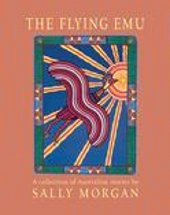
The flying emu: A collection of Australian stories by Sally Morgan
Walker Books, 2011. ISBN 9781921720642.
(Age 7+) Highly recommended. The Flying Emu is a collection
of short stories by Sally Morgan. In the preface Sally explains that
Aboriginal people have a tradition of storytelling that extends over
thousands of years. As she grew up she tells of her memories of her
family telling stories, often made up, as she fell asleep under a
rug on the grass outside. Her grandmother had introduced her to the
idea of bush creatures having their own stories to tell, which
prompted a curiosity about what they might say. Whenever she was
bored or unhappy she would drift off into another world that was
inhabited by all sorts of intriguing creatures. There she would have
great adventures. At the end of the preface she encourages the
reader to have fun making up stories of their own to share. The
ensuing collection of short stories optimises the spirit of this
request as Australian animals are given personalities that can make
you smile and provide a reason for a particular characteristic (such
as an Emu that can't fly). Each story has a clear moral, including a
reason for why things are the way they are. I thoroughly enjoyed
reading these stories and plan to use this book as the basis for an
English unit about fables with my upper primary class.
Matt Eldridge
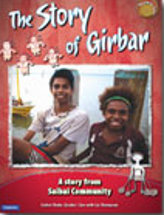
The Story of Girbar by the Saibai Thabu Clan with Liz Thompson
Pearson Australia, 2011. ISBN 978 1 4425 4692 9.
(Age 9+) The Story of Girbar is a wonderful book that not
only describes the people of Saibai (an island in the Torres Strait)
and their heritage but tells one of their stories - the story of
Girbar. It is illustrated by children in the clan and is retold by
the local story teller. The book is colourful and informative and
will be enjoyed by independent readers from 9+ to adult. Throughout
the whole book is a glossary, giving the English version to
traditional words as well as instructions on how to pronounce them.
As a teacher, I can picture reading this book to students as a way
to expose them to one of the Indigenous cultures that make up our
country. Children could illustrate their own version of the story,
research the islands in the Torres Strait and respond to the story
as part of a reading program.
This story could be compared to Dreamtime stories of local
Indigenous groups as well as other cultures from around the world.
The best part is, it is part of a 14 book series, presenting studies
of Indigenous cultures and each has a story specific to that group.
A great hardcover book collection for any library.
Kylie Kempster
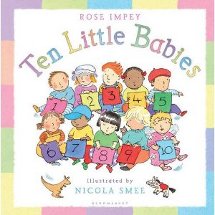
Ten Little Babies by Rose Impey
Ill. by Nicola Smee. Bloomsbury, 2011. ISBN 978 1 4088 1118 4.
A delightful counting picture book about ten little babies and the
mischief they get up to. The story flows in rhyme and could easily
be read aloud or made into a song. The babies crawl, float, slide,
trot, sail, climb, zoom, hop, fly, and hide. The illustrations are a
great support to the text and give clues as to what the babies are
getting up to. The individual children are diverse in their
appearance giving a multicultural feel to the story. The story takes
place outside on the grass in the fresh air. As is often the case,
the fresh air results in some sleepy babies by the end of the story.
Although number figures are not given on the pages the reader
soon understands that counting backwards is involved. Numbers are
however present on the cover of the story and can be shared prior to
the story being read. A great picture book to share.
Tracy Glover
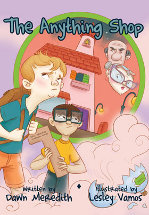
The Anything Shop by Dawn Meredith
Ill. by Lesley Vamos. Wombat Books, 2011. ISBN: 978-1-921633-51-5.
(Age 8-12) Charlie is a boy who stumbles across a shop which
promises that all his dreams could come true. After seeing other
children walking out of the Anything Shop with such wonders as a
walking teddy bear who seemed to be talking to its new owner and a
boy with two toy fighter planes that actually engaged in a dog fight
with each other as he walked along with them, his curiosity got the
better of him.
A man called Alfred is spruiking outside with a megaphone and
invites Charlie in, assuring him that money is not necessary. He can
buy or trade. Charlie decides to buy a cricket bat that only ever
hits sixes. He chose to pay for this cricket bat by trading the
embarrassing hugs his family members constantly give him.
Charlie experiences the short term joy of being the hero of the
cricket team but in the process he learns a valuable lesson about
what is really important in life. This book taps into the emotions
of a child effectively, from the feeling of not being good at
cricket, the initial joy of success and then the feelings of a life
with no hugs. In his search to resolve his problems, Charlie meets
Sam, another customer of the Anything Shop, and together they seek
to undo the decisions they both made.
This delightful book is well written and has great illustrations to
help young readers picture the characters in the book.
This book is aimed at 8 to 12 year olds and could be used as a quick
read aloud in an upper primary class to demonstrate the components
of a Narrative. Setting the scene, complication, sequence of events,
resolution and the moral are clearly evident in this book and could
be discussed along the way.
Matt Eldridge