Ill. by Barbara Lavallee. Bloomsbury, 2013. ISBN 9780 8027 3401 3.
(Age: 5-8) Warmly recommended. Picture book. Alaska. Non fiction.
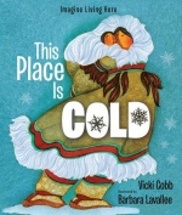
This fascinating little book, full of interesting and informative
stories about aspects of life in Alaska for plants, animals and
humans, piqued my interest from start to finish. Certainly that
interest was held by the range of facts given, the scope of the text
and the beautiful illustrations. Double page spreads in the first
seven pages explain why the place in the Arctic Circle is so cold,
and detail the severity of the cold for readers to better understand
the temperatures of the place. There follows eight pages outlining
how plants and animals survive in these harsh conditions, and then
what people live there and how they too survive.
But I longed for a map, contents page, glossary and an index! With a
non fiction text, these are essential tools for research, so I was
surprised to read that this is a republishing of a 'ground breaking
geography series' which first appeared in 1969. Despite these
shortcomings, the text is fabulous, full of interest and detail,
with illustrations that are full of life and colour, and I would
probably see this as a non fiction text in a reader box, although it
could be an information book within a group about the Arctic Circle,
about which little is written.
The last few pages are most interesting, detailing the effects of
humans on this environment. With the arrival of North American
Indians, then Eskimos, followed by sealers, trappers, and then gold
seekers, the place was opened up to outsiders, and has changed
considerably as a result. Another in the series, called This place
is wet, will follow.
Fran Knight
Verity Sparks Lost and found by Susan Green
Walker Books Australia, 2013. ISBN: 9781921977886.
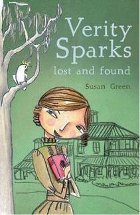
(RA: 10-14 years) Highly recommended. Themes: Psychic Ability, Girl
Detectives, Melbourne - 1870's, Boarding Schools, Mysteries. Susan
Green has certainly 'gingered up the action' in her second Verity
Sparks novel. Verity's psychic gift of teleagtivism, finding lost
things has gone; instead she is troubled by shadowy dreams, portents
of dangerous events.
Papa Savinov feels that Verity needs to develop into a proper lady
and enrols her at an exclusive boarding school Hilltop House. Verity
is a reluctant boarder, making both friends and enemies. She uses
her detecting skills to solve mysterious thefts at school and
investigates the dishonesty of college proprietors the Colonel and
Mrs. Enderby-Smarke. Verity uses her journal to record her
observations about school life, the dramas, bullying and home
situations of the boarders. Even Lucifer Miss Deane's fifty year old
cockatoo adds spice to the story.
There are a rich array of characters who both help and hinder
Verity's quest to find missing heiress Lavinia Ecclethorpe. The
settings of 1870's Melbourne and Mt. Macedon are realistically
brought to life.
Verity and her governess Miss Deane move to Mount Macedon to
investigate the murder of Lavinia's fiance Alan Ross. There are even
more twists and turns as Verity's dreams start to come true.
This is another exciting novel by Susan Green; Verity Sparks is a
dynamic character with a real sense of adventure. I would highly
recommend this book for upper primary and lower secondary students.
The accurate historical portrayal of Melbourne, Bourke Street, the
Yarra River and Mount Macedon and the modes of transport used in the
1870's, support the Australian History Curriculum.
Susan Green's blog-
provides further insight into her creation of the novels. -
Rhyllis Bignell
The Night Circus by Erin Morgenstern
Vintage, 2012. ISBN 9780099554790.
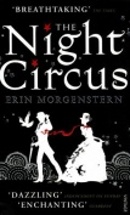
(Age: 14+) Highly recommended. The circus arrives without warning.
No announcements precede it. It is simply there, when yesterday it
was not. Within the black-and-white striped canvas tents is an
utterly unique experience full of breathtaking amazements. It is
called Le Cirque des Reves, and it is only open at night. But behind
the scenes, a fierce competition is underway - a duel between two
young magicians, Celia and Marco, who have been trained since
childhood expressly for this purpose by their mercurial instructors.
Despite themselves, however, Celia and Marco tumble headfirst into
love - a deep, magical love that makes the lights flicker and the
room grow warm. True love or not, the game must play out . . . The Night Circus is one of those rare books that manages to be
unique, original, charming and fascinating all at the same time.
It's written in beautiful, lyrical language that describes the
circus with a kind of awestruck wonder, that perfectly suits a book
like this. The characters are interesting and varied, from the cruel
Prospero the Enchanter, to the kind and studious Marco. All of these
characters, even minor ones, are developed well throughout the
novel, each with their own little stories and nuances.
The circus itself is incredible, mysterious and enchanting, a circus
one wishes was in reality, rather than embedded in pages of fiction.
The author describes the circus in such a way that it almost seems
to come alive, along with all the intricately detailed characters.
This makes the book very memorable. The Night Circus is unique, memorable, enchanting and
incredible all at once, with an exciting plot and an endless stream
of intriguing characters.
I highly recommend this book.
Rebecca Adams
Funny bums by Dr Mark Norman
Black Dog Books, 2013. ISBN 978
(Age: 6+) Recommended. Picture book. Animals. Humour.
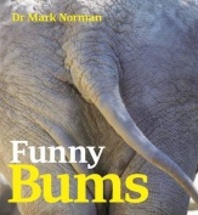
From the wonderful elephant on the front cover, back to the
audience, to the fabulous ducks on the back cover, emulating the old
poem,
All along the back water,
Through the rushes tall,
Ducks are a-dabbling,
Up tails all!
(Wind in the willows, Kenneth Grahame)
the photos and words in this book will keep children amused and
involved as they see the bums of many animals portrayed and
discussed. Dr Mark Norman has written several wonderful books for
black dog, including three books in the Wild Planet series (Antarctica,
Great Barrier Reef, and The shark book), and Into
the deep, Rare Earth: Saving Tasmanian Tigers.
In this one, he uses his prodigious scientific background to tell
the reader neatly and efficiently, about the nether regions of a
range of animals which includes the lemur, seahorse, several spiders
and creeping insects, skunks, porcupines and lizards. Some have
spines, some use smell emanating from their behinds, some have
sticky substances, while some have exploding behinds (kids will love
that one) Each group of animals has a few succinct words given and a
number of wonderful photographs to illustrate the text.
There is, as always with black dog books, a useful index, an
informative glossary and two pages with a fact file about the
animals mentioned. All in all a most useful and fascinating book.
But watch out for the African Bombardier Beetle.
Fran Knight
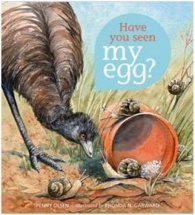
Have you seen my egg? by Penny Olsen
Ill. by Rhonda N. Garwar, National Library of Australia, 2013.
(Ages: 5+) Picture book. Australian animals. A non fiction book
presented as a story of an emu looking for his missing egg, this
book will interest and inform younger readers about the Australian
environment and the sorts of eggs which exist. The emu begins with
the magpies, describing his missing egg as large, green and hard
shelled, but the magpies tell him that their eggs are small and
spotty, and a life the flap in the corner shows one of the eggs
hatching. On he goes to the echidna, the lizard, a frog, snail,
shark and crocodile with a few others between, all the time
describing his egg in the same way and having the other respond with
a description of their eggs.
Readers will enjoy spotting the eggs and the hatching animals,
recognising the animals as they appear on the pages, lifting the
flap to see what is underneath and counting the number of eggs
produced by each animal.
The environment as well as the animals are presented in a bold mix
of colours, each page giving a strong sense of where that animal
lives. At the end of the book are four pages with photos and
information which add to the overall interest for the reader and
educator.
Fran Knight
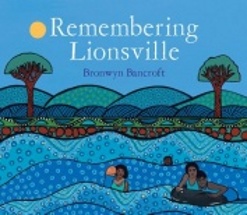
Remembering Lionsville by Bronwyn Bancroft
Allen and Unwin, 2013. ISBN 9781742373201.
(Age: 6+) Highly recommended. Picture book. Aboriginal themes.
Family. Beautifully illustrated in Bancroft's distinctive style, this
book is a homage to her Aboriginal family and their ancestries,
their environment and work ethic. Lionsville in northern New South
Wales is a small community where Bronwyn Bancroft's family was
raised. The grandfather, Pa, married Emily and they had four
children, but when Emily died, her sister, Annie moved in to help
raise the children, but living in the house was frowned upon, so Pa
married Annie and they too had four children, one of whom, Uncle Pat
still lives there and passes on the many stories about the house,
the family and the environment to the younger children.
A beautifully told recollection of a family life now almost gone,
where kids were able to swim in the creek, watch out for lizards and
snakes, tell stories under the trees with Uncle Pat and have picnics
in the woods beyond the house with Aunty Alice, reminds readers of
the importance of the older family members and the memories they
have to share.
With no mobile phone or internet to tear at the eyes and ears of the
children, there is time to listen to the older family members
telling stories of their land, or their family, of the others who
have gone before them. The children's anticipation when driving out to
the old farm is infectious, reminding readers of times when they too
drove long distances to visit older relatives or friends, full of
expectation and excitement, remembering times past when they could
do such things.
This is a book to savour, to take time sifting around and sharing
the stories in it, pointing out the many things which fill the house
and its garden, the orchard and places where the family members
worked. Along with other wonderful books like The Fair Dunkum
War and The Road to Goonong , both by David Cox, the
image of a time almost gone is breathtaking, and readers will enjoy
asking questions about some of the things in the illustrations which
are no longer seen.
Fran Knight
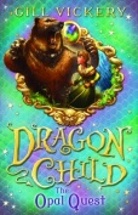
The Opal Quest by Gill Vickery
Dragon Child Book 2. A and C. Black, 2013. ISBN: 9781408176252. 80p. RRP $12.99
Highly recommended for children from 7-9 years of age. Suitable for
a class read aloud. Themes: Fantasy, Quest Adventure, Witches,
Magic. The Opal Quest is the second fantasy adventure in the Dragon
Child Series. Tia a young girl who has been reared by dragons must
recover the stolen Jewels of Power. She sets out on the journey to
find the opal that gives the power of shape-shifting. She needs to
prove that she is really a part of the dragon family.
This novel starts with a recap of her first adventure where
Tia and her DragonBrother Finn found the emerald which gives the
power of talking to animals. In this adventure they need to travel
across the island to the town of Kulafoss, where she needs to
confront the High Witch Yordis. Tia is confronted with challenges
and uses her powers to best the witch. She is concerned for the
young village children sent deep in the old mines to gather the
prized small crystals. Tia's journey is filled with drama and magic.
She shows her strength of character and draws on her quick thinking
ability throughout the story.
Gil Vickery's novel is tightly written and shows her understanding
of the young reader's need for excitement and adventure. Mike Love's
dark moody black and white sketches create atmosphere and add to the
reader's understanding of Tia's difficulties.
Rhyllis Bignell
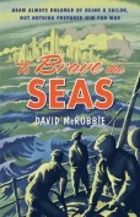
To brave the seas by David McRobbie
Allen and Unwin, Sydney, 2013. ISBN 9781743313077.
(Age: 12-15) Recommended. Adam Chisholm has grown up near Liverpool,
the busiest seaport in 1940's Britain, so it is no wonder that ships
have always been his passion. With his country at war, it is also no
wonder that 15 year old Adam chooses to sign up for the Merchant
Navy, to do his part for the war effort, especially given that his
beloved mother has recently died.
And so the story of Adam's sea adventures begins. Over the next few
months Adam will sail on an Atlantic convoy, face seasickness and
shipwreck, help to salvage a ship and take part in the destruction
of a submarine. As the ship's 'Peggy' he will learn how to keep a
mess tidy and how to ferry meals across a slippery deck to satisfy
the hunger of his fellow sailors. He will also discover a whole new
vocabulary of shipping terms, which he must learn, if he is to obey
the orders he is given on board.
Whilst Adam is a remarkably resilient lad and a faithful recorder of
events, he is inclined to tell his tale in a rather matter of fact
manner. So whilst there is plenty of action, there is a surprising
lack of drama or emotion in this story, despite the wartime
setting. However, what does come through quite strongly is the
sense of mateship that develops between the sailors during their sea
voyages; the camaraderie and humour that they use to relieve the
stress and tension of being at war.
Teenage boys are sure to find this book entertaining and quite an
eye opener. It certainly gives an intriguing insight into ships and
seafaring as well as life in Britain under the duress of
war. The inclusion of muted images at the start of each
chapter (including maps and posters of the era) and a glossary of
ship terms at the end, also help to suggest the veracity of the
novel.
All in all, an entertaining, if not a compelling, read.
Deborah Marshall
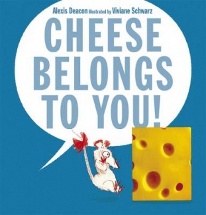
Cheese belongs to you! by Alexis Deacon
Ill. by Vivian Schwarz. Walker Books, 2013.
(Age: all) Warmly recommended. Picture book. Bullying. Democracy.
Rules. It amazes me when authors, supported by illustrators with an
awareness so suited to the tale, write a story about major themes
within our society, but told at a level that is able to be
understood by the youngest of readers. So it is with this one.
Cheese belongs to you except when a hairier, scarier, bigger rat
comes along. And so it goes all through the tale, each page showing
a different rat which gains power over the preceding rat for some
reason. At the end of the book, when the biggest, scariest, dirtiest
rat comes along, all the rats then fight for the cheese with
interesting results.
Readers will immediately see the logic of the big and powerful rats
taking over the cheese, equating it with what they see in the
schoolyard, or in society, or government or world affairs. And to
have this rise of power then erupt into war is even more obvious, as
most television news will tell them. But readers do not have to be
au fait with world affairs, this premise can be seen all around them
and will be a basis for discussion in all classrooms. And readers
will love looking at the range of rats shown on each page, the
scared, bullying and bullied, large and small, the cowering, the
brave, the sneering, all have faces that can be marveled at, as the
readers will look at them again and again with delight.
Fran Knight
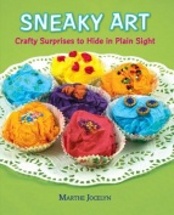
Sneaky art: Crafty surprises to hide in plain sight by Martha Jocelyn
Candlewick, 2013. ISBN: 9780763656485.
Recommended for 8-10 years of age.Themes: Art - construction,
Recycling in Art, Handicrafts. Sneaky Art projects made from
recycled materials readily available at home or school can add a fun
and surprising element to public spaces. Yarn-bombing where crafters
add knitting and crocheting projects to cityscapes continues to be a
successful artistic endeavour. This quirky handicrafts manual gives
the budding artist a step-by-step guide to creating exciting
short-term, easily removable artworks. They are meant only for fun
and enjoyment as the introductory reminder advises to be careful
with other people's property.
'Don't make anyone mad, make them laugh,' Martha Jocelyn states.
Each project has a full-page colour photo with a clearly defined
list of materials needed, instructions for making, how to sneak and
where to place the finished work. For children or students this
needs some adult input and guidance. Adding a fractured face made
with cut out eyes, nose and mouth and a speech bubble to a parking
metre needs consideration. It would be fine to add sneaky art around
the home.
Simple craft like Seeing Red, where red wool or pipe cleaners are
wrapped around 'anywhere that needs brightening,' could be adopted
for Harmony Day where students could add touches of orange to the
school fences or buildings. 'Post a Poem,' using sticky notes, or
'Library Shouts', using cut out words and letters are great ideas
for literacy lessons.
This unusual art book is recommended for children over 8 years of
age. It is suitable for class craft lessons.
Rhyllis Bignell
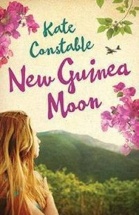
New Guinea moon by Kate Constable
Allen and Unwin, Sydney, 2013. ISBN 9781743315033.
(Age 13+) Highly recommended. There is a very good reason that Kate
Constable was the winner of the CBCA Young Reader award last year:
she is a wonderful storyteller. In her latest novel she has crafted
a delightful story about a young girl who is finding her way in
life, in a country which is also finding its way: both are seeking
independence.
Julie is quite literally facing a new chapter in her life. Having
been at odds with her mother for some time, is it any wonder that
she has been shipped off to spend the summer holidays with her
father? However, Julie hasn't seen or heard from her dad since she
was 3 years old and he lives in a different country: New Guinea. So
Julie is thrown into a new cultural experience on many levels!
This novel explores Julie's situation with credibility, sensitivity
and warmth. For Julie is both appalled and fascinated by 1970's New
Guinea. She falls in love with the scenery, which is evocatively
described by Kate Constable, and she warms to the shy locals.
However, Julie finds some of the sights and smells a tad
overwhelming and she is dismayed by some of the attitudes displayed
by her father's expat friends.
Julie is a credible, warm and intelligent girl. She is sensitive to
the nuances of relationships and aware of cultural differences but,
realistically, this doesn't mean that she always knows how to deal
with difficult situations without causing offence. However, by
novel's end, Julie has a clearer path forward: a clearer sense of
herself and her relationship with this strange new land.
This is a thoroughly engaging novel; it may be set in an era which
is unfamiliar to modern Aussie teens but the political context will
not detract from the story's popularity. Indeed, it is explored in
such a sensitive and even-handed way that it is more likely to
engage readers.
Deborah Marshall
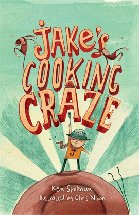
Jake's cooking craze by Ken Spillman
Ill. by Chris Nixon. Fremantle Press, 2013. ISBN 978 192208910 6.
(Age: 8+) Recommended. Junior novel. Cooking. Spurred on by the
cooking television series for younger chefs, Junior Cooks, Jake is
amused when his friends and those about him fall into the trap of
talking about nothing else. He studiously ignores the conversations
about the program, but when his teacher brings it up in class as a
topic of discussion, he knows he cannot hold out. He watches the
show and is soon asking his Gran for help with recipes, while
finding new things to cook for tea.
This all comes to a head when his teacher announces a cooking
competition to be held between the local schools. Jake is so wound
up in the whole idea that he volunteers and then tries to find a
different recipe that he could use which would be a prize winner. In
the garden, he spies some snails, and so hits upon the idea of
cooking snails as his dish. The hilarious illustrations follow
Jake's path to what he thinks is a winning idea, and the same
illustrations show quite clearly what the judges all think about his
smart recipe.
A funny read of about 40 pages, with easy to follow print, short
easily digested chapters, a flowing plot line all broken up with
wonderfully evocative illustrations, this is one of a series about
Jake and his exploits. This one taps into the hysteria caused by the
overabundance of cooking shows currently presented on television,
and students will giggle with recognition.
Fran Knight
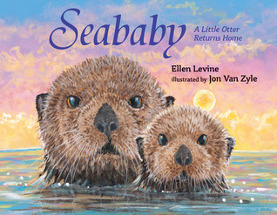
Seababy : a little otter returns home by Ellen Levine
Ill. by Jon Van Zyle. Bloomsbury, 2013. ISBN 978 0 8027 9808 4.
(Age: 5+) Recommended. Picture book. Animals. Family. A charming
tale of a lost sea otter, separated from his mother when the seas
become rough, but taken by humans to a rescue haven, where he is
nursed back to health and then put into a larger pool with an older
female otter who teaches him how to fend for himself. The survival
skills necessary for this baby otter are shown clearly from the
skills taught by his mother, to the care taken by the humans and
then the skills taught by the surrogate mother. Each shows readers
very distinctly how an otter survives and the sorts of things they
need to keep themselves alive and safe.
The otters must learn how to dive to find food on the bottom of the
sea, bringing up clams to open by smacking their shells on rocks
placed on their stomachs. And at night he must pull together some
seaweed to create a bed on which to lie in the rolling sea.
The happily descriptive illustrations show contented otter lazing
around on their seaweed beds, and also the skills taught them by the
older otters. A reader can be in o doubt about how these little
animals survive whilst at the end of the book, a page of information
is given detailing the work of the Californian Monterey Bay
Aquarium, along with further references and websites for students to
pursue their research. This book is a happy mix of story and
information.
Fran Knight
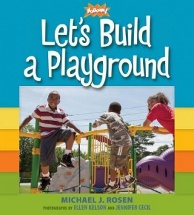
Let's build a playground by Michael J. Rosen
Photographs Ellen Kelson & Jennifer Cecil. Harper Collins, 2013.
ISBN: 9780763655327. Hardcover. 32 p.
Reading Age: 8-10. Themes: Outdoor Recreation, Planning &
Design, Measurement, Playgrounds - Design and Construction.
This is a bright, colourful photo journal that chronicles the
design, planning and construction of a fantastic playground in
Andrews Academy Indianapolis. Kaboom! Consultants, a US national
non-profit organisation joined with the students, parents and
community in their journey to build a creative play space.
Michael J. Rosen's questioning free-verse comments on each stage of
development. At the beginning the wildly imaginative ideas of the
students include 'a hot tub a tower, a roller coaster that turns
into a rocket'. These are developed into a purple triple slide,
climbing walls and much more. The choice of colour scheme needs a
vote for consensus - the perkiest green for spring.
Each stage of the procedure is documented through verse, supported
by photos that show the active engagement of the teachers and
students. The children's voice, enthusiasm and engagement is heard -
'we cooked up a project of our own; we painted dozens of stepping
stones.' Factual text boxes add interest using child-friendly terms
- the playground equipment weighed as much as 126 students!
This factual account is a great classroom resource: for procedural
writing; mapping; technology design; model-making; Maths -
measurement; Poetry lessons using Michael J. Rosen's free verse
style and his other poetry books including The hound dog's haiku
(2011).
Rhyllis Bignell
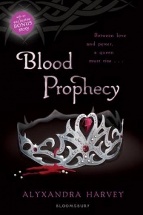
Blood prophecy by Alyxandra Harvey
Drake Chronicles. Bloomsbury, 2013. ISBN: 9781408836699. Blood Prophecy by Alyxandra Harvey is another beautifully
written and the last instalment to the Drake Chronicles.
Solange Drake, the youngest of the unusual Drake family is
prophesised to be queen of the un-dead but this is not something
Solange had ever wanted. Plagued by strange visions of another life
and another time Solange loses control of her actions and this
affects herself, the rest of the noble Drake family and the whole of
the vampire world.
This novel is written from Solange's point of view as well as her
bestfriend Lucy Hamilton and her vampire hunter friend, Hunter. The
fact that the author has written in these three different character
perspectives gives the reader the opportunity to see different
aspects within the one story. Solange gives the reader a sight into
the vampire world and the Drake family life, Lucy gives a human
perspective upon the events in the novel. Lucy has grown up with the
Drakes but attends the vampire hunter school Helios-Ra with the
skilled and highly academic Hunter. Hunter gives a view of the novel
from a Helios-Ra hunting student perspective with greater knowledge
on the hunters and their traditions.
The recommended age for this novel in my opinion would be a teenage
audience due to the supernatural themes and violence. Even though
this is the last book in the Drake series there are also novellas
and smaller instalments for the chronicles but in my opinion this is
a fantastic way to finish a fantastic series.
Sarah Filkin (Student)