Walker Books Australia, 2013. ISBN 9781922077295.
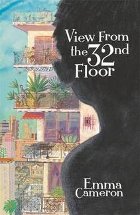
(Ages 8-12) Recommended. The View from the 32nd floor is an
uplifting and gentle story where care and concern for others and
themes of loneliness and friendship in an inner city setting and
across the generational gap abound.
William lives on the 32nd floor of his apartment block with his
musician parents and enjoys watching the residents of the apartments
directly across the street with his plastic binoculars as he sits on
his balcony. When Rebecca and her mother take up residence in the
apartment directly opposite, William is quick to befriend her and
together they begin a campaign to change the lives of the residents
William sees from his balcony.
There is old Mr Crispin who worries William as he seems to have lost
interest in life and is definitely not eating properly, and Fabian the
palm grower who now lives alone and irons his holey jeans and who
lives behind the sheer grey curtains which never open.
With the help of cake, visits by the children and some banana-shaped
Post-it notes to remind him to put in his hearing aids, Mr Crispin
begins to reconnect with the world but it is when the children are
forced to enlist Fabian's help to break into his apartment to save
his life that the real connections begin.
Tai chi in the park, lots of delicious food and a party to celebrate
the unveiling of a mysterious statue on the roof encourage all the
residents, even the reluctant Mrs Stavros who comes out from behind
the curtains to meet and talk to their neighbours.
I enjoyed William's penchant for changing his name daily and that
the meaning of the name reflected his actions and behaviour. The
lyrics of the song selected each day by his father became the theme
for the day as well, though I would think most of the references
would not be in the target audience's playlist.
If one young person is inspired to interact with an elderly
neighbour as result of reading this book the world can only be a
better place.
Sue Keane
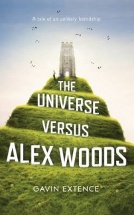
The universe versus Alex Woods by Gavin Extence
Hodder & Stoughton, 2013. ISBN 9781444764611.
(Ages: 15+) Highly recommended. This book tells the story of Alex Woods
from the time he is ten until he is nearly eighteen and it is a
truly extraordinary story.
At age ten Alex is hit by a meteorite and seriously injured.
After spending a considerable time in hospital and therapy he is
able to resume a somewhat normal life, hampered by the fact that he
has epilepsy, a quite noticeable scar and a mother who is a
clairvoyant. Being different, he is bullied at school and this
leads to his meeting and subsequent friendship with the reclusive Mr
Peterson, a widowed American Vietnam veteran. This proves to
be a mutually rewarding friendship that evolves into Alex virtually
becoming his carer as Mr Peterson's health deteriorates.
This is a wonderful story, Alex is very intelligent and pedantic but
an exceptionally interesting character, as is Mr Peterson. The
writing is assured and carries the story along to its satisfying
conclusion. To reveal the ending would be doing a disservice.
I would highly recommend this book to upper secondary students as it
deals with confronting issues sensitively but with humour and above
all humanity.
David Rayner
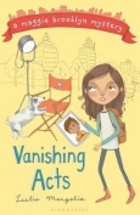
Vanishing acts: A Maggie Brooklyn mystery by Leslie Margolis
Vanishing acts: A Maggie Brooklyn mystery by Leslie Margolis
Bloomsbury, 2013. ISBN 9781599909813.
(Ages: 8-12) Recommended. This mystery story has no superspies or
gadgets, just ordinary kids in a familiar setting doing what we want
kids to do, observing, thinking, investigating, questioning and
researching, whilst attending school and battling parents about
after school commitments and homework.
Maggie Brooklyn is a 12 year-old who has a twin brother Finn and
walks dogs after school for busy neighbours. She successfully solved
a dognapping case (the first Maggie Brooklyn mystery, Girl's best
friend) so when dogs are being egged at the local park Maggie
is enlisted by a fellow school student to investigate. At the same
time teenage heartthrob Seth Ryan (think Justin Bieber lookalike)
is filming his latest movie in town. Maggie's friends convince her
and Finn to join them as extras on set. Maggie's career as an extra
is short lived, however she does meet the star Seth Ryan.
When Seth disappears, Maggie is determined to find him especially
as she learns more about him.
In the meantime there are personal issues to resolve like why is her
best friend Lucy acting so strangely; what is Finn, her twin
brother, not telling her; and why is Milo, who she thought might be
boyfriend material, ignoring her?
The author has developed a witty and independent character in Maggie
who narrates the story. The interactions with other characters are
believable, especially the devotion of the Seth Ryan fans and the
developing friendships between Milo and Maggie and Finn and Lucy.
As a fan of the detective story genre it is pleasing to see that
younger readers will have the opportunity to develop a taste for the
genre with intelligent and witty investigators long before they are
old enough to appreciate the likes of Stephanie Plum, Janet
Evanovich's feisty female lead character.
Sue Keane
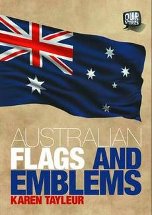
Australian flags and emblems by Karen Tayleur
Black Dog Books, 2013. ISBN 9781742031095. Pbk RRP $17.95
(Age: Primary school) Highly recommended. It seems quite a while
since there has been a new book on this topic and Karen Tayleur has
done a fine job of producing both a very useful and attractive
resource. With some introductory information on the background of
emblems, including traditional heraldic definitions and examples,
Tayleur leads the reader to a well presented explanation of the
flags associated with our country. Several pages are devoted to
official national flags - Australian national flag, Aboriginal flag
and Torres Strait Islander, with a history of each along with some
history regarding the Union Jack.
There is a pleasing uniformity to the format with a double spread
devoted to each state flag - the description and history faced with a
picture of flag, coat of arms (annotated) and fact box with
other state emblems. Each page is thoughtfully presented with white
space breaking up sections of text and illustrations.
Tayleur concludes the book with a double page spread of other
Australian flags such as the Eureka flag and Australian
Territory flags e.g. Norfolk Island, some flag protocol information
as well as a glossary and index.
All in all, a highly recommended book for primary school library
collections - superbly suited to Australian Curriculum (e.g.
History/Year 3/Historical Knowledge and Understanding/Community
Remembrance). This book could be used across year levels with
ease.
Sue Warren
Red Samurai by Tiffiny Hall
Roxy Ran series. Harper Collins, 2013. ISBN 9780732294540.
(Ages: 8-12) Recommended. Action. Adventure. In the Red Samurai, Roxy
Ran is the protagonist and narrator. She is a thirteen year old
ninja who stands up to the school bully while crushing on her
sister's ex-boyfriend. Her life mainly revolves around a ninja
fighting the samurai. When Roxy becomes the White Warrior she's
excited, nervous and scared. This isn't helped when her older sister
Elecktra starts acting strange and using unnatural powers in public.
Suddenly Elecktra is whisked off to the Cemetery of Warriors -
another world - without any warning or training. Things just get
harder and harder for Roxy as the days go on. The big showdown that
was expected comes along, ending the book with an enthralling fight.
All in all, the Red Samurai was an interesting book that I thought
was perhaps aimed at 8-12 year olds. This book really forced my
imagination to work as the sequence of events opened out in front of
me. It was really action-packed with almost every chapter including
a riveting fight scene. It was unusual in that it included battle
and combat, but also included a romantic and feminine feel to the
story. This is the second book in the trilogy by Tiffiny Hall which
meant that some things mentioned confused me, so I would recommend
reading the trilogy in order.
The Red Samurai was a thought-provoking book about teen problems
such as bullies and secret crushes. This book conveys them in a way
that's fun and suspenseful for pre-teens.
Jude Mills (student)
Kitty's war by Janet Butler
Queensland University Press, 2013. ISBN: 9780702249679.
Recommended. Biography. Memoirs. This book tells the story of Kit
McNaughton, a nurse in World War I. It describes the conditions that
nurses lived under in the pre-war years, the restrictions that
female nurses endured and their position in society. Kit was a
'country girl' and the freedom and excitement of being on a troop
ship, dining with the officers and enjoying the privilege that only
rich people could usually afford, was heady indeed. Then came
the arrival in Egypt, the experience of a change in culture and the
life of the Egyptian people. Nurses were volunteers and didn't
accept the British discipline very well. At this stage of the story
there is more mention of visiting the Pyramids and Sphinx than the
care and nursing of the wounded. Perhaps she didn't want to dwell on
this as she was still in a state of excitement of being overseas.
Later she does describe the poor facilities, the hardships the
wounded endured and the delay in getting them medical attention as
they arrived in huge numbers.
On Lemnos Island, the hospital consisted of tents. The weather was
freezing and the island was wind swept, causing the tents to
collapse. This was bad for the nurses, but much worse for the
wounded. The nurses didn't complain about the bad conditions -
limited food, clothes and accommodation - as they believed they had
to handle them, as did the troops. In addition to the abysmal
conditions, the men were also wounded. This side of the war was not
mentioned in the diaries of the nurses. As the nurses did not
hold the rank of an officer, a difficult situation emerged where the
nurses were unable to give instructions to male orderlies working
with them - despite the fact they had three years nursing experience
and the orderlies had only three months.
I have read much about the action on the front lines and the
trenches but this story has been a real eye-opener.
Kit goes by troop ship to Marseilles and on shore there was little
to do until the nurses went to a hospital to look after wounded
German prisoners. She is eventually sent north to an English
hospital where things were difficult - as the British nurses were
attached to the Military - unlike our Australian volunteers.
She is later stationed at an Australian Casualty clearing station,
where the conditions are appalling. At this point, she is writing
less of what she is doing in her diary. A lot of friends she has
made along the way are being wounded or killed. The war is taking
its toll on her health and the diary rarely mentions her nursing
duties.
We eventually read of her trip back to Australia, her arrival in
Melbourne and the subsequent parade. Her health is failing and she
is on leave until she recovers. She then works in the Caulfield
Military Hospital for a time, before going home to Werribee and
marrying a farmer.
I was especially interested at this point, as my maternal
Grandmother nursed the soldiers at this same hospital after the war.
I highly recommend this book to students of Australian war history,
of the history of Nursing, and to anyone who is interested in
Australians at war.
Bob Quinton
First book of . . . series by Isobel Thomas
First book of tractors and trucks by Isobel Thomas. Bloomsbury,
2013. ISBN 9781 4081 9292 4 First book of trains by Isobel Thomas. Bloomsbury, 2013. ISBN 978 1
4081 9291 7 First book of aircraft by Isobel Thomas. Bloomsbury, 2013. ISBN 978
1 4081 9293 4
(Age: 5-7) Recommended. Machinery. This easily held, colourful
and informative set of little books for younger readers will
introduce them to the delights of non fiction with its easy to
read and highly pictorial style of presentation. Each of the three
books I read have the same easy to use features including concise
contents and index page, and I was pleased to see on the back cover
that more are in the offing.
Using the aircraft book as a guide, each page presents an
illustration of the aircraft under discussion, with pointers showing
its features. A small amount of information is included, adding to
the boxes of information which will readily draw the eye of the
reader. The illustrations are clear, labelled and uncluttered,
allowing a child to see clearly what the machine has. Some
planes have a double page spread (cargo plane, supe jumbo,
helicopter, titlrotor and seaplane) while all the rest (25 in all)
have only one page. A glossary of words is followed by a spotter's
guide for the last few pages and then a page of useful websites to
follow up after reading the book.
The train, tractors and trucks books follow the same layout, simple,
clear and informative and the set would be a useful group of non
fiction books for the early reader. I enjoyed reading them
particularly the aircraft book, all of which was new to me, and I am
sure boys particularly will love them.
Fran Knight
Day of doom by David Baldacci
Cahills Vs Vespers series. Scholastic, 2013. ISBN
9780545298445.
(Age: 11 +) Recommended. Day of Doom is a great way to
finish the second series of Cahills vs Vespers.
Amy and Dan have recently found out that the Vespers are trying to
build a doomsday device that could destroy Earth. It is an 'all out'
chase to stop them using this device.
This book takes you on a ride of mystery, action, near misses and
reunions. I was a little disappointed with the use of so much bad
language and the excessive amount of deaths, but absolutely loved
the suspense and action.
Isaiah Low (student)
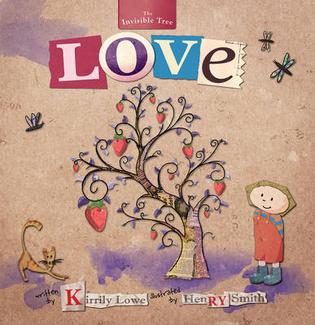
Love by Kirrily Lowe
Ill. by Henry Smith. Wombat Books, 2013. ISBN 9781 1 922074 82 9.
(Age: 3+) Picture book. Love. Part of a new series called The
Invisible Tree, at first I thought this book to be published
in the USA, as the tale is very didactic and obvious in its concern,
having the theme of love to extol to the readers. On rereading it
and looking more carefully at the illustrations, I did find things
to like about the book, and can see that it may have a place in some
classrooms where the intention is to be more forthright in teaching
virtues.
I love the recycled look of the illustrations, the pages that look
like they are made from hand made paper, the scraps used to make up
words and images, the cut outs making up the characters, all drew me
in to look at them more closely. I like the rhyming nature of the
sentences, which will draw in an audience to predict what word will
rhyme, and repeat sentences to gather the rhythm. And the list of
things which explains what love is all about through the book can be
discussed and added to by the audience, particularly in a class
where values are a focus. And the last page has a template for using
an idea in the classroom to discuss love.
Fran Knight
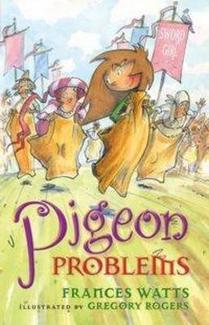
Pigeon Problems by Frances Watts
Sword girls series, bk 6. Allen and Unwin, 2013. ISBN 978 1
74331322 0.
(Age 9+) Highly recommended. In Pigeon Problems, we meet
Tommy, a young girl who wants to be a knight. Part of a series, Pigeon
problems revolves around a day of games and activities to
celebrated Lady Beatrice's birthday. There is also an underlying
story about Sir Walter's pigeon who feels unwanted and neglected
when Sir Walter fails to call on him to sing or deliver messages.
Young Tommy is Keeper of the Swords and has discovered the animals
around the castle talk. There is also a group of old swords, in her
care, who have the spirits of their previous owners inside! The
swords speak too! Sounding interesting and a bit quirky? Set in the
times of knights, I like the idea of a girl being allowed to be
non-stereotypical but caring and supported. It is a fun and quick
story with a moral and I highly recommend it for independent readers
aged 9+. I think both girls and boys will enjoy the easy to read
language and the talking swords give some good advice.
Kylie Kempster
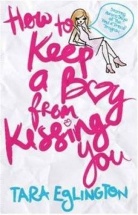
How to keep a boy from kissing you by Tara Eglington
HarperCollins Australia, 2013. ISBN 9780732295172.
(Young adults) How to keep a boy from kissing you by Tara
Eglington is a novel that turns out completely differently from a
first impression of the book. This novel is inspirational and
relatable, the target audience being young adults.
Aurora Skye is a dating guru, or she aspires to be, sweet sixteen
and never been kissed and she wants to keep it that way until she
finds her perfect prince. But her own love life is almost pushed out
of the window when a number of her friends find potential princely
partners; it's up to Aurora to play the role of Cupid. As well as
all of these romance situations, Aurora has to deal with Hayden, the
infuriating boy-next door AND family troubles at home.
In this book, the theme being romance, the story of Aurora Skye is
set in modern times. One of the best features of this book is that
you can't judge it by the cover. It has the ability to change and
influence the reader about being open-minded and positive in most
situations, (even if things look their worst) and that sometimes
accidents were meant to happen.
Aurora Skye and her friends all change throughout the novel which I
believe makes them so realistic, the author's ability to make
everything seem so real has you fooled through the book and thinking
that you were in the slightly hap-hazardous world that is the life
of Aurora Skye.
Sarah Filkin (Student)
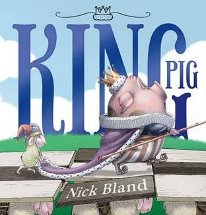
King Pig by Nick Bland
Scholastic, 2013. ISBN 9781 74283 495 5
(Age: 4+) Highly recommended. Picture book. Power. Kingship. A
salutary tilt at the misuse of power, Nick Bland's comic tale is of
a king worried about his subjects not liking him, trying different
means to gain their sympathy but failing miserably. Bland shows the
king in all his majesty, strutting around the kingdom in his rich
clothes, a small sheep holding his train. King Pig is pompous, high
handed and besotted with appearance. He has the sheep, his subjects,
clean the castle walls, he has them strap boards to their backs so
he can walk over them without getting his dainty feet dirty, he
unfurls a huge portrait of himself, but all to no avail, they simply
do not like him. Disturbed by this he invites them into his castle
and then in the most amazing contraption, dyes their coats, strips
them of their wool and has them knit him some new clothes, while he
sleeps. The next day sees him strut around in the most fantastic of
clothes, resplendent, rich and brightly coloured. But still the now
bare sheep ignore him. It is up to his little servant to point out
the error of his ways to create a neat conclusion.
This is a charming story beautifully illustrated and presented,
offering a funny tale for younger readers, a fantastic book to read
aloud, and with a theme which is universal in its application at
home and in the classroom. For younger readers being introduced to
the idea of government with its array of presentations around the
world, this book would make a great opening to the theme.
Bland's illustrations are wonderful, from the king sized word, KING,
emblazoned across the cover and title page, to the little jokes
hidden in the pages to the expressions on the faces of the sheep,
all is a delight to look at again and again. Watch out for the pig
shaped topiary and the No pigs sign above the drawbridge, the King's
feet, and the bath used at the end for dying the wool. All is
glorious. Children will not help but spy the differences between the
king's lifestyle and that of his subjects and this will engender
even more conversation amongst the readers.
Fran Knight
Stagefright by Carole Wilkinson
Black Dog Books 2013. ISBN: 9781922077585. Paperback, 289 pp. RRP:
$15.99
(Age 13+) Recommended. What a talented writer Carole Wilkinson is,
seemingly able to turn her creative hand to any genre. Not
many writers have the chance to publish their novels twice either!
This is exactly what Carole did with Stagefright - you will enjoy
the anecdote of how this came about at the end of this hugely funny
but also insightful book.
Velvet S. Pye is feeling very hard done by - with the sudden plunge
of the family fortunes from very comfortably off to pretty well
destitute, Velvet has lost everything she considers important. She's
lost her clarinet and her piano, there are no more luxury holidays,
her old friends have deserted her and worst of all she can no longer
attend St Theresa's Anglican Ladies College. Instead she is forced
to attend her local state high school Yarrabank High - which is not
only apparently full of feral students but has no music or dramatic
program of any description, all available funding being poured into
the school's sporting program. For a girl who despises sport,
landing in the middle of a school renowned for its sporting prowess,
headed up by a sports mad Principal Kislinski, there could be no
worse fate.
Bringing all her energy to finding a way to get out of sport, Velvet
finally convinces Mr Kislinski that she is completely and utterly
without any aptitude for any kind of physical activity and is off
the hook. Her delight with her success is short-lived however, when
she finds the alternative for the very few non-sporting students is
a Cultural Studies class, populated by a small but particularly
bizarre group of misfits the like of which she has never before
encountered, including jaded teacher Mr MacDonald.
No doubt motivated by his annoyance with this bunch of no-hopers, Mr
Kislinski charges the group with living up to the Cultural Studies
title and 'giving back to the school' by producing a performance for
the school's anniversary celebrations. With no budget, zero
motivation and apparently few skills, the Cultural Studies
group surprise themselves bonding into a supportive team of friends
with a modicum of various talents, in the process turning
Shakespeare's Richard the Third into a rock musical.
A continuing thread of hilarity runs through this novel and I found
myself laughing out loud on several occasions, but underlying the
humour is a strong message about what is most valuable in one's
life, not judging on appearances and tolerance. Carole
Wilkinson suggests it is possible that there will be another
Yarrabank High novel and I for one will look forward to encountering
the students and staff again.
Recommended for readers 13 +, it would work well as read
aloud for both boys and girls though I think boys might be put off
by the rather 'girly' looking cover.
Sue Warren
In too deep by Tom Avery
Frances Lincoln, 2013. ISBN 978 1 84780 389 4.
(Age: 12+) Highly recommended. In Too Deep is the story of two brothers, Emmanuel and Prince, from the Democratic Republic of Congo. They are currently alone, living in foster care and in England. It is part 2 in the story and even though we don't know how they were separated from their family, the story gives hints and thoughts to help you understand.
Imagine the brother's surprise when their mother turns up with a new baby sister and no idea where their father is! Life changes quickly for Emmanuel and Prince as they move in with their mum and get to know her again. For Prince, there is one question he needs an answer to - where is their dad?
A heart-felt story of a young boy who tries to be happy but can't, of a father who will do anything for his family. I would highly recommend this to independent readers aged 12+ as it switches between what is happening in Tanzania (with the father), England (with the boys) and the past. The story is quite grown up and despite being set in England; it is still relevant to young Australian readers as they befriend refugees from across Africa. Some of the events in the story seem quite impossible but it is those moments that keep you wanting to read more.
Kylie Kempster
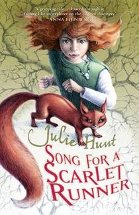
Song for a Scarlet Runner by Julie Hunt
Allen and Unwin, 2013. ISBN 9781743313589.
(Age 9-12) Julie Hunt, author of CBCA shortlisted Picture Book The
Coat has written about survival and loyalty, superstition and
the value of friendship set in a bleak and unwelcoming landscape. It
will take a mature 9-12 year old reader fond of the fantasy genre to
appreciate the whole story.
Nine year old Peat, red haired with one green and one brown eye
lives with her sister Maisie at the Overhang tending cows and making
cheese. They were banished to this lonely, desolate place 4 days
walk from the nearest village due to Peat's appearance.
When a travelling stranger brings disease to the village Peat is
blamed and just escapes the mob. Alone and knowing she cannot return
to the Overhang Peat travels towards the marshes at the opposite end
of the valley. She is accompanied in her adventures by an animal she
calls a 'sleek' which will scratch and steal her food one moment and
save her life the next.
In the marshes she is captured by Eadie one of the magical 'marsh
aunties' who takes Peat on as an apprentice and teaches her how to
tell stories particularly the one about the Siltman. Peat is taken
by the mysterious and Siltman and his hounds during a storytelling
at the Hub and needs to escape again with the help of the sleek, a
nine hundred year old boy and a ghost hound.
There is much to like about the characters especially the
independent and optimistic Peat and the sleek which is so human in
its reactions. Siltboy with his stilted speech and bravado and even
Eadie, despite her betrayal of Peat, elicits sympathy at the end.
The story moves along at a good pace with twists and turns a plenty
as Peat seems to move from one perilous situation to the next and
one hopes the sleek will turn up like the cavalry, just in time.
However it is the Siltman's kingdom across the Silver River, 'the
Ever' as Siltboy calls it' which keeps me thinking and poses the
most questions.
Sue Keane