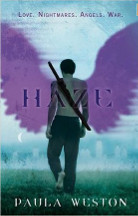
Rephaim series bk 2. Text, 2013. ISBN 9781922079923.
(Age: 15+) Recommended. The second in the Rephaim series sees Gaby
Winters beginning to come to terms with the fact that she is one of
the Rephaim, the wingless half-angels who have supernatural powers.
She still can't remember the life that she once had as the Rephaim's
best fighter and she is desperate to believe that her twin brother
Jude, might be alive. And then there's Rafa, who was the one who
came looking for her and changed her quiet life in a seaside town.
This series is one of the better ones that focus on angels and is
sure to delight readers who enjoy this genre. I thoroughly enjoyed
it because like the first in the series, Shadows,
it was a combination of exciting action and character development.
Gaby is a feisty heroine who although she cannot remember her past
life, begins to act as the leader that she is. Maggie is a great
best friend, and the romance between Rafa and Gaby is fraught with
complications that add to the tension. The action and fight scenes
were thrilling and the mystery surrounding Jude and Gaby continues
to confound.
What makes it a standout read in this genre is the clever writing,
with witty dialogue and a believable cast of characters. It is not a
slow middle book in a series but certainly packs a punch with its
action packed scenes, sword fighting and tension surrounding the
twins.
Pat Pledger
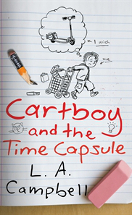
Cartboy and the time capsule by L.A. Campbell
Allen and Unwin, 2013. ISBN: 9781743314807.
Recommended. Cartboy is another tribute to the success of the Wimpy
Kid style of books though with less drawings and more text.
Hal Rifkind is in year 6 with simple needs, a room of his own, the
key to reaching level 14 on the best videogame ever, RavenCave,
which he plays with his best friend Arnie and an easy year at
school.
Not only does he have to share a bedroom with his twin baby sisters,
but he has an aversion to History and his father will only entertain
moving his home office to the shed, enabling Hal to have his own
room, when his grades in history improve . . . . . dramatically.
Mr Tupkin the history teacher sets a yearlong assignment, to write a
journal to someone living in the future telling them about life
today which will be placed in a time capsule to be opened in 2500.
The book is Hal's journal complete with greetings like 'Dear
Alien/Person/Possible Humanoid/Robot:' drawings and pictures with
funny captions, and some highly amusing and inventive timelines.
Hal has other problems not least of which is the shopping cart he
uses to take his books to school in, resulting in his new nickname
favoured by the school bullies and his mother's aim to save the
planet through recycling meaning Hal wears ill fitting
hand-me-downs. The looming school dance, Arnie's apparent betrayal
and even worse history results are all documented as entries in his
journal.
This book will be popular especially I expect with boys who will be
able to relate to Hal's trials and tribulations with family and
friends and enjoy his funny attempts to solve his problems with a
minimum of effort on his part.
Sue Keane
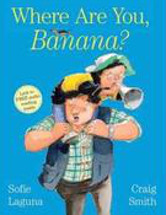
Where are you, Banana? by Sofie Laguna
Ill. by Craig Smith. Allen and Unwin, 2013. ISBN 978 1 74331 053 3.
(Age: 4+) Highly recommended. Picture book. Animals. Family. Lost.
Banana the dog has been with the family since Roddy could first
speak. On sighting this brown and black long thin dog, his first
word was banana, so that is what he was called. He is part of the
family, sleeping on Roddy's bed at night, chewing the twins' rug and
Mum's shoes and Dad's helmet, crooning in the yard if left outside,
and on this particular day, escaping though a hole in the fence,
after being left at home alone. After all, Aunt Celia does not like
having Banana at her house so he must miss out on her bbq and
especially her chooks.
When the family arrives home, they search everywhere, but cannot
find their pooch. During the night, Roddy cannot sleep thinking
about his dog, so dons his clothes, takes the torch and searches the
streets. Following the sound of Banana leads him to the distressed
animal, stuck down a hole dug by maintenance workers. He rushes back
home for help, gathering some equipment which may help drag out the
hapless dog, and even the neighbours lend a hand.
This happy, family centred story is a quiet and subtle
exposure of the household and how it works together, given greater
resonance through Smith's drawings, adding detail to the spare,
evocative text. The watercolour illustrations are deftly done with
differing perspectives of the family given. Craig Smith captures
this significant and emotive event within the family with seeming
ease, but the details reflect incredible skill. The looks on all the
faces, particularly Banana's, will captivate a large audience as
this book is shared, read aloud or borrowed to take home.
Fran Knight
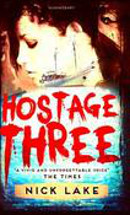
Hostage Three by Nick Lake
Bloomsbury, 2013 ISBN: 9 781408 838372.
(Age: 15+) Highly recommended. Hostage Three is an atmospheric novel
told in first person and recounting a series of events which led to
the capture of the yacht The Daisy May by Somali pirates and the
tedious negotiations which followed. Amy is the narrator of this
compelling story which begins in London on the morning of Amy's
final exam, she is trying to get her father's attention by rebelling
against the school rules. She arrives with piercings and leaves with
a lit cigarette; her rebellion has cost her what would otherwise
have been a successfully completed final year. In response to this
her father, who is never home, has The Stepmother tell Amy about his
plan to sail around the world. Dismissing the plan Amy is shocked to
learn that the plan is actually going to happen, her father had
bought a yacht and they were leaving the following week. The family
spend the next few weeks on board The Daisy May until they are
assaulted by Somali parasites. Unable to reach help the crew
surrender and are held hostage in Eyl until the yacht's owner can
pay the ransom. The pirates refer to the hostages by number to avoid
familiarity but something goes wrong when the youngest pirate begins
to spend time with Amy. It is a forbidden love on both sides. The
couple must keep their love a secret until Farouz can free himself
and his brother from the terrors of their Somali lives.
I highly recommend it for mature audiences aged fifteen and up
as it makes the reader reflect on how lucky they are to have a life
where hunger is not a daily battle. At first I was wary of this
novel, without speech marks and chapter-less, written in a similar
way to Tim Winton's work, but Nick Lake makes his writing flow
despite the his unusual choice in writing style. This
beautifully crafted novel is a gem just waiting to be discovered and
I can't help but re-iterate the Daily Mail's conviction, Hostage
Three is unputdownable! I look forward to reading more of Nick
Lake's work.
Kayla Gaskell (Student, age 17)
The keeper by Rosanne Hawke
University of Queensland Press, 2013. ISBN 9780702249730.
'Gran used to watch me like a one-legged gull at a picnic' is one of
the brilliant expressions from The keeper. Set in a small
seaside town on the Yorke Peninsula, this marvellous story centres
upon Joel, a young boy without parents who lives with a loving
Grandmother. Having a learning disability and a tendency to respond
to taunting bullies with his fists, Joel is frequently in trouble at
school and is frustrated and angry, except when fishing or playing
with his friend Mei, the daughter of a local fisherman.
Fed up with not having a Dad, Joel places an advert in the newspaper
to offer the position and is impressed when tough looking biker Dev
arrives on a Harley to try out for the job. The pair establish a
friendship with shared experiences, conversation and intuitive
understanding which is developed by the opportunity to compete in
the annual fishing competition, a chance previously denied to the
fatherless Joel.
This is a genuinely enjoyable novel and wholesome but realistic life
lessons are delivered within a captivating story and polished
narrative. Hawke presents a flawed individual with a shady past who
has learned from his mistakes and seeks to teach a youngster to
avoid conflict and violence. The author is to be commended for
including such a character whilst avoiding gushing sentimentality or
diminishing the threatening nature of bikies, drugs and crime.
The basis of the relationship may be implausible to adults,
especially in the context of stranger danger and child protection,
however the story's development feels natural, especially given
Joel's loner behaviour and tendency to keep quiet about what he gets
up to.
The arrival of other significant characters from the past could be
considered too contrived, however the story works satisfactorily
towards an acceptable conclusion.
Written for children of 9 years onwards, Primary school librarians
can be confident that the content and language is age appropriate.
This story also serves the needs of older struggling readers who
require less demanding text but still enjoy well-crafted narrative
with a solid plot.
Rob Welsh
The Perplexing Pineapple by Ursula Dubosarsky
The Cryptic Casebook of Coco Carlomagno and Alberta series. Allen
and Unwin, 2013. ISBN 9781743312575.
(Age: 9+) A strange pineapple floats by at the same time everyday
followed by a scream and then laughing. That's enough to scare
anyone! When the Chief of the Buenos Aires police is scared who does
he call? He calls his very smart cousin, Alberta, because she has a
very big brain.
Alberta and Coco (the Chief of police) are guinea pigs by the way
and their story is a quick paced, easy read for independent readers
aged 9+. It is especially good for those readers who don't like
large novels and as part of a series, children can follow these
guinea pig cousins as they crack more mysteries.
As Alberta and Coco get to the bottom of the strange pineapple, Coco
ends up solving another police issue. Maybe he is not that silly
after all.
The book includes illustrations to help solve the mystery and it
asks the reader questions along the way, helping involve them in the
mystery.
Kylie Kempster
The first third by Will Kostakis
Penguin, 2013. ISBN 9780143568179.
Billy Tsiolkas loves his Yiayia (Grandmother) openly, without
embarrassment and he endures her ethnic idiosyncrasies with good
humour and respect. In his final year at school, with two estranged
brothers and a mother who is saddened by her single status, Billy
becomes fearful when Yiayia is hospitalised by complications from a
kidney stone. The elderly woman clearly has a major influence in
family affairs and Billy dares not decline when she submits to him a
'bucket list' or series of wishes to be granted before she dies.
Accompanied by an amusing best friend 'Sticks' who has cerebral
palsy, Billy sets forth to try to bring about three seemingly
impossible feats which Yiayia considers will fix his family. This
story is all about relationships including friendships, familial
interactions and romantic involvement. Sticks inveigles his way into
Billy's negotiation of all three and shows a curious mix of
compassion and kindness with a merciless attitude to dropping Billy
in embarrassing situations.
This is a realistic portrayal of adolescent life and I liked the
fact that everyday situations encountered commonly in families were
presented in an entertaining manner and were completely adequate in
framing the narrative.
The novel still has quirks however. Items on the bucket list include
'fixing' Peter, the aggressive, truculent younger brother with whom
Billy no longer has any communication beyond grunts, and finding a
girlfriend for the eldest brother Simon who lives interstate. The
rift with Peter troubles Billy greatly and he agonises over its
causes as he seeks to reconcile differences and restore the
relationship, yet the reader never discovers why and how this has
come about. Similarly, the amusing twist in finding Simon a
girlfriend, given that he is gay (known by the family but an alien
concept to Yiayia) becomes secondary in Billy's difficulty to fulfil
this promise when he discovers a facade which is never explored in
any depth.
The characters represented in this novel are familiar in an
Australian context and the reader is caught up in Billy's quest to
ease their pain and strengthen the bonds within his own family as
its members negotiate the ups and downs of contemporary life.
Rob Welsh
Let's paint by Alborozo
Allen and Unwin, 2013. ISBN 9781743313695.
(Age: 3+) Picture book. Art. Experimenting. This joyous colour
filled book that will encourage and delight young readers to try
something for themselves will be a hit amongst parents and early
childhood teachers alike.
From the different coloured dog prints on the front endpapers
through all the different experiments with paints and paint brushes
and canvasses through to the endpapers showing coloured human foot
prints, the book encourages children to try their hand at painting.
Faced with a blank canvas and a handful of paint, the question is
what if I make a mistake. The answer that there are no mistakes in art
can be very salutary to the young beginner. Then ideas crowd in as
the reader is told that ideas come from anywhere, they can be big or
small, uninvited or collected. From there the reader is shown a
variety of different methods with some pages hinting at the artist
who used this technique. The author then shows the reader that it
can be scary or embarrassing, but whatever, it is important that the
painter has fun!
The lightly sketched illustrations do not overwhelm, the colour is
filled with fun and interest, inviting the reader to run out and get
some paint and get painting.
Fran Knight
Doomsday by Chris Morphew
Phoenix Files Book 6, Hardie Grant Egmont, 2013. ISBN
9781921502446.
(Age: 12+) Recommended. Doomsday picks up with less than
twenty-four hours until the end of civilisation as we know it. With
Luke and Jordan desperately fighting to rescue humanity from the
dire plans of the Shackleton corporation, it seems they have more
enemies than ever before, with even Peter being out of control and
seemingly about to destroy them. As war rages, they battle against
the clock to put an end to the plans of their enemies. Who or what
is Tobias and will he have the power to put things to rights?
This is one series which seems to appeal to girls and boys alike,
despite its violence, bloodshed and the traumas faced by the
population of Phoenix. Initially, it is only the children who are
aware that something is seriously amiss within the confines of the
town but slowly the adults come to realise that things are not as
they should be. From book one in which the town reminded me of a
children's version of The Stepford Wives to the final resolution,
the action and excitement keep one on the edge of one's seat. The
appeal of having a different narrator for each of the earlier books
adds to the gender balance, helping to make the books accessible to
all readers. Changing the narrator chapter by chapter in the final
title gives one a multitude of different perspectives throughout
Doomsday, thereby keeping the reader informed as to how each group
of characters is feeling and how they are being occupied.
Personally, I felt reasonably satisfied by this final instalment,
despite having had to suspend disbelief totally. Most of the loose
ends were tied up sufficiently and I continued to be intrigued by
the characters that underwent major changes toward the end of the
series. I found the ultimate battle between good and evil to be
powerful and engaging. Not a read for the fainthearted, however!
Jo Schenkel
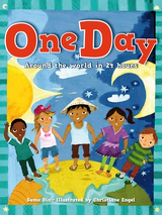
One day: Around the world in 24 hours by Suma Din
Ill. by Christina Engel. Bloomsbury, 2013. ISBN 9781408180235.
(Age: 6+) Picture book. Time. World travel. In one day, fifteen
different children around the world are shown in their own houses,
schools and towns. Each page reflects their variety and their
similarities as twenty four hours passes. Starting with a double
page map of the world and the faces and places of the fifteen
children, the book map is divided into the time zones of the world,
allowing some discussion before reading about the children. Using
the twentyfour hour clock will also teach the readers a different
way of telling the time.
Each double page thereafter contains one large page of illustrations
alongside four smaller illustrations. Each of the five illustrates
one child in one country and what they are doing. So each is
occurring at the same time around the world, but in different times
zones. So a child at school in the United Kingdom, playing soccer at
11 will be doing this at the same time as a child in the USA is
eating breakfast, but there it is 8 in the morning, while in South
Africa children are just going home from school, and India they are
having dinner and in China, going to bed. Pages are crowded with
images of children doing different things around the world, and can
be a springboard for all sorts of discussion about similarities and
differences, but above all about time. Two pages at the end give
information about time zones, Greenwich Mean Time and Universal
Coordinated Time.
Fran Knight
The whole of my world by Nicole Hayes
Woolshed Press, 2013. ISBN 9781742758602.
(Age: 15+) Highly recommended. Shelley Brown is hoping for a fresh
start; a new school brings the possibility of new friends and new
interests, the possibility of a new life. Since the loss of her
mother, Shelley and her dad are drawing a line between the past and
the present, so Shelley jumps at the chance to attend footy training
with her new friend, Tara. After all, football has always been
Shelley's passion especially her beloved Glenthorn Football Club.
Attending Thursday night training also gives Shelley a chance to
befriend the new player, Mick Edwards. They have a lot in common: he
is new to the club and is trying to put together a good season to
keep his future in football alive. Shelley is the newbie in the
Cheer Squad, trying to put together a new future
Shelley and Tara are obsessed by their footy team and this novel is
cleverly structured to reflect this passion: every chapter and
section references the game, from 'The Draft' to the 'Pre-Season' to
'The end-of-season Trip'. Author Nicole Hayes has also cleverly
structured the plot development. Whilst most readers will accept
Shelley's lingering grief at losing her mother, midway through the
novel the full story behind Shelley's loss is revealed in a manner
which will make readers empathise with the deep pain behind her
journey of rebirth.
In a sports mad country like Australia it is always intriguing to
shine a light on that obsession and Nicole Hayes does this
thoughtfully, as her novel explores the importance of football in so
many fans' lives: the euphoria when their team wins, the despair
when they lose and the relationship they have with the players
themselves.
However, this is more than just a football yarn; set against the
football background is a bigger story about grief and loss, about
family ties and family breakdown, of burgeoning love and the
resilience needed not only to face another football season but also
to face life's many ups and downs. Even those who don't love
football will find a lot to enjoy in Shelley Brown's world.
Deborah Marshall
The Cloud Road by Isobelle Carmody
Penguin Books, 2013. ISBN 9780075188. 289p
Well recommended for young readers. The Cloud Road is the
second in The Kingdom of the Lost series. Written for
younger readers, this fantasy-adventure takes Bily and Zluty and
Redwing their navigating bird away from their home after the
'arosh', a storm of red stones destroyed their home and all around
them. That strange storm had brought Monster into their cellar. It
was half dead, an 'enormous beast (with) long, deadly, claw-tipped
paws and a red maw full of teeth as long and sharp as daggers' p6.
They placed the Monster in the wagon and set off to find water,
which the Monster said would be beyond the desert they needed to
cross.
Carmody entices the young reader to wonder what the 'arosh',
'whiteout', 'the Makers', the 'Monks' and the 'diggers' might really
be. Perhaps there's a lesson for everyone when Bily says, 'Now I
think we must live by the rules of the places we come to' p143.
It's an intriguing tale of brotherly love, friendship and trust with
good triumphing almost over evil. That's left to book three. Her use
of descriptive and unusual language formations enriches the fantasy.
Carmody encourages her readers to think about the visual images and
to use the language that inspires. As adults we might use snow but
here they are 'coldwhites'. Readers will be keen to read The
Velvet City.
Sue Nosworthy
Life after theft by Aprilynne Pike
HarperCollins, 2013. ISBN 9780007515561.
(Age: 14+) Recommended as an easy to read, light story. Ghosts.
Theft. Romance. How would you feel if you came face to face with a
ghost? That's the dilemma that faces, Jeff, who is confronted by
Kimberlee Schaffer, who dropped dead the previous year. She has come
back to haunt him because she needs his help with her unfinished
business. In real life Kimberlee may have been gorgeous and popular,
but she was a kleptomaniac and she wants Jeff to help her return all
the things that she stole.
I enjoyed this story that was told from the point of view of Jeff,
who was a positive male voice. He doesn't want to be haunted by
Kimberlee so he agrees to help her, especially when she tells him
that the things that she stole had real value for the people
concerned. Faced with the huge hoard of stolen goods that Kimberlee
has secreted in a cave on her parent's property, Jeff has to come up
with some innovative ways of getting stuff back to its original
owners and this propels the plot forward in often amusing ways.
The character development is great and we see Kimberlee grow from a
selfish teen, albeit a ghost, to a girl who can see other points of
view. Jeff is believable as the boy who helps her out and his
growing romance with Sera, who is the girl Kimberlee has really
hurt, adds some tension to the plot.
This is a fun read that will appeal to girls in particular and will
have the added bonus of some dark moments as the reader ponders why
Kimberlee has stolen so much and whether she will be able to
understand her actions enough to stop haunting Jeff.
Pat Pledger
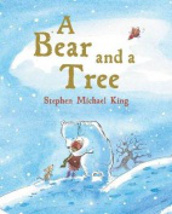
A bear and a tree by Stephen Michael King
Penguin, 2012. ISBN 9780670075829.
(Age: 4+) Warmly recommended. Picture book. Friendship. Change. When
Ren is upset that her loved tree has lost all of its leaves, Bear
stops collecting the leaves for his den for the winter, and sits
with her until she is calmer. They then spend the day together, Bear
answering Ren's questions about the snow as best as he can. They
play together in the snow, looking at the patterns in the snow, the
icicles and simply dancing. They meet Mouse who is waiting for the
night so that he can catch the first winter stars. They spend the
night watching the stars, and when morning comes, Bear realises that
he must sleep. He attaches some of the leaves he has collected to
the tree, adding some of the things they have made together and goes
to his den to sleep.
A tale of friendship and change, this story is seemingly simple, but
has many layers to reveal as it is read and reread. The idea of
change permeates the book, from the leafless tree, to Bear needing
to sleep, so leaving his friend, to the change in the patterning of
the sky, to the increasingly cold landscape. The blue and white of
the pages, the lack of leaves on all the trees, the change from
rainy landscape to one covered in snow, all point to the fact that
Bear must soon retire to bed.
For parents and teachers simply looking at weather patterns and
seasonal changes then this is a wonderful introduction, and for
those wanting to look at friendship and change, then this book will
provide a masterful springboard.
Fran Knight
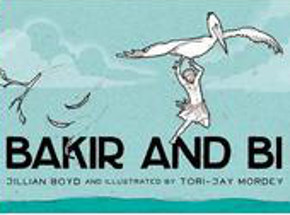
Bakir and Bi by Jillian Boyd
Ill. by Tori-Jay Mordey. Magabala Books, 2013. ISBN 9781921248863.
I read this
book from a teaching point of view, and found it useful for
comparing Aboriginal and non-Aboriginal cultures. For example:
attitudes towards conservation and drought, interpretation of
dreams, beliefs. It could be used for some topics in Aboriginal
studies in the middle primary, such as the traditional use of
resources and the naming of children and places. I think it
would also be good for use in discussions about relationships, such
as what causes good friends/family to become estranged and sometime
enemies.
Rhoda Jenkin