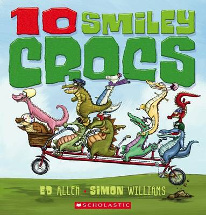
Scholastic, 2014. ISBN 9781742836355. 10 Smiley Crocs incorporates rhyme, counting and great illustrations
to engage readers of all ages. Sing along to the tune of 10 Green
Bottle as children count backwards from 10. Young children will
enjoy counting the crocs on each page and discussing the rhyming
words.
It would be a great book for developing observation skills and
memory skills. It will be a good read out loud book and older
children could use it as a model to create their own number rhymes.
Kylie Kempster
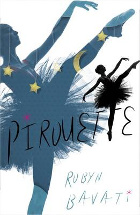
Pirouette by Robyn Bavati
Penguin Books, 2014. ISBN 9780143569374.
Well recommended for Middle secondary. A fascinating insight into
the world of twins, one who loves ballet and wants to dance as a
career, the other, a beautifully talented ballet dancer who doesn't
want to dance but has a prestigious place at a dance academy. Simone
and Hannah were born in Brazil where their parents died in a car
crash. Their Mother danced with the Paris Opera and thanks to a
caring nurse, who couldn't bear to see them separated over
continents swapped one baby and so they were both adopted and sent
to Australia. There they lead very different lives and when they
finally meet by chance at 'Candance' for a holiday ballet school
they agree to swap roles. Complications arise as they both like
different boys who find their behaviour unsettling and confusing.
The teachers too, observe the differences but stay silent to the
girls. The dialogue between the girls is intimate and well- drawn.
They send away for their DNA and are delighted to find the positive
result. Their individual characters are very different but also very
engaging. The final outcome is cleverly contrived and very happily
resolved. The final chapter brings the story to a complete
conclusion back in Brazil. It's a very engaging novel with family
relationships strong and supportive. A delightful book for those who
love ballet and developing relationships with boys, family and
friends. Ballet terms are used throughout so there is an
authenticity about the text.
Sue Nosworthy
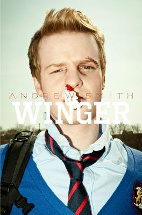
Winger by Andrew Smith
Simon & Schuster, 2013. ISBN: 9781442444928. Winger is the most honest and raw book I have read in a while. Set
in an elite boarding school, the novel takes the reader inside the
mind of a teenage boy, (which is undoubtedly a scary place to be,)
but does so with an honesty and vulnerability that is absolutely
endearing.
Ryan Dean West is intelligent, young for his grade, part of the
rugby team, and stuck in 'Opportunity Hall,' the residence of boys
who are being punished for various school misdemeanours. He's also
in love with his best friend Annie. Winger is written as a running commentary of Ryan Dean's life; his
thoughts, his insecurities, his fantasies and his battle to find his
identity, manhood and self-respect in the chaotic and tumultuous
time that is adolescence and high school.
The novel is written in very colloquial style, with copious run-on
sentences, intermittent drawings and cartoons and language that
makes us privy to Ryan Dean's innermost thoughts. It's an easy read,
without being simplistic. As a character Ryan Dean (Winger) West is
multi-faceted, honest and very well constructed. It is unlikely that
there would be any young man who could not find some common ground
with him.
Chapters are short, but powerful. I found the first quarter a bit
slow, but it soon picked up pace, and by the end I couldn't put it
down. The novel deals with love, identity, bullying, sexuality and
relationships, and works to expose the honest truth that even the
toughest and most popular people have their inner insecurities.
The plot is engaging and often surprising, and puts the reader
through a full range of emotions from laughter, to grief,
understanding to disbelief.
While I was disappointed with the frequency of coarse language and
sexual/fantasy references, this may well be the type of book that
could change a young man's life, offering him hope, guidance and the
sense that he is not alone in his struggles. I would recommend this,
in particular, for boys who are struggling with various aspects of
life and also those who are struggling to engage with other novels.
Sarah Rose
Editor's note: Winger was on Publisher Weekly Best Books 2013 and YALSA Top Ten
Best Fiction for Young Adults 2014
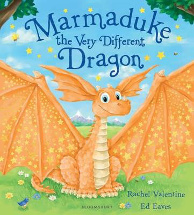
Marmaduke the very different dragon by Rachel Valentine
Ill. by Ed Eaves. Bloomsbury, 2014. ISBN 9781408836781.
(Age: 6+) Dragons, Humour, Difference, Being yourself, Friendship.
Marmaduke with his orange body and sticky out scales is very
different from the smooth skinned, purple dragons usually seen in
the kingdom where every princess has a dragon as a minder. Marmaduke
longs for a princess of his own, but is rejected because he will not
open his wings to fly.
But far away a row of pretty princesses, all with neat hair and
pretty dresses, sitting tidily, look upon Princess Meg with some
disdain. She is so different, hair a mess, clothes dirty, and
certainly not attuned to sitting neatly. None of the dragons want
to protect her, but not minding a bit she goes into the forest where
she runs into the sad dragon, Marmaduke. They join forces, Marmaduke
finally having to open and show his wings to fly her home.
A neat resolution brings both their problems to an ending suitable
for both who wish to remain different and be themselves, not what
the others want them to be. In a classroom, this book will not only
serve as a humorous book to read aloud, but could be the springboard
to discussions about being yourself.
Fran Knight
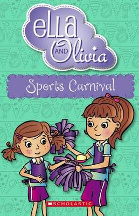
Sports Carnival by Yvette Poshoglian
Ill. by Danielle McDonald. Ella and Olivia series.
Scholastic Australia, 2014. ISBN 9781743620526.
(Age: 5-7) Sports Carnival is the latest addition to the
growing list of titles in the Ella and Olivia series which
is squarely aimed at 5-7 year old girls moving into chapter books
and independent reading. The larger font and short simple sentences
support the reader whilst the line drawings and embellishments as
well as the lacy page borders add interest to and break up the
written text. Sports Carnival centres on that yearly school event, Sports
Day. The winning team will spend a day at Slip and Slide Water Park
so sisters Ella and Olivia are in training to be sports champions.
The whole family, including the dog join in by supporting the purple
team and training with the girls after school.
The Saturday of the Sports Carnival arrives with the school oval
awash with streamers, banners and stalls, running tracks and a
winner's podium all set up. They all participate in different events
contributing to the team score but the final event of the day, the
Tug-of-war will decide the winning team.
In a departure from the expected happy ending, the purple team comes
second so there is disappointment and no trip to the Water Park for
Ella and Olivia. Dad, however, comes up with a clever plan and the
family enjoy their own day of fun.
This book could serve as a way to introduce juniors to a tabloid
sports day and the concept that you do not have to win to enjoy a
reward for effort.
Sue Keane
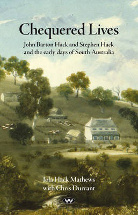
Chequered Lives by Iola Hack Mathews with Chris Durrant
Wakefield Press, 2013. ISBN 9781743052587.
(Age: Adult - Senior secondary) Recommended reading. Chequered
Lives is the engrossing biography of a pioneer Quaker family
from England, who arrived in South Australia in 1837. Specifically,
it tells the tale of John Barton Hack, his younger brother Stephen
Hack and John Barton's wife Bbe Hack. However, it also tells some of
the story of the Society of Friends (the Quakers) and of early South
Australia. As such it's worth noting that the National Library of
Australia has catalogued this book in South Australian history.
On arrival the Hack family quickly erected a small cottage by the
lagoons at Glenelg beach before the city of Adelaide was created.
Over time and from this simple beginning John Barton became a
merchant who owned a 3000 acre estate in the Adelaide Hills, as well
as ships, a whaling station and the first vineyard in South
Australia. Stephen became a grazier and explorer. He was the first
person to overland cattle from New South Wales to South Australia.
Their business and grazing interests had many ups and downs and the
title of this book Chequered lives represents these times very well.
The author, Iola Hack Mathews is John Barton's great,
great-granddaughter. Much research has gone into uncovering her
family's beginnings in South Australia. I particularly enjoyed the
accounts of the development of Quakerism in England and South
Australia, of which I knew very little.
This book is finely written with great detail but also lightly
written in a style that is easy to read eg "Nick Vine Hall, the
Australian genealogist, said that after sex, the number one area of
research on the Internet was genealogy, 'and oddly enough the two
are sort of related.' " p.8
Included are Sponsors and Acknowledgements with a clear explanation
of the painstaking research process and in particular the use of
primary sources; and a lengthy Introduction.
At the end of this history/biography is an Appendix with details of
John Barton's 8 sons (his 6 daughters all died young) including Iola
Hack Mathews' great-grandfather Theodore Hack and details of
Stephen's 2 surviving children (his daughter died in infancy); Notes
(chapter by chapter); and a comprehensive Index.
There are also photographs, artworks, a family tree, maps and
diagrams.
The predominant audience for this book is adult, but it would be
useful for Senior secondary students of Australian History and
Religion Studies, as well as for Research Projects investigating
genealogy topics.
Margaret Strickland
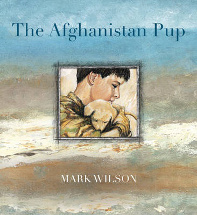
The Afghanistan pup by Mark Wilson
Lothian, 2014. ISBN 9780734415325.
(Age: 8+) Highly recommended. Picture book, Afghanistan, Animals.
When the pup is born in Afghanistan, it has no control over its
welfare, so one day when its mother goes out in search of food, she
never returns. The pup and his siblings must fend for themselves in
this city under siege. Luckily for him a young girl finds him,
emaciated and weak, and takes him home. She cares for him, leaving
him in the corner of her room when she goes to school. One day she
takes him too, and insurgents bomb the school, leaving the pup alone
again. An Australian soldier helping to rebuild the school finds the
pup and takes him home, caring for him. The pup goes with him as he
works, but one day when the soldier goes out to battle, he does not
return. The pup goes back to the school and is reunited with the
girl.
This is a moving tribute to the strength and courage of the children
of Afghanistan as they struggle on to school, despite the war which
surrounds them. Girls particularly are not encouraged to be educated
and so it is common for schools to be bombed, and sometimes the
girls beaten or shot.
In this story we see the plight of the children at the school,
desperate to receive an education despite what happens to them, the
girl returning to the school when it is rebuilt by the Australians
after she is released from hospital. The pup neatly connects the
two, the brave girl and the courageous soldier, both fighting
against ignorance.
Wilson's illustrations magnify the spare story, adding texture and
layers with his line drawings, water colour images and copies of
newspaper articles. The multi-media approach which has worked so
well with his other books, Vietnam Diary, My Mother's
eyes and Angel of Kokoda, works again, giving the
younger reader a glimpse into the lives of children in Afghanistan,
a little of the various work expected of soldiers, and the struggle
they all have to stay alive.
Fran Knight
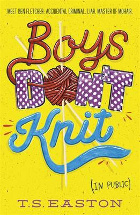
Boys don't knit by Tom Easton
Hot Key Books, 2014. ISBN 9781471401473.
Highly recommended for early adolescents. This is an unexpected,
(considering the title) quirky and cleverly contrived novel set in
Ben's last year of secondary school in England. The inauspicious
title draws the reader's curiosity for knitting is not commonly
connected to boys. Written from Ben's viewpoint, his adolescent
worries about girls, acceptability from mates, a crush on his
English teacher and bullying are threaded through the storyline.
Initially forced to do community service after a confrontation with
a lollipop lady, (school crossing lady) Ben lands in the knitting
class thinking that Miss Swallow (on whom he has a crush ) was
taking the class. But he had that wrong. And so began a weekly saga
of knitting lessons. Ben found he actually enjoyed creating patterns
while talking to the rest of the group. Except for his Dad. How
could he tell him when he was a staunch Chelsea soccer fan? Mum is a
stage magician and travels but agrees to keep Ben's knitting a
secret from Dad. So, what with his mates making clever puns on
knitting, 'she certainly stitched you up' p228, he knits a sweater
for Miss Swallow's soccer star boyfriend, wins the local then state
championship amidst the bullying boys from his class who try to
sabotage the meet. Dad and Mum turn up as well as the lollypop lady
whom Ben has befriended.
Humour flows through the story with a young person's frustrations
ever present. This is a wonderful example of turning adversity into
a happy and positive experience along with lots of laughs and
chuckles. The language is vibrant and expressive, belonging to a
young person but with a maturity all can relate to. A most enjoyable
read.
Sue Nosworthy
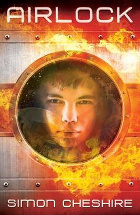
Airlock by Simon Cheshire
A&C Black, 2014. ISBN 9781408196878.
Recommended for Upper Primary, easy read for lower secondary. Short
and pithy, this futuristic novel sees four students and their
teacher Mr Snodbury, land on 'Berners-Lee' orbital Platform in a
shuttle, in space. 'George and his friends were going to stay on the
station for a week. This had been their reward for getting the best
results in their year's science class'. p.13. George, Amira, Josh
and Dwayne, (a troublesome classmate) are all year 6 students. They
are shown around by two technicians. There are rivalries between the
two companies manning the station. The children were wearing logos
from the opposition and when the Commander sees this, he is incensed
and orders the children away. But George notices an unusual problem.
Chaos reigns and the culprit who causes the massive damage is the
teacher, lured by money! The shuttle hurtles to earth with the
probability that they will burn up. But, the children work out a
solution.
There are many technical terms which would appeal to young readers
and perhaps they dream of doing what this group have done, without
the disaster! A short read for young readers wanting to think about
space travel and what it entails. The text is well spaced and not
very long. George, Amira and Josh are well drawn and believable but
the teacher, sadly, rather poorly portrayed and the bully Dwayne no
different. The three children are resourceful, thinking children who
work out, firstly the problem and then the answer. It's sad the
adults are characterised as bombastic and unable to think clearly in
a crisis!
Sue Nosworthy
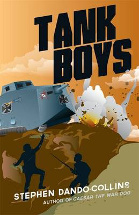
Tank boys by Stephen Dando Collins
Random House, 2014. ISBN 9780857981301.
(Age: 12-16) This highly-charged story is about three teenage boys,
actively engaged in the historic first battle between tanks, in WW1
France. Seeing the enemy up close and mates slain before their eyes
was a very sobering and emotional experience for likeable
Australians Frankie & Taz, who lied about their ages to enlist,
and German boy Richard, who grew up in the USA.
Assigned to the massive German tank Mephisto as an artillery
loader, Richard's job in hot, cramped conditions, was to feed the
deadly shells into the firing cylinder of the hulking machine as it
lumbered across the picturesque Villers-Brettoneaux countryside. The
16 yr-old felt sickened at the thought of the formidable war vehicle
firing enormous guns at the enemy, towards whom he felt no
animosity.
British and Australian troops fought valiantly side by side against
the Germans in the smaller Whippets, much less powerful than their
immense German counterparts. However the German vehicles were
difficult to manoeuvre and many, including Mephisto, broke
down or floundered in craters left by the barrages of shelling. Mephisto
became hopelessly stuck in this manner and its crew abandoned the
machine to shelter in a nearby crater, fearing the allied forces
would attempt to destroy the tank. Ultimately all were killed,
except Richard, who was eventually discovered by and surrendered to
Frankie & Taz. Tank Boys is an engrossing, but at times distressing story of
courage, mateship, innocence and heroism. Boys aged 12 to 16 would
revel in this superbly crafted story, composed with a mix of plenty
of amiable, youthful humour.
Joan Kerr-Smith
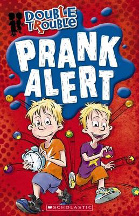
Prank Alert by Felicity Carter
Ill. by Louis Shea. Double Trouble series, Book 1.
Scholastic Australia, 2014. ISBN: 9781742838564.
This fun series is suitable for readers from 6-7 years of age.
Themes: Twins, Families, Fun, Schools. Felicity Carter's Double
Trouble series is written for emergent readers who are just
beginning to engage in chapter books. Louis Shea's humorous
illustrations add fun to this story.
Identical seven-year old twins Tommy and Coop love to play practical
jokes on their family, friends and classmates. From the moment they
wake up they begin their plotting. They hate being woken up at seven
each morning, so they set out to cause mayhem at home. With Mum and
Dad busy the twins set every possible clock and timer to trigger
their alarms in staggered intervals, causing their parents some
difficulty in finding the devices and turning them off.
The day progresses with the punishment of Tommy and Coop having to
practise their recorders for one hour after school. They manage to
record their music teacher's perfect recorder playing to foil their
grounding. At lunchtime an incident with Ballistic Bouncer balls
from their favourite joke shop also causes problems.
Rhyllis Bignell
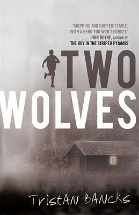
Two Wolves by Tristan Bancks
Random House Australia Children's, 2014. ISBN: 9780857982032.
Highly recommended for readers from 12-15 years of age. Themes:
Family relationships, Siblings, Action adventure, Missing persons. Two
Wolves by Tristan Bancks is a powerful novel for readers from
twelve to fifteen. The Cherokee prophecy in the prologue sets up the
story's tension and signals the moral dilemmas faced by the main
character Ben.
There is a battle raging inside him, inside all of us. A terrible
battle between two wolves. One wolf is bad - pride, jealousy, greed.
The other wolf is good - kindness, hope, truth. The child asks, 'Who
will win?' The grandfather answers simply, 'The one you feed.'
Ben is an overweight thirteen year old who escapes from his family
troubles with online games and creating stop motion movies. He asks
so many questions about his dad's problems at work and his financial
issues that he earns the nickname Cop.
After a visit by four policemen, Ben's parents hurriedly arrive;
pack up Ben and his younger sister Olive for a 'holiday', in reality
a life on the run. Ben's anxiousness deepens as they change their
appearances, swap cars with Uncle Chris and hideout in his grandpa's
rundown cabin. Ben records all his thoughts in his notebook,
gathering evidence about his parents' misdeeds and self-absorption.
The development of Ben's resilience is powerful. When faced with his
dad's duplicity he chooses a different path, taking Olive on the
most difficult journey of their young lives.
Bancks builds the tension and drama using short punchy sentences,
creating tension and drama through the carefully crafted scenes. The
main character's inner dialogue is relatable and realistic. Teacher's
resource is available.
Rhyllis Bignell
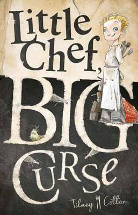
Little Chef, Big Curse by Tilney Cotton
Scholastic Australia, 2014. ISBN: 9781742832692.
(Age: 8-11) Highly recommended. Themes: Cooking, Magic, Fantasy. Little
Chef, Big Curse is a delicious read, entertaining and
engaging, a story of dreaming big and striving for your goals.
Eleven year old Matty Swink is trapped into servitude for the
disgusting owner of Fenella's Food Fort. Her cooking is disastrous
try Furry Floss made with her dog's fur and the kitchen is gross.
Matty dreams of being a chef and late at night he slips away to his
own kitchen in the diner's giant sign the size of a minivan. Here he
pours through his grandma's recipes, practises his sauteing
techniques and wishes he could become a master chef.
When the King of Yurp announces a great Cook-off to choose the new
Royal Chef, Matty is determined to win. All the contestants plan to
cook their tastiest dishes to tempt poor Princess Meg whose appetite
has disappeared. Unfortunately her loss of appetite is caused by the
curse of the Moon Mice. Each of the phases of the gross curse
infects the townsfolk with more and more disgusting symptoms.
Princess Meg and Matty are needed to save the day.
Tilney Cotton's writing style is humorous, wonderfully descriptive
and his main character Matty's comic misadventures fun to read. This
is an enjoyable story with a hint of Dahlesque fun, written by a
South Australian author. I would highly recommend this novel for
classes from Year 4-6 and for readers from 8-11.
Rhyllis Bignell
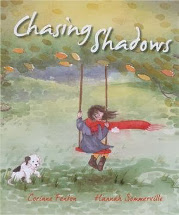
Chasing shadows by Corinne Felton
Ill. by Hannah Summerville. Ford St., 2014. ISBN 9781925000146.
(Age: 7+) Death, Grief, Animals. The photo frames on the title page
show us a happy smiling family, but turning over the reader is
alerted to the fact that there are now only two, Beth and her Dad.
He brings home a puppy, Patches for her, but she is unable to
respond, she is still grieving. While Patches explores his new home,
Beth sits alone in the window, or in the comfy chair, or looking at
the photos. Patches runs and jumps, sniffs and plays, chases leaves
and walks with Dad. But all the while he keeps his eyes on Beth,
curls up at her feet, waiting.
One day as Beth watches out of the window, she spies Patches in the
long grass, a snake nearby. When the dog is bitten she runs outside
to bring him in, caring for him as he gets better. The bond is set.
This is a charming story, deceptively simple of a child grieving for
her mother who has died. The lovely soft watercolour illustrations
show her moping around the house, unable to concentrate or turn to
attention to anything else. Her father can only watch as his
daughter grieves, but in bringing a dog into her life, hopes this
will help her, which it eventually does.
Fran Knight
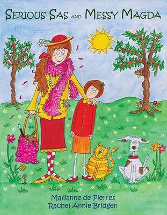
Serious Sass and Messy Magda by Marianne de Pierres
Ill. by Rachel Annie Bridgen. Books to Treasure, 2013. ISBN
9781909423046.
The picture book Serious Sass and Messy Magda is a change of
pace for well known Australian author Marianne De Pierres who is
better known for her young adult fantasy science fiction books.
This is a story which celebrates difference as Sas and Magda go
about their daily lives with a bit of a twist. Mum, Magda, is a free
spirit who likes to have fun. She leaves a trail of mess behind as
she enthusiastically embraces life's experiences. On the other hand
Sas, her daughter is tidy and almost obsessively serious, thoughtful
and well behaved. (Think Ab Fab's Edina and Saffron)
Sas becomes quite worried as 'Bring your Mum Day' at school
approaches. With Magda dressed in an old flamenco dress and odd
shoes, Sas is sure she will do something silly and tries to hide as
it is Magda's turn to speak, but all turns out for the best as the
other students enjoy having fun singing and dancing with Magda.
The colourful illustrations add to the story as we see the
difference between the tidy and messy bedrooms and bathrooms and
feel Sas's embarrassment and frustration at the cafe and circus as
Magda behaves in a perfectly child like manner. The family dog and
cat feature on every page participating joyfully with Magda and
worrying with Sas.
This story will be a useful addition to any discussion on
stereotypes in children's fiction and roles in the family as well as
celebrating the different characters that inhabit our lives.
Sue Keane