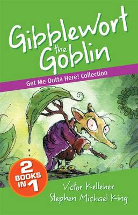
Ill. by Stephen Michael King. Random House, 2014. Get me outta here collection (Goblin in the city;
Goblin in the rainforest) 9780857982643 The summer holiday collection (Goblin in the bush; Goblin
on the reef) 9780857982636 The winter escape collection (Goblin in the snow; Goblin
at the zoo) 9780857982650
Gibblewort is a nasty goblin who likes to be in his home country of
Ireland with its grey clouds, squelchy rain and icy winds, playing
mean tricks on his mates. But instead he finds himself in Australia
- the Snowy Mountains, The Great Barrier Reef, the rainforest, the
bush - and in each story he finds the country gets the better of his
nasty nature and he longs for Ireland again. Except he never quite
gets there.
These books are a re-release of one of the most popular series for
younger readers that I had in my school library's collection. They
were never on the shelves and the reserve list was long. With two
complete stories in each book, they're an ideal way to support those
making the transition from instructional readers to novels. Each has
short chapters with sparse text and many illustrations - all the
essential elements which give them the confidence to take their
reading journey further - and the humour in both the text and the
illustrations as Gibblewort tries to extricate himself from
precarious situations of his own making appealed to both boys and
girls. They also found that it was a safe bridge to the world of the
fantastic - a nasty Irish goblin was much less scary than some of
the creatures and worlds their older siblings were reading about as
the fantasy genre began to grip. "Blither and blather!" was commonly
heard in the playground and even the most reluctant readers wanted
to be part of the in-crowd who had read each story and eagerly
awaited the next one. (We had competitions to see who could have it
first!)
Now that my grandchildren are reaching the stage of independent
reading, I've been searching for some of those titles that were so
popular with my students 8-10 years ago and I'm so glad that
Gibblewort is available for them to enjoy. Your students will be
too.
Barbara Braxton
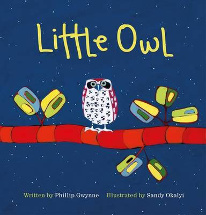
Little owl by Phillip Gwynne
Ill. by Sandy Okalyi. Working Title Press, 2014. ISBN 9781921504587.
(Age: Preschool) Recommended. Owls. Animal behaviour. When the
Little Owl falls from his tree, he calls out, Whooo am I? In
searching for his identity he comes across a number of other animals
in the forest, and asks the same thing of each of them, Whoo am I?
The two lines are repeated:
But when he opened his beak, out came a hoot
Whooo? Whooo? Whooo? am I? asked Little Owl.
He asks a sugar glider, eating the same thing that he eats, but the
glider soars away. He asks a bat, but the bat swoops away. He asks a
cockatoo, but the cockatoo struts away, and so on until at the end
his Whooo is answered by his mother and he is restored to the branch
once again.
This is a lovely story of loss, of finding one's place in the world,
of families and relationships, of finding your feet. In telling us
the tale of Little Owl, Gwynne also introduces other Australian
animals to the reader, using words which best describe their
behaviour, a neat introduction to words that describe for younger
readers. The repeated refrain too, encourages younger children to
join in with the known lines as they appear, listening for the new
line inserted each time it is read out, a neat way of surprising
them and expanding their knowledge of the known refrain. By the time
the book has been read several times, I am sure most children, if
not the adult reading it, will know that refrain well.
The illustrations are wonderful, showing the owl and the other
animals in sculptural forms, angular and boldly coloured, lighting
up the pages as each is turned. The tree branches sprout the most
fascinating leaves while many of the animals had me chortling as I
took them in. The layout of the book too is something which helps
the story flow, and small children will love to read of one animal
and how it scarpers away looking eagerly to see which animal
follows. Younger readers are in for a treat when this book is read
to them.
Fran Knight
How the Beatles changed the world by Martin W. Sandler
Bloomsbury, 2014. ISBN 9780802735652.
(Age: all) Recommended. Beatles, Music industry, The 60's, Social
history. Historian Sandler has put his considerable talent and
expertise to this weighty tome about the Beatles. He has written
thirteen essays to accompany some of the many photos covering the
Beatles and their rise to fame and after, all of which show with
certainty the impact these four young men had on the world. The
first chapter deals with the night in 1964 when the Beatles, newly
arrived from Liverpool, appeared on the Ed Sullivan Show in
USA. This was an amazing thing to do, as they admitted, Cliff
Richards had gone to America and failed, so for a group, unlike most
other rock and rollers who were lone acts, it was a risk. But their
reception at the airport set the stage. For a studio audience of
seven hundred, Sullivan's office turned down fifty thousand
applications, and the show that went to air remains the most watched
of any TV event of all time.
The next chapter concerns itself with the Beatles' impact upon
popular music, and includes things like album covers, offering hit
songs on both sides of singles, producing albums with themes and
writing your own words and music. It is only in the third chapter,
'How Hamburg changed the Beatles', that the reader is able to see how
the Beatles evolved and began their spectacular rise to fame. The
pictures in this chapter show the Beatles as they were before the
mop tops and suits took hold and tells the story of their incredible
round of appearances in eight hour shifts in the nightclubs of that
bombed city.
Chapter four, 'Beatlemania sweeps the world', shows their rise to fame
outside Britain and the USA, while the next two chapters deal with
their impact upon fashion, film and religion. In between these
chapters are more sobering discussions of how success imprisoned them
while the second to last chapter deals with their split and what
happened afterwards. The final chapter is a summary of their impact
upon the world, a coming together of what has been said before.
Entertaining and always interesting, it must be hard for writers to
find something new to say, but Sandler has brought together much of
the material seen in other books, on websites and magazines, and
has produced a book worth reading and keeping, a fascinating insight
into fame and its dangers, to the way a band can have an impact on
things much wider than the music they play. By starting with the Ed
Sullivan Show, Sandler announces his book will rely heavily on
stories and photos from the perspective of USA which sometimes
rankled in what otherwise is a readable and involving book.
A discography, list of sources and detailed index round off the 176
pages of good clear text and an array of crisply reproduced photos.
A wonderful addition to any library.
Fran Knight
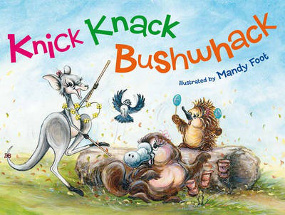
Knick knack bushwhack ill. by Mandy Foot
Lothian, 2014. ISBN: 9780734413123.
The classic kids' song 'Knick Knack Paddywhack' has been revamped
for this fun Aussie retelling. Beginning with little croc, the book
follows many beloved Australian animals 'with a knick knack
bushwhack' as they join in with their mate, the little croc, and his
catchy song. The lovely illustrations by Mandy Foot show the
cheerful-looking animals against a realistic Australian backdrop
using a colour palette that is predominantly blue, green and brown.
This would be suitable for use in an early childhood educational
setting as a simple counting book and could be extended across the
primary years as a stimulus for a music or drama lesson. The inner
cover pages both feature the musical score although the book could
be a great prompt for children to imagine what alternative materials
they could use to create music.
This is a fun book that is bound to get any reader smiling as they
sing along with this group of little Aussie mates.
Stephanie Bell
Red Shadow by Paul Dowswell
Bloomsbury, 2014. ISBN 9781408826249.
In Red Shadow Dowswell provides the reader with an evocative
account of Moscow 1941 just before and at the beginning of the
German invasion.
The tale is related through the experiences of Mikhail ((Misha)
Petrov. The prelude sees the arrest of his mother by the NKVD whose
ominous and fearful presence pervades the story.
Misha is a clever, yet ordinary boy who despite being two years
younger is in love with his best friend, Valya and it is largely
through these characters they we see the story unravel. They are
schoolmates and committed members of the Komsomol (Youth wing of the
Communist party). Misha loves literature and after school conducts
classes for the workers at the Stalin Automobile plant. Valya, on
the other hand, is a science wiz who has her sights set on becoming
a pilot, a real possibility for a female in Stalinist Russia.
Misha and his father live together in the Kremlin where his father
works in Stalin's inner circle and consequently works long hours.
Through this, the reader gains some insight into the character of
Stalin or Vozhd (boss) and is direct witness to some of his
idiosyncrasies which increase as the German army moves closer to
Moscow.
The fear provoked by the NKVD is repeatedly illustrated by the
arrests and disappearance of Misha's acquaintances. To begin with,
Dowsell provides the reader with only subtle hints of violence
perpetrated by this menacing group but as the story evolves the
detail becomes more explicit and the reader shares the anxieties of
living in a society where individuals, even at the highest level,
have only a tenuous hold on personal security.
The appeal of this story lies both in its humanising of a
totalitarian regime, as well as in its attention to detail and
authenticity. As with all good historical fiction the reader has a
sense of reading a true account. Dowsell uses Russian terms and
references to real historical events to create this reality. A
glossary of the terms is provided at the end of the book. Red Shadow is a good read, especially for those who enjoy
historical fiction.
Barb Rye
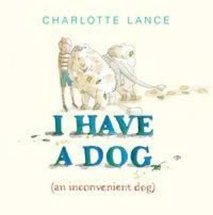
I have a dog (an inconvenient dog) by Charlotte Lance
Allen and Unwin, 2014. ISBN 9781743317815.
(Age: 3+) Recommended. Dogs, Pets, Relationships. A charming picture
book which focusses on the good and bad behaviour of the pet dog in
the house exposes not only the convenience and inconvenience of the
dog but also the relationship between the boy and his dog. In so
doing the author creates a platform where the reader is able to look
at the difference between the two words, convenient and
inconvenient, applying them readily to the boy and his dog. Children
will see that the breadth of the story widens as the underlying
humour is taken in and understood.
The boy finds that his dog's behaviour is inconvenient when he wakes
up, and the illustration shows the dog pulling the blankets from the
bed: or at breakfast, and here the illustration shows the aftermath
of trying to have breakfast with a dog at hand, or wanting to play.
The list of things is endless and readers will laugh with glee as
the illustrations encourage them to imagine the mayhem caused by the
dog. But sometimes his dog's behaviour is convenient. When for
example, the boy breaks something and can blame it on the dog, or
watches something sad on TV, or his dinner is disgusting, then the
dog is very handy.
Whether read out loud or individually this book will cause gales of
laughter from the audience, recognising situations they have seen or
know about, looking closely at the humorous illustrations to laugh
further, with the fun continued on the endpapers.
Fran Knight
Through the Cracks by Honey Brown
Penguin, 2014. ISBN 9781921901546.
(Age: 16+) Child abuse. Thriller. Crime. Reluctant readers.
Four-year-old Nathan Fisher disappears from the bank of a rocky
creek but an extensive search cannot find him. A decade later Adam
Vander knows that he is tall enough and strong enough to take down
his father, who has abused him, locking him in the house and never
letting him leave. He enters a world that is completely foreign to
him and with a young man, Billy, as his guide has to survive without
money or a home.
Honey Brown unravels the story of Adam in a compelling way that
ensures the reader doesn't put the book down until the final page.
The fate of Adam is engrossing, from the moment he leaves the
suburban house where he has been kept, to his experiences in the
underbelly of society where children are abused by adults. The
friendship between Billy and Adam is brilliantly described as is
Adam's development in understanding the world he lives in.
The suspense is kept up throughout the novel as the reader is left
wondering who Adam really is and what part Billy played in his fate.
I was on the edge of my seat wondering what would happen to the pair
and whether Adam will find a happy resolution.
Although the themes are very dark, they are not handled in a
sensational way and the ending is ultimately positive. Readers will
have plenty to think about as Adam emerges from his prison and
begins to relate to people and the character development of both
Adam and Billy is exceptional.
Pat Pledger
The Bone Season by Samantha Shannon
Bloomsbury, 2014. ISBN 9781408849989.
(Age: Year 10+) A debut novel published when the author was 21, The Bone Season is a dystopian fantasy set in 2059 AD.
Interestingly, Shannon has chosen to begin the divergence from our
current society back in 1859, so the London world of the novel is
200 years into a society of many types of clairvoyants.
The main character, Paige Mahoney, is a 19 year old clairvoyant who
has been headhunted for her special talent as a dream walker,
becoming part of a gang in the criminal underworld of London, where
all clairvoyants are regarded as unnatural. She is then kidnapped
and transported to Oxford along with other variously talented
people, there supposedly to spend the remainder do her life in
servitude to a human-like race, the Rephaim, who live in abandoned
Oxford and feed off the auras of clairvoyant humans.
The plot is fast and furious, and follows a pattern of young
talented protagonist caught up in a world order out of her control,
but whose special gift is key to a successful resolution. There is a
love/hate relationship (or maybe I should say . . . hate/love)
between herself and her keeper, the mysterious Rephaite Warden.
Naturally, this relationship develops as trust between the two grow
and we discover that all is not harmonious within the ranks of the
Rephaim.
Shannon has created a complex world complete with its own jargon. I
first read the book in hard copy and was then interested to try it
as an ebook. The beginning contains four pages of explanatory
diagrams of the different magical orders which becomes background
assumed knowledge as you read the novel. I had hoped I could use the
search function to reference these terms quickly and easily, but
sadly, the search function only went back as far as Chapter 1, and
thus didn't pick up on 'The Seven Orders of Clairvoyance' preceding
the story. It did, however, take you to the glossary (nine pages) at
the end.
This is the first novel of a proposed series of seven, and already
has been acquired by 20th Century Fox for a proposed film. Students
who love fantasy should enjoy this novel, so it could be a good one
for the library shelves, though at over 460 pages, it's not one for
the casual reader. Having said this, The Bone Season has
been a New York Times and Sunday Times bestseller, and has been sold
in twenty-eight countries.
The interest level is around Yr 10 and up.
Anne Veitch
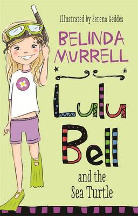
Lulu Bell series by Belinda Murrell
Ill. by Belinda Murrell. Random House, 2014. Lulu Bell and the Sea Turtle. ISBN 9780857982018 Lulu Bell and the Circus Pup. ISBN 9780857981998
These are the two latest additions to the new series by Belinda
Murrell for young girls who are verging on being independent readers
and looking for a novel which features a young heroine just like
them. Lulu Bell is just eight, the practical one in a family
that includes her six-year-old sister Rosie, who loves wearing angel
wings and sparkly shoes; her three-year-old brother Gus who always
wears his superhero suit; her dad, a busy vet and her mum, an
artist- not to mention a menagerie of pets. Lulu Bell and the Sea Turtle is set on the Dampier Peninsula, which
stretches 220 kilometres north of Brome in Western Australia and is
based on the adventures that the author's family had when they were
there. This time Lulu's mother has been invited to visit an
Aboriginal community to choose paintings for an art show and so the
family accompanies her to this remote place. From camping out,
visiting the famous reef which flows like a waterfall as the tide
recedes, making spears in the traditional way and learning to use
them, this is a story packed with both adventure and authenticity
that is characteristic of Murrell's writing. Lulu Bell and the Circus Pup is set much closer to home and involves
all the fun of the circus when Spangles the performing dog goes
missing, although Lulu finds out it is not all glamour when she
finds her new friend shovelling horse poo! Her willingness to help
with the tasks leads to all sorts of new opportunities that will be
the envy of many a young lady!
This is a refreshing series of stories about characters the readers
can relate to, particularly Lulu as the strong, sensible
level-headed lead. Each story is well-written, based on
everyday events that only the most accomplished can turn into an
engaging story and accompanied by charming illustrations by Serena
Geddes who had six years' experience with Walt Disney Studios in
Sydney before turning to book illustrating. Miss 7 has
been eyeing these on my to-read pile for a few weeks now,
impatiently wanting to get her hands on them since we read the first
episodes together last year and Santa left some too. (Now she
can read them for herself!) Add these to you collection and
look out for two new titles in June and you will find that your
younger girls will be queuing up for them.
Barbara Braxton
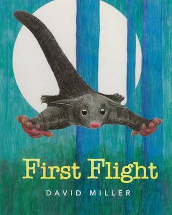
First flight by David Miller
Working Title Press, 2014. ISBN 9781921504570.
(Age: 3+) Recommended. Australian animals, Family. The story
of how the yellow-bellied glider takes its first flight is told in
this seemingly simple tale of a baby animal falling from a branch
near its nest and having to spread its wings to float to the ground.
But nothing about Miller's work is ever simple. His tale takes in
the broad sweep of loving families, familial responsibility,
friendship and learning to adapt while looking at a number of
Australian animals in their environment.
At dawn when all the other night animals snuggle into their nests to
sleep, the noise of the birds wakes the baby glider and he ventures
out onto the branch where he falls. This forces him to spread his
legs and the membrane between allows him to fall smoothly to the
forest floor, landing with a bump. Alarmed he must find a quiet out
of way place to hide during the rest of the day. From his position
he watches some of the other forest animals go about their daily
business until night falls, allowing his parents to come and search
for him. His little adventure ends happily and he snuggles down for
the night as do all gliders.
Miller used watercolour and watercolour pencils to present his
images of the forest and the animals in this lovely book which will
delight younger readers and stand out from the array of books which
teach them about Australian animals.
Fran Knight
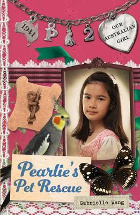
Pearlie's pet rescue by Gabrielle Wang
Our Australian Girl series, (Pearlie Book 2). Penguin Australia,
2014. ISBN 9780143307952.
(Age: 8+) Pearlie is the 1940s girl and the second of the new Our
Australian Girl characters for 2014. An Australian-Chinese
daughter of hardworking parents in Darwin, Pearlie's life is being
turned upside down by the threat of the war in the Pacific close at
hand. Her best friend Naoko and her family have been interned,
simply for being Japanese and Pearlie is devastated. She and Nao had
suspected one of their neighbours, Mr Beake, of being a spy and had
been almost caught out - Pearlie is still worried that he may found
her bracelet in his house. Now Nao is gone, Pearlie is left on her
own with her anxiety and she wonders what will happen next. Her only
consolation is that she now has Nao's tiny monkey Tinto to look
after and keep her company. The school year finishes, not just for
the year, but for good as women and children begin to be evacuated
compulsorily from the city. While this is traumatic in its own
right, Pearlie discovers that residents have been ordered to destroy
their pets before they leave and she is heartbroken thinking of
these poor animals. She comes up with a plan - Pearlie's Pet Rescue
- which she thinks is brilliant. She knows her own father will never
leave his shop so she is the perfect person to take care of
evacuees' loved pets. They can leave their pets, with enough money
to feed them, with Pearlie and she will look after them as if her
own. Soon, as well as her own Tinto, Pearlie is looking after Rusty
the dog and Santa the cockatiel. But what will Pearlie do when the
worst happens and her own family must leave the city under orders as
well?
Full of appeal for the Our Australian Girl set, girls from 8
and up - especially those who love to follow a series through each
of its episodes.
Sue Warren
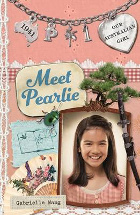
Meet Pearlie by Gabrielle Wang
Our Australian Girl series. Puffin, 2014. ISBN: 9780143307945.
Pearlie and her best friend, Naoko, live in Darwin in 1941. As the
war continues Naoko, because of her Japanese origins, begins to be
treated differently by the other local residents. Evidence that
there is a spy living in the town seems to have placed Naoko's
family under suspicion. When the two girls go out together to
investigate, they come across some indications of who may really be
involved in plotting against Australia and sharing information with
the enemy. Will Pearlie be able to maintain her belief in and
friendship with Naoko, knowing that she may well be given the same
poor treatment as her friend?
The Our Australian Girl series is one which has become incredibly
popular, especially with our female students from Year 4 and above.
A large part of the appeal would seem to be due to the large font
and double spacing which make the titles easily accessible to
confident readers, as well as the adventure element being introduced
to these stories which involve children 'just like them'. Daily
activities and routines are broken by the introduction of a mystery
which the children seem likely to be able to solve with little help
from the adults in the stories. With four titles about Pearlie and
each girl in the series, readers who begin Pearlie are more than
likely to want to keep reading until the resolution has been reached
at the end of the fourth book. A number of our classes from Years 5
to 7 are now completing English units which focus on students
reading historic fiction as a basis for their assignments. These
titles sit beautifully alongside the My Australian Story series
favoured by many of the boys from the same age group and have
motivated the students to read more titles in this genre.
This is the first title I have read from the series, but the appeal
of the books was immediately apparent. I now very willingly
recommend these books to many of our confident younger readers.
Jo Schenkel
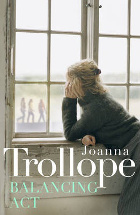
Balancing act by Joanna Trollope
Transworld Publishers, 2014. ISBN 9780857521088.
(Age: Senior Fiction). Susie Moran is a very successful business
woman, at the helm of a pottery company, which produces charming and
collectable ceramic pieces - potentially a very interesting backdrop
considering the history of the Stoke-en-Trent potteries. She is
determined not to have the traditional side of the family business
altered but her daughters and their partners are concerned for the
future of the company and want her to rethink this stance. The
sudden arrival on the scene of her 'hippy' father who had abandoned
her as a child adds to her overall distress.
The book treats the subject of family and work needs rather lightly,
with very few character and narrative developments, and it is busy
with unnecessary detail. Balancing Act is an easy read, but
ultimately rather unsatisfying and unfinished.
The reader seems to drift through this middle class family's life
for no apparent reason.
Julie Wells
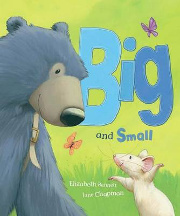
Big and small by Elizabeth Bennett
Ill. by Jane Chapman. Koala Books, 2014. ISBN: 9781742761053.
A sweet tale about two unlikely friends, this picture book follows a
bear called Big and a mouse called Small as they head out to have a
picnic in the woods. Along the way, they have many adventures and
Small repeatedly finds himself in trouble and asks for Big's help.
Suitable for preschool to year 1, this fun rhyming story will entice
young readers to join in as they anticipate Small's repeated
catchphrase 'a little help please!' The full-page illustrations are
eye-catching and have lots of close-up pictures of the bear and
mouse.
A fun tale about friendship that demonstrates that everybody has
value, this book is sure to engage children to continue reading in
order to find out how Small helps Big in a very important way at the
end of their big day out.
Stephanie Bell
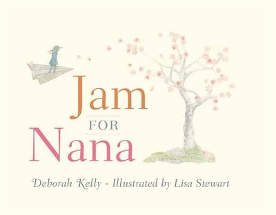
Jam for Nana by Deborah Kelly
Ill. by Lisa Stewart. Random House, 2014. ISBN 9780857980014.
(Age: 3-7) Grandmothers, Babysitting, Reminiscences. Going to Nana's
house means making pancakes. The narrator in the story loves doing
this with the older woman, spreading the jam to the edge of the
pancake, using her spoon to make it smooth. Then the pancake is rolled
up tightly, sprinkled with sugar and eaten. But Nana is a little
disappointed, as she can remember when the jam had real apricots in
it and would cling to the spoon when turned over, and tasted like
the sun.
Nana has not tasted anything like this real jam since she left her
home over the seas, and so the little girl decides to get some for
her Nana. She makes labels for the jam for her Nana, jam which will
have real apricots in it, and not fall off the spoon, and most
importantly taste like a hundred summers.
I found this story rather unusual, and I read it several times,
thinking I had missed out a page as the leap from the child wanting
to help Nana taste the jam of her youth and actually doing it was
very quick.
The soft pencil illustrations suit the story well, showing the child
and her Nana as they work together in the kitchen and talk of how
far away her original home is, but how I wished that the apricot
tree could have looked like an apricot tree.
This is a tale to use with small children, increasingly having their
grandparents look after them when their parents work, or who take on
full responsibility for them, a growing trend within Australia.
Fran Knight