Ill. by Lisa Allen. Starfish Bay Publishing, 2014. ISBN
9780994100306
(Age:(for children under 8). Recommended. Themes: Problems;
Counselling; Social and emotional development; Problem Solving; Peer
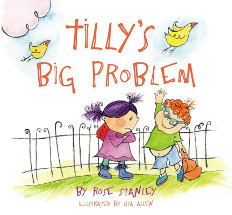
support. Tilly has a problem so big that she is unable to deal with
it on her own. Her close friend, Ned, comes up with a plan to share
the problem with a 'big person', and they list the likely candidates
and come up with a test to see who is the most suitable to share the
details of the Problem. At no stage in this book do we find out what
the 'Big Problem' might be, but the fact that it is something that
cannot be solved without some intervention is the essence of the
problem.
There is an element of humour in the manner in which the children
problem-solve to select the favoured counsellor, and the illustrator
has a suitable quirky, naive style. This masks what might be a
serious issue for some children, 'Who do I tell when I have a
problem that overwhelms me?' This book may be used in discussions
about who would be suitable to entrust with issues.
This is definitely a book to encourage students to share with school
counsellors. It does not minimise children's issues, nor suggest
that they might be easily solved.
Carolyn Hull
Lifespan of Starlight by Thalia Kalkipsakis
Hardie Grant Egmont, 2015. ISBN: 9781742978710
(Age: 15+) Scout, Mason and Bloc live in the future, 2084. It is a
world where most humans are microchipped. With a microchip the human
has access to food, water, accommodation and travel. All travel,
food and water is monitored and rationed.
The novel begins well, with Scout providing a firsthand description
and analysis of the society she lives within. Scout is illegal. For
reasons unexplained in the novel, her mother has kept her presence a
secret for fourteen years. Also unexplained is the presence of the
character Alistair and his motivation for educating Scout in using
technology with such skill she can hack into the computer systems of
other individuals and the government.
After Scout steals a microchip from a homeless woman, she discovers
that time travel is possible. Together with Mason and Bloc she
trains to extend her capabilities. This ends in tragedy and leads to
Scout choosing to leap ten years into the future.
This is the first novel in a trilogy, however there are too many
loose ends in the second half of the novel for the reader to feel
entirely satisfied with the ending.
The author's website
includes a link to Teacher Notes.
Linda Guthrie
The Story of Owen by E.K. Johnston
Dragon Slayer of Trondheim bk 1. CarolRhoda Lab, 2014. ISBN
9781467710664
(Age: 12+) Highly recommended. Science fiction. Fantasy. Music. 2015
YALSA Best Fiction for Young Adults (Top Ten), William C. Morris YA
Debut Award Nominee (2015), Kirkus Prize Nominee for Young Readers'
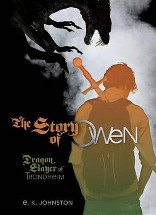
Literature (2014). This is the story of Owen Thorskard, slayer of
dragons and his bard Siobhan McQuaid, who tells his story. Set in an
alternative America, where dragons are drawn to fossil fuels, the
people are protected by dragon slayers, who are lured to the cities
by big corporations, leaving small towns unprotected. When the
Thorskards, a legendary dragon fighting family, arrive in Trondheim,
a remote Canadian village, 16 year old Owen faces an onslaught of
dragons with just his sword and his bard to help him.
This is a stunning book. Once I got reading I couldn't put it down.
It is a wonderful and original mixture of modern life, carbon
emission eating dragons and song writing. Owen and Siobhan have to
face ordinary situations at school and extraordinary situations
fighting the dragons and this mixture adds to the humour and
sometimes pathos in the story. A droll social commentary on big
corporations and the environment adds to the interest of the story.
The tale is told in the witty and humorous voice of Siobhan:
'Listen! For I sing of Owen Thorskard: valiant of heart, hopeless at
algebra, last in a long line of legendary dragon slayers. Though he
had few years and was not built for football, he stood between the
town of Trondheim and creatures that threatened its survival.'
The reader gets to know both Owen and Siobhan very well. Owen is a
likeable hero and Siobhan grows as a bard in training and as a sword
wielder while recounting their story. The focus is on the nature of
heroism and partnership rather than romance as the pair learn to
cope with modern life while defending their village and those they
love. They also learn that sacrifices have to be made.
This story was complete in itself. It was such a relief not to be
left on a cliff-hanger! However I am thrilled that there will be
other adventures in the series and eagerly wait for the next book.
Pat Pledger
The silent boy by Andrew Taylor
Harper, 2015. ISBN 9780007506606
(Age: Young adult/adult) Highly recommended. Crime, Historical
novel, French Revolution, Eighteenth century England. When young
Charles sees his mother, Augusta killed during the first stages of
the French Revolution, he keeps himself quiet and unobserved, not
saying a thing, just like she said. So he does not speak. At all.
Emigres take him to England and he finds himself in a country house
with a man who was a friend of his mother's and insists he is
Charles' father. Savill, estranged husband to Augusta has a claim
and wants to do the best for the boy even though he knows he is not
his son. But he is commissioned by the enigmatic Rampton a childless
civil servant within the Post Office, great uncle to Augusta, to
fetch the child from the country as he needs an heir. Savill goes on
his quest armed with an array of documents giving him the legal
power to take the boy, but suffering from tooth ache is laid up for
several days. During this time the child is kidnapped, and so the
hunt is on.
This is a surprising story. At first I found it rather muddled, and
the disjointed writing did not help, but I persevered as the setting
is so well defined, and found it a gripping read. Chapters in the
past tense carry most of the action, while those in the present
revolve around the mute boy and his activities at staying alive.
When a young woman reads him the story of Robinson Crusoe he deems
that flight to the safety of an island is his only option, so he
escapes from his captors several times, making Savill's hunt even
more precarious. Cat and mouse chapters follow, with Charles falling
into the hands of a variety of people, and Savill being often just
one step behind the lad. The plot delves and dives into some amazing
places with an array of great characters to keep the readers'
interest.
Above all the reader will want to know what happens to the boy, and
why he has been struck dumb, while the descriptions of life in both
town and city in eighteenth century England makes for a fascinating
backdrop to the tale.
Fran Knight
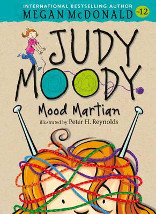
Judy Moody, Mood Martian by Megan McDonald
Ill. by Peter H. Reynolds. Judy Moody bk 12. Walker Books, 2015. ISBN
9781406357837
(Age: 7-9) Recommended. Themes: School stories, Family Life,
Emotions, Friends. Judy Moody returns in Judy Moody, Mood
Martian, and the young girl we know and love, the emotional,
messy, quite contrary has disappeared! Just for a short while
luckily! It's Backwards Day at school and she double-dares herself
to change into the Queen of the Good Mood for just one week.
"Star-spangle bananas," her mother exclaims when a radically
transformed Judy appears the next morning. Judy is transformed, red
hair slicked back, all her clothes match and she even laughs at
little brother Stink's jokes. Her mood ring is painted with purple
nail polish to signal she'll be in a good mood all day. Mr. DDOT
(Todd backwards) even introduces the class to palindromes. With her
success of staying in a positive frame of mind all day, she decides
to continue the positive top-secret experiment for a week. She even
decides to ask Jessica-A plus-Finch for advice.
With the help of lots of finger-knitting and making the right
choices Judy Moody finds the week challenging. Her family thinks she
been invaded by an alien! Once again, Peter R. Harvey's cartoons add
to the drama and humour of the story, Martian Judy and the rescue of
the finger knitting from the toilet bowl are memorable!
This is a wonderful addition to the Judy Moody series, it will
delight the fans.
Recommended for 7-9 year olds
Rhyllis Bignell
Assembly of shapes by Danielle Weiler
Ranga Books, 2015. ISBN 9780987546715
(Age: 16+) Highly recommended. 'I need a place, just for me, a place
to escape, a place to just be. If I could create an assembly of
shapes on endless pages I do believe my life would be complete.'
The main character, Chas is an intense character, so skilfully drawn
that the reader feels they know him and the suburb he lives in.
Chas is working his way through year 11 and has lots of secrets. He
doesn't know who his father is, he's in love with his best friend's
girlfriend and he is an 'undercover' artist.
This book is about relationships. Relationship with family, friends,
and self are all put under the microscope in this captivating story.
The writing style is compelling and the situations portrayed so
realisticly as to be shocking and thought provoking. Chas grows in
maturity as he tackles the challenge to achieve his dreams,
seemingly against all odds. He has unexpected champions and foes as
the story unfolds, culminating in unexpected tragedy.
The power of this book is the reality of the situations the young
characters find themselves dealing with. There is much to discuss
and explore.
'I've finally done it. They will all be safe. And this is the sole
reason for my sacrifice.'
Linda Guthrie
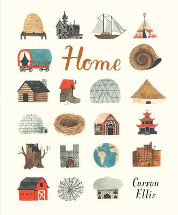
Home by Carson Ellis
Walker, 2015. ISBN 9781406359428
(Age: 4-8) Highly recommended. Housing. Homes.
Imagination. Buildings. Carson Ellis is an artist and illustrator
whose unique naive style is showcased in her debut picture book Home.
She is known for her artistic covers on band albums and backdrops
and for her illustrations in the Wildwood series written by
her husband, Conor Meloy. Here her pen and ink illustrations use
dark tonal colors, with solid lines and small, quirky touches to
create mood and interest. There is a fairytale quality to her work,
the characters stylishly dressed with princesses and pirates. Each
setting and each home waits to be explored, studied and discussed.
She takes us on a journey around the world and even into space; the
Moonian's home is in shades of grey, with the colourful Earth, a
small ball in the distance viewed through a large circular window.
From a home in the country, we are taken on a journey past flats in
the city, to Indian palaces with underground lairs. Animals' homes
are included as well as spiders' webs and birds' nests. The old
woman who lives in the shoe is surrounded by her multicultural
family drumming, swinging, climbing, sliding and balancing on a
tightrope, having fun. Mythical places - underwater Atlantis, a
Norse god home are shown in detail. With contrasting scenes placed
side by side we see the a Slovakian duchess and her stately home
next to a Kenyan blacksmith's small abode. As the pages are turned,
each new painting is a celebration of the imagination. The text is
simple, engaging and questioning. Where is your home? Where are you?
In the final pages, Carson is peering out the window of her
two-story home asking the reader to think about their own place.
Highly recommended for 4-8 years and for Early Years Geography and
History lessons.
Rhyllis Bignell
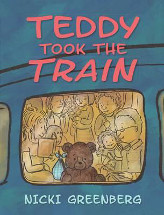
Teddy took the train by Nicki Greenberg
Allen & Unwin, 2015. ISBN 9781760112134
(Age: 3-5) Recommended. Teddy bears. Poetry. Lost
and found. Trains. The market place is bustling as Dot and Teddy are
finishing the shopping, they race after Mum to catch the early
train. The train is crowded, Dot squeezes in to get the window seat,
whilst Mum sits beside her in her wheelchair. They see diggers,
skyscrapers and a runaway balloon. Dot's excitement on arrival at
the station, dancing and splashing in the puddles is suddenly marred
by a realization. Did the train take Teddy, or did teddy take the
train? Sitting on her mother's lap whilst the station attendant
Peter (a quite dark figure) talks to them, Dot's imagination
takes over and she can see Teddy enjoying a picnic with friends at
Bear Bend. Ted's journey home is long and tricky, he's caught in a
crowd, tumbled down a riverbank and left alone to watch cloud
patterns in the sky. After Dot's tea and her bath, she becomes a
little teary, Ted is lost, she's missing her her best friend.
The rhyming story builds momentum, like the rhythm of a train on the
tracks, until we read the refrain - The train took Teddy... No!
Teddy drove the train! Dot's in bed and Mum's reading to her when
they hear the whistle blow, it is the seven-oh-two. Someone is there
on the doorstep with a very special surprise.
Nicki Greenfield's illustrations combine the use of ink, pencil,
acrylic with digital graphics and scanned objects. Cartoon sketches
and caricatures fill the train carriage and market, with the
backgrounds flooded with darker colours. As the story picks up
speed, Dot's hair becomes wilder and more exuberant.
A delightful picture book, asking to be read aloud at home,
preschool, kindergarten or school.
Rhyllis Bignell
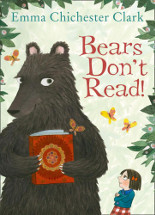
Bears don't read by Emma Chichester Clark
HarperCollins, 2014. ISBN 9780007425181
Bear is not like the other grizzly bears in the woods. While they
are perfectly happy doing bear things like fishing, Bear is bored.
"Oh, life is lovely," he thought. "Tra-la-la and all that! But is
this it?" he wondered. "Is this all there is?"
Then one day, Bear discovers a book. And inside it were pictures of
bears just like him, but there were also a lot of words and even
Bear knew that they meant something, even the tiny ones. But what?
So he decides to go into the town to find out, to find someone who
will teach him to read. But instead of being greeted by a band of
willing helpers, he is met by people fleeing and the police riot
squad! Until he meets Clementine.
As well as being a charming story, this book celebrates Bear's
determination and acknowledges that reading is not an easy task,
something the target audience will be able to empathise with.
Clementine's patience mirrors that of the early childhood teacher
and the ending is delightful. Even though bears are depicted as
fierce and scary, the illustrations are soft and gentle supporting
the words to show a different side of this species. Emma Chichester
Clark has a distinctive style that has seen her win many awards for
her illustrations and this is another superb example.
Barbara Braxton
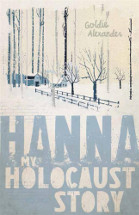
Hanna: My Holocaust Story by Goldie Alexander
My Holocaust Story series. Scholastic Australia, 2015. ISBN
9781743629673
(Age: 10+) Highly recommended. Themes: Poland, Holocaust, World War
11, Survival, Family Life, Courage. Only this afternoon Papa had
warned us of the German threat to Poland. Now the Luftwaffe's bombs
had succeeded in convincing us that everything was about to change.
Scholastic brings us a powerful and emotive new series, My Holocaust
Story with strong girl protagonists, set against the horrors of
World War II. Each book sold raises funds for the Courage to Care
educational program, whose goal is to oppose injustice in the world.
Eleven years old Hanna Kaminsky enjoys her life in Warsaw, Poland,
living in a large house with her mother, father, younger brother
Adam and baby Ryzia. She loves gymnastics, spending time with her
best friend Eva and reading. On one afternoon in September 1939
everything changes, as the Nazis invade Poland and all the Jewish
families are pushed into ghettos.
Their loyal maid Elza risks her own life by hiding the family in her
mother's farmhouse attic. With little food, freezing conditions and
Mama and Ryzia forced to hide all the time, life is tough. Papa
rises early to help with the farm work and Adam and Hannah help with
the chickens and milk the cows. Goldie Alexander captures the
hardships and realities of this life; she doesn't hide the difficult
times. Hannah's love of reading, Adam's playing his imaginary violin
and their secret forays into the forest lighten the mood.
Their capture and move to the ghetto are confronting and realistic,
the stealing, gangs, fighting for food, underground schools,
sickness and loss of life are presented openly and authentically.
Hannah and Adam's final choices show their courage in adversity and
present a hope for their future.
These stories need to be shared with a new generation of readers,
they are powerful and confronting. They are important for older
readers to develop an understanding of family life, courage and
survival in times of war. Our political refugees in classrooms have
similar stories to tell.
Rhyllis Bignell
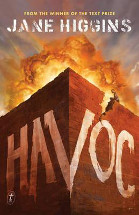
Havoc by Jane Higgins
Text, 2015. ISBN: 9781922147295
(Age: 14+) Highly recommended. This dystopian novel is the sequel to
Bridge (winner of the Text Prize for Young Adult and
Children's Writing in 2010) and has the reader urgently turning the
page to see what happens next.
Nick Stais and Pathmaker Lanya, are skilfully drawn main characters
who share their inner world with the reader as they grapple with
betrayal and conflict. They are caught in a war between two cities,
Cityside (rich and powerful) and Southside (portrayed as
disadvantaged). A more sinister plan involving biological warfare is
discovered. Nick and Lanya must find Nick's father (across the river
in Cityside) in order to establish collaborations that will reveal
the conspiracy of the governments involved. The writing that
explains the actions and thoughts of the characters is intelligent.
The reader is often held in suspense as the intrigue and power games
threaten to overcome the main characters.
This novel provides opportunities to examine and discuss
contemporary issues such as border security, asylum seekers,
conflict, loyalty and trust in government.
Excellent teaching
notes are available and these are aligned with the Australian
Curriculum.
Linda Guthrie
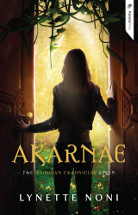
Akarnae by Lynette Noni
Pantera Press, 2015. ISBN: 9781921997501
Recommended. Much to her dismay, Alexandra Jennings is being shipped
off to boarding school while her archaeologist parents make their
next big discovery. But Alex is taken by surprise when she walks
into the principal's office on her first day and instead finds
herself in Medora, a futuristic other world, where she must remain
until the missing Professor Marselle can send her home. Surrounded
by advanced technology and students with special gifts, Alex
embraces the wonder that the Akarnae Academy has to offer, and forms
some unlikely friendships along the way. Alex may be from another
world but she is far from normal, and little does she know that the
fate of Medora and those she has grown to care for, may very well
rest in her hands.
Noni's debut novel is a fantasy whirlwind filled with loveable and
charismatic characters. Her writing is simplistic yet beautiful, and
she constructs the world of Medora so eloquently that the reader is
pulled in from the first page, experiencing all that Akarnae
has to offer. Although this is primarily a fantasy novel, readers of
dystopian and science fiction are sure to take pleasure in the
fast-paced action and futuristic technology that Noni describes. Akarnae
is the first in a series and the cliff-hanger ending will leave
readers needing to know what happens next. This story of adventure,
friendship, wonder, and sacrifice is sure to entice middle school
students and all readers with a wandering imagination.
Emma Gay
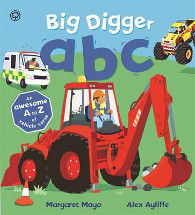
Big Digger ABC by Margaret Mayo
Ill. by Alex Ayliffe. Awesome Engines. Hachette, 2015. ISBN
9781408332696
(Age: 3-6) Recommended. Subjects: Transport, Boats, Cars, Trucks,
Road vehicles. Margaret Mayo and Alex Ayliffe have rolled out
another fun picture book in their Awesome Engines series.
From ambulances through to quad bikes to zooming rockets Big
Digger ABC is filled with transport on land, under the sea and
into the sky. Margaret Mayo's fun short verses use descriptive
phrases, sounds and actions that are great to read aloud, youngsters
will soon be reading along too! There's the Express Train,
super-fast and speeding, the ice-breaker, crack, crack, cracking and
the narrowboat chugging through the canals of England. Underwater
robots dive to find lost treasures while the eXtra big wheels of the
monster trucks race around the track.
Alex Ayliffe's layered papercut illustrations and her vibrant use of
colours showcase each of these awesome engines.
This is an exciting alphabet book for young ones who love trains,
planes and all types of transport.
Rhyllis Bignell
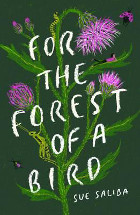
For the forest of a bird by Sue Saliba
Penguin, 2015. ISBN 9780143571780
(Age: 12+) Highly recommended. Change. Perception. Divorce.
Environment. Nella has a secret vigil. She waits by the creek for
the return of the swallows in spring, believing that her father, like
the swallows, will return home. At home, her mother's mental illness
has become worse since the divorce and Nella and her older brother
have found it very difficult to cope. When her father has a heart
attack, Nella is convinced that this is the right time for him to
return home and prepares a room for him. But life has unexpected
twists and turns, as Nella discovers.
Sue Saliba's writing is beautiful. Each page is a lyrical journey
into the feelings of a teen who desperately believes that her father
wouldn't abandon her. The reader discovers the bleakness of her home
life with a mother who can't cope at all and a brother who is angry
and doesn't communicate. It is easy to empathize with Nella as she
journeys to Phillip Island where her father has been living and
uncovers the life that he now lives. The reader gains a deep insight
into the nature of perception and change and how people can have a
very different slant on the same thing. This is a message that is
important for the reader as well as Nella to uncover.
The beauty of Phillip Island rings out with the descriptions of the
wildlife and forests and people aspiring to help the environment
will be inspired by the actions of the girl that Nella meets on the
island. It is this friendship that ultimately helps Nella to
understand about loss and abandonment.
This is a lyrical coming of age story, beautifully and evocatively
written. It is not very long, but it covers many themes in a unique
way that I have found impossible to describe in a review. I believe
that it would be a wonderful class novel or book for a literature
circle to explore.
Pat Pledger
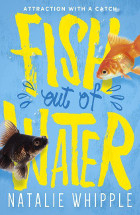
Fish out of water by Natalie Whipple
Hot Key Books, 2015. ISBN 9781471404306
(Age: 16+) "People like to think fish don't have feelings - it's
easier that way - but as I watch the last guppy squirm in his bag,
his eyes seem to plead with me. I get the sense that it knows just
as well as I do that bad things are on the horizon."
Mika loves fish but her plans for the summer holidays come awry when
her estranged grandmother arrives unannounced. This sets the scene
for a difficult family reunion as old grievances resurface and
conflict ensues. The characters are lightly drawn, yet the reader
can relate to the complications life presents them.
The characters in this novel are all fish out of water. Alzheimers,
cultural differences, socioeconomic differences, and educational
differences are all explored in this novel. While it lacks
complexity, and can be predictable at times, this novel does show
the power of forgiveness in resolving difficulties in relationships.
While there is, of course, a love interest in this book, the most
nuanced relationship is that between Mika and her grandmother. It is
these segments that bring the book to life and allow the reader to
experience the complexities of Alzheimers.
Linda Guthrie