Allen & Unwin, 2015. ISBN 9781743314821
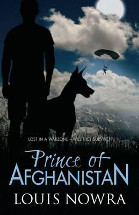
(Age: Teens) Highly recommended. Louis Nowra's first venture into
teenage literature, Into that forest, was a highly literate,
compelling and confronting exploration of the instinctive bonds
between Mankind and Nature. It was not generally appreciated to the
extent it deserved. This, his second novel, is a book of a different
cover - though the writing is no less assured. For this story Nowra
has used the age-old and perennially popular theme of the surviving
hero making his way home, with little more than a talisman. The
setting is wilderness Afghanistan, evoked by pre-chapter
illustrations (mainly stock sourced) that illuminate the hostile
solitude of the landscape. The hero is a young Australian soldier,
Mark, not much older than the implied readership of the book. The
talisman is Prince, a trained war-dog, who has survived the
catastrophic aftermath of a successful rescue mission, in which his
handler is killed. Prince is injured, and temporarily deafened, so
securing a bond with him is more difficult; but Mark is determined
to do so, to save Prince, and himself, by forging a way through the
unforgiving environment.
The pace of the writing is exciting and the author never loses
control. The adrenalin rush of the first chapter remains throughout
as Mark must avoid capture by the Taliban and certain death. Enter
the intriguing character of Ghulam, whose ambivalence and cruelty is
a summation of this conflict over its long history; he doesn't stay
long in the story but his appearance is memorable. In time, hunger
and their acquired injuries become dangers to the pair. The reader
gets to catch a breath at the times when Mark reflects, profoundly,
on the life he has left behind, his damaged father, his own flawed
youth unbecoming of a hero; yet he longs to return.
This is a story for younger teenagers to gain a realistic view of
war; some language, drug references and violence - all in context -
place it beyond the reach of younger readers. The survival
strategies Nowra gives to his character are convincing and the
product of detailed research. It is also a book for older teenagers
who are classed as reluctant readers, particularly boys closer to
Mark's age. The action is vivid; the characterisation, even with
Prince, is authentic; and the message is that war is not worthy of
being glorified. Highly recommended.
Kerry Neary
You can't take an elephant on the bus by Patricia Cleveland-Peck
Ill. by David Tazzyman. Bloomsbury, 2015. ISBN 9781408849828
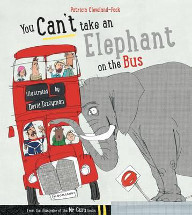
(Age: Junior primary) Recommended. Transport. Elephants. Size and
shape. London. With two odd looking creatures welcoming the reader
on the opening page, to an array of bus tickets for London Transport
on the title page, the readers know they will be highly entertained
by this fast moving verse story. Each animal represented has been
crowded into a most inappropriate mode of transport which will cause
gales of laughter from the readers and listeners. An elephant on a
bus, what next? Well try a monkey in a shopping trolley or a tiger
on a train, a camel in a sailing boat, and a taxi driven by a seal.
Each causes mayhem as the bus seat is squashed flat, the trolley
skidding out of control in the shopping aisles, the boat turned
upside down, and the taxi causing traffic chaos. Eleven animals are
shown with a mode of transport that will cause hilarity amongst the
readers, and the double page devoted to each is a delight to look
at.
The entertaining illustrations are wildly imaginative as each animal
is shown in its particular form of transport, delighting in the way
they are moving, but by the looks on their faces, aware that there
is some underlying concern. I loved the giraffe stuffed into the
plane and the hippo in the hot air balloon, while the bear and the
ice cream van is hilarious. Each page has lots of things to look at,
ponder and seek out, while the story lends itself to discussions
about forms of transport, size and shape as well as animals of the
world, and the verses will be read over and over again.
Fran Knight
Please by Lisa Kerr
Cheeky Monkey manners series. Five Mile Press, 2015. ISBN
9781760067205
(Age: 3-5) This is one of two Cheeky Monkey manners books
(the other is Thank you) but one of many in the Cheeky
Monkey series (others include Country on the go and City
on the go). The small board book format is suited to
preschool and early childhood and is a fun way to springboard
discussions about manners - what they are, and when to use them.
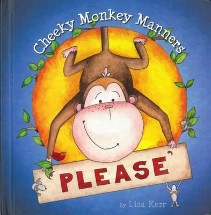
Cheeky Monkey is not really cheeky, he just doesn't know about the
power of the word please! He would really like a banana and he very
politely asks his friends, 'Can you pick me a banana?' They all keep
answering his request with 'What do you say first?' Cheeky Monkey
doesn't know what he is supposed to say - he tries telling Mr Elephant
that he looks nice today but that isn't the right answer. Finally
Miss Mouse explains that the word he must say first is 'please'. He
isn't sure how this one little word could help but he decides to try
it anyway. Lo and behold it works and his friends all pick him a
nice ripe banana.
As with the other Cheeky Monkey books, the colourful
illustrations make the book visually appealing to young children.
The illustrations themselves are large without great amounts of
detail, Cheeky Monkey always being the main element on each page.
The focus is on the animals and their facial expressions. There are,
however, lots of little additional small animals (frogs, birds,
mice, butterflies etc) which will enable younger children to retain
focus and discuss the illustrations.
While there is quite a large amount of text the book itself is kept
very short to keep engagement high. With only 5 double-page spreads
this book will keep young readers interested until the very end.
Overall, a fun way to introduce the word 'please', and discuss when
to use it and how one little word can make all the difference!
Nicole Nelson
A hot cup of chocolate by Rose Stanley
Ill. by Lisa Allen. Starfish Bay Books, 2014. ISBN 9780994100283
Recommended (especially for the Library of those who counsel young
children). Family. Family Problems - impacts on children.
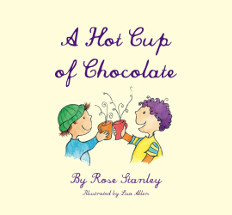
Social and emotional development. Friendship. Johan lives in a
stable family and he is introduced as a lover of hot chocolate. He
befriends Henry who has problems at home. Initially this is only
hinted at and might be seen by an adult, but not so clearly by a
child. As the interactions between the two boys develop, it is
obvious that something is not right at Henry's home and it boils
over into the young friend's school life. Eventually it is revealed
that Henry's parents have separated (with some hostility) and Henry
faces good days and bad days. Counselling is required for Henry on
the bad days.
This book appears to be written for those in stable family settings,
to understand the dilemmas that some children face, and to explain
why they might need to talk to someone. It is gentle, with the
majority of the narrative talking about simple family 'normality'
and hot chocolates. It is also about friendship, and what that might
look like when a friend has struggles at home.
Carolyn Hull
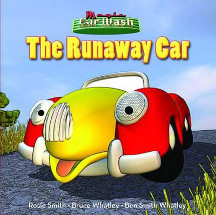
Magic Car Wash series by Rosie Smith and Bruce Whatley
Ill. by Bruce Whatley and Ben Smith Whatley. Five Mile Press, 2015. The runaway car. ISBN 9781760065300 The Giant Mouse. ISBN 9781760065294
(Age: 3-5) The Magic Car Wash series is a picture book
collaboration between author Rosie Smith, her husband Bruce Whatley
and their son Ben Smith Whatley. The CGI graphics bring the six
vehicles to life and make them personable. There's Tess the green
and yellow tow truck, Maggie the yellow and red sports car, Red the
fire engine, Amy the white ambulance, Pedro the pickup and Toni the
taxi. Kit their owner's home is behind the Tire Flats garage. Each
stand-alone adventure calls for them to work together and solve a
problem. The runaway car has themes of motor cars, trucks, transport,
heroes, magic. Just after Kit leaves for lunch, Sam pulls up and
needs his brakes fixed. He tries to mend the brakes himself, but
leaves an important part out. He tests his work on Hubcap Hill,
coming down he's in trouble. Maggie and Tess drive through the Magic
Car Wash and form a new car; with a Maggie's winch and Tess's speed,
they zoom off to help. With teamwork, Sam's problem is solved. The giant mouse has themes of fear, motor cars, trucks,
magic, cooperation. It deals with overcoming fears. Kit is off for
his morning paper and Toni the taxi sees a giant mouse in the
garage. Tess investigates and thinks there's a dinosaur in there.
When brave Red looks he comes out wet. He has seen something that
can jump really high. Amy and Tess drive through the Magic Car Wash
without success. When Kit arrives back from his walk, he discovers
the answer to their predicament.
The computer graphics are reminiscent of the Disney Cars movies and
'Budgie the Little Helicopter' animated series. Kit the mechanic with
his bushy moustache, overalls and low sports cap is very similar in
appearance to Mario the plumber in the Super Mario Nintendo game.
This is a series for the young reader who enjoys cars and trucks.
There are messages about cooperation, collaboration and teamwork in
each picture book.
For a reading audience of 3-5.
Rhyllis Bignell
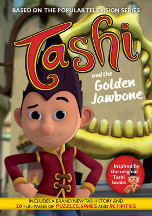
Tashi by Anna Fienberg and Barbara Fienberg
Ill. by Kim Gamble. 20th anniversary edition. Allen & Unwin.
ISBN 9781743319697
(Age: 6-8) Recommended. Dragons. Fantasy. Magic. Anna
and Barbara Fienberg celebrate twenty years of Tashi stories with
this edition.
In Tashi and the silver cup, we learn of Tashi's birth, how
his mother and father long for a child and seek the help of
Wise-as-an-Owl who brews a special potion. The whole village watches
with delight as the baby is born and begins to grow up. For his
first birthday, he receives a special silver cup from the owl and
his son. After the party is over, the cup has gone missing. Tashi's
family and friends begin a frantic search, however, young Tashi is
very observant and when released from his high chair, he toddles
over to the thief.
In Tashi, Jack begins to tell his parents about his special
friend, how his family was so poor they sold him to a warlord.
Jack's dad keeps interrupting his storytelling with lots of wrong
questions, much to his annoyance. A week goes by and Jack eats lunch
with his friend each day, learning more about Tashi's escape from
the warlord with the help of a swan and his ridding the world of
dragons.
Tashi stories continue to delight a new generation of readers eager
to begin chapter books. Kim Gamble's detailed sketches are engaging,
adding to the enjoyment of the young audience.
Happy 20th birthday, Tashi!
Rhyllis Bignell
We are pirates by Daniel Handler
Allen & Unwin. ISBN 9781408821459
(Age: Senior secondary - adult) Lemony Snicket, this is not! While
you may well be used to the dark humour of the Lemony Snicket
children's novels, this newest novel from the same author,
alternatively known as Daniel Handler, is a disturbing mix of
fantastical realism most definitely only suited to mature readers.
Against a backdrop of contemporary San Francisco, Handler presents
an interesting take on modern family dynamics as he introduces the
Needles family - Phil, struggling radio producer with a condo he
can't afford and a family to which he can't relate; Marina, bored
unfulfilled wife whose painting is not enough to sustain either her
married life or her relationship with her daughter; Gwen, fourteen
and troubled, a shoplifter, ex-swimmer, rebel with a desire for
romantic adventure. When Gwen assumes an alter ego as Octavia and
swashbuckles her way through a swathe of shoplifting at her
neighbourhood drugstore and is busted bigtime, she is forced to
spend 'punishment' time as companion to Errol, an Alzheimer's
patient who imagines himself as a retired Navy veteran, who revels
in piratical fiction and non-fiction.
Gwen and her newly acquired friend Amber, a strangely fierce and
feisty being, take to the pirate notion with fervour and begin to
plot to escape the humdrum existence of their teenaged lives and
useless parents with adventure on the high seas. It is a little
difficult to imagine two 14 year-olds enthusiastically embracing
such offerings as Captain Blood but it is the hook for the rest of
the plot. They 'spring' Errol from his retirement home and almost
accidentally acquire a couple of other crew members and hey ho! It's
off to sea they go - in San Francisco bay, where they create not
just mayhem but murder with a very nasty edge to it.
While this is all rolling along, Phil Needles is beset with
complications around a radio project he is developing, his
not-very-successful production company and his attractive new
assistant. Summoned home from a conference, where he is meant to be
pitching his newest idea, by news that his daughter has gone
missing, Phil's professional worries are eclipsed by Gwen's
disappearance and his wife's manic reaction. With an ending that is
bleak and, frankly, creepy, this is not a novel for the
faint-hearted. I found the plot somewhat uneven and the characters
are at times more caricatures but it was nonetheless intriguing and
often very humorous, albeit also somewhat repugnant at times.
With a dose of very explicit language and sexual references, this
would only be suitable for your senior students if you chose to add
it to your library collection (the publisher's comment is that it is
an adult novel). On a personal note, you may like to try it out
yourself, to see another side to Lemony Snicket.
Listen to Daniel Handler talk about the book on YouTube.
Sue Warren
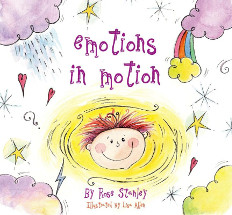
Emotions in motion by Rose Stanley
Ill. by Lisa Allen. Starfish Bay Publishing, 2014. ISBN 9780994100290
(Age: Preschool - 6) Recommended. Emotions. Emotional
development. Figurative language. Early Childhood. This is a
charming picture book aimed at a young audience (below the age of 6)
when the variety of emotions can be a rollercoaster and sometimes
difficult to understand for a young child. It would be excellent for
use with pastoral care counselling or for teachers to use in the
early years of schooling. In the first section of the book the
author has delightfully matched each highlighted emotion to a
colour, the illustrator has illustrated a facial expression that may
match the emotion, and then the author describes the emotion as a
simile. The use of the simile gives this book a use beyond a social
and emotional text, and could be used with older students when
explaining figurative language.
The second portion of the book could almost be described as a simple
workbook, with space for individual responses which would make it
useful for a child to reflect on their own emotional concerns.
Carolyn Hull
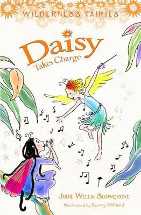
The Wilderness Fairies series by Jodie Wells-Slowgrove
Penguin, 2015. Daisy takes charge. ISBN 9780143307486 Daisy's secret. ISBN 9780143307495
(Age: K-3)
Across a meandering river
In a forest tall and green
Live the magical Wilderness Fairies
And their wise Fairy Queen.
Guided by their Callings
The Wilderness Fairies strive
To use their magic wisely
And help the forest thrive.
But one impatient fairy
Has lessons yet to learn
Her Calling to discover
And fairy wings to earn.
Readers first met this lovable fairy early in 2014 in Daisy's
quest and Daisy's new wings and now, much to the
delight of a number of young girls I know, she is back in two new
adventures. In Daisy takes charge her sister Maggie is going
to compete in a singing contest with Melody Magpie but the jealous
and spiteful Grevillea has other ideas about who the winner will be.
In Daisy's secret she is invited to visit Queen Jasmine but
right from her meeting with Keeper Raven of Tea-tree House security,
things do not go well. From a mysterious conversation overheard
through a closed door Daisy finds herself on an amazing adventure
with the future of Fairyland resting on her shoulders.
With the Australian bush as the background, readers are introduced
to a variety of its flora and fauna through very clever
characterisations and there is a substance to these stories that
other fairy books do not always have. Daisy is what many young readers
would like to be - apart from being a fairy which could be enough in
itself, Daisy is resourceful and resilient and even though she makes
mistakes her actions are always driven by her concern for others.
Interspersed with detailed illustrations by Kerry Millard, this
series offers newly-independent readers a modern take on the
more traditional fairytale.
And the fairies have their own website for even more
fun and reading.
Barbara Braxton
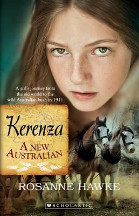
Kerenza by Rosanne Hawke
New Australian series. Scholastic, 2015 ISBN 9781742990606
(Age recommended Upper Primary and Lower Secondary students) The
opportunity to farm their own land in Australia is the driving force
behind Kerenza's poor family leaving Cornwall in 1911, to take up a
selection in the South Australia's Mallee country. Kerenza knows
little of what awaits, yet leaving her older sister, her
Grandmother, friends and home causes her great distress.
Despite her misgivings, as an obedient and caring daughter, Kerenza
tries hard to be positive, knowing that her parents depend upon her
to assist with the endless work and caring for her younger siblings.
Having an Uncle and cousins Jacob and Harry already living in
Adelaide makes the transition slightly easier for the family as they
work together to establish themselves in this strange new land.
Kerenza however is confused and unimpressed by Jacob's unpleasant,
taunting behaviour.
Even travelling to their new farm in the Swan Reach area is an
arduous undertaking, with the possessions of two families carted on
a heavily laden dray at walking pace. Upon arrival in the area, the
men must fell trees to create a track just to gain access to their
land grant where the real work of clearing mallee scrub must be
completed before the crops can be sown.
Every aspect of daily life is difficult, from consuming limited
foodstuffs cooked in a makeshift kitchen to struggling to maintain
hygiene with limited water whilst living under canvas.
This simple story describes the everyday difficulties and trying
circumstances faced by settlers attempting to survive under severe
climatic conditions. A terrible drought ruins crops and would have
destroyed the prospects of many migrants of the time, yet with
fortitude, hard work and a great deal of luck, many prospered.
As often happens in historical fiction, the author assigns modern,
progressive values and informed attitudes to certain characters
which detracts from their authenticity. The tendency to do so is
understandable however as it is necessary to foster less bigoted
views on race relations, social welfare and environmental concerns
in young readers.
The narrative style is refreshing with the author refraining from
employing excessive and unnecessary drama in the presentation of
rural life just prior to the First World War. This story is suitable
for Upper Primary and Lower Secondary students.
Rob Welsh
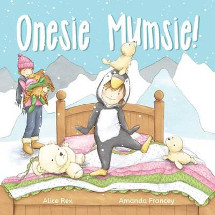
Onsie Mumsie! by Alice Rex
Illus. by Amanda Francey. New Frontier Publishing, 2015. ISBN
9781925059243
(Age:3-6 years) We see them everywhere - the ubiquitous animal
onsie. What young child today would not have one of their own?
Penguin, tiger, bear, rabbit. . . the little girl in Onesie Mumsie
has many! In fact, she refuses to go to bed until she has tried on
all of her onesies. Mum is surprisingly patient as her young
daughter tries on her rabbit onesie and then decides 'it might be
bedtime for rabbits, but it's not bedtime for. . . crocodile!' And
so it continues with the young girl taking on the persona of various
animals while her Mum cuddles, tucks in and says goodnight to each
animal in turn. The surprise ending sees mum put on her own onesie.
The loveable illustrations make use of the colour of each onesie in
providing the palette for each page. The rabbit page is tinted pink
and highlights the pink elements of the girl's bedroom, while the
crocodile page is primarily green. The illustrations also provide an
insight into the little girl's imagination as we see her as a hungry
crocodile swimming up to her mother in a boat and as a penguin
sliding along in the snow. All these scenes retain some elements of
her bedroom so we know that we are journeying into her imagination.
This is a repetitive and predictable story, perfect for children to
read with their parents, or by themselves. It would make a great
bedtime story and will be enjoyed by young children and parents
because of its fun and playful tone. This spirited story with its
realistic illustrations will appeal to all young children,
especially those who love dressing up and using their imagination.
Nicole Nelson
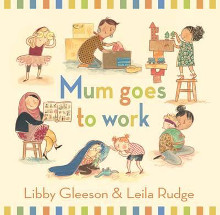
Mum goes to work by Libby Gleeson
Ill. by Leila Rudge. Walker, 2015. ISBN 9781921529825
(Age: 3-6) Highly recommended. Subjects: Mothers, Women's Occupations, Family Life, Work life. It 's early morning. Everyone is arriving at the centre.
The childcare centre is a noisy, bustling place as the children are dropped off and Mums are farewelled. Libby Gleeson's new picture book is a warm and inviting story, showing the variety of roles and jobs mothers do while their children are cared for during the day. Often children know their father's occupation, but what about their mothers? While Nadia's mother is busy studying architecture, attending classes, reading in the library and building model homes, her daughter Nadia is painting her a picture and building a large city with her friend Jack. Each of the mother's work and activities correlates to her daughter or son's activities - Max's mother is a nurse and Max dresses up in pyjamas covered in bone designs and tucks the toys into bed. Rosie and Jack's Mum works at home caring for the new baby, her day is shown in small scenes, bathing, bottle feeding, sorting laundry and cleaning while the baby sleeps. At childcare Rosie, Jack and Nadia wash all the dolls and teddies, then empty out the baby bath and make a mud pie.
Time for lunch and small snapshots of the children and mothers are illustrated without text, they are enjoying the fruit, having a picnic, using the microwave or feeding a dinosaur these provide opportunities for shared engagement with the reader or class.
Libby Gleeson's picture book looks at a variety of jobs women undertake. It is a wonderful story to read aloud at a childcare centre, preschool or kindergarten, it may help those children who suffer from anxiety about Mum leaving them or coming back for them. When the youngsters are playing, they show they know just what their mother's do, who they work with and where they work.
The choice of cream coloured backgrounds and use of mixed media, watercolours, coloured pencils and collage by Leila Rudge makes this a visually engaging story.
A great addition for library shelves and family collections, a celebration of mothers and their careers.
Rhyllis Bignell
Golden Boys by Sonya Hartnett
Penguin, 2014. ISBN 9781926428611
Recommended for Adults, not a Young Adult novel. Themes: Family dysfunction; Poverty; Child abuse; Friendship; Bullying; Class issues. Note: Language issues - swearing. A story set in a working class suburb and populated with dysfunctional characters. Into this world, with the pain of working poverty, family violence, abuse by neglect and children who seek small glimmers of hope or love, comes a family who don't seem to fit. The father is a professional, and seems too good to be true and his two sons, Colt and Bastian, are strangely disconnected to their new world. The family has wealth and toys and are showered with everything that could possibly buy friendship. However, even here there is dysfunction, loss and pain.
The story is told via the stories of the young children and there is a naivety and confusion as they connect to one another. Freya, the only female character whose internal dialogue we are permitted to hear, is initially attracted to the eldest son, Colt, and yet his father becomes the one to whom she can unburden herself as she begins to lose faith in her own family. Her younger brothers are also attracted to the family and its collection of boy's toys. The local bully and another neglected child also become tangled within the web, and as an adult reader we become increasingly concerned for the welfare of all the children.
Hartnett plots this tale so subtly, that initially it reads as a coming of age tale, with young characters revealing their growing maturity and criticisms of the adult world in which they live. However the underlying and creeping pain insidiously drifts through the story and we become increasingly uncomfortable as we realise that the children are all at risk and we are powerless to help. This is an adult novel as the issues of abuse and paedophilic grooming are not targeted to a young audience - however it is not a graphic telling. This is a tragedy, and every child seems to lose, and every adult relationship is flawed and sad.
Caroline Hull
Cold, cold heart by Tami Hoag
Orion Books, 2015. ISBN 9781409151951
(Age: secondary to adult) Highly recommended, Post Traumatic Shock Disorder, Brain injury, Crime. When Dana Nolan returns to the small rural town where she was brought up, she becomes embroiled in the increased media attention of the disappearance of her best friend at school, Casey Grant. Dana was a media presenter before being kidnapped and raped by a serial killer, and now all she wants to do is recover from this ordeal as best she can. But her physical injuries include brain damage and she must learn to think, speak and act without fumbling. Her journey to this end makes fascinating reading as she relearns to say words that are common, to put her thoughts in some order, and survive the attentions of well meaning relatives and friends. She is made of stern stuff, after all she escaped her would be killer where many did not.
But back home, the media scrutiny of her friend's unproven death begins to involve her and she uses her investigative skills to begin researching what happened that day.
She pieces together media reports, asks questions, talks to police who did the original investigations, eventually meeting up with a young man form her class at school, John Williams, a boy from a different social group, but one who dated Casey and was strongly implicated in her disappearance. He too has a brain injury, acquired when serving in Afghanistan, and now lives at home, despite the animosity between him and his father.
The contrast between the two protagonists is rivetting as both are bound in some way by Casey's presumed death, as well as the effects of their not dissimilar brain injuries.
The story is tightly plotted as the many characters add further layers of involvement and understanding, and when truths begin to emerge, truths that have been hidden all these years, only then can the events of that night be truly understood. I enjoyed this book particularly because of the presentation on post traumatic shock syndrome and the effect of brain injuries with the two major characters.
Fran Knight
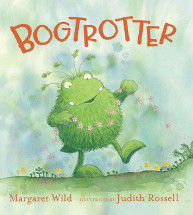
Bogtrotter by Margaret Wild
Ill. by Judith Rossell. Walker Books, 2015. ISBN 9781921977558
(Age: Junior primary) Loneliness, Change, Horizons. Bogtrotter does
the same thing every day. He wakes, runs over, around and up and
down the bog all day then goes back to his cave. The next day is the
same and the one after that. Sometimes he feels lonely and sometimes
he wishes for change, but he still does the same thing everyday. One
day he meets a frog who asks him why he does this, and this impels
Bogtrotter to pick a flower. This small event initiates a change in
his behaviour. The next day he talks to a family of muskrats, the
next day he swings from a tree, and after that he picks enough
flowers to make a chain. He does a variety of different things he
has not done before, but still feels lonely. Frog passes by and
suggests that he might try outside the bog, and with that,
Bogtrotter takes off and goes off into a whole new world outside his
bog. The last page will draw suggestions from the children about
what the Bogtrotter finds over the wall, and perhaps suggest new
things they could do as well.
This is a charming, gentle story about change and trying something
different, about taking a risk, about doing something unfamiliar.
The beautiful gentle watercolours suit the story admirably,
softening the edges of Bogtrotter and his world, the bog. The
Bogtrotter's environment is charmingly displayed. Children will not
help but see the implications in this story about trying something
new, and be impelled themselves to add something new to their day.
Fran Knight