Scholastic Australia, 2015. ISBN 9781760157234
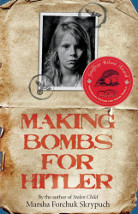
(Age: 12+) Highly recommended. Captured by the Nazis during the
Second World War, two orphaned sisters are forced to take divergent
paths. Larissa's story was documented by Marsha Skrypuch in Stolen
Child (2010). In Making Bombs for Hitler (2015), the
author details the experiences of Larissa's older sister, Lida. This
companion novel is a testament to the legions of young Ostarbeiters,
mostly Ukrainian; who were captured, worked and starved, during the
war.
We learn in the Author's Note that adolescents abducted during raids
across the Soviet Union, were forced to work long hours in
laundries, hospitals, road works and munitions factories for the war
effort. At first, Lida's sewing skills gain her a position in the
camp laundry. Unfortunately, for the remainder of the war, her deft
hands are utilized in making explosive devices.
Eventually, as the Allies gain the upper hand, Lida & her fellow
prisoners become emboldened and sabotage the German bombs. But with
the Allied bombs raining down with increasing regularity, the
friends are forced to take different paths in order to weather their
liberation and its aftermath.
Riveting despite the horrors, Skrypuch has written convincingly in a
detached style - much like the mental state these children may have
employed to survive. This is an important piece of juvenile
literature given that few historians have told the story of these
enumerable Eastern European children, whose struggles and deaths
were hitherto largely unacknowledged during the darkest years in
human history. Though the subject matter breaks new ground, both
academic and public libraries have a duty to expound totalitarianism
of any kind for the improvement of mankind. Accordingly, Marsha
Skrypuch's factional history, describing the incarceration of
millions of young slave labourers, is highly recommended for
potential teaching moments or as a discussion starter.
Deborah Robins
Kid Glovz by Julie Hunt
Ill. by Dale Newman. Allen and Unwin, 2015. ISBN 9781742378527
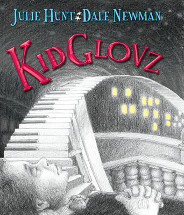
Themes: fable, magic, music, friendship, resilience. The lavishly
produced cover of this Australian graphic fable with its embossed
musical notes invites the reader to pick it up. Inside Hunt's epic
tale with Newman's pencil rendered drawings, reminiscent of Brian
Selznick's The Invention of Hugo Cabret, tell a dark story
about a boy with a musical gift. His mother sewed her song with a
magical thread into his gloves before she died and they are the
source of his musical genius. Brought up by a mean guardian Kid
Glovz is exploited as a child prodigy: 'at two years of age he
played the minute waltz in thirteen seconds' p5. At concert halls
and competitions, for a fee, he plays the piano. 'Tonight this
brilliant child prodigy will play Rackhoven's Symphony No.3 in E
minor with his left hand while playing Fekonhoff's Sonata No. 563
with his right' p6. There is no joy in the music and Kid Glovz is
not allowed to play his own compositions. To keep him small he is
underfed and made to rehearse all day. One night a thief, called
Shoestring, tightrope walks into his room and offers friendship and
a way to escape. The ensuing action is complex and involves a gang
of thieves, giant goatherds, a hermit oracle and Splitworld Sam, a
central character, condemned to live between worlds for robbing the
dead, who lures the boys into the underworld. At times the story is
a little confusing with a prelude and dream sequences that are not
immediately obvious but generally the graphics add another dimension
to the story and the characters are particularly expressive and
beautifully rendered. Additional readings will reward as subtleties
are revealed. The friendship between the boys develops, though each
starts out pursuing self-interest in the end looking after each
other becomes more important.
Upper primary to middle school students, especially boys, will enjoy
the developing friendship but all ages can enjoy the graphics and in
spite of the scary bits, like most fables, it would be a good book
to read aloud to younger children.
Sue Speck
The Star of the Week by Sally Rippin
Hey Jack series. Hardie Grant Egmont, 2015. ISBN
9781760124410
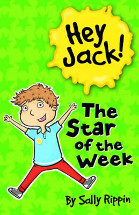
This is the final in the very popular Hey Jack series
written for those very young readers who are stepping between "home
readers" and "chapter books." The best friend of Billie B. Brown now
has a 20-book series deliberately written for boys who don't
identify with action heroes or spies.
As with the others in the series, Rippin takes a situation that her
target audience can relate to and explores it in an imaginative and
engaging read. This time, Jack is named "Star of the Week", a much
sought-after accolade but he's not sure he can carry the
responsibilities of the role particularly as his primary duty will
be to introduce soccer star Tim Little at the impending school
assembly and he is full of nerves and excitement. But then he
discovers Aaron crying in the boys' bathroom because his dog has
died and he has a brainwave that might cheer his friend up. It means
he won't get to meet the famous sportsman but . . .
Rippin says she was inspired by Dr Seuss, Richard Scarry and Joyce
Lancaster Brisley (Milly-Molly-Mandy series) when it came to
writing both Hey Jack and Billie B. Brown and she was determined
they "would begin in second person, contain the language of a school
reader and stick to the simplest day to day occurrences of a six to
eight year old," so they would be accessible and appeal to the
reluctant reader. She tried them out on her own son, massaging them
based on his responses and eventually bringing two series that have
been the starting point for so many to fruition. In an interview,
she says that she wanted her readers to be someone "who is ready to
try their first chapter book. Someone who wants to read about a
character they can relate to and who could, very possibly, become
their very best friend."
Having watched both family members and students immerse themselves
in both Hey Jack and Billie B. Brown and make
enormous steps in their competence and confidence, I think she has
hit the mark.
Barbara Braxton
Belinda the ninja ballerina by Candida Baker
Ill. by Mitch Vane. Ford St Publishing, 2015. ISBN 9781925272048
(Age: 5+) Recommended. Humour, ballet, Individuality, Difference.
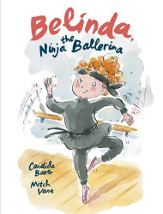
Belinda, enrolled in ballet classes against her wishes strives to
tell her mother and her teacher what she really wants to do. Dressed
in her tutu with slippers and leotard, but with a ninja belt and
headband, she practices her ninja moves on the bar, next to the row
of very pretty pink clad girls doing exactly what they are told. Her
teacher is not helpful, insisting on the moves for ballet classes,
but every Tuesday Belinda says the same thing, that she wants to be
a ninja. Towards the end of the term the class is organised for a
special performance, and Belinda is dressed in the costume the same
as the other girls, but doing handstands across the floor, sees a
germ of an idea develop with the teacher.
She uses Belinda's skills in a different aspect of the performance,
and while the other girls dance, Belinda is the spider, using her
ninja skills to great effect.
This is a glorious little story of one girl sticking to her idea of
being different, of not doing what is expected of her, but striving
to do what she wants to do. The illustrations perfectly reflect her
cheeky grin, her determination and courage to stand up for what she
wants. I love the humour in Mitch Vane's pen and ink illustrations,
revealing the movement of Belinda's ninja moves and the array of
girls within the ballet class. Her drawings underscore the idea of
being active, of sticking up for what you want to do and being an
individual.
Fran Knight
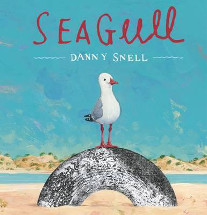
Seagull by Danny Snell
Working Title Press, 2015. ISBN 9781921504815
(Age: 4+) Highly recommended. Environment, Marine animals, Rubbish,
Pollution. When Seagull's legs become entwined in an old discarded
fishing line on the shore, she can no longer do the things she
loves: soaring in the blue sky above and floating in the strong
winds, hovering over the beach. Children will be dismayed at her
plight and hope, as I did, that she finds some relief from her
predicament as they turn the pages.
She attempts to disentangle herself, but finds it is stuck fast. As
she moves over the sand the line catches on other pieces of rubbish
left on the beach and her burden increases. She asks other animals
along the shore for help, and each; a mullet, crab and pelican only
succeed in loosening the attachment. Worn out she settles down into
the sand to rest and a boy comes along to help her.
This is a wonderful allegory for our misuse of our environment and
the story will intrigue readers making them both aware of the
dangers lurking on the beach for animals and encourage them to take
some responsibility for the rubbish left around. Involvement in the
plight of Seagull is instantaneous as the gentle words pull the
readers into her story, the illustrations reflecting her position.
Snell gives us a seagull with character, her eye peering out at the
reader on the cover, then looking more and more worried as the story
proceeds. The background of the small sand dunes, dotted with
tussocks contrasts vividly with the scattering of rubbish left
behind by human activity, and children will love noting the
different things Snell includes. I love the endpapers with their
small clutter of rubbish, the tyre covered in bird poo, the
depiction of the seagull as she tries to extricate the burden on her
legs.
This is a wonderful picture book, full of meaning, impelling lots of
discussion between children, in classrooms and at home, encouraging
a closer look at the rubbish thrown away by our society and the
impact it has on the animals we see every day.
Fran Knight
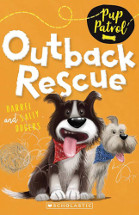
Outback rescue by Darrel and Sally Odgers
Ill. by Janine Dawson. Pup patrol series. Scholastic, 2015.
ISBN 9781743623022
(Age: 6-8) Highly recommended. Australian stories, Outback Life,
Dogs, Rescue Animals, Search and Rescue. The Pup Patrol
series are positively fun Australian stories narrated by Stamp the
loveable Border Collie. James his nineteen year old owner is
exploring the country in the Fourby the 4WD, with mixed breed
terrier Ace. They are in Far North Queensland ready to venture into
the outback off to Normanton and The Gulf. Cyclone Julia has caused
flooding on some of the roads and when James is forced to detour,
they meet some great new friends along the way.
They spend some time with Bobby Corella and his family at Camp
Billabong. Ace, of course is ready to get into the action while
Stamp knows he needs to be a good example, even though he really
wants to herd the free range hens. When Stamp and Ace encounter
Burnu and Girra the camp dogs, they are introduced to new
perspectives and dog understandings. After farewelling their new
friends, they travel down dusty tracks for several days and when Ace
needs a break they discover an abandoned car. A real bush search and
rescue mission follows.
Darryl and Sally's attention to detail with the dogs' behaviour and
their actions, as well as their true accounts of the dangers of the
outback create another great Pup Patrol adventure. Telling
the narrative from Stamp's point of view engages the reader's
interest and the abundance of doggy puns makes this a great book to
read aloud to a class. Janine Dawson's pen and ink illustrations,
especially the camp dogs singing in the moonlight and Stamp and
Ace's interactions and range of expressions add excitement to the
story.
Rhyllis Bignell
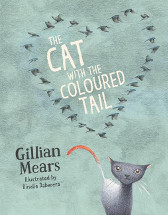
The cat with the coloured tail by Gillian Mears
Ill. Dinalie Dabarera. Walker Books, 2015. ISBN 9781922077400
(Ages: 6+) Recommended. Gillian Mears is known for her previous
fiction for adults, in particular the award-winning Foal's Bread.
The jacket tells us that Mears was inspired to tell this story while
travelling through the South Australian mallee country in her
converted 'ambo camper'. From the opening page, the reader is
fascinated by the ice-cream truck; its shape, and the type of ice
creams on offer - Moon Creams. The cat with the coloured tail is
especially intriguing - he senses the distress of others and can see
when the world is in danger, indeed his tail changes colour.
Together Mr Hooper and the cat change lives as they journey with the
ice cream van - this story is a fable, magical and lyrical. There
are all the ingredients of a fairy tale, given extra liveliness with
the gentle and evocative illustrations of muted and coloured shades,
some wonderful verse and the song-like descriptions. This is a
joyful, lovely little book, beautifully designed in hardback and
offering a rewarding environmental message. This would work well as
a family or classroom read aloud.
Julie Wells
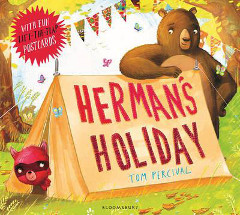
Herman's holiday by Tom Percival
Bloomsbury, 2015. ISBN 9781408852088
(Ages: 4-8) In this follow-up to Herman's Letter, Herman the
bear and his best friend Henry are off on a camping adventure. They
would have liked to go somewhere fabulous, like a luxurious beach or
Cake World, but they all cost much more money than Henry and Herman
can afford. While Herman has a wonderful time camping, nothing seems
to be going right for Henry - camping is just not his thing! Herman,
not wanting to see his friend sad any longer, puts into action a
plan that will turn the camping trip into Henry's dream holiday. The
matte illustrations provide much of the humour and detail of the
story, with funny signs, and pictures showing Henry's camping
misfortunes (being attacked by fish, struggling to pitch his tent,
the bridge collapsing under him). Creative touches like a black
cloud raining on Henry when he is upset as well as varied structural
elements (thought bubbles, multiple scenes on a page) all help to
make this an aesthetically pleasing, and engaging book. The
lift-the-flap postcards that Herman and Henry write provide another
element of fun that children will enjoy for their sensory appeal as
well as their humour. Tom Percival's wittiness here will appeal to
children and adults alike, especially fans of his other Herman
story.
Nicole Nelson
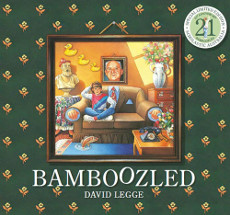
Bamboozled by David Legge
Scholastic, 2015. ISBN 9781743620212
(Age: 4+) Highly recommended. Award winner. Grandparents. Wit and
Humour. When a young girl visits her grandfather, she feels that
something is odd but cannot quite figure it out, and this contrasts
amazingly with what the reader sees on every page. Readers will
smile broadly at the topsy-turvey nature of the house in which her
grandfather lives. No ordinary place, there is lawn instead of
carpet, animals in the most unusual places, people seem to lean out
of the picture frames on the walls, the inside of the house
sometimes feels like the outside, but she still cannot see what is
different.
They do the things people do when they visit. They have morning tea
with freshly baked cakes and play cards; she helps with the
housework and does some gardening with her grandfather. The
watercolour illustrations are filled with things for the readers to
look at and laugh about, sharing what they see with others in the
group. They will laugh out loud turning the pages eagerly to see
what else Legge has added to this topsy-turvey place.
This edition republished for its twentyfirst year, will intrigue and
delight a new generation of readers as they find all the differences
in grandpa's house and ponder over the one difference the
granddaughter can see.
A welcome addition is a note from David Legge outlining where his
ideas for the book came from, and showing some of his drawings as
the ideas developed, including photographs of the people he used as
the models for his characters and a photo of himself at work.
Children will simply love this house and the gentle relationship
between the grandfather and his granddaughter, culminating in her
realsising what the one difference is. Along the way, readers will
see grandfather looking after himself doing most of the work around
the house, a child visiting and helping and the sorts of things
people do when visiting. This book contains a lovely image of
day-to-day activities set against an improbably hilarious house, one
that will keep children chuckling for a long time after the book is
read.
Fran Knight
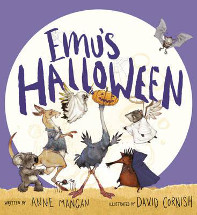
Emu's Halloween by Anne Mangan
Ill. by David Cornish. Harper Collins, 2015. ISBN 9780732298906
(Age: 5+) Recommended. Halloween. Australian animals. Rhyming story.
Emu is worried because he has a Halloween party coming up but he
feels it is not scary enough. So his friends, Cockatoo, Kangaroo,
Koala, Tasmanian Devil, Red-back Spider, Echidna and Fruit Bat come
to the rescue. Each brings along its own invention designed to make
things scary. Kangaroo dresses as a zombie, while Tassie Devil is
resplendent in angelic white, Koala has nuts and bolts in his neck
like Frankenstein's monster, while Red-back Spider doesn't need to
dress up at all! Echidna comes as Dracula, and Cockatoo uses a sheet
to make him appear as a ghost. When October 31 comes around
everything is just as scary as Emu had hoped. Everyone has dressed
up, he tells lots of ghost stories, and Fruit Bat bobs for apples.
Everyone has a truly scary time celebrating the evening.
Told in rhyming couplets, children will love reading it aloud,
predicting the rhyme that matches the first line, and marvelling at
how the animals fit into the tale. The story includes many known
Australian animals and readers will adore looking at David Cornish's
wonderful illustrations of the animals at play.
As the tale proceeds, children will learn many things about
Halloween, its date, what children do on the night, how they scare
each other, and learn about Frankenstein and Dracula, as well as how
to use things close at hand to dress up for the celebration. Not
only a wonderful story well told, and sumptuously illustrated, but a
model for classrooms to celebrate an Australian Halloween.
Fran Knight
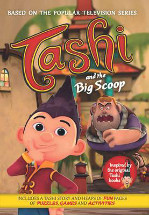
Tashi series by Anna Fienberg and Barbara Fienberg
Based on the popular television Series. Allen & Unwin, 2015. Tashi and the big scoop. ISBN 9781925267006 Tashi and the magic carpet. ISBN 9781925267013
(Age: 6-8) Recommended. Two more exciting stories are taken from the
animated Tashi series produced by Flying Bark Productions.
In Tashi and the big scoop the boys and in fact the
villagers are woken each morning by the raucous shouts of ogre Tiku
Pu and the loud ringing of his bell. He's letting everyone know
about the upcoming kite festival and the catastrophes occurring
around the town. Jack builds a printing press, determined that the
village news should be printed not shouted! Every time the boys rush
to gather the news, the ogre beats them to it, yelling out the
information to the villagers instead. When icy snowballs splatter on
the villagers' heads, the boys race up into the mountains, and an
ogre stuck in a crevasse, a large blue monstrous creature and Tiku
Pu's greediness, all make for a daring adventure. The boys finally
have a big scoop for their paper. Tashi and the magic carpet begins with Second Uncle preparing
to set off on another big adventure, rescuing the monkeys of
Munchanana from their prison in the jungle. The boys watch as their
uncle auctions off his treasures to raise funds. The boys become the
lucky owners of a magic rug, just right for Can Du's birthday
present. Whilst beating the dusty rug on the outside line, the boys
observe two disguised guards dressed as clowns entering the village.
Mayhem ensues when Tashi begins to interpret the diagrams on the
dusty rug as ancient runes, and saying the magic words leads to time
travel and more adventures. The appearance of the escaped monkeys
causes mayhem as well, and the boys are in for another wild ride.
Each book concludes with puzzle pages, activities and games, just
right for a young Tashi fan.
Rhyllis Bignell
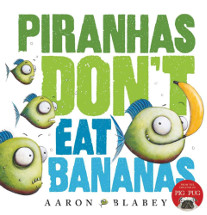
Piranhas don't eat bananas by Aaron Blabey
Scholastic, 2015. ISBN 9781743625781
(Age: 4+) Highly recommended. Humour, Piranha, Food, Fruit and
vegetables, Diet. Beginning with a grisly list of what piranhas are,
where they live and what they eat, Blabey's tongue in cheek attitude
to this fish begins, making readers laugh from the first endpaper to
the last. Blabey's list of edible delicacies begins with animals,
particularly those found in the South American jungles, but quickly
descends into all the animals kids know and love, bunny rabbits,
puppies and kittens before listing, I suspect, a few people that
Blabey could do without, including naughty children, astronauts,
professional tennis players and belly dancers.
With the tone set on fantastic fun, the rhyming couplets detail
Brian's attempt to get his peers to eat some fruit and vegetables.
Readers will love predicting the rhyme of every line and learning to
say the lines out loud. Little by little the child in the water is
revealed, adding to the fun as the readers predict what part of him
the fish may chose to nibble on, but when Brian suggests 'juicy
plums' then the readers will love yelling out the word that rhymes,
and then want to start over again. The last endpaper gives
information about bananas, showing why piranhas simply do not eat
them, but leading the way for the group to discuss what they eat,
and for a parent or teacher to look at fruit and vegetables in a
different way.
Blabey's illustrations are just wonderful: the cheeky looks on
Brian's peers, the predominance of razor sharp teeth, the Carmen
Miranda fruit, all add to the fun of the reading for one and all.
Fran Knight
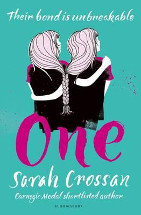
One by Sarah Crossan
Bloomsbury Publishing, 2015. ISBN 9781408863114
(Age: 14+) Highly recommended. Topics: Conjoined twins. What it
means to be an individual - identity, What it is like to have an
absolute soulmate. What it is like to be born different. Teenage
relationships. One is about the fascinating subject of the unique
relationship between conjoined twins. The book explores what it
means to be an individual, who is totally connected to another
person, and dependent on them for your existence, in a most
sensitive way. It is written from the perspective of one of the
twins in such a convincing manner, that the reader can start to
embrace what is means to constantly think of someone else. When
flicking through this book, you may be forgiven for thinking it is a
series of poems, but it is actually a book where the typeset is used
in a unique and cleverly decluttered style. The space entices the
reader to stop and think, imagine and be challenged. This is a true
page-turner, with chapters flowing from one topic to the next. Often
the shortest chapters are the most poignant.
The sixteen year old twins Grace and Tippi experience much more than
most teenagers. Daily they have to deal with people's ignorance and
insensitivity, constant monitoring by doctors, parents who are
protective and often overwhelmed, and low life expectancy. There are
some fascinating insights into how synchronized they are and the
complexities of shared body parts, yet how they like doing different
things, enjoy different food and manage having private
conversations. As teenagers they are more than challenged when it
comes to learning to drive, are interested in boys, want to earn an
income, and need time on their own. One is also a story of
two people who are so connected in love and sisterhood that it would
be almost unthinkable if they weren't together.
Sue Galpin
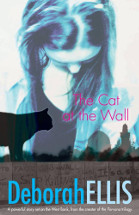
The cat at the wall by Deborah Ellis
Allen & Unwin, 2015. ISBN 9781760112448
(Age: 11+) Recommended. Palestine, Conflict, Israel, School, Family.
When Clare dies in her home town of Bethlehem in Pennsylvania, she
is reincarnated as a cat in Bethlehem, the West Bank caught between
the enmity of the two opposing groups as she takes refuge in a
Palestinian house which two Israeli soldiers are using as a
observation post. Here the cat is grudgingly befriended by the two
National Service soldiers, one from the USA and the other an
Israeli, but the cat can smell another human in the one roomed
house. A child is hiding from the Israelis, and becomes a catalyst
when his teacher knocks on the door wanting to know why he is not at
school. The situation escalates when she sees the soldiers inside
and while calling for help, some older children arrive with stones
ready to fight.
Ellis masterfully aligns the two stories, that of Clare at school, a
knowing thirteen year old, pitting herself against a disliked
teacher, and the cat in the Palestinian house watching the events
unfold. Both stories reveal the nature of conflict built up over a
period of time, with suspicion and a lack of trust taking only a
small flash point to become a major incident. As the cat tells what
is happening inside the house, she also relates the events in
Pennsylvania leading to her death, the antagonism with the teacher,
her bullying of her sister, her manipulation of her friends and
family. She is a selfish young girl, one who steals and tells lies
to get her own way. And it is the situation in the Palestinian house
which eventually makes her see herself for what she was.
The continually enthralling story of Clare and her manifestation as
a cat will intrigue readers as they see her become a more humane
person, just as the two soldiers and the crowd outside the
Palestinian house peacefully resolve the conflict which is about to
happen with the cat leading the way for Clare to redeem herself.
Ellis has distilled a major conflict on the world stage to a story
involving just a few people, reminding us all that no matter what we
see on the news or hear politicians say, these are people like any
of us, wanting to live on their own patch of land in peace.
The background against which the drama unfolds is well drawn
allowing younger readers to develop some understanding of the
mistrust between some and the efforts by others to keep the
situation conflict free.
And overlaid with the Desiderata, several lines seem to run as a
theme through the story, Speak your truth quietly and clearly; and
listen to others, even to the dull and the ignorant; they too have
their story.
Deborah Ellis is the author of a growing group of stories for middle
school people, giving a point of view not often exposed to our
readers such as the Parvana series and the Diego
books about children's involvement in the cocaine trade in South
America, amongst others.
Fran Knight
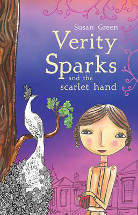
Verity Sparks and the Scarlet Hand by Susan Green
Walker Books, 2015. ISBN 9781922244895
(Age: 9-12) Recommended for those who like a Magical Mystery.
Themes: Mystery; Family; Adventure; Paranormal. This is the third in
the series involving the young girl Verity Sparks, and it is
possible to read it as a stand-alone book (although I suspect that
some of the relationship history would have made more sense if the
previous two books had been read.) Verity comes from an unusual
background (undoubtedly revealed in earlier books) and her family
seems to have been created by linking those in need of love. Set in
Castlemaine in 1880, it has a lovely old-fashioned feel, and is
filled with characters with unusual histories, laced with tragedy,
from places far and wide.
Verity Sparks has a prophetic gift that enables her to see and solve
mysteries by touching items that trigger connections, allowing her
hallucinations to reveal the past or the future, and then to connect
these visions to present day problems. This unusual gift is put to
good use in solving a mystery of a shadowy woman, whose appearance
creates confusion and also to unravel a kidnapping.
This book reads like a young person's detective mystery (with a
magical dose of prophetic inspiration). Readers who have begun the
series will no doubt be delighted that Verity has returned.
Carolyn Hull