Random House, 2015. ISBN 9780857981707
(Age: 14+) Highly recommended. Depression, Suicide, Relationships,
Psychiatric hospitals, Therapy, Future. When Declan sees the train
appear, he runs towards it but suddenly pauses, thinking about the
impact his death will have on those around him. His girlfriend, Lisa
has been sent to Hong Kong, the furthest her dragon mother can send
her away from Declan, and without a mobile phone, has not
communicated with him for days. He is absolutely bereft and long
forgotten trauma builds adding to his depression and anxiety. That
pause saves his life, and the novel, told in non chronological
scenes, tells us why and how he got to this point.
But Larkin is at pains to tell us in his opening letter that this is
not a suicide novel, rather one of hope and the reasons for living.
He has been at this point and wants readers to know the signs, to
know there is help, to know that life is worth hanging on to.
Told in first person, Declan reveals his growing relationship with
Lisa, the abject disdain of her mother, the waiting for a call from
her in Hong Kong, the build up of tension and anxiety as he comes to
the conclusion that their affair is over, and so the decision to
die.
His pause on the railway station sees him surrounded by caring
people, holding his hand, calming him down, talking gently to him.
The ambulance takes him to emergency with the ambo holding his hand
the whole time, and from there he is sent to a psychiatric unit.
Here he learns techniques to avoid stress, to be aware of the signs
of depression, to take medication that will help and he learns to
laugh.
In the background his parents are bickering, hints are given about
the dreaded Aunt Mary, and what seems an average family home,
becomes more splintered. The second part of the story in part
belongs to Lisa. Declan and his mother opt to got to Hong Kong for
their family trip and there he meets Lisa and she is able to tell
him what has happened to her. Overwhelming as her tale is she always
felt that Declan was there, propping her up, encouraging her to take
a stand against her mother, showing her that other families exist
quite differently. And Declan finally opens up to her about the
trauma of his past and the triggers which brought it all to the
surface.
This is a wonderful story. Declan is frank about his reasons for
thinking about suicide and just as frank about the pause. The story
breathes truth, the psychiatric unit resounds with people's lives
interrupted by trauma, and readers will be left knowing how to
approach their friends who are having a rough time and recognise
symptoms within themselves. Larkin has certainly achieved his aim of
writing about hope.
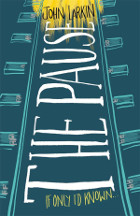
And I must point out the wonderful cover and book design, the
chapter headings and placement of the chapters, which all contribute
to an absorbing read.
This book unsurprisingly won the Queensland Literary Award in 2105
for Young Adult Novel.
Fran Knight
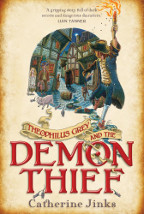
Theophilus Grey and the demon thief by Catherine Jinks
Allen & Unwin, 2015. ISBN 9781760113605
(Age: 10+) Highly recommended. Humour, Historical novel, London,
1750, Street children. Theophilus (Philo to his friends) works for
the lawyer's clerk, Garnet Hooke, a man who stays all day in bed,
sending out his gang of linkboys to not only take people home in the
dark of the night, but also gather information which he then sells.
Philo hears from one of the less desirable acquaintances that there
is something not quite right, a feeling of someone behind him, of a
fearful smell. Philo talks to his master about it, but his fears
about a demon are dismissed, although Philis is dismayed when later
he finds that Garnet has been giving herbal remedies to others who
are worried.
A London of two and a half centuries ago is brought incredibly alive
in Jinks' writing as we see the children who work the streets,
lighting the way for people going home, pickpockets, potboys and
footpads, all squeezing out what little money they can get to
survive. We see the women coming into London escaping their
husbands, going to the parish church for help, girls selling small
bunches of herbs on the street, the workhouses that some of Philo's
crew have lived in, all uncomfortably real, redolent of the
eighteenth century, of the London of a century before Jinks'
previous series, City of Orphans.
This is the first in a series of two novels following Philo as he
tries to unearth the demon that people think is striking people
down. Helped by his new friend, the physician, Mr Paxton, he treads
a wary path through the machinations of his ill employer and those
who want him out of the way. His investigations take him to Rat's
Castle, the dwelling of the worst of men in the byways of London's
West End, and here he finds the flower seller, Samantha in a
particular predicament.
The background of this wonderful story is so well detailed that any
reader will be able to smell the filth and grime in which people
live, and wonder at the changes that have befallen our lives in two
hundred years and be grateful for it.
Philo is a most likable character, illiterate but street wise, canny
in keeping himself and his crew safe, waiting for an opportunity to
make a small amount of money and wary of those around him who would
do him and his friends harm.
Fran Knight
Sad, the dog by Sandy Fussell
Ill. by Tull Suwannakit. Walker Books, 2015. ISBN 9781921529641
(Age: 5+) Highly recommended. Pets, Dogs, Family, Home. A dog given
to an older couple as a gift is looked after by them but never given
a name. They feed him, wash him, scold him for barking or digging
the garden, or tearing up the newspapers but do not name him. So he
names himself. He calls himself Sad, because that is how he feels in
this home where he is unwanted and unloved. One day the couple pack
their belongings and move away leaving Sad behind. A new family
arrives and the young boy sees the dog and is instantly excited. The
family feeds him, they give him fresh water to drink and take him
for a walk. He is given a soft warm bed on the back verandah and
when he wakes, Jack is there with a treat. He does all the things he
did with his previous family but now he is not scolded or left
outside; he is loved, wanted and called by his new name, Lucky.
This is a treat of a story, one full of warmth and charm as the dog
is at first not cared for and then finds someone who loves him.
Along the way readers will see the difference between owning a dog
and loving and caring for a dog, how a dog reacts to the care given
it, of how an animal fits into the family. Children will love
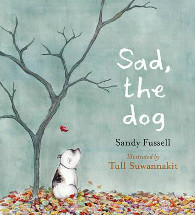
reading of Sad and marvel at his change of fortune, and be instantly
mesmerised by the watercolour illustrations showing the changes in
the dog's fortunes as he goes from being alone and dejected to being
alive and happy. The endpapers reflect his status beautifully. This
is a treat simply as a great story well told and illustrated, but a
boon for teachers and parents wanting to discuss the care of a pet.
Fran Knight
Shadowcat by Julia Louise
Ill. by Anne Ryan. Five Mile Press, 2015. ISBN 9781760067090
(Age: 4+) Recommended. Bravery, Dreams, Siblings. Edith often sits
in the garden alone, avoiding her baby brother. She feels she is
turning into a garden gnome, sitting there quietly, without moving,
allowing the grass to grow around her. But one day a cat comes by
and asks her why she is doing what she is doing. He inquires why she
doesn't dream, and Edith, surprised asks him how he knows. He tells
her that cats can see when people dream as stardust forms around
them. He takes her hand and together they walk into the overgrown
garden and he teaches her to dance. Each night she dances and
stardust forms around her as she dreams. She dances in the garden
taking her brother's hand in hers. But one night the cat does not
come back, and she begins to feel a bit gnomish, until she finally
sees him through her window and he tells her to dream alone, to be
brave as the stars are always with her.
This is a charming story of daring to dream, of being brave, as
Edith becomes introverted when a baby appears in the household,
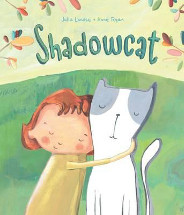
losing her place within the family. The stylised acrylic
illustrations show the young girl sitting quietly in the garden,
amongst the gnomes. The shadows of the trees make the garden look
ominous, but the night sky becomes warm and encompassing as she
dances with the cat.
A wonderful addition to the range of stories about the arrival of a
new baby in the household and learning to be resilient.
Fran Knight
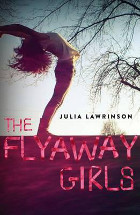
The flyaway girls by Julia Lawrinson
Penguin, 2015. ISBN 9780143308652
(Age: 10+) Highly recommended. Gymnastics, Jealousy, Friendship.
Chelsea is threatened when a new girl, Telia joins her gymnastic
club. Chelsea has worked hard for a long time, doing extra training
at home after her five hours at the club each week, in preparation
for the Nationals. But this new girl has a natural talent that
Chelsea can only dream about, and each time she tries a new skill,
needs only a small amount of instruction from Louisa to get it right
the next time. Ellie does not believe that she has not been trained
and continues her snide remarks and comments towards the new girl.
Chelsea's other friends, Rosie and Gemma, practising for the school
band, form a neat contrast to the problems at the club, especially
when Chelsea can see her aim of being chosen for the Nationals
slipping away. But she likes Telia, and cannot abide the bickering
of Ellie, so she has a dilemma to work out, who to support.
This is a wonderfully written story of middle primary girls training
their hearts out for a chance at a place in the top rung of their
sport. The threat of not making it is always hangs over their heads,
and their regime at the club reinforces the work they must do to
succeed.
The finely observed detail of working so hard at club level pervades
the story and the reader settles in easily into the strengths and
weaknesses shown by the girls.
Problems at home also add to the mix of this very readable story
which will make all readers watch with new eyes the gymnastics at
the Olympic and Commonwealth Games.
Fran Knight
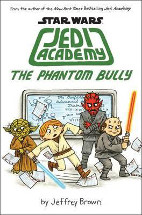
The Phantom Bully by Jeffrey Brown
Star Wars: Jedi Academy bk 3. Scholastic, 2015. ISBN
9780545621267
(Age: 9-12) Recommended. Author, illustrator Jeffrey Brown's popular
Star Wars Jedi Academy returns. Roan Sanchez is about to
enter his final year at the Jedi Academy. Middle School proves to be
challenging for the young trainee, as he is honing his Jedi skills,
performing in a class talent show, dating and coping with the class
bully Cronah. Creatively set out as diary entries with class
schedules, notes, holomail, holobook chats, cartoons, graphic
diagrams, Roan's diary is an exciting account of his student life.
After Spring Break Roan settles down to training with his mentor Mr.
G, as he wants to be a pilot like his father and enjoys using the
flight simulator. There's the Jedi Obstacle Challenge Trial to
complete where Roan learns the importance of friendship and
resilience. At the Icecream Social, Roan serves the dessert with
mite sauce and beetle jelly added for extra taste. Of course
Cronah's involved in this mischief. After a light saber battle
between Roan and his enemy, the reader gains an understanding of the
reasons behind the bully's behaviour.
This diary format with personal information, insights and
illustrations is an extremely popular format with preteen readers.
Jeff Brown's setting of the Jedi Academy and his understanding of
middle school life makes this another exciting adventure for Star
Wars fans.
Rhyllis Bignell
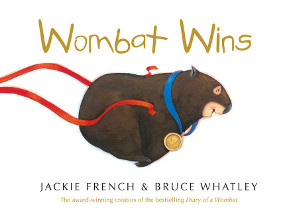
Wombat wins by Jackie French and Bruce Whatley
Angus & Robertson, 2015. ISBN 9780732299576
(Age: 4+) Recommended. Wombats, Winning, Carrots. The winning
combination of French and Whatley has produced another book in the
series about wombats. In this one, Mothball goes along to the school
sports day. She has yawned, scratched, eaten some grass and noticed,
after rummaging through the fridge that the small humans are racing
past the window.
The reader can see from their distinctive clothing that they are off
to a sporting arena of some sort, but Mothball has only one thought
in mind, to beat them getting to the carrots. So begins a marvellous
series of pages where Mothball is seemingly competing against the
small humans, winning the race by burrowing through the hill,
winning the sack race, jumping across the heads of the swimmers to
reach the end of the pool and inadvertently taking a gold medal. But
she spies a shopping bag out of which is sticking some greenery, so
hunts it down and luxuriates in the greens until she falls asleep.
Ah, just another day in the life of a wombat, Mothball. Readers will
love reading the story and looking at the wonderful illustrations,
reveling in the antics of this creature, wondering just how one
comes to be in a household, and marveling at the patience needed to
house such a thing. And also contemplate the idea of sports days,
winning and aspects of competition.
Fran Knight,
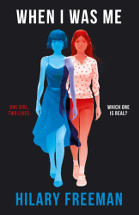
When I was me by Hilary Freeman
Hot Key Books, 2015. ISBN: 9781471404924
(Age: 15+) Story: Yesterday, Ella's life was completely normal.
Today, she woke up as a different person. Or, to be more exact, she
feels like the same person, but she looks different, her friends are
different, and every facet of her life is different to what she
remembers. At first she thinks she must be crazy, especially since
she's the only person who thinks that anything is wrong, but when
she meets a stranger named Daniel, she starts drawing closer and
closer to the truth . . .
Review: First things first: When I was me is actually a good
book. It has an intriguing, very original plotline, some interesting
characters, and tremendous amounts of potential. However, this
potential is never fully achieved - despite being very promising at
first, this book ends up just sitting squarely within the genre
of 'teen romance'. While not a bad thing necessarily, the
intrigue of the original idea - that of a girl waking up in a life
that is not hers, and all the consequences of that - almost feels
wasted here. One feels that Freeman could have easily made this into
a complex thriller with a dash of science-fiction sensibilities, but
instead the book remains simple - at times far too much - and
becomes just another run-of-the-mill teen novel rife with romance
and friendship dramas. This is not to say the novel is totally
flawed, however - there are some excellent themes here at play, and
Freeman deals deftly with complicated topics such as finding your
identity, and how we perceive reality. The characters are
interesting, yet ultimately underdeveloped, and it rollicks along at
an exciting pace. But while this novel is definitely enjoyable, it
never quite reaches the heights it could have, and ultimately,
that's the most frustrating thing.
Rebecca Adams (university student)
Battle of the Heroes by Kate Forsyth
The Impossible Quest bk 5. Scholastic, 2015. ISBN
9781743624104
(Age: 9-12) Highly recommended. Themes: Fantasy, Magical Creatures,
Good and Evil, Sorcery, Quests, Adventures. Kate Forsyth's
impressive conclusion to her magical fantasy series Battle of
the Heroes pits the four young heroes and their magical
creatures against the most frightening of creatures in Wolfhaven
Castle. Quinn, Sebastian, Elanor and Tom have escaped the evil witch
sisters' clutches by ingenious trickery and begin preparations for a
dangerous sea voyage to return to their former home, free the
imprisoned lord and his people and fulfill the ancient prophecy.
They have gathered the magical elements, a griffin's feather,
unicorn's horn, sea-serpent's scale and dragon's tooth and are ready
to wake the four sleeping warriors hidden beneath the castle. Sabre
the sea-serpent aids the travellers pulling their wooden coracles
across the dark treacherous lake.
Each step of their journey is fraught with danger - fighting the
spear-wielding bog-men, escaping from the Mistress Mauldred's
attacking ravens, relying on their magical creatures for rescue -
Tom's griffin helps with Jack's escape. The young adventurers draw
on their skills and knowledge to race into the underground tunnels
constantly being chased by their enemies. Together they discover the
hidden bone key in the Great Room and the secret passage that leads
to the sleeping warriors' chamber.
The final battle scenes are heightened drama, fighting a skeleton
army riding skeleton horses, fierce giant rats, swash-buckling sword
fights and overcoming the witches evil acts that nearly foil the
prophecy's fulfillment.
Kate Forsyth's rich imagery, feisty characters, lyrical language,
fast-paced action and engaging magic and fantasy elements, make the
The Impossible Quest series appealing to both younger readers
and adult fans of this genre.
Rhyllis Bignell
Me and Earl and the dying girl by Jesse Andrews
Allen & Unwin, 2015. ISBN 9781760290184
(Age: 14+) Recommended. For those thinking this contemporary debut
is similar to John Green's The Fault in Our Stars, think
again. This entertaining and highly realistic novel is not your
average 'sick lit'. Greg Gaines is a bit of a social chameleon. His
goal is to remain civil with everyone at school but not to belong to
any particular clique. After all, Greg just wants everyone to like
him. He only has one real friend, the pint-sized and foul-mouthed
Earl, who shares his love of film making. At least Greg only has one
friend until his mother makes him hang out with Rachel, an old
childhood acquaintance who has been diagnosed with leukaemia.
Despite Greg's protests, his mother believes that he can use his
infamous humour to cheer Rachel up in her time of need. Greg ends up
sharing more with Rachel than just his jokes, and he is well and
truly pushed out of his comfort zone. The one thing that he tried to
avoid, being disliked by anyone, becomes all too hard after all.
Jesse Andrews explores many themes in his debut including grief,
peer pressure, poor family backgrounds, and of course, cancer. He
tells the story of a leukaemia stricken girl in a very honest way
and uses humour to soften the harshness of this topic. Some mature
middle school students could handle this book, but it would better
suit senior school students due to the language used, and the
reoccurring use of drugs and smoking in the novel. Although, both
are well within the context of the story and are necessary in
exploring the theme of poor family backgrounds. Boys will especially
enjoy this truly hilarious and very real novel.
Emma Gay
Blue whale blues by Peter Carnavas
New Frontier Publishing, 2015. ISBN 9781925059410
(Age: 4+) Warmly recommended. Whales, Depression, Friendship,
Environment. When Penguin hears Whale singing the blues, he decides
to investigate. He asks what the problem is and Whale points out
that his bike is not right. Penguin laughs saying it is just upside
down and puts it up the right way and Whale is happy. Later Penguin
hears him singing the blues again and asks him what the problem is.
Whale is concerned that his bike is getting wet so Penguin gives him
a towel to dry it. This story line continues as the Whale sings the
blues and Penguin comes along like a good friend to help. Each four
page sees something which troubles Whale, and a friend coming to his
aid. When Turtle turns up on a trike, Whale laughs when Penguin
explains that he cannot use a trike as he has no legs and arms. This
evokes a great belly laugh from Whale and the friends are happy that
Whale is happy.
A gentle repetition of one line about the Whale feeling happy will
be a line readers will call out when each situation occurs. The song
to accompany the story is available as a download, and the
illustrations will cause a ripple of laughs from the readers as they
spy the absurdity of Whale's concerns under the sea. Along the way
readers will get a sense of some of the rubbish which eventually
finds its way into the oceans, and wonder how it affects the animals
that live there.
Fran Knight
The Tournament at Gorlan by John Flanagan
Ranger's Apprentice, The Early Years bk 1. Random House
Australia, 2015. ISBN 9781742759302
(Age: 10+) Recommended. I admit that I am a big fan of the Ranger's
Apprentice series and so I was looking forward to reading this
prequel.
This book takes us back to earlier days when Halt was an aspiring
Ranger. He travels with friend and fellow Ranger, Crowley, on a
mission to rebel against Baron Morgarath's evil plotting.
King Oswald is virtually a prisoner and Prince Duncan apparently has
begun to behave in a cruel and un-princely manner, losing the
support of his people.
Halt and Crowley need to find the many Rangers who have been
dismissed and replaced with Baron Morgarath's puppets.
This book highlights the friendship between Halt and Crowley. They
enjoy each other's company and their friendly banter and jibes are
comical and entertaining. Each ex-Ranger that joins their group
brings their own story and skills but they are only a small group
and Mogarath has the support of many.
The action, suspense and dialogue keep the reader entertained and
always curious about the next chapter. This is a classic good
against evil story that delivers a great tale.
I recommend this book for students from 10 years +.
Jane Moore
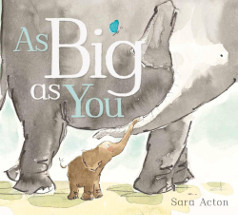
As big as you by Sara Acton
Scholastic, 2015. ISBN 9781743629697
(Age: 4+) Highly recommended. Difference, Elephants, Size and shape.
The soft watercolour illustrations of Sara Acton fill the pages of
this engaging book showing its readers the difference between the
words big and small, as the father (Claude) and baby elephant
(Finlay) compare their exertions. Claude flaps his ears to cover his
head from the sun, while Finlay can only wriggle his: Claude can
trumpet loudly but Finlay can only produce a squeak: Claude's feet
on the ground sound like thunder, while Finlay's little feet only
bounce. Claude can run very fast and Finlay has trouble catching up,
so much so that he lags behind and cannot see his father. He climbs
a tree to see if he can see Claude, and then falls, finding he can
use his ears to float to the ground and into his father's arms.
All the while the wonderful illustrations will attract the readers
to watch as Finlay explores his environment, learning what he can
and cannot do at his age. Guided by dad, he learns things about
himself, and learns particularly that he will grow up to be like dad
in time. A wonderful book to read with young children, reinforcing
the relationship between father and son, showing readers that they
too will be like dad one day, and teaching them the difference
between the words big and little.
Fran Knight
Emmy and Oliver by Robin Benway
Simon & Schuster, 2015. ISBN 9781471144134
(Age: 15+) Readers will laugh out loud and sympathise with a heart
wrenching story as they enjoy Robin Benway's, Emmy and Oliver.
After the kidnapping of her best childhood friend - Oliver - in 2nd
grade, Emmy has wanted to be in charge of her own life and break
free from her overprotective parents. Now, in her final year of
school and on the cusp of adulthood, Oliver is back. He's not the
little boy Emmy remembers from next door - he is a tall, handsome
stranger. Though he isn't the carefree little boy he once was.
Oliver is dealing with a tumultuous past - he must come to terms
with being kidnapped and lied to all these years by his own father
and learn to fit in to his new life with a mother he barely
remembers and her new family - the one she started after he was
snatched away.
Emmy and Oliver have always shared a connection that neither can
ignore - one that picks right up where it left off. Benway writes
with humour and captures poignantly what it's like to be a teenager
facing grown up decisions. Readers will love her easy-to-read style
of writing and connect with her surprisingly real characters, though
should be aware of the occasional profanity she uses in order to
express the raw emotions of an aching heart. Benway drops the pace
slightly midway through the novel, but finishes strong. This novel
is recommended for public and school libraries for mature teen
audiences. (15+).
Rhiannon Mesner
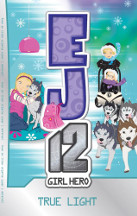
True Light by Susannah McFarlane
EJ12 bk 20 series. LemonFizz Media, Scholastic, 2015. ISBN
9781925206036
(Age: 8-10) Highly recommended. Themes: Family Life, Spies, Codes
and Ciphers, Resilience. Family is a very important part of Emma
Jack's life, both her mother and her Farmor - father's mother have
undertaken SHINE missions and adventures. Although Emma is upset
about the loss of her grandmother, she must show courage and
resilience as she takes on a new mission with SJ45 her mum.
Somewhere in the Arctic Circle SHADOW agents have set up a
laboratory to make copies of every world currency. Emma's skills in
solving codes are called upon to help find the hidden location.
In EJ12 Girl Hero 20: True Light, solving the present day
mission and one that occurred nine months earlier in Sweden are
mysteriously linked. In a flashback Emma recalls her special visit
with her father's family, celebrating wonderful Christmas
traditions. She loves the food - smorgasbord meals, making the
meatballs with her cousin and singing to the ham. Emma's father and
aunt are concerned for their mother who is looking frail. The day
after Christmas Emma and her mother are called out on a mission -
Farmor BH85 has a secret spy room in her wardrobe as well.
EJ12 is on another amazing adventure, dog sledding across the icy
landscape, helping poisoned reindeer, finding the hidden mine and
collecting a mysterious little red horse that has a hidden message.
Her present day mission in the Arctic summer is just as exciting, as
she works with her mother again to stop SHADOW's evil plans.
Susanna McFarlane's novel gives the reader a great insight into
Emma's family life and the SHINE connections. Her descriptions of
fabulous scenery, delicious food and Swedish Christmas traditions
make this an extra special story in this popular series.
Rhyllis Bignell