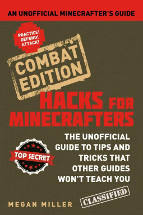
Bloomsbury, 2015 Hacks For Minecrafters: Combat/Builder. ISBN 9781408869635 Hacks for minecrafters: Master builder. ISBN 9781408869628 Hacks for Minecrafters: The Unofficial Guide to Tips and Tricks
That Other Guides Won't Teach You. ISBN 9781632204400
(Age: 9-12) Recommended. Themes: Gaming, Survival, Building. These
books would be enjoyed by all people who enjoy playing computer
games and in particular Minecraft. The three books are about 'Hacks
and Tips', 'Combat' and 'Building' in Minecraft. The books have tips
from: how to build glass domes, to how many times you have to hit a
creeper with an iron sword to kill it.
The books are titled Hacks For Minecrafters yet after
reading all three I discovered that there is only one hack between
all the books, and that hack is common knowledge to most PC
Minecrafters. Although there are no hacks in the books almost every
piece of information they contain is very helpful. I may not be an
avid Minecrafter but I found the books very interesting. These books
would not make very good gifts but for people new to Minecraft they
would be very helpful given the amount of information they contain.
I would recommend the books for people who play Minecraft at about
9-12 year olds. For those who struggle to read, they may be a little
difficult as they contain a few complex words.
Reuben Schumacher (Student, aged 13)
Now you see me, now you don't by Silvia Borando
Walker Books, 2016. ISBN 9781406364217
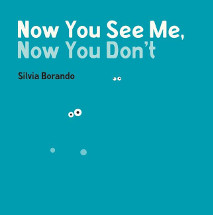
(Ages: 2-7) Wordless, Camouflage/Visibility, Colour, Animals. This
is an English translation of a 2013 Italian publication and part of
the Minibombo series (little book buzzing with a big idea).
The website has information,
activities and games related to the books that could be used or
adapted for the classroom. The big idea in this book is colour and
camouflage/visibility. There are the same animals and configuration
on each page, with the landscape and colour of the background
changing each time (green grass, orange autumn leaves, blue sky,
etc.). So on each page one or more of the animals is camouflaged
with the background (blue bird blends in with the blue sky, grey
mouse with the stony ground, etc.) and only their eyes or other
differently coloured features can be seen. The animals are not all
naturally coloured and life-like or this concept wouldn't work. They
are all block colours and there is a purple elephant and a pink
rabbit. Most of the others are their general colour (eg. green
crocodile, brown bear and grey mouse). The book will encourage
conversations about what animal cannot be seen on each page and why.
There is no other text so it relies on children and parents to talk
about and interact with the book. This is a useful resource for
teachers to use when discussing colour and the concept of
camouflage. It could be used as a starting point for camouflage
activities and artwork. The last spread also provides for great
discussion as the background is black and now none of the animals
(except for their eyes) can be seen. There is also a chameleon that
is only seen on the first page.
Nicole Nelson
Bear make den by Jane Godwin and Michael Wagner
Ill. by Andrew Joyner. Allen and Unwin, 2016. ISBN 9781760110017
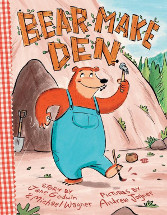
(Ages: 3-6) Recommended. Andrew Joyner's superb illustrations make
this immediately appealing and the story does not disappoint. The
bear on the cover immediately comes across as loveable and
hardworking, depicted working away in his blue overalls with a
satisfied grin. He sure is a competent DIY bear - painting, sewing,
building, baking, he can do it all. The country feel of the book,
owing to the red and white check cloth of the spine, the forest
setting and the simplistic 'caveman' language used throughout the
book ('Bear make den, den good, den done') works perfectly with this
gentle, simple story. It all starts with bear reading a book called
'How Make Den'. He finds a cave, shovels out some dirt and is pretty
satisfied . . . until he realises he is sitting on the ground! 'Den
not done.' So he constructs a table and some chairs out of a log.
Again, he is chuffed until he realises the dining chairs are
uncomfortable for sleeping on. And so it continues . . . .a bed, a
lamp, an oven, a game to play, art, and finally . . . friends! At
its heart, this is a simple and fun story about what truly makes a
house a home. The whole story is leading up to this as bear makes a
bunk bed, a two seater couch with lamps on either side, two dining
chairs, a huge cake too big for one, a chess game for two, etc.
The simplistic language is perfect; it sets the speed of the book as
bear quickly works to build things for his den and is all that is
required to tell the story. In fact, you could just as easily read
the story from the pictures alone, as bear's mannerisms and facial
expressions perfectly portray what he is thinking and feeling. This
is perfect for sharing and independent reading. Children will also
love guessing what bear is going to do next.
Nicole Nelson
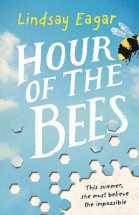
Hour of the bees by Lindsay Eagar
Walker Books, 2016. ISBN 9781406368154
(Age: 12+) Recommended. Themes: Identity; Memory; Family and memory
loss; Death and dying; Relationships. Carol (short for Carolina) is
about to enter Junior High School in New Mexico, USA. Her life is
sent into a spin at the start of her summer holidays with the news
that they are to spend the entire break at the desert ranch
belonging to her grandfather (with rattlesnakes and dust and heat).
This is not just a family holiday, it is her family's responsibility
to prepare the house and sheep ranch for her grandfather's move into
a secure retirement home. Her grandfather Serge (Sergio) is
struggling with illness and advancing dementia, and his ebb and flow
as a reliable independent farmer and teller of tales of his past is
deeply connected to the desert-like drought affected landscape. Into
this environment, with its harsh reality, Carol reluctantly connects
to her history and her roots. The grumpy Serge, and the stories he
tells of his past is woven together with an almost mystical story of
a tree that has powers of restoration. Bees that are bearers of hope
of the breaking of the drought also appear in the stories and into
Carol's environment. She changes from a reluctant child forced to
spend a busy holiday 'working' to unpack a life's possessions, to a
mature keeper of memories of the past and an advocate for her dying
grandfather. Her view of the family home of her father changes to
respect, and affects her choices in life-altering ways and changes
her view of her identity.
Although Carol is the principal character of this story, her blended
family and their quirks and interactions are also important. Their
actions and reactions speak of love, but also the way that families
sometimes can sometimes 'rub each other up the wrong way'. Love is
not always easy, and Serge's stories reveal this too. The Central
narrative is woven together with Serge's 'memory mystical stories'
and consequently there is a quality of the unbelievable about some
aspects of the tale. This is woven together with the influence of
the Mexican background of the family. (For Australian readers, the
environment of New Mexico is not unlike our Outback experience.)
Recommended for Aged 12+
Carolyn Hull
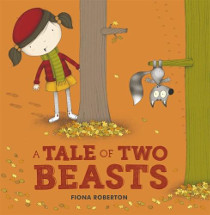
A tale of two beasts by Fiona Roberton
Hachette, 2016. ISBN 9781444916737
(Age: 4+) Recommended. Point of view, Animals, Pets. Prefaced with a
quote from Mark Twain ('there are two sides to every story, then
there is the truth') this two handed story will be such a treat for
younger readers who are the centre of their own existence. This book
will encourage them to see that there are two sides to every story,
that everyone's version is from their own perspective, that not
everyone tells a story which includes someone else's point of view.
A tall order, but exceptionally well done in this offering from
Fiona Roberton.
A young girl finds an animal in the forest hanging upside down from
a branch. Assuming it is in need of help she takes it home, washes
it, feeds it, dresses it in a hat and scarf and lays it down in a
box with her stuffed toy. She attaches a lead and takes it for a
walk, and introduces the animal to her friends. Children reading it
will be encouraged by the girl's care and love of the foundling
animal and be saddened when it jumps through the window and runs
away.
But this is only the first part of the tale.
The second half of the book, shows the opposite side of the coin:
the animal tells the tale of being taken by a strange beast who
feeds it inappropriate food, dresses it in hot clothing and lies it
down when all it wants to do is hang from a tree. It cannot wait to
escape and get back to its own environment.
Readers will see a different perspective of the same story, and
ponder the different points of view. The book will be enjoyed by a
range of children, and is able to be used in the classroom when
discussing points of view with a large dose of humour.
Fran Knight
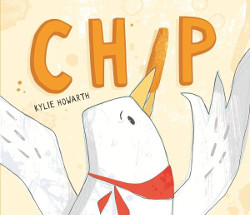
Chip by Kylie Howarth
Five Mile Press, 2016. ISBN 9781760400736
(Age: 3+) Recommended. Seaside, Seagulls, Food. Chip the seagull
just loves chips. He dives for them, picks them up off the beach,
rustles for them in bins and hassles customers at the fish and chip
takeaway van by the shore. He eats 'fat chips, skinny chips, crunchy
little bits of chips and even spicy chilli-dipped chips'. This cute
little line is repeated through the story begging children to learn
and repeat it themselves. But in being forward in winning his treats
he falls foul of the owner of the van, Joe, who puts up a sign to
tell his customers not to feed the gulls, and shoos the gulls away.
Chip has an idea, and collects the other gulls together to do
something spectacular. It is so absorbing that their display is
responsible for keeping customers at Joe's food van and the two work
together to make it work. A neat resolution will satisfy the readers
immensely. Chip the seagull with the bright red neck kerchief stands
out in the crowd of gulls as he orchestrates their surprise display.
The illustrations beautifully reflect the seaside and all that it
means to kids and their families, and many will recall family
excursions and holidays to the beach when reading this book.
Fran Knight
Magrit by Lee Battersby
Ill. by Amy Daoud. Walker Books Australia, 2016. ISBN 9781925081343
(Age: 10+) Recommended. Magrit lives in an old cemetery with her
friend and mentor Master Puppet whom she constructed from old bones.
When a stork passes through one night, it drops an unusual bundle in
to the abandoned cemetery. Magrit is very curious however Master
Puppet warns her that it is ugly and will only result in bad news.
Despite the warnings she discovers a baby which she decides to keep
for herself. She names him Bugrat and loves him like a brother, but
why is Master Puppet being so weird and who does that strange voice
belong to?
I found this short book quite easy to follow along. I did find some
of the story lines predictable but there were still a few surprises
in store especially for a younger reader. It is written superbly
taking it from a simple children's story into something more
descriptive. The story is slightly dark and beautifully packaged.
The characters have been given personalities who are mysterious and
intriguing that you will want to know more. Magrit has
plenty of soul, sadness, despair, and hope. It's a delightfully dark
fairy tale, full of Battersby's whimsy and charm. Because of the
very slightly scary theme I would recommend it for 10 year olds and
above and anyone who loved Neil Gaiman's The Graveyard Book.
Jody Holmes
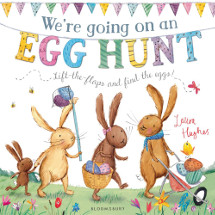
We're going on an egg hunt by Laura Hughes
Bloomsbury, 2016. ISBN 9781408870112
(Ages: 0-5) Lift-the-flap book, Counting, Easter. The bunnies are
going on an egg hunt. They're going to find them all. And they're
REALLY excited. As is obvious from the title, this is a twist on the
classic We're going on a bear hunt, only here the hunt is
for eggs. A family of bunnies living on a farm traipse through
paddocks filled with lambs, chicks, bees and ducks on their hunt for
Easter eggs. The Easter association with spring and new life is
emphasised as the bunnies trek through natural environments filled
with plants, flowers, insects, birds and animals. This book contains
many small flaps, most of them hiding Easter eggs that children can
find as they journey with the bunnies. The hidden eggs are numbered
from 1 - 10 so that children can count along with each one they find.
The wolf hiding behind the tenth egg is reminiscent of Wile E Coyote
as he has set up a giant Easter egg and hides behind it to trick the
bunnies into coming close. Moreover, just like Wile E Coyote, the
wolf's plan fails and he ends up with the door to the bunnies' cosy
cottage humourously slammed in his face.
The book itself is visually appealing with shiny foil detail on the
cover and a gloss finish. Thick card pages and flaps make it hardy
for young children. The busy, colourful illustrations are great and
if children look closely they will be able to spot the wolf
following the bunnies all around the farm. This is a shameless
celebration of chocolate Easter eggs and the hunt that young
children love about Easter. 'Hooray for Easter Day! . . . It's
Easter eggs for tea!'.
Nicole Nelson
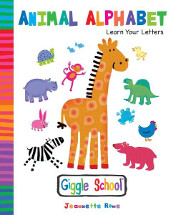
Animal alphabet: Learn your letters by Jeannette Rowe
The Five Mile Press, 2016. ISBN 9781760068837
(Ages: 3-5) This is part of the Giggle School range of
preschool and early learning activity books for parents to use with
young children. This is one of the first in the series - the other
is Count on me. The books contain big, bright distinctive
illustrations by Jeannette Rowe and were developed in consultation
with an international education consultant. In the back of each book
are some fantastic quick tips for parents about ways to support
their child's early learning. This one starts by showing the whole
alphabet, then looks at capital and lower case letters and names and
sounds of letters before telling the reader that letters can make
words. The text is appropriately simple and contains age-appropriate
activities on each page (saying letter names, saying letter sounds,
colouring, finding letters in words, writing their name).
The majority of the book follows an alphabet picture book concept
showing each letter of the alphabet and some animals that begin with
that letter. On the bottom of each of these pages, it shows how the
letters are formed and has some dotted letters for the child to
trace. The child also has to write the letter to finish one of the
animals' names. (eg. -iger). All of the animals on these pages are
already coloured, which means there is not much for the child to do.
Interspersed with these pages are a few other activities, most of
which involve colouring and tracing, good for developing fine-motor
coordination. There is only one page (alternative letter sounds and
blends, eg. Gi for giraffe) that seems inappropriate for the target
level of the book.
A marketing point of these activity books is that they are
full-colour, but this seems somewhat wasteful for books that may be
used once and then discarded. However, if used well by parents, this
could be a worthwhile tool (able to be used more than once),
especially for letter and sound identification and letter formation.
Nicole Nelson
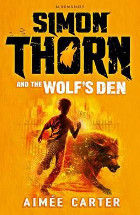
Simon Thorn and the Wolf's Den by Aimee Carter
Bloomsbury, 2016. ISBN 9781408858011
(Age: 12+) Recommended. Simon Thorn and the Wolf's Den is a
novel that is rich with the themes of fantasy and mystery as young,
shy Simon reveals a shocking truth about his family members and his
own heritage. Simon believes he is an ordinary if somewhat lonely 14
year old boy who is bullied at school and has no real best friend.
His mother travels for work and as a result, Simon lives with his
gruff uncle. Simon is shocked when he finds he can talk to the
pigeons on the street, his resident mouse Felix and every creature
he comes across. But when rats and pigeons swarm and fight one
another on the sidewalk, when his fly-away mother suddenly appears
out of nowhere, when a Golden Eagle shows up outside his window
talking of danger and when a new student sticks up for him at
school, Simon knows that something isn't right. Suddenly, the life
of Simon Thorn isn't as ordinary as he copes to make sense of the
new world that has been shown to him and as he weighs the words of
strangers whom could be new allies or new enemies.
This fantasy novel by Aimee Carter is packed with action and
mystery, the exciting plot takes the reader on a roller-coaster ride
of emotions and theories as the characters aren't always like what
they appear to be. This novel is well suited for younger teens (12+)
and lovers of fantasy and action.
Overall, Simon Thorn and the Wolf's Den was a magnetic read
and was impossible to put down.
Sarah Filkin (University student)
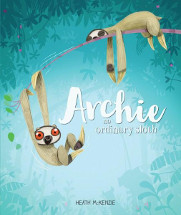
Archie no ordinary sloth by Heath McKenzie
Five Mile Press, 2016. ISBN 9781760067892
(Age: 4+) Recommended. Animals, South America, Difference. What a
delight, a cute sloth hanging about with his peers and families, but
finding it hard to fit into the sloth like demeanour of the rest. He
aches to try new things, to branch out, to swing from the trees. But
not so the rest of the group: they prefer to do what sloths do -
hang about, laze over the branches, sleep all day long and night
time too. They become annoyed at the noise he makes, waking them
from their slumber, and are disturbed by his antics, so tell him to
go away.
So Archie goes off to find others like him. In so doing, he
discovers that his difference is most useful to his clan and he
saves the day.
What a perfect opportunity for a teacher or parent to talk about the
word sloth, and see what it means, and talk of how language is
intertwined. While a wonderful time could be had by all the animal
lovers in the class looking at a map of South America to see where
Archie and his cohort live, and discuss what other animals actually
do live side by side with a sloth, particularly in this year of the
Rio Olympic Games, where stress will be put upon all things South
American. And of course, the opportunity to talk about difference
presents itself to anyone who reads beneath the words and
illustrations.
Fran Knight
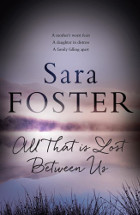
All that is lost between us by Sara Foster
Simon and Schuster, 2016. ISBN 9781925184785
(Age: 15+) Recommended. Seventeen year old Georgia Turner is
isolating herself from her friends and family because she has a
secret she has been keeping but is desperate to tell her cousin and
best friend, Sophia. Anya, Georgia's mother is the school
psychologist but no matter what she tries, Georgia pushes her away.
If only she could have the back up from her husband, Callum, but
that relationship has become distant and isn't like when the
children were younger. Zac, Georgia's younger brother is worried
about his sister after she is involved in an accident. He stumbles
across Georgia's secret and is determined to help keep it for her.
When Georgia's secret is revealed on social media the twists and
turns of everyone's secrets begin to unravel. Can this tragedy bring
the Turner family back to a whole family unit once more?
This is the fourth book from Sara Foster, with the previous 3 all
reaching into the top 8 Australian good reads. The story is told
from the point of view of the Turner family so you get both sides of
the story and feel empathy for the characters. The mystery element
was compelling and I found it hard to put the book aside. At times
it is fast paced and at other times you are able to sit back and
enjoy the beautiful scenery of the Lake District. Foster brings
attention to the hazards of Social Media and how it can impact not
just the individual but a whole community.
I really enjoyed this book and would recommend it to readers who are
15 years and above.
Jody Holmes
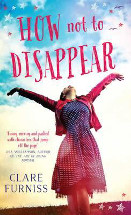
How not to disappear by Clare Furniss
Simon and Schuster, 2016. ISBN 9781471120305
(Age: 16+) Recommended for mature readers. Themes: Unplanned
pregnancy; Regret; Decisions; Family; Relationships; Memory and
Memory loss. Memories and our past - how important are they? Do they
define us? To Hattie and her Great Aunt Gloria they are what connect
them. Surprisingly they are connected in ways beyond their familial
link. Hattie is a young teen dealing with the normal stresses of
life and family. She is dependable and caring and she has just found
out she is pregnant. Her turmoil occurs at the same time as an
unknown elderly relative appears in her life. Gloria was fiercely
non-conformist in her youth (a trait she retains in her senior
years) and never had anything to do with her extended family, but
now connects with Hattie at a time when her memory is becoming
unreliable and her sense of self is disappearing. The unusual
cross-generational Thelma and Louise road trip that they
take to rediscover Gloria's past is also a time of discovery for
Hattie and the important decisions she must make about her future .
. . and the future of her relationships with the father of her
unborn child and everyone else in her life.
This is a compelling story - an adult tale of dementia and unplanned
pregnancy written for a younger audience. It is confronting and the
dilemmas facing both Hattie and Gloria are filled with uncertainty.
Clare Furniss, the author of The Year of the Rat, writes
powerfully about internal struggle and the fears and conflict that
accompany some major decisions. Abortion, unplanned pregnancy across
the generations, adoption, regret and its consequences are addressed
in the different voices of the disparate generations. Gloria's story
as she seeks to remember and be remembered is extremely moving and
gives Hattie and the reader a powerful insight into changed
relationships and the struggles and decisions that accompany an
unplanned pregnancy, and the struggle to retain your identity when
your past and memory disappears.
Written through the voices of the young Hattie; Gloria, as she
remembers her life from the past, and at the present time with her
failing hold on memory; and also with excerpts from text and email
exchanges. This variety adds to the appeal of the book. The setting
within beautiful English countryside has a minor role in influencing
the story, but will appeal to Anglophile readers. Minor characters
are also well developed and interesting, secondary to the essence of
the book, but important to understanding the two main characters.
Recommended for mature readers aged 16+.
Carolyn Hull
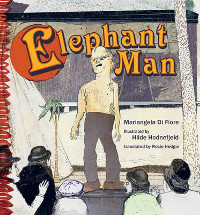
Elephant man by Mariangela Di Fiore
Ill. by Hilde Hodnefjeld. Translated by Rosie Hedger. Allen and
Unwin, 2016. ISBN 9781760292201
(Age: 7+) Highly recommended. Prejudice, Isolation, Disfigurement,
Disease, Nineteenth century England. When I first saw this on the
Allen and Unwin website, I grabbed my iPad to check on the story of
this singular man, Joseph Merrick who died in 1890 so I was excited
to receive the book for review. But nothing prepared me for this
tale of isolation, of rejection, of disfigurement and finally of
friendship. The bare facts on Wikipedia are embellished in this
beautiful retelling, the author, Mariangela Di Fiore, telling us
that she used the facts but added what she felt would have been
Joseph's voice. She has successfully drawn an image of a man bereft
of friends, abused, ignored, derided because of his deformities, but
in her words, translated most effectively by Rosie Hedger, given a
presence that cannot be ignored by the reader.
Born in 1863, his deformed body took some time to develop. His
loving mother died when he was eleven, and his father remarried a
woman who despised him. Forced to find work, he had problems as his
ability to use his hands decreased, and eventually he was taken up
by a character who ran a freak show, which toured the countryside
exhibiting others with deformities: a bearded woman, a very thin
man, a fat lady and so on. Nobody spoke to Joseph and daily his life
became more secluded. He met a doctor who worked at the London
Hospital, and he gave him his card. Later when Joseph was abandoned
in Europe, the police found the card and contacted the doctor who
took him in. He lived the rest of his life in the London hospital in
his own rooms, a curiosity but treated with care and attention by
the doctor and other visitors.
The beautiful writing develops an empathy between the plight of this
young man and the reader, and the whole is consistently ablaze with
incredible photographs, sepia images of Joseph, tickets and writings
forming a strong feeling for nineteenth century England. This book
will impel readers to rethink their attitudes to those they see and
meet who look different, and leave behind a lasting impression of
one man's story and his final acceptance.
Fran Knight
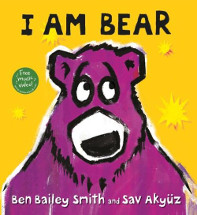
I am bear by Ben Bailey Smith and Sav Akyuz
Walker, 2016. ISBN 9781406359251
(Age: 4+) Recommended. Words, Individuality, Humour. A clever
rhyming tale of a bear has phrases which enable children to make
predictions about the words which follow, increasing their word
knowledge and understanding of rhyme. With humour the bear entreats
the reader to follow the story in the text as well as through the
illustrations, which are bold and full of fun. Each page has the
bear outlined in black, filled with colour, staring out at the
reader from a position of authority. He makes statements about
himself, which the readers will be able to follow in the
illustrations, statements which younger children will easily learn
to recognise and repeat. The opening pages make a pun on the word
bear, entreating children to look at the two words, bare and bear
and see how they are different, eve though they sound the same. His
purple colour will be a hit, and turning the pages the children will
see words to do with his love of honey, and following he tells them
what he finds funny. I love the next pages showing the bear in a
huge cape while we hear of his love of magic and tricks that he can
do. I can imagine younger children shrieking with delight as he
plays tricks on the reading audience as well as his audience in the
forest.
Full of fun, the book will easily become a favourite amongst pre
school children, especially when read aloud with an appropriate
voice and actions.
Fran Knight