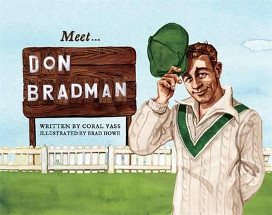
Ill. By Brad Howe. Penguin Random House, 2016. ISBN 9781925324891
(Age: 6+) Recommended. Cricket. Meet . . . Don Bradman is
the latest in the popular Meet . . . series and showcases
the famous cricketer in a meaningful way that will delight children
and provide extra information about his life and times. Coral Vass
has written an engaging book that brings Don Bradman to life. The
book starts off with his early life when he loved to practise
cricket using a golf ball and a cricket stump for a bat. After
watching Australia play England in the Ashes he was determined to
one day play on the Sydney Cricket Ground. At the age of 14, he left
school but was too young to join the local cricket team. Instead he
played tennis successfully, but cricket was his first love and when
he was 16 he joined the cricket club, making 234 not in less than
three hours. He then went on to become a very successful cricketer,
thrilling the crowds and giving heart to Australia during the Great
Depression.
Brad Howe's often comical illustrations have great appeal, as he
shows Don Bradman emerging from a very young boy to the older great
cricketer, at the same time giving a good impression of the life of
the times, with drawings of the type of clothes that were worn, food
that was eaten and lifestyle of the people.
An historical timeline at the rear of the book details Bradman's
career and is a great way to culminate the book and give the reader
the opportunity to go over his life, reflecting on what he achieved.
This is an enlightening and entertaining read that is sure to have
great popular appeal.
Pat Pledger
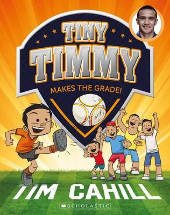
Tiny Timmy makes the grade by Tim Cahill and Julian Gray
Ill. by Heath McKenzie. Tiny Timmy bk 2. Scholastic
Australia, 2016. ISBN 9781760273644
(Age: 7+) Recommended. Themes: Soccer, Sports, Teamwork. Tim Cahill,
Socceroos superstar has co-authored a series of sport-based junior
novels filled with likeable characters, tips and fun facts that are
easy to read. His goal is to foster a love of reading amongst young
sports fans.
Follow your dreams is the underpinning theme for Tiny Timmy makes
the grade. With hard work, dedication, plenty of backyard and after
school practices, young Timmy is chosen for the Rep Team. His
special skill is combining a turbo-powered jump with a header to
shoot straight into the net. Even when Studs and Hacker, two
bullies, taunt him, call him names and play pranks on him, Timmy is
not fazed.
When Timmy spends time week after week on the bench, Coach Roach
offers Timmy some wise advice - to be the best Super Sub he can be,
researching soccer skills online; playing fun family matches
sometimes even Rugby games with his cousins and brothers.
The simple to read narrative engages the reader's interest by
incorporating different sizes of font, words in bold, graduated
sizes, animated words and bigger spacing. Heath McKenzie's line
drawings are snapshots of the trials and triumphs of Timmy, his
family and his team. There are humourous scenes throughout -
backyard disasters - when his brother Kyah's science experiment
explodes and great soccer moments. This series is great for
high-interest, lower reading age students as well.
Rhyllis Bignell
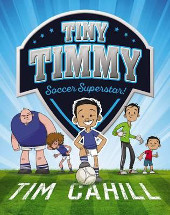
Tiny Timmy: Soccer Superstar by Tim Cahill and Julian Gray
Scholastic, 2015. ISBN 9781760158880
(Age: 7+) Highly recommended. Soccer, Tim Cahill, Bullying,
Achievement. Tim Cahill gives an outline his early life in short
easy to read chapters, using different fonts and illustrations for
the younger reader to develop an idea of the commitment it takes to
be a good sports player. Gently humorous details are given to
introduce the range of skills it takes to be a soccer star.
Tim is known as Tiny Timmy, his stature overlooked by many when he
tries out for the soccer team. Older kids make rude remarks, and
even girls are chosen before him to be part of the team. Used as the
orange boy, he is determined to prove his worth and keeps practising
all the time. He asks all those around him how he can become taller,
with some very funny results. Readers will chuckle at these attempts
to change his size. The coach sees his efforts and suggests that the
only way he can make the team is by continuous practice, and
practice he does in every spare minute through the day. And one day
in trying to escape a vicious dog, he realises just what he can do
with his feet. The following week he becomes the spare, and when
called to the field, he uses his newly learnt skills to save the
day.
This is a lovely story of striving to achieve your goal, and will
appeal to the fans of Tim Cahill and soccer in middle primary
school. The characters are clearly defined, the story simply told
using a variety of techniques to make some words stand out, with
illustrations by Heath McKenzie used to break up the page. The theme
of bullying lies within the story, as part of the background against
which Cahill strives to be better, but the emphasis on doing your
best is more important and will be the idea taken away by the
reader.
This is the first in what should prove to be an excellent and
inviting series of books introducing the game of soccer to a wider
audience by Socceroos legend, Tim Cahill, and Julian Gray.
Fran Knight
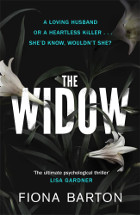
The Widow by Fiona Barton
Bantam Press, 2016. ISBN 9780593076224
(Age: 15+) Recommended. Psychological mystery. Secrecy, Journalists.
Missing children. When the police begin to ask questions, Jean
Taylor defended his husband, refusing to believe that he could have
committed the crimes he was accused of. Then their was no reason to
keep quiet - but what did she really know about the man who was
accused of kidnapping and paedolphilia.
Told from the point of view of five people, Glen, the accused man,
Dawn the grieving mother of an abducted child, A reporter Rose, the
policeman who won't give up the search and Jean the widow, this is a
rivetting mystery that keeps the reader biting their nails as the
story unfolds.
Not only does it explore the life of a woman who is down trodden,
isolated and trusting, it also explores the exploitation that the
popular press makes of the victims and the trials of the police
trying to solve a really difficult case.
To write more would give away too much but The widow is a
great thriller that will keep you on the edge of your seat and one
definitely recommended for who those who like psychological
mysteries.
Pat Pledger
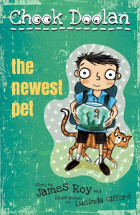
Chook Doolan: the newest pet by James Roy
Walker Books, 2016. ISBN 9781922244949
(Age: 5+) Highly recommended. Pets. Friendship. Problem solving.
Chook Doolan's real name is Simon, but he is called Chook, because
he is not very brave. When the teacher tells the class that it is
Pet Day at school, Chook is happy because he has Bruce the goldfish
to bring along, but his friend Joe doesn't have a pet. Together they
come up with all sorts of ideas to get him one, but none of them
work. When Ricky finds a solution to the problem will Chook be brave
enough to take that pet to school?
The second in the Chook Doolan series, following Rules
are rules, this is a wonderful book that will engage newly
emergent readers with its funny text and relatable characters.
Everybody is fearful at times, but Chook acknowledges that fear and
tries to overcome it. He is also a very caring friend, knowing that
it is very important that Joe is not left out on Pet Day. The
friends generate lots of ideas to try and provide Joe with a pet,
and there is much humour around the final solution.
The black and white illustrations are very appealing and the
portrayal of all the animals that the children bring to school is
delightful. Big, clear print, short chapters and an engaging plot is
sure to make this series a winner for children who are just
beginning to become independent readers.
Pat Pledger
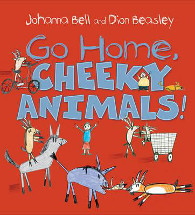
Go home, cheeky animals! by Johanna Bell
Ill. by Dion Beasley. Allen & Unwin, 2016. ISBN 9781760291655
(Ages: 3-7) Recommended. This is a sequel of sorts to Bell and
Beasley's previous collaboration, Too many cheeky dogs,
which itself stemmed from Dion Beasley's cheeky dog brand of
t-shirts. There is a wonderful story behind the cheeky dogs project
(see the website )
and the series provides many teaching opportunities beyond the text
itself. This sequel uses the same textual techniques, same
illustration style and the same setting as Cheeky dogs. It has a
story map in the endpapers as well, this time showing where all the
cheeky animals did their cheeky business! The rough pencil
illustrations that look like they have come straight from a child's
drawing book are not highly technical, but they are effective and
children will relate to them.
As with its predecessor, this book has been created with an
indigenous audience in mind but will appeal to children of all
backgrounds. It also has the potential to kick start a discussion
about feral animals in Australia (goats, camels, etc.) and the real
problems they create. Children will love the humour in the
illustrations (the animals drink from milk cartoons, and push their
babies in trolleys and prams) and the crazy antics of the cheeky
animals (eating grandpa's pants, stealing the lunch). Mum tries
shooing, Dad tries yelling at them, Uncle stamps his feet and Aunty
waves a big stick. But even the police can't help when the cheeky
animals are on the rampage! This is great fun and will be a big hit
with fans of Cheeky dogs.
Nicole Smith-Forrest
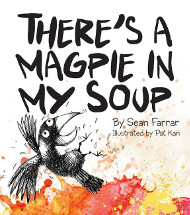
There's a magpie in my soup by Sean Farrar
Ill. by Pat Kan. Big Sky Publishing, 2016. ISBN 9781925275674
(Age: 3+) Humour. Australian animals. There's a magpie in my soup.
His wings have started to droop.
He's black and white.
And sure gave me a fright.
There's a magpie in my soup.
Not only is there a magpie in the soup, there is a big black snake
in the cake, a cockatoo in the loo, a blue tongue lizard in the
lunch, and many other crazy animals in strange situations,
culminating in a tease about a giddy goanna who had gout.
This is a very funny rhyming story that young children will love to
listen to when it is read aloud and could appeal to the newly
emerging reader. Lots of alliteration and similes bring the book to
life and one of the rhymes makes the reader think - what is that
marsupial in the milk?
The illustrations by Pat Kan are very funny and clever. The image of
the cockatoo emerging out of the loo, armed with a knife and fork
and asking for food is one of many that catch the imagination and
tickles the funny bone.
Celebrating Australian animals, this light-hearted picture book is
enjoyable and entertaining.
Pat Pledger
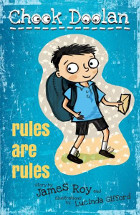
Chook Doolan: Rules are rules by James Roy
Walker Books, 2016. ISBN 9781922244932
(Age: 5+) Highly recommended. Courage. Rules. Independence. Chook
Doolan is afraid to walk to school by himself. His father tells him
the special 'Walking to School' rule - no talking to anyone until he
gets through the school gates and insists that RULES ARE RULES.
Chook walks along the familar path to school, where he meets Mrs Pho
from the bakery, Eddie Two-Hats the busker and Mrs Holston the
lollipop lady. He knows them but refuses to speak to them or
acknowlege their greetings and even though he knows he has hurt
their feelings, he believes what his father said about rules being
rules. Chook has to make a plan to ensure that these people won't
hate him, so with the help of his friend Joe, comes up with a
solution that means he doesn't break his father's rule, but
apologises and stops their hurt feelings.
This is a feel good book that will appeal to children who are just
becoming newly independent, not only in their reading, but in the
things that are expected of them. Chook is very frightened of lots
of things and it is a big achievement for him to walk to school by
himself. What is just as important though, is the way that he and
Joe problem solve and work out how to smooth over the ruffled
feelings of the people that Chook ignored on his way to school.
The short sentences, easy text and clear print will be a boon for
newly emerging independent readers, and the black and white
illustrations by Lucinda Gifford give contextual clues as well as
portraying a brave and caring Chook Doolan. Rules are rules is sure to be a winner with its targeted
audience because of the themes of becoming independent, facing fear
and seeking help from friends, are ones that they will be able to
relate to easily. There are guided reading program teacher's notes
available for the series.
Pat Pledger
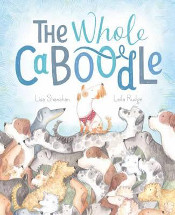
The whole caboodle by Lisa Shanahan
Ill. by Leila Rudge. Scholastic, 2016. ISBN 9781743629321
(Age: 4+) Highly recommended. Dogs, Pets, Counting, Word play. One
dog wakes his owner to go for a walk. As he dresses and has
breakfast, a tea cosy in the shape of a poodle can be seen on the
table. He asks his dog who they will see in the park today, perhaps
'one itsy-bitsy poodle?'
Readers will love the rhythm of the phrase and love practicing it
when they reread the book, while searching for the poodle on the
page. Turning the page the question is asked again, 'two lovey-dovey
bolonoodles?' but with a number two this time and a different set of
dogs. On the page somewhere they will find the bolonoodles. One the
next page, 'three fuddy-duddy Irish Troodles?' and three somewhere
on the page, and so on until the last page when they all come
together in the park. A wonderful read a loud, an amazing prediction
text and a marvelous way with words will greet all readers. The play
on words begins with all the names for the designer dogs based
around poodle, so adults and children alike will have a lot of fun
working out the mixture of dog breeds and working some out for
themselves to add to the story.
The coloured pencil and wash illustrations are most attractive,
giving lots of detail for the eyes to peruse and take in. There are
many funny moments on the pages offering incidents which dog owners
will recognise immediately all culminating with a double page full
of dogs to drool over.
Fran Knight
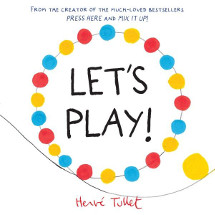
Let's play by Herve Tullet
Allen and Unwin, 2016. ISBN 9781760292980
(Age: 3+) Recommended. Following instructions, Wordplay, Humour. A
companion to Press here and Mix it up, this board
book offers great fun to both reader and listener, as little fingers
follow the instructions on each page.
The single line and yellow ball draws people's eyes across the page
and the simple question,'do you want to play?' invites the reader to
turn the page to see what will happen. Over the next few pages the
reader is invited to press the page and again follow the ball on the
line. The line becomes wavy with the ball jostled about, it does
loop the loops, and increases in number, and then colour, each time
with an instruction, but soon things become more complicated and the
ball goes into a black cave, then we see a double page of colour
wash, then colours and squiggles again.
The reader is lead through a whole range of words describing what is
happening: so they might use press, or middle, top or bottom, there
might be words to describe the path they re traveling, or green and
red traffic lights to obey.
All of it is highly amusing, involving the reader in play with each
page as it is turned, regaling them with things to do, instructions
and things to see. Children will laugh out loud as they move through
the book, each page evoking a response. Children will participate in
the actions asked by the book and be a willing player either by
themselves, with a parent or group.
The simple line drawings will encourage children to try things out
for themselves and some may use the idea to invent their own 'Let's
play' images.
Fran Knight
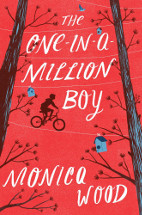
The one in a million boy by Monica Wood
Headline, 2016. ISBN 9781472228369
An amusing and warm friendship develops between an eleven year old
boy scout and Miss Vitkus, a one hundred and four year old lady,
when he volunteers for yard work to earn a badge for service. The
lad's obsession with Guinness World records, his quirky outlook and
impeccable manners appeal to the woman who has no time for the
shallow time wasting of other well - wishers in her mature years.
The voice of the boy is never heard despite his interviews with the
woman about her long life experience which are recorded in chapters
for a school project. Clever authorship reveals the disarmingly
honest questions he asks by the style of the responses which the old
lady voices with equal honesty and candour.
For reasons revealed early in the book, Quinn, the lad's father
presents himself to Miss Vitkus to continue the yard work and odd
jobs on the boy's behalf until the end of the agreed period. The
boy's parents have been married and separated and Quinn has spent so
much time away from his family whilst touring in music bands that he
has become estranged from his son.
Guinness World records are important and recurring in the narrative.
By their nature they are superlative, yet the categories include the
mundane, the pointless and the ridiculous. One old lady's relatively
unremarkable life is shown to have had highs and lows of joy and
suffering (leading to hard earned wisdom) which are as meaningful to
her as that experienced by the most famous or accomplished
individual. Miss Vitkus' trust and friendship must be earned and
Quinn works hard in many senses to build a relationship with her,
partly to establish an emotional connection with his son who is only
ever referred to in the text as 'the boy'.
Regret, particularly due to inaction rather than mistakes presents
often in this story and characters in various situations are
revealed to agonise over whether failures may be amended and
disasters salvaged. Everyday decent people are the characters
playing out their lives in this book and I liked that the author
refrained from including unrealistic or uncommon elements which
would have detracted from readily identifiable normal life.
Whilst I did not find the tale particularly moving or captivating, I
suspect that it may be deeply meaningful to many.
Rob Welsh
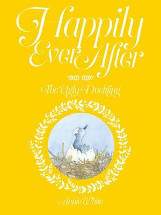
Happily ever after: The ugly duckling ill. by Annie White
Happily Ever After series. Scholastic, 2016. ISBN
9781925059526
(Ages: 3-6) Classic fairy tale, belonging, differences. This is a
simple version of the classic tale about a mother duck who is
disappointed when one of her ducklings is not as pretty as the
others are. The duckling doesn't feel that he belongs anywhere, and
his new family certainly don't want him. But when he finds a family
of swans he realises he has found where he is supposed to be. The
book uses simple, almost old-fashioned illustrations that show the
stages of the duckling's journey perfectly. The large text is
perfect for emerging readers who will be able to pick out words they
know and use the pictures to assist them in reading along. This is
the first in the planned Happily Ever After series, which
now includes The Princess and the Pea. This is a pleasing
version of an old classic perfect for sharing with a new generation
of young children.
Nicole Smith-Forrest
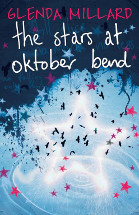
The stars at Oktober Bend by Glenda Millard
Allen and Unwin, 2016. ISBN 9781743315897
(Age: 14+) Highly recommended. The stars at Oktober Bend by
Glenda Millard is a beautiful and realistic novel about a girl
called Alice Nightingale, a 15 year old who wants to be normal and
accepted by the people in her home town. Alice struggles to
communicate in the everyday, her thoughts and feelings are presented
to and shared with the reader through her internal dialogue as she
struggles to write and talk like other people her age. Alice lives
with her grandmother and her brother; both have fiercely protected
her since the day of her incident which left her introverted,
ashamed and isolated from the normal world. Alice is not the only
person running from a horrific past full of trauma and pain, Manny
James, the running boy is also in his own internal isolation,
withholding the fear of his past from his adoptive parents and
everyone he knows, except Alice; somebody whom understands his
situation. Manny and Alice meet one night as Alice stands on her
roof, among the stars, wanting to be free to soar on the wings of
clear words and coherent speech. Manny spies this lonely figure and
is instantly captivated by her and her poetic statements and
questions left all over town.
Written in a way that is different from the generic first-person
novel format, The stars at Oktober Bend allows poetry,
symbolism and emotion to show through to the audience as the
intertwined stories of Alice and Manny charm the reader, making this
book hard to put down. Because of the symbolic content, themes of
violence and the tragic histories of both the main characters, I
would recommend this novel to an older audience of 14+ so that they
may engage in the story to the fullest extent. This novel truly is
an eye opening read which presents an astounding view of the world
through a relatable style of writing making this an unforgettable
work of fiction.
Sarah Filkin (University student)
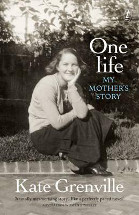
One life. My mother's story by Kate Grenville
Text, 2015. ISBN 9781925240962
Highly recommended. Kate Grenville, the author of The Secret
river and Sarah Thornhill amongst other novels,
explains this biography of her mother as an attempt to describe the
life of an individual who was part of a social class that is largely
ignored in historical writing. However, Grenville needs no excuse or
rationale; the story is beautifully told and gives her mother, Nance
Gee nee Russell, 1912-2002, the dignity she deserves. It is also a
very enjoyable read. There is no authorial voiceover or explanatory
commentary, but this is clearly the story of women whose aspirations
were stifled by societal expectations. Nance was born to Dolly and
Albert Russell, an unhappily married couple who made a career from
hotel keeping until the Depression hit in the early 1930s. Nance and
her older brother were boarded out for a number of years, Nance at
first with a very rigid and unloving Catholic spinster and then in a
convent, despite not being Catholic. She was fortunate to have
several years of excellent schooling in Sydney before being forced
back to a country school where few boys and even fewer girls stayed
past leaving age, and standards were low. Nance wanted to be a
teacher but this was emphatically rejected by her mother, and
instead was sent to Sydney to train as a pharmacist. She was
apprenticed to a martinet and struggled to understand the university
lectures. No-one had money, because of the Depression, and Nance,
lonely and poor, at times thought life too hard to be worth living.
There were very few girls studying and the attitude to them was
disparaging. When Nance qualified she was paid less than male
graduates and she missed the bonds of family life. However, she had
met inspiring young women and had learnt that she could have some
control over what happened to her. She ran a pharmacy and had a love
affair with its owner. She could have married any one of several
young men but eventually chose an inspiring young communist lawyer.
When war broke out she was disillusioned by his attempts to evade
service and she realized that secrecy and subversion were essential
parts of his character. She saw too that while despite his evasions
she loved him he admired her rather than loved her. They had two
children and Nance daringly planned to run a pharmacy again. The
business was a success but in the early fifties there was no child
care available; her mother failed her despite offering support and
her husband could not imagine doing more than he did about the
house. Nance sold the pharmacy, built a house with the money and had
another child, Kate. Nance tried again later to have a business but
even in the late fifties child care was not available.
Love of family was a dominant theme of her life, despite a difficult
relationship with her mother, and her children were a constant
delight to her. Another theme is the necessity to make the most of
one's talents. She believed that the unexamined life is not worth
living and this is a theme of her later life in particular. The
writing is engaging and the character of Nance believably
established. The social history of the times is accurately
reflected. This book is highly recommended.
Jenny Hamilton
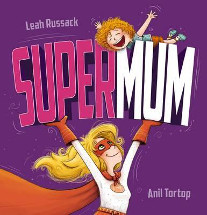
Supermum by Leah Russack
Ill. by Anil Tortop. Scholastic Australia, 2016. ISBN 9781760158545
(Age: 3-5) Highly recommended. Themes: Mothers, Family Life. Supermum
is a celebration of a mother's special powers, her amazing abilities
that help her cope with the daily challenges and delights of
motherhood. On waking she stretches and yawns, strategically placed
next to television heroes from the Secret Superpowers copying her
movements on the screen. Outside the rain may be lightly falling,
but inside the house Mum is ready to play with her ginger,
curly-haired boy. As an eagle dressed in her super cape, scarf and
special silver belt and M buckle she uses her x-ray vision to find
her child hiding in a box. Supermum 's octopus tentacles carefully
hold; bags, bottles, keys, a bunny and a large green umbrella
protect her little one. Supermum's mouse ears are just right for
super-hearing and Supermum penguin is there for special first aid
treatment and a kiss for a grazed knee. She can sniff out smelly
socks, read her child's mind and even tell when someone is telling
Porky Pies. The loving hugs she gives are the best, what a wonderful
mum.
Leanne Russack's gentle, caring story is delightful to read aloud,
why not think of some new super powers for Mum or Dad? Anil Tortop's
colourful digital illustrations creatively capture the happiness of
a day spent with Supermum and her son.
Rhyllis Bignell