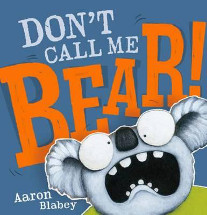
Scholastic, 2016. ISBN 9781760159849
(Age: 4+) Highly recommended. Humour. Koalas. Verse. Assertiveness.
With the quotation, 'Do I look like a bear to you?' on the back
cover, readers will know they are in for a treat opening Blabey's
latest picture book. An array of koalas covers the back page and one
on the front cover asserts, 'Don't call me bear!'
In rhyming lines, Blabey's koala called Warren tells the reader of
the history of his species in Australia when the first Europeans to
see them mistakenly called them bears.
Captain Cook made the mistake according to Warren's history book,
and this error has come down through the ages. Well, Warren has had
enough. He cites all the bears in the world, showing us an image of
what they look like and where they are found, underlining the fact
that they do not appear in Australia. He is a marsupial, not a bear.
He shows us other Australian animals and offers us comparisons. We
do not call an emu a chook, or a platypus a duck, so why call him a
bear? The arguments Warren puts forward are strong, but eventually
to no avail, as the other Australian animals still call him a bear.
Blabey's illustrations are hilarious, showing the exasperated Warren
doing his best to change people's minds. Each page is different,
drawing the eyes to the text which is often boldly placed in large
declamatory font. A group of Australian animals appears throughout
the text like a chorus, a quiet offering of the accepted truth
against Warren's assertions that they are wrong.
Reading this out loud with a group of kids will be hilarious. I can
see many kids wanting to take Warren's part as the book is read,
predicting the rhyme of each line, calling out the lines as they are
read out a second and third time.
I had a great deal of fun reading this book and I am sure others
will too.
Fran Knight
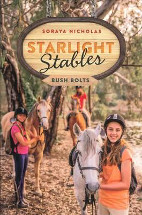
Bush bolts by Soraya Nicholas
Starlight Stables series bk 3. Penguin Australia, 2016. ISBN
9780143308621
(Age: 8-12) Recommended. Horses. Bushfires. Friendship. Although
this is part of a series it can be read as a stand-alone and is sure
to appeal to horse crazy girls. Poppy is thrilled to have her best
friend Sarah visit Starlight Stables with her. She really wants her
to love horses as much as she does, but it soon becomes apparent
that Sarah is more interested in helping Poppy's uncle, who is a
vet, with the small animals at the farm. Sarah is brave though, and
goes on a trail ride with Poppy, and her friends Milly and Katie,
but fierce lightning threatens to start a bushfire and the girls
have to ride for their lives.
Although Bush bolts is the third book in the series it was
very easy to quickly become familiar with the four main characters.
Poppy is worried that her best friend Sarah won't fit in on her
first visit to Starlight Stables. One of the main themes of the
story is about Poppy accepting what her friend Sarah is interested
in, even though she finds it hard to understand that Sarah doesn't
love horses as much as she does. Milly is a fiery character who
often blurts out things without thinking while Katie is sweet and
understanding but gradually the four begin to understand each other.
Readers will be drawn to the adventures that the group have, trail
riding, facing down cattle and escaping a bushfire. The girls face
danger of the bushfire with great bravery, and Poppy shows her
leadership skills as she looks after Sarah and directs the girls
back to the farm. The author gives excellent background information
about bushfires and proper preparation for them, as well as lots of
riding hints and details about caring for horses.
Readers are sure to want to find more of the series after reading
this very enjoyable story.
Pat Pledger
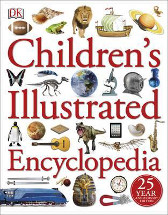
Children's illustrated encyclopedia by Carolyn Bingham
Dorling Kindersley, 2016. ISBN 9780241238905
A few years ago, perhaps in an effort to be seen as a cutting-edge,
digital-age facility, many libraries weeded their reference
collections, disposing of almanacs, atlases and encyclopedias in the
belief that 'everything was now available on the Internet'. True,
some of those multi-volume sets did take up precious shelf space
even though they were seldom consulted but were retained because of
the expense of acquiring or replacing them. Those who sent them to
new homes (or the skip) were seen as brave and even now there are
libraries where one can find these sets taking pride of place
despite being years out of date.
But gradually there came a realisation that not everything was
available on the Internet and what was there was not necessarily
accessible physically or intellectually to those requiring it at
their point of need. In addition, research started to emerge about
the differences between reading print and digital material with
strong evidence that those who read, evaluate, interpret and use
online information best do so because they have a solid foundation
of traditional print-based skills. But it is tricky to help our
newest readers develop those skills if we no longer have that
traditional collection of print-based resources to offer them.
So this updated, 25th anniversary edition of the iconic Children's
illustrated encyclopedia is going to be a welcome addition to many
school and home libraries. It is hard to imagine that it is more
than a quarter of a century since Dorling Kindersley (DK)
revolutionised the presentation of non-fiction to cater for the
needs of younger readers with clear headings, smaller chunks of
information, clear, coloured illustrations and the use of white
space which decluttered the page and allowed the reader to feel more
in control rather than overwhelmed. With indices, glossaries,
quick-fact boxes and a host of other features DK pioneered this
new-look non-fiction which made all sorts of topics accessible to
the youngest readers who could learn much just from browsing the
pictures even if they couldn't read the words yet.
This 8th edition of the 1991 original covers nearly 400 topics,
arranged in the traditional alphabetical format, offering full or
double-page spreads on those things that young readers want to
investigate as well as new things that will catch their eye as they
navigate through it. One of the common arguments raised against the
cost of and access to online encyclopedias is that they have a
particular bias towards their country of publication, but this one
does not appear to favour anywhere over another. Australia has the
same amount of space as the United States; England has no more than
New Zealand.
Each topic is presented in that clear DK style and does what an
encyclopedia is supposed to do - offer an overview of each featured
topic that can be further explored in more in-depth texts if
desired. There is both a full index and gazetteer, critical for
developing effective search terms and location skills, as well as a
full list of acknowledgements so we can demonstrate the ethical use
of information and illustrations.
Even though it is heavy for little muscles, it would be a wonderful
and affordable way to introduce students to those essential,
traditional skills that are going to provide the platform for more
sophisticated use of non-fiction resources, print or online, in the
future. And being just one volume, it won't take up the real estate
of those older, more traditional sets. Parents and grandparents will
be pleased to know that there is something with which they are
familiar appearing on the shelves, and many will find their birthday
or Christmas gift problem solved.
Barbara Braxton
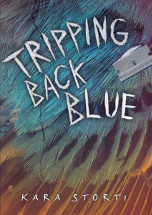
Tripping back blue by Kara Storti
Carolrhoda Lab, 2016. ISBN 9781512403084
(Age: Older teens) Illegal drugs. Family violence. Twins.
Being a small scale drug dealer is dangerous but Finn is smart and
careful, he enjoys the excitement and he is doing it for a good
cause. Finn and his twin sister Faith live in a trailer park in
Dammertown. It is their graduation year, a critical time with the
chance to escape to college. Faith, who lost an eye in one of their
father's drunken rages, is such a good student she has qualified for
Harvard but won't be able to afford it even with a scholarship.
Finn, who feels responsible for her lost eye, intends saving enough
money from dealing drugs to pay for her education. In escalating his
drug dealing he increases the risk and stress which he manages with
his own increasing use of drugs, mirroring his mother's use of
antidepressants and his father's use of alcohol. His escape from it
all is birdwatching in the local cemetery where he meets an old
lady with a common interest in birds and access to a wonder drug
which seems to take the user back to their best memory with a
lasting euphoria and no after effects. Better still it is so unknown
it is not illegal and Finn comes to an arrangement where he is given
access to the drug he calls Indigo in exchange for spending time
with the old lady who turns out to be the grandmother of the new
girl at school, the daughter of a cop who chases drug dealers. From
this point the story focuses on their relationship and Finn's
complicated schemes for marketing the new drug, avoiding the big
dealers who have become interested in controlling it and
acknowledging his own dependence on drugs. The pace picks up and
there is an exciting climax at a cabin in the woods and a final
grappling with the challenges of the future but it seemed too little
too late and I am not sure too many of the older teen readers, who
might be drawn to read this novel because of its illicit drug
appeal, would stick with the rather drawn out story development to
enjoy the exciting but abrupt end. It was a depressingly believable
and explicit account of the rationalizing around drug use and the
'live in the now' escapism which replaces ambition.
Sue Speck
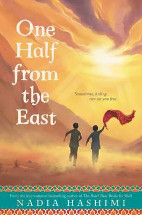
One half from the east by Nadia Hashimi
Harper Collins, 2016. ISBN 9780062572196
(Age: 12+) Highly recommended. This is such a fascinating story. It
is about a young girl in Afghanistan whose life undergoes a drastic
change, at the age of 10, after the calamity of her father losing a
leg in a random bomb blast. With three sisters, and her father
incapacitated and depressed, there is no male provider in the
family, so in order to fill that space and to bring luck to the
family, Obayda is made to become Obayd, dressed as a boy and treated
as one. She is a 'bacha posh', a custom in Afghanistan where some
families select a girl child to live as a boy thus avoiding the
social stigma of not having any male children.
Obayd comes to discover the many advantages of being a boy, he is
given the most choice parts of a meal, he can run freely, join in
rough games, and stay out longer. And he makes friends with another
bacha posh, Rahim, a boy who teaches him to be brave and strong,
daring to do things he would never have dreamt of as a girl.
However there is a cost - there comes a time when the bacha posh is
expected to turn back into a girl and forget all the freedoms he has
enjoyed. For Rahim, promised as a child bride, the prospect is
appalling. Obayd struggles to change his own future.
The book raises many questions about what is a girl, what is a boy,
and society expectations of each of the sexes. It is a sure
discussion starter about issues of identity, gender and family
roles.
This book has been written for young readers. Author Nadia Hashimi
has also written a bestseller for adults, The pearl that broke
its shell. I'll definitely be seeking it out.
Helen Eddy
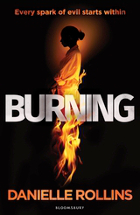
Burning by Danielle Rollins
Bloomsbury, 2016. ISBN 9781408869956
(Age: Mature 14+) Just before Angela's scheduled release from juvie,
THINGS start happening. First, a 10-year-old girl (Jessica) is
brought in under high security. Then, a new program called Sci-Girls
is causing a major stir among the inmates. There's something about
Jessica, Sci-Girls, and the director of Sci-Girls (Dr. Gruen) that
freaks Angela out. Weird things begin happening, and soon it becomes
clear that there's evil in this prison that has nothing to do with
the girls who are serving sentences.
I enjoyed reading this book. I enjoyed the characters, the writing
style and the atmosphere. I couldn't put the book down. I was
enjoying getting to know the characters' back stories and how they
all interacted with each other. However, it then started along a
different path that was like reading an entirely different book.
Even though I persisted until the end it had just become so
far-fetched I literally thought I was in another story. The ending
finished rather abruptly and left many questions hanging in the air.
There is a companion book being written which will be released in
2017 which I think if the two books were read together, the story
line might come together nicely. Due to the couple of incidents of
murder and a sex scene I would recommend this book for a mature
14-year-old and above. Teacher's
notes are available.
Jody Holmes
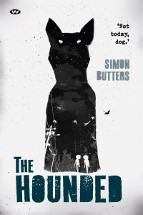
The hounded by Simon Butters
Wakefield Press, 2016. ISBN 9781743053959
(Age: 16+) The black dog is a common metaphor for depression and in
the initial stages of this novel, the appearance of one to teenaged
Monty seems to indicate exactly that. Monty has an eating disorder,
is underweight and has an unnatural lack of appetite for food. His
personal hygiene has declined to the extent that he rarely washes,
smells and looks dirty as he dons the same filthy clothes day after
day.
Home life for this teenager is grim as his mother has a severe
psychiatric illness and endlessly chain smokes, confined to an
extremely dilapidated house which she believes is being entered by
persons unknown who steal its contents. Monty's father, obviously
trying to escape the pressure of the dysfunctional household seeks
refuge in his work and has little interaction with his son who is
clearly suffering from neglect in a home which fails his basic,
everyday needs and gives little structure to his life.
It is no surprise that visions of a black dog might be interpreted
as depression, however in this novel the creature develops to
represent something even more sinister and dangerous. Without giving
the plot away, there are many elements of teen trauma in this novel
(perhaps too many) and the reader is never quite sure if Monty's
conversations with the dog convey thoughts which he is working
through or whether he really is having delusional interactions with
a talking dog.
Where school should provide some refuge of normality and routine,
Monty is largely invisible except when being attacked by violent
thugs, cyber bullied or tormented by popular students who manipulate
and determine social acceptance versus pariah status. When Monty is
noticed by Eliza, the most beautiful and popular girl in school, he
is naturally overwhelmed by her attention and finds himself in
places and situations which are unfamiliar and challenging to him.
There are some really unappealing behaviours and traumatic
experiences on display in this novel. Luckily this is balanced to
some degree by kindness, decency and aspects of recovery.
The inclusion of so many traumas and miserable elements made this
story too 'busy' in my view, yet some might argue that it is a sad
but realistic portrayal of life for some teenagers. My stance may be
old fashioned and naive, however I have concerns that novels with
elements as bleak as this has can emphasise a sense of hopelessness
with young people, especially if they are in an emotionally
vulnerable state.
This is an edgy and different story in which the author has worked
hard and with success to describe scenes in which the reader can see
the dirt and share the pain. It will appeal to many adolescent
readers and I caution school staff to give thought regarding those
for whom it is appropriate to read for study or pleasure.
Rob Welsh
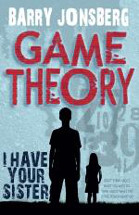
Game Theory by Barry Jonsberg
Allen and Unwin, 2016. ISBN 9781760290153
(Age: 14+) Highly recommended. Mystery. Thriller. Kidnapping. Jamie
loves numbers and one day gives his sister Summerlee a group of
numbers that wins her $7.5 million in the lottery. But things do not
go well in Jamie's family especially when his little sister Phoebe
is kidnapped and a ransom request for $2 million follows. Jamie is
convinced that he can save her using the principles of Game Theory,
but is he playing with her life?
The family dynamics are a feature of this book and provide a
stunning background to the events that take place. Jamie is very
good at maths and is obsessed with the Game Theory, so much so that
he is prepared to take risks on his beliefs about it. Readers will
enjoy finding out about it and will be rather horrified that he is
arrogant enough to believe that he can fool the kidnapper. Jamie's
relationship with his little sister Phoebe is touching, and
rebellious Summerlee also loves Phoebe and is prepared to do
whatever she can to get her back. Phoebe may not be as intelligent
as Jamie but she understands people really well and this leads to
surprising results as the novel comes to a climax.
Moments of humour lift the dark material of the book. The episode
when Jamie goes to buy a gun from a biker although very tense is
also very funny and would be hilarious if read out loud. The episode
when Summerlee is fired from her job is also hilarious and will be
enjoyed by the reader.
An exciting and tense thriller, Jonsberg keeps the suspense going
throughout the whole book. It is not easy to guess who the kidnapper
is and the conclusion is really unexpected and very nerve-wracking.
This is one for lovers of thrillers and could be used as a
literature circle book or class set for older teens. Teacher's
notes are available from the publisher's website.
Pat Pledger
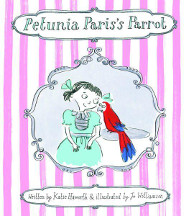
Petunia Paris's parrot by Katie Haworth
Ill. by Jo Williamson. Five Mile Press, 2016. ISBN 9781760403690
(Age: 4+) Highly recommended. Birthdays, Macaws, Belonging. Opening
the initially very pink and powder blue pages I was quickly taken in
by the tale of Petunia Paris and her family. Each year they ask
Petunia what she wants for her birthday and each year she gets
exactly what she asks for. Problem is she has everything she could
want so this particular year she says the first thing that pops into
her head, a parrot.
And she receives it at her gigantic birthday party, when a pink
clown takes the pink wrapping off the cage to reveal a bright read
and blue macaw.
She is thrilled, and when everyone has left, settles down to hear it
talk. But no matter what she does all he does is squark. She asks
everyone, and reads all her books, but to no avail. He just squarks.
She becomes frustrated and yells at him while the butler suggests
that perhaps she asks him more kindly, which she does, and the macaw
opens his heart to her. He tells her that he does not want any of
the things she is offering, and all he wants is to go home. So her
next birthday when she is six, she does not have to think at all.
She knows exactly what she wants. She wants to go to Peru, and so
off they go, making her sixth birthday party very different indeed.
The simplest gift turns out to be the best of all gifts for both the
macaw and Petunia.
This delightful tale of belonging, of being in the right place will
amuse younger readers as they see the macaw is a 'fish out of water'
in his new environment and Petunia is to be heralded for finding out
where he lives and returning him to his home.
The lively illustrations are full of humour as we watch the family
about their breakfast, or at one of the huge birthday parties, or
trying to make the macaw feel at home. The pen and water colour
drawings are whimsical in their depiction of the fabulous Petunia
and her family.
Readers will love seeing where the macaw really lives and be tickled
by the last fold out page of the macaw at home. And perhaps grab
hold of the idea that not all presents have to be big and bold,
expensive or exclusive, a family being together is all that we
really need.
Fran Knight
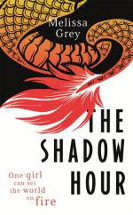
The Shadow Hour by Melissa Grey
Atom, 2016. ISBN 9780349002156
(Age: Teens) A rich and indulgent fantasy, Grey presents a world
coloured by fear, despair, and highlighted by the ray of hope that
is the Firebird. While this is a great fantasy concept, it seems
oddly disjointed, tripping up the reader and making it more
difficult to read.
Echo is back in this sequel to The girl at midnight, this
time holed up in a warehouse with the former Dragon Prince, his
sworn sword, a duplicitous Avicen, and her best friend, Ivy. The
group have nowhere to go, all having thrown their support with Echo,
the murderous firebird who killed an Avicen warhawk in order to
protect a Drakharin - the ultimate betrayal to the tenuous trust
Altair, the Avicen general, holds for her.
The stakes grow when another mythical beast, the Kucedra, the
Firebird's enemy, appears, reaping havoc not just on Grand Central
Station, but on the otherwise impenetrable Avicen nest. The
unsuspecting Avicen were decimated, the few survivors evacuating to
an enchanted island prepared to safeguard them if ever the nest were
threatened. With despair reigning the Avicen are prepared to welcome
Echo back and embrace her as their saviour - but at what cost? Will
she remain herself or will she become a simple weapon?
Like the first, for me, this was a disappointment - made greater by
the introduction of a love triangle between Echo's Drakharin and
Avicen suitors. It seems that even despite all that is going on,
lust and love are the primary concern of the characters, rather than
the more pressing threat of a shadow monster. To her credit, in this
novel Echo is less concerned with boys and more with the monster -
however the issue of the love triangle appears to be presented as
the most pressing issue. Again, I would only, hesitantly, recommend
this to boy-crazy, fantasy-loving, teenage girls.
Kayla Gaskell, university student, aged 20
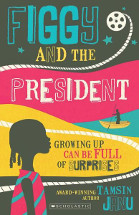
Figgy and the President by Tamsin Janu
Figgy series bk 2. Scholastic, 2016. ISBN 9781742991559
(Age: 8+) Highly recommended. Award winning author Tamsin Janu
continues the story of eleven-year-old Figgy who lives with her
Grandma Ama in a small village in Ghana. Orphan Nana who lives with
them is very concerned about his future career. As Figgy and Nana
sit in the rain catching raindrops in their mouths, Nana describes
his ambition to be President of Ghana. He would have unlimited food,
travel the world, give to the poor and meet important people.
Figgy's goals are similar, travel, food and a having an operation to
repair her damaged eye.
Village life is described in a matter-of-fact manner; hand washing
clothes, dirt floors inside the huts, school life and buying food
from the open-air market. The author realistically portrays the
economic, social and cultural backdrop told through the first person
account of her feisty protagonist.
Figgy is overwhelmed when her pregnant mother returns. At first she
refuses to see her, as she believed her mother was dead. During this
difficult time, Figgy auditions for a role in a movie about orphans
filmed by a group of Abrunis - white people. She wonders if her
career path is acting.
The most challenging events occur after Nana is taken away by his
abusive father and sold as a slave to work on a fishing boat.
Figgy's ingenuity comes to the fore, and with the aid of Jeffnick
their friend and Kwaku the village taxi driver, they set out to
rescue Nana. Figgy's life is a busy one; just before she leaves on
her rescue mother delivers a baby boy - a brother for Figgy.
Interwoven into the narrative are comments on ethical issues,
children forced into slavery, her mother's drug and alcohol abuse,
children's rights, orphanage life, parental rights, stealing to
survive and the differences between living in poverty and the lives
of the wealthy.
Another powerful and moving story from Tamsin Janu, this is a great
novel for middle primary students. It introduces the issues of
social justice and opens students' eyes to life of children in other
countries. Figgy and the President is an excellent resource
for Year 4 Geography as a literary focus on the importance of
different environments to both people and other living things and as
a study of one African country.
Rhyllis Bignell
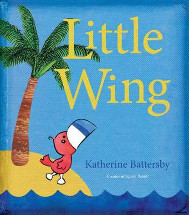
Little wing by Katherine Battersby
UQP, 2016. ISBN 9780702254000
(Age: 4+) Recommended. Belonging. Books. Birds. Little Wing lived on
a small island. He was very smart and when a trunk filled with books
washed up on his island, he read them all. They taught him how to
read and write, how to calculate, all about science, and about
almost everything else in the world. But there was one problem. No
where in all of his books was there something like him.
He read them all twice. He wasn't a lizard, he wasn't a fish, and
neither could he fly. Each day he tried out to be something he had
seen in his books, until one day something flew past that looked
just like him. He used all of his new skills to learn to fly and
follow the bird. He joined the other bird on another island and he
knew where he belonged.
Accompanied by full colour illustrations, children will love looking
at Little Wing and working out where he belongs. They will enjoy
recognising the different iconic images shown in the book,
reflecting Little Bird's attempts to find out just who he is, and
rejoice at the emphasis placed upon books for fun and research.
I enjoyed the endpapers with their summation of being alone and then
being one amongst many, using the images of feathers to show how his
isolation has finished.
Many discussions could emanate from reading this story: of being
together, of being with people of like minds, of belonging and
finding a place where you belong. And of course of the importance of
books in our lives.
Fran Knight
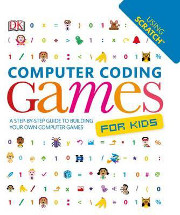
Computer coding games for kids by Jon Woodcock
Dorling Kindersley, 2016, ISBN 9781740333405
Way back when, in the dawning of the age of home computers which
were huge and clumsy in comparison to today's mini-marvels; which
ran on cassette tapes; had green or amber font on a black screen and
had no facility to display graphics, if you wanted to play a game
you bought a book of instructions and carefully tapped the commands
in, one keystroke at a time. It was the realm of the real computer
nerd and if you were patient and precise, eventually you got to play
the most basic of games.
Fast forward 30+ years and now our kids have computers in their
pockets, on their wrists and even in their clothes. And with the
increased focus on science, technology, engineering and maths once
again the red-hot buzzword in schools is coding as students learn
not to program a clumsy turtle that only went backwards, forwards
and sideways, but to create and develop their own games to play,
some in the hope that theirs will be even bigger than Pokemon Go!
But no longer do they have to sit in solitary confinement
painstakingly tap, tap, tapping. These days, the most commonly used
development tool is Scratch,
a free program which helps young people learn to think creatively,
reason systematically, and work collaboratively, essential skills for
life in the 21st century, and Dorling Kindersley have produced what
might be the beginners' bible in learning how to create a computer
game. Not for them the single volume, monochrome pamphlet that
crossed your eyes just looking at it this is a beautifully
presented, full colour, step-by-step guide presented in the typical
DK layout that is so user-friendly. Beginning with an introduction
that describes what makes a good game, the types of games and how
coding works, it moves on to introducing Scratch, accessing it and
then straight into making a basic game, eventually moving on to more
and more complex tasks and challenges.
Fifteen years ago I went to computer classes and tried very hard to
make a cow jump over the moon using a program Macromedia Flash.
Night after night it absorbed me until I gave up in defeat and
despair, clearly I just didn't have the brain for it. So to test out
Computer coding games for kids I read through the
introductory chapters, accessed Scratch and had a go at the first
project Star Hunter, a fast-paced underwater treasure hunt. In
just seven quick steps I had a cat that followed my mouse all around
the screen and was ready to build the next part of the game. WINNER!
If I can do it, anyone can! So when the curriculum requires students
to have a basic knowledge of coding, this has to be the go-to book
for teachers and students. Even the most confirmed luddite will
succeed and the students will be having such fun as they read and
follow instructions and learn without realising it that coding
will become a key part of the school day!
In fact this book was going to be a donation to a school library I
know but I think I will keep it because I can see hours of fun ahead
for Miss 10 and Miss 5 and me on the wintery days yet to come for us
and even those when it's too hot to go outside. Who knows, we may be
the creators of the next Pokemon Go!
Barbara Braxton
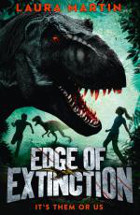
Edge of extinction: It's them or us by Laura Martin
Edge of extinction series, bk. 1. Harper Collins, 2016. ISBN
9780008152895
(Age: Upper primary, Lower secondary) This absorbing story, set in a
future world, is the first in a series and it establishes a momentum
that is sure to carry readers along to the final book.
It is easy to empathise with the three main characters, living in a
world fraught with danger since scientists brought dinosaurs back
from extinction.
Sky Mundy is the first person narrator, explaining her motivation
for leaving the underground colony where she has lived since the
disappearance of her father, branded a traitor. Her best friend,
Shawn, follows her into exile and they take refuge with a young boy,
Todd, and his family and friends in a treetop sanctuary.
But Sky and her friend, Shawn, are followed by ruthless members of
the Underground Compound, and now with Todd accompanying them, they
must elude them as well as the ferocious dinosaurs. Fortunately, a
dinosaur hunter saves their lives and Sky discovers that he, Ivan,
is her grandparent. The three young people are relieved when he
agrees to join their search for Sky's father.
The next episode is coming soon. I'm sure young readers will look
forward to it.
Thelma Harvey
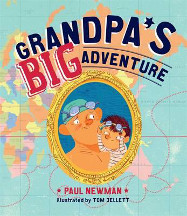
Grandpa's big adventure by Paul Newman
Ill. by Tom Jellett. Penguin, 2016. ISBN 9780670078172
(Age: 4+) Highly recommended. Grandpas, Swimming, Tall tales,
Adventure. The narrator of this delightful story is afraid of the
water and cannot swim. Grandpa tells him he must learn to swim if he
is have big adventures like his and so takes him to the pool to
learn. At the pool Grandpa recounts the tale of his big adventure,
where he swam around the world. He tells of how he covered himself
with grease, and packed his things in a plastic bag to keep them
dry, and took along sweets and tea to eat and drink along the way.
He swam all day long, making sure he turned onto his back to avoid
one sided sunburn, and slept at night. One day he bumped his head on
the equator, another time he had to deal with sharks, and one time
he had afternoon tea with the Prince of Whales, and while coming
into New York harbour, he was treated gloriously. Grandpa's big
adventure encourages the young boy to learn to swim, and Jellett's
illustrations show the lad becoming more at ease with the idea of
getting into the pool as the story progresses. At first his face
reflects his dislike of the water, and as the story is told, he
comes closer and closer to the water's edge, donning bathers,
goggles, having sun screen lotion applied, then sitting on the edge
of the pool before finally getting in. Grandpa's tall story has led
the boy to the water.
The story is a delight, dealing with overcoming a child's fear of
the water with small steps, Grandpa telling him a wonderful story
full of adventure and overcoming adversity.
The humour in both the text and illustrations will resonate with the
young readers, and they will have a great deal of fun looking at the
range of people at the pool, listening to the word play and mapping
Grandpa's swim around the world.
Jellett's illustrations are full of life and humour and I love his
depiction of Grandpa in his bathers with a wry look upon his face,
talking his grandson into attempting to swim. And I love the use of
the end papers to showcase images of Grandpa at various locations
around the world. This will have readers looking at a map of the
world to work out just where he went. Readers will love the ideas
presented in this book, recounting tall tales they have heard from
their families, talking about their attempts to learn to swim, and
what they do with their grandparents. Close to Father's Day this is
a lovely way of including Grandpas as well.
Fran Knight