Ford St Publishing, 2016. ISBN 9781925272406
(Age: 4+) Highly recommended. Bushfire. Australian bush. Disasters.
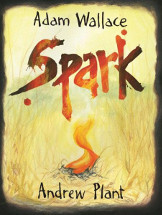
A cigarette casually thrown onto the dry grass is the spark which at
first flickers but then the wind becomes its friend and helps the
spark grow. It races across the dry grass, increasing in size, until
it tops the trees and frightens the animals from the bush. It now
flies above the tree tops, burning everything in its path. It asks
the wind to quieten but it is too late, the wind keeps pushing it
along until eventually weakening, it changes direction and the fire
is reduced back to where it started, a small spark.
This involving story of taut, measured words shows readers the
strength of a fire as it races over the scrub. With both the author
and illustrator having first hand experience of fire in Victoria and
South Australia (Ash Wednesday, 1983 and Black Saturday, 2009), the
words and images are stunningly presented.
Plant's illustrations encapsulate the dreadful intensity of a fire,
from the tiny spark to the ferocious firestorm engulfing all in its
wake. His use of mixed media including water colour, pencil and
crayon present the small flame beginning quietly in yellows with a
pale blue sky then building to a intensity of reds and dark yellows,
and on to blacks, grays and reds savagely taking up the whole page.
Different illustrative techniques convey the changing nature of the
fire, and readers will be in no doubt about its destructive force.
This will make a powerful addition to any class study of disasters
and fire, of how fires start, of their destruction and place in the
Australian environment.
Fran Knight
The Legends series by Michael Panckridge
Ford St, 2016. Chasing the break. ISBN 9781925272482 Against the spin. ISBN 9781925272499
(Age: 10+) Highly recommended. Sports. School. With the upper
primary reading group such a hard batch to satisfy with good books,
it is great to see the republishing of Michael Panckridge's exciting
series, The Legends. This is most welcome, with the series
repackaged with an up to date cover and blurb, designed to appeal to
this difficult group of the reading public. Each of the eight novels
in The Legends series are very school based using day to day
encounters to develop the plots, involving sports which are part of
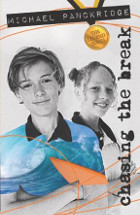
the school's competitions. Chasing the break involves a surfing competition at Sandhurst
Primary School. One boy, Travis Fisk, won the competition at last
year's annual beach camp and intends to win again, but he is
challenged by the new boy at school, Mitchell Grady. Told in short,
easy to read chapters, the characters are well developed and
identifiable, and the integrity underlining the story is easily in
reach of every reader. They will cheer the hero as he strives to win
despite the odds, overcoming the antagonism of the antihero of the
story. Against the spin has a similar plot line, with Travis nursing
his wounds and Mitchell shining on the cricket field as well. But
this involves more of Travis' undesirable bullying coming to the
fore, and Mitchell and his friends having to deal with his antics
both on and off the sporting field.
Exciting, fast paced and easy to read, each of these stories is
about one hundred pages long with scores and quizzes at the end for
further excitement. The whole set will rarely be left on the shelf.
Fran Knight
Animalia by Graeme Base
Penguin, 2016. ISBN 9780670079131
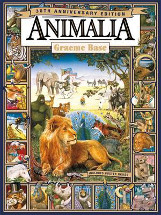
Thirty years ago in 1986 an armoured armadillo avoiding an angry
alligator appeared from the pen of one of Australia's most iconic
illustrators. It was followed by beautiful blue butterflies basking
by a babbling brook and a host of other creatures including eight
enormous elephants expertly eating Easter eggs; horrible hairy hogs
hurrying homeward on heavily harnessed horses; meticulous mice
monitoring mysterious mathematical messages; and even zany sabras
zigzagging in zinc zeppelins.
For this was the magical, mystical, marvellous Animalia - an
alliterative alphabet book and which, after selling more than three
million copies worldwide and spawning a television
series, is now celebrating its 30th birthday and a whole new
audience is set to wonder at its creativity, its detail, its colour
and try to spot the tiny Graeme on each page. It is indeed a feast
of vivid visual literacy. And underneath the familiar dust cover
which so cleverly hints at what is inside is a glamorous golden
cover AND a fabulous poster of the lazy lions lounging in the local
library. (Great role models for reading!!!)
Since Animalia's original publication we have come to
associate Graeme Base with intriguing stories woven around the most
scintillating illustrations and if this is your first introduction
to his work, you will be on the lookout for his other works.
Congratulations Graeme - thank you for bringing us these superb
creatures and creating such riches for our young readers.
Barbara Braxton
His Bloody Project. Documents relating to the case of Roderick Macrae by Graeme Macrae Burnet
Text, 2016. ISBN 9781925498257
(Age: Capable senior students) Recommended. Shortlisted for the Man
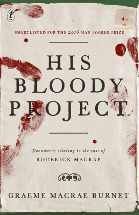
Booker prize 2016. His Bloody Project is clearly subtitled
as a novel, which is a useful guide as the book has the authenticity
of a historical investigation. It has also been described as a
'crime story', that is, a story about a crime and not a 'crime
novel'. The text is comprised of a number of sets of documents,
including reports from the crime scene, the accused's thoughts
written in prison, an account from a psychiatrist engaged to assess
the accused and press reports written during and after the trial.
The accused is Roderick Macrae, the son of a poor crofter living in
a remote village in the Scottish Highlands in 1869. The reader
learns that Roderick, aged 16, has admitted to brutally murdering
the constable of the village. The crime scene documents detail
events seen by a number of villagers who are all shocked and some of
whom are sympathetic to Roderick. They agree that he was seen
walking to the constable's house with several agricultural
implements and returning covered in blood. However, attitudes to the
boy differ. The school teacher attests that Roderick was a clever
student, a neighbour that he was treated too severely by his father,
but the minister that he was wicked and retarded. Roderick's
statement is written in gaol at the behest of his lawyer. The reader
is given a clear picture of the hardship and deprivation that was
part of Roderick's life, though Roderick does not acknowledge that
his own circumstances are any more difficult than anyone else's.
Roderick's father is a dour, punitive man who seems to accept and
administer hardship with a religious zeal. He is a poor farmer and
father, and sends Roderick to work for the laird despite the teacher
recommending further education. Roderick is dismissed as unsuitable
and so is unable to help with the family's finances. Motivation for
the murder is provided when the constable harasses the family and
finally deprives them of their land. Roderick's lawyer is moved by
the statement and hoping for a verdict of insanity engages a
psychiatrist. The psychiatrist's report illustrates the nature of
psychiatry at that time more than the character of Roderick. Doctor
Thompson is supposedly an expert in the criminal mind. He has no
interest in Roderick himself and little in justice but rather is
concerned with proving his own theories about the criminal
physiognomy and the criminal class. He is unimpressed by Roddy's
writing though to the reader it seems thoughtful and humble. Doctor
Thompson travels to Roddy's village and reinforces his theories by
categorizing the villagers as stereotypes of the lowest class.
Finally, the newspaper accounts relay the trial and its unsurprising
conclusion.
The book is convincing and is a disturbing look at poverty and
victimisation. It also, with its use of multiple voices and
viewpoints, powerfully illustrates the impossibility of truly
understanding the minds of others. It is recommended for capable
senior readers.
Jenny Hamilton
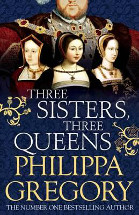
Three sisters, three queens by Philippa Gregory
Allen & Unwin, 2016. ISBN 9781471133022
(Age: secondary) Recommended. English history, Tudors, Henry VIII,
Status of women, Scottish history. When Katherine of Aragon comes to
the Tudor court to marry Arthur, his younger sister, Margaret looks
on with petulant disdain. This woman will be her sister in law, but
Margaret is in no mood to be charitable. She will have to take
second place to this foreigner who cannot speak English, and
Margaret above all else, wants to be first.
However, she must be on her best behaviour at their wedding, as an
ambassador is there to confirm her as the wife to be of James IV of
Scotland. She is thrilled to be betrothed at twelve hardly able to
wait until she marries at fourteen to be a queen.
Her younger sister, Mary is initially betrothed to the Spanish
emperor, so the three sisters are to become queens and are all
related through Henry. Katherine of Aragon becomes Queen of England
when she marries Arthur's brother, the future Henry the Eighth,
Margaret is Queen of Scotland and Mary, Queen of France, and their
fictionalised lives make fascinating reading. Gregory's research is
obvious in the huge amount of detail providing a solid background to
these women's imagined lives. Details like James' metal belt worn
next to his skin to remind him of his killing his father or
Katherine's pregnancies and hair shirt, the progress made by the
kings surveying their lands, the clothing and jewelry and
extravagance of Henry's court are intoxicating. And the details of
court behaviour, the differences between the three courts, the
intrigues behind the decisions to declare war and the hapless lives
of these women dependent upon the men in their lives, are absorbing
to read. Margaret's petulance does not subside, she is ever
comparing herself with the other queens, sometimes their solicitous
friend, other times disgruntled and critical.
Her life going between Linlithgow, Holyrood, Edinburgh and Stirling
Castles, carrying six children and losing all but one, is
magnificently retold, ensuring the reader knows all there is to know
about Margaret of Scotland and her part in the Stuart succession to
the throne of England two generations hence.
She is self absorbed, but her life, always bound but her brother's
ambition and political game playing, or that of her husbands and any
people currying her favour, made her a more sympathetic creature,
tossed around in a world where a woman's voice was seldom given
credence.
A wonderful historical novel for those who love reading of Tudor
times, and are particularly interested in the role of women in this
society.
Fran Knight
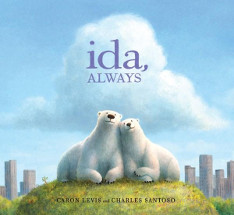
Ida, always by Caron Levis
Ill. by Charles Santosa. Scholastic, 2016. ISBN 9781742761909
(Age: 5+) Recommended. Polar bears, Zoos, Cities, Death and
grieving, New York, Friendship. Based on the true story of two polar
bears at New York's Central Park Zoo, this emotional story will have
all readers sniffling by the end of the tale. Ida and Gus have lived
a long while at the zoo, where they are seen by the many visitors,
and are looked after by the keeper, Sonya.
The two bears wait for each other in the morning, ready to feed
together, swim together, play with the ball, sit on their island and
watch the city around them. They listen to its sounds, and watch the
skyscrapers reach into the cloudy sky. They are inseparable, and
always there to be with each other. But one day Ida does not appear,
and Gus must do all the things they did together, by himself. Sonya
comes to tell him that Ida is unwell, and so the keeper and Gus look
after her, making sure she is comfortable and in no pain. They
remember the things they did together, reminding each other that
they will always be there, always. She eventually dies and Gus
misses her, all alone doing the things they did together. But when
he listen to the sounds of the city, he knows she is with him,
always.
This wonderful story of death and grieving will have resonance for
many children who have had a death in the family. They will
recognise the process of death, some times knowing that it is
imminent, and see the way people deal with the process of dying.
They will see too that although that person has died, things live on
to remind them of that person, there will be memories that keep that
person alive.
The soft illustrations will entrance the younger readers who will
look at the bears and their lives in the zoo with fresh eyes. They
will see the images in the clouds, and the skyline of New York, the
depiction of what these huge animals get up to in a zoo, and perhaps
ponder how different their lives would be in the wild. This will be
a lovely read aloud, but have the tissues handy.
Fran Knight
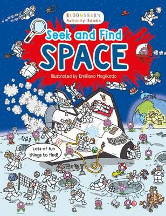
Space: Seek and find activity book ill. by Emiliano Magliardo
Bloomsbury, 2016. ISBN 9781408870037
(Age: 5-7) Recommended. Themes: Space; Seek and Find. This is a
simple 'Seek and Find' concept book with a Space theme. Each double
page contains a simple factual paragraph and then humourous
cartoon-style illustrations which are crowded with fun and sometimes
ridiculous detail for a young reader to search and investigate. A
single text question on the featured page gives instructions for
something to find, but also each double page includes 10 smaller
pictures to locate from within the larger complex illustration.
Recommended - as a book to share with pre-readers or for early
independent readers. It will fill those moments when adults need a
bit of focused quiet time!
Carolyn Hull
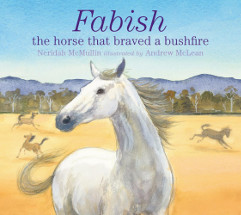
Fabish: The horse that braved a bushfire by Neridah McMullin
Ill. by Andrew McLean. Allen and Unwin, 2016. ISBN 9781925266863
(Ages: 5-9) Recommended. Bushfire, horses. This uplifting story is
based on events that occurred during the 2009 Black Saturday
bushfires in Victoria. Fabish, a retired racehorse, now takes care
of the flighty young horses. When fire looms large on the horizon,
the trainer knows he cannot save all the horses; he throws open the
gates and orders Fabish to take the yearlings and go. The author, a
horse enthusiast herself, does an amazing job of helping the reader
experience the terror of bushfire for both people and horses and the
desolation they leave behind. Rich, visual language makes it easy to
hear, feel and see the story, particularly the situation after the
fire (baked-hard soil, a pile of twisted iron and white ash, the
sound of crackling embers, blistered hands, a stinging throat,
melting boots). The story of the surviving horses seems secondary to
that of the sheer power of the bushfire, but it turns the book into
an uplifting one of against the odds survival and highlights the
love between people and animals. The watercolour paintings are
breathtaking and alongside the clear and concrete language, they
transport the reader into the story. While the subject matter could
be frightening for young children, it dwells more on the positive
behaviours and emotions of the trainer and the horses (hope,
leadership, determination) rather than on the negative. Particularly
as it relates to a real event, this book is a fantastic way for
teachers to stimulate discussion about the effects of bushfire on
humans, animals, and the environment and of the incredible spirit of
both humans and animals.
Nicole Nelson
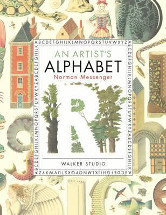
An artist's alphabet by Norman Messenger
Walker Studio, 2016. ISBN 9781406346763
(Age: All) Highly recommended. Aptly named An artist's alphabet,
the stunning illustrations make this a stand-out picture book.
Ranging from drawings of fabulous animals, beautiful flowers and
stylish buildings the reader is taken through the upper and lower
case letters of the alphabet each on a double page spread. Starting
with Aa, there is a wonderful acrobat standing on top of a horse and
another curled up to make the small letter a. The illustrations for
the letter Bb are a little more difficult to work out, but beetles
and a butterfly can be seen. From this beginning the reader would
expect to see a traditional alphabet book, with the pictures
matching the letters - but this is not always so. When the page is
turned to the letter Cc, beautiful waves are drawn, but the reader
is left wondering how the waves represent a Cc. This trend continues
throughout the book - a very round grey cat is on the Dd page, but
the Gg page has subtly patterned goldfish. Hh is easy to identify
with its wondrous multi-storied houses with archways and bridges,
but the trees and tree trunk for Rr is much more difficult to work
out.
The strange and fantastic drawings will also pull the individual
into the wonderful world of the imagination, providing so many
stimulating pictures that the reader will want to look at again and
again, not just to try and work out the associations with the
letters, but for their beauty and delicacy of colour. It is a book
that begs to be shared with other people, leading to discussions of
what the illustralions could refer to and coming up with different
solutions.
This is a book that I can see becoming a classic, one that people
who appreciate the surreal and beautiful will want to keep on their
book shelves.
Pat Pledger
Burn baby burn by Meg Medina
Candlewick Press, 2016. ISBN 9780763674670
(Age: 14+) Recommended. 17 year old Nora Lopez lives in New York
during the terrible year of 1977. The heat is scorching and there is
a killer on the loose. But that's not all Nora has to face - her
family is spiralling out of control, with her mother having
difficulty paying the rent and brother Hector becoming
uncontrollable and befriending drug dealers.
In a story of resilience set against a fascinating historical
backdrop, Medina brings to life the difficulties that Nora faces
with courage and thoughtfulness. With her father only interested in
his new family and not paying his way, it is she who must interpret
for her mother, and try and avoid the increasing violence of her
younger brother. When she meets a cute boy at the deli where she
works, she and her friend Kathleen know that Sam the Man, the serial
killer, is murdering young couples, and they both wonder if it is
safe to go out on dates. Her teachers are encouraging her to go to
college but all Nora wants to do is reach the age of 18 when she can
leave home and become independent, without the family worries that
are so overwhelming.
I enjoyed the thread of feminism that weaves its way through the
story, with Kathleen's mother an ardent believer in going to rallies
for women's rights. She takes the girls along with her on marches.
Nora too is clever with non-traditional skills of woodwork and these
skills will ultimately help her in a resolution to her problems.
Friendship plays an important part of the story, and the
relationship between Nora and Kathleen will leave readers asking
questions about when it is right to tell family secrets and seek
help from friends.
There are some big themes here: not only is there the simmering heat
that erupts in violence in the city, and the threat of a serial
killer on the loose, but the family dynamics are dire. In the
author's note at the back Medina talks about her theme of juvenile
domestic violence that is rarely touched on in young adult novels
and the novel being a 'celebration of people who find their strength
even in the worst circumstances'.
This would make a great literature circle book, with lots of themes
to be discussed.
Pat Pledger
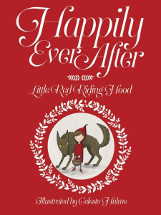
Happily ever after: Little Red Riding Hood ill. by Celeste Hulme
New Frontier Publishing, 2016. ISBN 9781925059564
(Ages: 4-8) This is exactly what it says: a version of Little
Red Riding Hood that ends happily! The story begins the same
way as in most versions of the story, with Little Red Riding Hood
setting out across the woods to take her sick grandmother a tasty
treat. 'Don't talk to strangers' her mother warns. The illustration
on this page shows a clever bird's eye view of the long path to
Grandma's house, which winds past the wolf's lair. The potential for
talking to young children about stranger danger is made clear as
Little Red Riding Hood disregards her mother's advice, not only
talking to the wolf, but giving him directions to her grandmother's
house. 'I will run fast through the woods and meet you there. I
would like to see if your grandma is feeling better' says the wolf.
A bird's eye view is used again, showing the wolf's shadow looming
large over tiny Grandma huddled in her bed. The iconic scene where
the wolf pretends to be Grandma goes just as expected but Little Red
Riding Hood somehow manages to open the cupboard door, releasing
Grandma and the avalanche of things in the cupboard! The wolf looks
injured and the reader is told he is never seen again. There are
some large passages of text and the ending seems a little peculiar,
but the language is relatively simple and the story flows well,
making it an appealing version of a traditional tale, especially for
children who are more sensitive.
Nicole Nelson
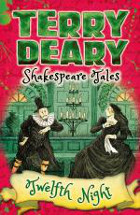
Twelfth night by William Shakespeare, retold by Terry Deary
Terry Deary Shakespeare Tales series. Bloomsbury, 2016. ISBN
9781472917836
(Age: 8+) Highly recommended. Theatre. Another in Deary's retelling
of Shakespeare's plays will help introduce this play to a new
audience. One of his best loved plays, Twelfth night is
often presented on the stage around the world and has been made into
countless film adaptations.
Here it is presented as a story and stripped back to its bare
essentials. John and Jane are at Richmond Palace to watch Master
Shakespeare's latest play, 'Twelfth night'. Through their eyes
we see the court and its splendour, Queen Elizabeth, now coming
towards the end of her life, the courtiers pressing their advantage
and the play set out before them. Their story and observations make
a fascinating backdrop to the play which tells of deception, just as
Lord Essex deceives the Queen. The two children could see that Essex
and his armed men, were up to no good and using the suit of armour
in the hall were able to defuse the plot by Essex's guards.
So the play continues, the parallels between what is actually
happening and the play's plot gathering speed. Both come to a
satisfactory conclusion and readers will have a sound grasp of the
play, while infusing some details about Elizabethan life. A
postscript about Essex's true attempts to overthrow Queen Elizabeth
rounds off the short book. This is one in Deary's series presenting
Shakespeare's plays in an abridged story version which will acquaint
younger readers with an outline of each play. Behind the play
presented is a story of young people involved in some way with the
play, giving a perspective which will appeal to the readers.
Fran Knight
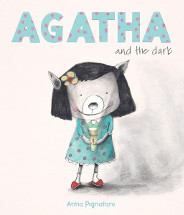
Agatha and the dark by Anna Pignataro
Five Mile Press, 2016. ISBN 9781760402075
(Age: 4+) Recommended. Fear of the dark. Anxiety. Friendship. Being
afraid of the dark is tackled well in this Agatha's second outing
for Anna Pignataro. Agatha wakes one cold wintry morning and dresses
to go to kindergarten with her mother, dresses in her bright red
coat. On the bedroom floor can be seen an outline of something in
the shadows which should not be there. Her teacher admires her coat
reminding her of the story of Red Riding Hood, a story Agatha likes,
although the walk though the dark woods is a little unsettling.
A storm outside upsets her friend, Yoko, so Agatha fetches her bear
for her to cuddle. Soon everyone wants a cuddle too. Miss Tibble
tells the group that everyone is frightened of something - why, even
she is afraid of spiders. But the day remains just as dark, and one
of the group tells them his brother had told him that monsters were
in the dark. After that Miss Tibble does some positive work with the
class about shadows, while at home, when Agatha goes to bed and is a
little upset, her parents ask her to draw a monster she would like.
All the way through different tactics are taken to allay the
children's fears about the dark, underlining the work being done at
school and at home, as well as by Agatha and her friends helping
each other.
Pagnataro's illustrations complement the text, showing some of the
things the children are afraid of, but supporting them in their
endeavours to overcome their fears. This will be a welcome
introductory picture book for discussions at home and in the
classroom, modeling strategies for parents, teachers and students.
Fran Knight
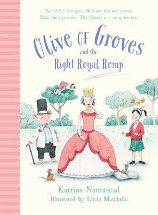
Olive of Groves and the right royal romp by Katrina Nannestad
Ill. by Lucia Masciullo. Harper Collins Children's Books/ABC Books,
2016. ISBN 9780733333712
(Age: 8-12) Recommended. Themes: Humour, Boarding schools,
Friendship. Continuing the rollicking series involving the
wonderfully loving, kind and generous Olive and her classmates at
Mrs Groves' Boarding School for Naughty Boys, Talking Animals and
Circus Performers, is this wild romp involving all the weird and
wild characters from previous books as well as a visit from the
Queen. Because this is a boarding school that defies description,
with a Principal who is entirely incompetent, and students who are
bizarre in the extreme, the local School Inspector is doing all he
can to close down the school that Olive has grown to love. The
Queen's visit creates a flurry of activity that is laughably
impossible and introduces an advisor sent by the School Inspector to
overcome the obvious dysfunction. This book can only be described as
mayhem - with flying food, multiple explosions, and an evil and
duplicitous pig. Bizarre, curious, uncanny and peculiar antics from
all characters are drawn together under the umbrella of Olive's
steadying and loving influence. Friendship proves its capacity to
overcome all problems.
Nannestad knows how to create a story that kids will enjoy. There is
nothing normal or 'mature' about this series, and language is used
creatively and artistically to describe characters and events, and
the humour is just silly. In fact this book series would make a
wonderful cartoon adventure. Although this is the third book in the
series it could be read on its own without having read the earlier
books, but the flow of misadventure is worth recommending to young
readers. Comedic naive illustrations are dotted through the book.
Caroline Hull
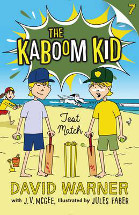
Test match by David Warner with J. V. McGee
Ill. by Jules Faber. The Kaboom Kid bk 7. Simon and
Schuster, 2016. ISBN 9781925368185
(Age: 7+) Recommended. Themes: Cricket, Friendship, Meeting
Challenges. Davey Warner is an 11 year old cricket 'tragic'. Every
moment of the day is an opportunity to think about cricket . . .
even in the middle of a test at school. In this book in The Kaboom
Kid series, Davey and his mates have organised a 2-day weekend
cricket test match at the beach. Their rivals have included a
surprise 'secret weapon', a Davey doppelganger, in the hope that
this would unsettle Davey and his team. But even though Davey ends
up in trouble with the authorities at the beach, there is still hope
that they can pull off the big win.
This is an uncomplicated narrative which will appeal to young lovers
of cricket (males and females). The friendship opportunities within
a team sport are highlighted, but also the interest of competition
adds a spark of narrative tension. Davey's family is portrayed in a
wonderfully ordinary light, with a sunscreen promoting mother, who
also sets rules for the young boy. This is a book that you can
recommend to young readers - even those who are not cricket
aficionados as cricket terminology should be understood by most.
Simple cartoon style black and white illustrations are scattered
through the book. (Note: Teachers, who don't mind their profession
being the object of some humour, could use this as a shared novel.)
Caroline Hull