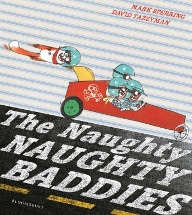
The naughty naughty baddies by Mark Sperring and David Tazzyman
Bloomsbury Publishing, 2017. ISBN 9781408849736
(Ages: 2 - 6) Highly recommended. Picture Book. A highly improbable
and amusing tale whereby 4 baddies hatch a 'dastardly' plot to steal
the spots of the Queen's little dog amongst other minor naughtiness
like the sticking out of tongues and the blowing of raspberries.
What greater fun is there to be had than to see oneself as a 'baddy'
creeping around with your friends in a quest to make as much
mischief as possible? And to put oneself in a position of power over
someone as powerful as the Queen herself is definitely irresistible
to the average 4 or 5 year old!
There are a number of powerful words used in the text that would
bear discussion with the young reader, 'dastardly' and 'fiendish'
being great additions to anyone's vocab. Delightful, 'diabolically
dreadful' and 'dastardly' alliteration is used throughout, and that
wonderful repetition of the 'naughty, naughty baddies' is sure draw
in the young reader when read aloud.
Creeping is at the forefront of the baddies' skills with 'sneaking'
coming in at close second. My three year old granddaughter is quite
convinced that her creeping skills are vastly superior to any
adult's ability to spot her little body wending its way slowly along
the lounge room curtains. If you creep well enough you can get away
with anything and steal the spots off the Queen's doggy, indeed the
4 baddies do. What happens as a result of this improbable crime
needs to read to be believed.
The ending was a little up in the air for me - not a particularly
satisfactory resolution with the tables turned on our most powerful
leaders. It may leave the little reader wondering exactly what
happened.
Elizabeth Avery
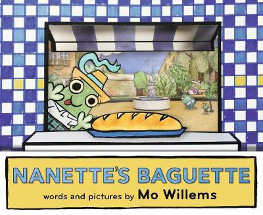
Nanette's baguette by Mo Willems
Walker Books, 2016. ISBN 9781406376210
(Age: 2 - 6) Recommended. Picture Book. It's all in the rhyme! Just
exactly how many words can one get to rhyme with baguette?? You will
quickly find out on reading Mo Willems' latest picture book.
Cleverly illustrated with photographs of his own purpose made paper
and cardboard constructions, Nanette, the little French frog is sent
to the bakery by her mother on a quest for a baguette; indeed, to
'get the baguette'. She can't resist the wonderful smell, however,
and wonders how on earth she will give her mother the bad news on
arriving home. The delightful ending will put a smile on the dial of
every small reader; just no one can resist the smell of warm
baguette.
This is definitely a book to be read aloud, the whole fun of it
being in the rhyme. Whilst the plot is one all young children will
relate to, it isn't particularly deep and meaningful; just crazy
fun. My three year old granddaughter likes a little more of a plot
than this book developed but nevertheless enjoyed thinking about how
many words could be rhymed with baguette very much warmed to the
thought of eating one.
Elizabeth Avery
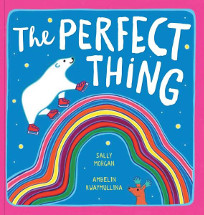
The perfect thing by Sally Morgan
Ill. by Ambelin Kwaymullina. Scholastic, 2017. ISBN 9781742991122
(Age: 4+) Highly recommended. Aboriginal themes, Grandparents,
Solutions, Family, Imagination. When Grandpa wants to go to the
park, Lily thinks up all the excuses in the world She tells him that
the dog has eaten her sneakers, and the cat has shredded her rain
coat, she has a sore throat and the bird has taken her scarf for its
nest, the wild weather will give her an ear ache and the wombat has
used her warm hat to put in its burrow. Every time she finds an
excuse to deflect Grandpa from going to the park, he finds a
solution, and each solution is wonderfully inventive and
delightfully illustrated In place of her sneakers he offers his
thongs and when she tells him that they are too big, he suggests she
pretend that she is a whale and that the thongs are flippers helping
her to get to the park. Each of his perfect solutions offer another
humorous response from Lily. His perfect thing is offered over and
over again to her excuses, inviting the audience to think of perfect
things for themselves when Lily offers another reason for not going
to the park.
Kwaymullina's bold illustrations in bright swathes of colour are
presented in framed sections on each page, asking the reader to see
the story in sequences from one frame to the next.
The ending will bring more smiles as Morgan cleverly brings the
story back to the beginning, with Grandpa and Lily going to the
playground, the perfect thing.
This delightful story will encourage responses from the readers as
they join Lily in her excuses and think along with Grandpa of ways
to circumvent her reasons for not going. Imagination is all, from
the invention of Lily's reasons, to the perfect things suggested by
Grandpa to the two of them finding marvelous things at the
playground. I loved the interaction between Lily and her Grandpa a
wise old man, and the interplay between them. And younger readers
will love the range of animals shown in the story.
Fran Knight
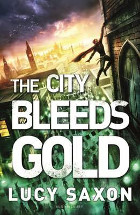
The city bleeds gold by Lucy Saxon
Tellus series book 3. Bloomsbury, 2017. ISBN 9781408847732
(Age: 11+) Recommended. An initial impression was one of
disappointment, starting with the all too convenient map of the
Tellus archipelago. Learning that the protagonist Noah has an alter
ego, Daniel, who is pretty much the Spider-Man of this fantasy
realm, didn't help matters - but to be fair, this is Volume 3 and
the world of Tellus has already been well described in Volumes 1 and
2: Take Back the Skies and The Almost King. The City Bleeds Gold gains momentum with Daniel's nocturnal
forays into the lower city to protect his fiance, Princess Crysta.
Crysta is the future Queen of Erova, the largest territory of
Tellus. In her parents' absence, it is her job to organize the
annual festival to ensure the favour of the Goddess and the
sustainability of the kingdom. Noah, a commoner and mask-maker like
his father, is not exactly the most popular choice of future consort
according to just about everyone but Crysta. With both Damian, head
of security, and the younger princess Rosa, in tow, they focus on
protecting Crysta and the supremacy of Erova from an assortment of
threats. Daniel (Noah in disguise) has both the ability and the
motivation to be spying on potential enemies but is unacknowledged
due to his secret identity.
A measure of romance means that the main characters are developed
well. A young author of 21, Saxon expertly builds suspense as Daniel
uses the roof tops to spy on and stymie the bad guys. When Daniel's
intelligence gathering finally plays out, the novel becomes a heady
page-turner in the milieu of the high fantasy and appropriately
named, Tellus series.
Deborah Robins
Tiny Timmy on tour! by Tim Cahill and Julian Gray
Ill. by Heath McKenzie. Tiny Timmy series, book 5. Scholastic, 2017.
ISBN 9781743816509
(Age: 7-9) Recommended. Themes: Soccer, Team Sports, School stories.
Tiny Timmy and his soccer team performed extremely well at the Gala
Day and now they have the opportunity to play against some of the
best country school teams. Coach Roach calls a lunchtime team
meeting and shares the good news with the players. They are off on a
five-day bus trip to play the Big Country Beasts, the Pine Hill
Possums and the Wave Beach Wanderers. Timmy is both excited and
nervous as this is the first time he has spent so long away from his
family.
The five days away from home are filled with fun, laughter, food and
plenty of soccer. While Timmy and his mates focus on eating healthy
foods, team clowns Studs and Hacker overindulge at the motel buffets
resulting in a loss of stamina during the games. The first game
against the Big Country Beasts is too much for the Lions, they
struggle with the much bigger players. Back at the motel, Tiny Timmy
can't fall asleep due to Stud's snoring and the boys' late night
video game playing. The Pine Hill Possums prove to be a sneaky team
up to all sorts of tricks and dirty tactics but Studs saves the day
with a lucky goal. Their final game is fast-paced, filled with super
teamwork, great goals and a surprising outcome. After a fun
celebration at the beach, the team board the bus and head home
tired, but happy.
This easy to read chapter book features text with different sizes of
font, words in bold and in graduated sizes, animated words and
bigger spacing. Heath McKenzie's line drawings are humourous
snapshots of Timmy's life, his family, friends and the soccer games.
This series is great for high interest, lower reading age students
as well.
Rhyllis Bignell
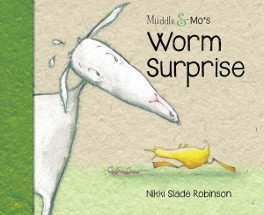
Muddle and Mo's worm surprise by Nikki Slade Robinson
Starfish Bay Children's Books, 2017. ISBN 9781760360306
(Age: 3+) Goats, Friendship, Food. Friends, Muddle and Mo are going
to have lunch. Muddle collects a range of worms to add to the lunch
basket: big and little, fast and slow. They then must take the
basket up a rather steep hill to sit beneath the tree and eat lunch.
Mo does not seem too happy about his Worm Surprise, particularly
after his exhausting climb, but is pleasantly surprised when Muddle
reveals that Mo's lunch does not contain any worms.
I love the illustrations: the goat and chicken are very cute and
will appeal to the young people who read the book. The range of
expressions on the animal's faces are a mine of information for the
reader, and the movement will ensure the readers' eyes are drawn
across the pages.
Initially I thought the story was showcasing comparative words such
as big and little, fast and slow, and expected that to continue, but
the story fades a little to the climax of Mo giving his friend a
Worm Surprise that contains no worms. Children will certainly
sympathise with the goat's possible worm salad, and be relieved when
his friend makes an exception for his taste. Children will be able
to talk about things they like and what they do and do not eat when
talking about this book with others, and see that friendship means
not imposing your taste on your friend. First published in New
Zealand.
Fran Knight
Trouble tomorrow by Terry Whitebeach and Serafino Enadio
Allen and Unwin, 2017. ISBN 9781760291464
(Age: 12+) Recommended. Civil war, Refugees, Refugee camps,
Survival, Sudan. Obulejo and his friends must run for their lives
when rebels come, searching for boys his age to train as boy
soldiers. He is living in a boarding school, St Xaviers, far from
his village, where he hopes for a good education, but they are all
aware of the civil war outside the confines of the school, causing
alarm throughout southern Sudan.
Escaping into the bush, he is exhausted, hungry and thirsty when a
woman offers him food. He meets others like him, and together they
head for the border with Kenya where they hope they can get into a
refugee camp and be safe.
The book falls easily into three sections, the first is his village
life and its disruption by civil war and the trek to the refugee
camp, next comes his survival in the camp, and finally the trip to
Australia.
If the trek to Kenya was harrowing enough his survival in the camp
causes him huge concern. Here he learns to steal to survive. With
his upbringing and education, he knows this is wrong and it causes
him great heartache, but he makes the decision to focus on his
education with the hope of getting out of the camp.
Densely packed with his life story, images will stay in the readers'
minds, and the question always asked of what would they do in his
place. An absorbing read of a life far from our own, the tale will
give a background to some of the stories seen on TV, and help
younger people sympathise with the plight of displaced people, who
for no fault of their own have lives totally disrupted by civil war.
At the beginning of the book is a welcome map to chart his journey
and at the end, Whitebeach has included a brief history of the
Sudanese Civil War, along with a photo which astounded me. Reading
about the harsh bush and frightening jungle through which Obulejo
walked it was a surprise to see an image of a serene village
surrounded by dense jungle and a mountain. It had me looking at
photos of Sudan on the internet to look further at this beautiful
place.
Fran Knight
Wimmera by Mark Brandi
Hachette, 2017. ISBN 9780733638459
(Age: 16+) Recommended. The prologue to this story starts the
mystery off - two young boys, after idling away time yabbying
unsuccessfully in a country dam, explore into the bush further, and
make an intriguing discovery. The story then moves to some years
earlier and it is a different set of boys passing their summer
holidays together - Ben and Fab are good mates, they enjoy each
other's company, and the banter between them is easy and natural.
But Fab doesn't have an easy life, he is picked on by the bullies at
school taunting him for being a wog, and at home things are even
worse when his father loses his temper and starts beating him up.
Ben tries to protect Fab, standing beside him when he needs help in
the schoolyard and even trying to take the blame for a cricket
accident to deflect the wrath from Fab's father. The friendship and
trust between them is real, the conversations are natural, and they
fit easily together.
It sounds like one of many engaging stories of adolescent boys
growing up in the Australian country. However this story goes to a
darker place very quickly. There is a shocking young suicide next
door, a sign that all is not as it seems. And when the grieving
family moves out of that house, the new resident with the smart car
becomes an object of curiosity for the boys - who is he? Is he a
secret agent? The new neighbour, Ronnie, a tall muscular man, seems
to take an interest in Ben, offering him the opportunity to make
some money with odd jobs. He is friendly, he offers to help Ben,
shares secrets with him, and builds up a gradual intimacy. But it is
not the friendship of mates like Fab, it feels strange and Ben
doesn't know how to handle it.
The way that Ronnie charms Ben's parents and gains their trust, and
the description of the gradual grooming of Ben, provide insight into
how a paedophile might work, revealing the very real quandary that a
young unsuspecting teenager might find themselves in. What can Ben
do about it, what will happen next? Can Fab help?
This book carried me along very quickly and I read it in almost one
sitting captured by the tension of wanting to know how the boys
handle the menace and what happens next. It is a dark story, but
there are no ugly graphic details, the danger is merely suggested.
We don't have to know the details to solve the mystery. The
denouement makes sense; the descriptions of the relationships have
an authenticity that makes one feel that if it is not a true story,
it is coloured by real events, and is worth reading to gain an
insight to how such things might happen. It left me pondering things
afterwards - questions such as what makes a friendship, what is the
dividing line between genuine closeness and closeness that is
manipulative and exploitative? How do you know when to trust and
when not to? Maybe it is just luck, and we could all use Fab's lucky
rabbit's foot.
This won the 2016 UK Crime Writers' Association Debut Dagger.
Helen Eddy
Editor's note: This is also available as an audiobook through
Audible and iTunes.
Sci-Fi Junior High by John Martin and Scott Seegert
Scholastic Australia, 2017. ISBN 9781743818046
(Age: Middle primary school) Sciriustrati-Fibronoculareus Junior
Things for High is Kelvin Klosmo's new school, 56,000 light years
away from the last one, in Outer Space. Kelvin is part of a strange
family, with genius scientist parents whose new role involves
inventing a way to put people's minds into robotic bodies and a
4-year old sister Bula who he thinks is the most annoying person in
the world. In the style of Diary of a Wimpy Kid and Dear
Dumb Diary, the reader finds themselves at Sci-Fi Junior High
with Kelvin making new friends, dealing with the school bullies and
learning a lot as well . . . well, trying to. Kelvin is a Mighty
Mega Super Genius, who is just waiting for his Super Genius to kick
in.
The comic style of the story is complimentary to the storyline and
definitely adds a lot to the tale. The science fiction technology
aspect is also aided by the diagrams and illustrations. The alien
food fight in the cafeteria is especially comedic as Kelvin tries to
differentiate the food from his new classmates. This novel has many
zany characters including a mad scientist out to conquer the
universe and a dog who makes replicas of anything he is looking at,
made of whatever substance he is eating. It is a great read with a
sequel coming out next year and many middle school aged students
are sure to look forward to it.
Clare Thompson
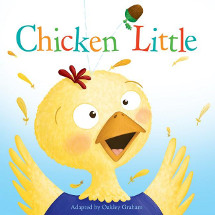
Chicken Little by Oakley Graham
Ill. by Kimberley Barnes. Big Sky Publishing, 2017. ISBN
9781925520026
(Age: 3-5) Themes: Folk Tales. Chickens, Heroes. Author Oakley
Graham's retelling of the popular English folk tale Chicken
Little introduces this story to a new audience. When Chicken
Little walks through the woods, an acorn falls on his head. He
imagines the worst-case scenario that the sky is falling, and he
needs to inform the king.
As Chicken Little races off, he meets Henny Penny, Cocky Locky,
Ducky Lucky, Drakey Lakey, Gooey Loosey, Gander Lander, Turkey
Lurkey and Foxy Loxy the villain. Each animal listens to the warning
that the sky is falling and there is a sense of panic and everyone
is easily convinced that this is true. As the group hurries off on
their mission, they meet the villain Foxy Loxy, a very clever and
very hungry animal. He lures them into his foxhole with the false
promise of a safe place to shelter. Luckily, the king's dogs run by
and start barking and Chicken Little and his friends are saved.
As the eight animals race away from the hungry fox, they stop under
the big oak tree in the woods. 'Plop! Plop! Plop!' Of course, they
see the acorns falling down and immediately realise that the sky is
not falling!
This cumulative tale with the fun rhyming names and repetitive text
is a delight to share with children from toddlers to Early Years
students. Kimberley Barnes colourful illustrations are bright and
lively. The expressive characters take on human characteristics and
wear fun clothing, Foxy Loxy is very stylish in his purple boots.
This folk tale's message is do not believe everything you are told.
This is an important life lesson, very relevant in this digital age
with news and information available in so many formats. Chicken
Little also introduces the male and female names for each
animal. Foundation learners can engage with the cumulative text, and
share their feelings and thoughts about the events and characters.
Oakley Graham's picture book is just right for retelling through
performance and by developing a class big book using digital media.
Rhyllis Bignell
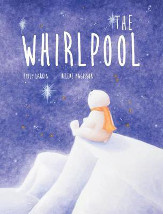
The Whirlpool by Emily Larkin
Ill. by Helene Magisson. Wombat Books, 2017. ISBN 9781925563047
Life is lovely for Polar Bear Cub. He has a happy, loving family
where he is safe and protected. He has friends and dreams for the
future. Each day is better than the last and he is in charge of his
life. Even the stars shine just for him.
But suddenly all that is snatched away. Without warning, darkness
descends and there is no family or friends. No hopes and dreams.
Loneliness is his only companion - not even the stars are there for
him.
Born from a uni assignment of using words and pictures together to
make meaning, this is an unusual story because as the text speaks
directly to the reader, it is the pictures of Polar Bear Cub that
provide such a graphic interpretation of what they are saying, even
though there is no reference to him in the words themselves.
Together, they give depth and understanding to a situation that many
of our children find themselves in when disaster and catastrophe
strike their lives and all that is familiar is gone. Even its title
is symbolic of the range of emotions that are within us, sometimes
raging out of control but always eventually calming to a manageable
level.
To children, some things - such as the coming of Santa Claus - seem
to take forever, while to adults the time passes in a flash.
Similarly, to a child darkness lasts forever with no hope of light
and their emotions are intense. This book is written "for kids to
know that it's okay to feel a range of emotions. It's okay to feel
lonely, sad or uncertain - but these times don't have to last. "
The well-being, particularly the mental health, of our students is
receiving more and more focus in our curriculum as mindfulness
programs are seen as crucial to a student's success in other areas
so this is an timely addition to that collection of resources to
initiate discussions and provide support.
Barbara Braxton
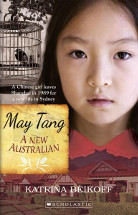
May Tang: a new Australian by Katrina Beikoff
A New Australian series. Omnibus, 2017. ISBN 9781742990743
(Age: 10-12) Highly recommended. Themes: Immigration, Chinese in
Australia, Chinese History. Eleven year old May Tang's familiar life
in Shanghai is about to change. Her oldest brother Peter is settled
in Sydney, studying at university. The year is 1989 and Chinese
students are campaigning for democracy, for freedom of the press and
political change. May is unaware of the real reasons that Peter was
sent to Australia. She enjoys going to the park with her grandfather
Ye Ye, listening to his stories and his beautiful singing bird. At
home, her older sister Jie Jie bosses her around, always telling her
what to do. May is a dreamer, she loves her Chinese life, her
mother's cooking, the little street stalls and the sights and smells
of her city. May begins to understand when her mother shares her
story about the government's taking her out of uni and sending her
to work on a farm and reading Peter's letter about a better life in
Australia. Her father shares the news about the terrible turmoil in
Tiananmen Square and Peter's political activism, so the family
decide to send mother and daughter to Australia for safety.
Everything is strange and different in this new big city; she is
reluctant to leave the airport. Peter settles them in an apartment
and then leaves to work picking cherries in the country. May has to
be the adult, interpreting for her mother, helping her find a job
and face the difficulties of attending a new school. Here, she is a
victim of bullying and racist views, and when taunted for her
Chinese ways she becomes very unhappy. When she meets a new friend
Jade she finds acceptance and encouragement as she learns to believe
in herself.
May Tang is the sixth novel in the A New Australian series
exploring a specific historical period and the impact on a girl and
her family immigrating to Australia. Katrina Beikoff's novel
interweaves factual information with a beautifully detailed story.
She realistically captures both the Chinese and Australian ways of
life; the sights and smells of Sydney's Chinatown, the eighties
clothing - shoulder pads, the big hairstyles - crimped and curled,
even the birds are so different. With relatable characters,
realistic settings and slices of history these novels are suitable
for Middle Primary classes studying Australian History and
immigration.
Rhyllis Bignell
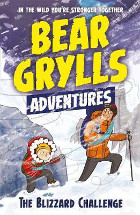
The Blizzard Challenge by Bear Grylls
Bear Grylls Adventures. Bear Grylls, Bonnier Publishing
Company, 2017. ISBN 9781786960122
(Age: 7-11) Bear Grylls is a well known adventurer and survival
expert. He's had several TV programs and has written books for both
adults and children. His Mission Survival books were
targeted to older primary school students but this series Bear
Grylls Adventures will appeal and be accessible to a younger
reader.
The theme in The Blizzard Challenge is survival and being
the best person you can. Physical struggle and adversity against
nature teach lessons about both persistence and self belief. The
first message on Bear's website is 'Life is an adventure. Live it'.
This is something that Olly learns in this first book.
Olly is reluctantly on a camping trip and he lets down his friends
during the activities. He doesn't want to put up the tent, build a
den or be part of the team. While wandering in the woods he is given
a compass by another child whom mysteriously comments, 'I think you
need this'. This compass has a strange fifth direction which takes
Olly straight to Bear Grylls on a high mountain range. Bear teaches
Olly how to survive in sub zero temperatures and hazardous
situations such as walking on a cracking frozen lake and enduring a
blizzard.
Olly returns from his adventure having learnt important lessons
about the environment and himself. He passes the compass onto the
next adventurer who features in Desert Challenge book 2 of
this series. There are 4 books available in this 12 book series.
Emma McCann is the illustrator and her drawings feature throughout
the book. Colour is used only on the cover.
Bear Grylls appeals to children and this series will interest to 7
to 11 year olds. Jane Moore
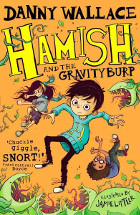
Hamish and the gravity burp by Danny Wallace
Simon and Schuster, 2017. ISBN 9781471147128
(Age: 7+) The bright cover and illustrations covering the paper
edges promises humour and fun, and they certainly deliver this for
young children!
The story surrounds Hamish Ellerby, who begins by finding his family
stuck to the roof through the strange happenings that is a 'gravity
burp'. The whole town of Starkley is affected and obviously causes
lots of questions and a then big town meeting.
It becomes up to Hamish and his friends (who are all in a gang
called the PDF - Pause Defence Force) to save their town once again.
After some research I found that this book is part of a well
established series, where Hamish and the PDF try to save Starkely
(and the world) from Alien invasion. This made sense as although
Danny Wallace gives information to the reader to allow this to be an
interesting stand alone book, I feel that reading this series in
order would be very beneficial to getting to know the long list of
characters.
The story is consistently funny, with toilet/gross humour throughout
keeping even the most reluctant reader or listener entertained.
My favourite character of the bunch was Madame Cous Cous (who
couldn't love that name!) and her sweet shop. She is always doing
something amusing like nailing down all the sweets in the shop, and
through the wonderful illustrations I was able to form a great
visual image to compliment the story.
This book would suit readers who love Roald Dahl and David Walliams,
as it is clever, humorous and filled with little tidbits (like the
flick-a-book illustrations!!) to delight every reader.
Suitable for readers or listeners from 7+
Lauren Fountain
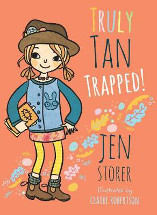
Truly Tan: Trapped! by Jen Storer
ISBN: 9780733334122.
(Age: 9-11) Themes: Friendship; Mystery; Child detectives. Tan is
the youngest of four girls. Many girls would find this a difficult
burden, but Tan is forthright and intelligent and able to solve
mysteries. Her impressive powers of observation - seeing details
that others might miss, her special notebooks and her best friend
Gloria (a perpetual optimist) help her to rise above the dilemmas
that she faces. In this book she is needed to be on security detail
for a holidaying neighbour (the weed and water role is probably the
most important part of this detail) and she goes hunting for a
mysterious vehicle, a mysterious white flash (that may be a spirit
deva) and a mysterious 'gypsy'. Mystery at every turn! But will this
investigation lead her into danger? And who is the mystery person
who has infiltrated their secret Head Quarters? Added to this, we
hear about the arrival of an unwanted and surprising visitor and the
weird and wonderful personalities of her older sisters. Does Rose
really have the power of predicting the future? Will Tan really be
trapped in a web?
Even though there is a hint of 'mystical' in this series with some
'mildly spooky' moments, mostly it is just a story of inquisitive
friends trying to make sense of their world. The curious girls also
have to deal with parents' demands and chores, and their personal
sense of importance in their family.
A book that 9-11 year old girls will connect with.
Carolyn Hull