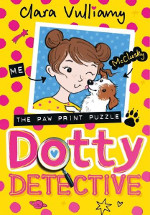
Dotty Detective: The paw print puzzle by Clara Vulliamy
HarperCollins, 2016. ISBN 9780008132453
(Age: Beginning independent readers) Inspired by their favourite
television character Fred Fantastic, Ace Detective, Dotty
and her best friend Beans have formed the Join The Dots Detective
Agency. They have special badges that they wear underneath their
coat collars so they don't blow their cover and are ably assisted by
Dotty's dog McClusky to solve mysteries that seem to occur. They are
guided by Fred Fantastic's tenets of :
1. Stay Frosty. Always be on the lookout.
2. Follow That Hunch. If you've got a funny feeling you may be onto
something important.
3. Use Your Noodle. Think.
4. A Light Bulb Moment. A sudden genius idea.
5. Get Proof. You must have the evidence before you can solve your
case.
6. Jeepers Creepers. Use your Peepers.
In this episode they set out to solve the strange noises that Dotty
hears in her hallway at night. When she opens her door and can't see
anything she is almost convinced to believe in ghosts and that her
house is haunted. But by using the clues, conveyed through secret
notes written in invisible writing, they are able to identify what
is really going on . . .
This is a series that is perfect for the newly independent reader
with its layout, illustrations, larger font, shorter chapters and
humour. The pace is rapid and the use of a variety of fonts
highlights key ideas and actions without the need for a host of
words. Girls will relate to her feisty nature but boys will also
find the situations familiar and appealing. Others in the series are
The
Midnight Mystery, and The Lost Puppy.
A worthwhile new series to get for those who are beginning their
independent reading journey.
Barbara Braxton
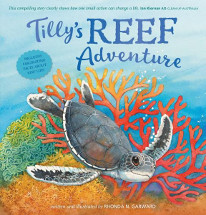
Tilly's reef adventure by Rhonda Garward
National Library of Australia, 2017. ISBN 9780642279088
(Age: 7+) Recommended. Themes: Reef, Sea animals, Fish, Turtles,
Great Barrier Reef, Pollution, Lift the flap book. Tilly a small
green turtle has against the odds made it to the sea on the east
coast of Australia where she learns to survive amongst the other
animals. Through her eyes we see the array of coral which makes up
the reef and the plethora of animals which make it their home.
Dodging the lizards and seabirds ready to make a feast of the new
hatchlings, she must make it past the whales waiting for a feast.
Diving down into the clear water on the reef, she finds smaller
animals that bear no danger but there are larger ones which do pose
a danger to someone her size. She must learn to recognise these and
avoid them. But one day she is trapped by a plastic bag which
catches around her and she is washed up onto the beach amongst a lot
of other litter.
It is here that the point of the book is made crystal clear. The
little green turtle is helpless, the plastic around her makes her a
rudderless piece of flotsam drifting with the waves, and once on the
beach she is stranded, ready to be picked up by any predator. In
this story, the humans come to her rescue, putting her back in the
sea. But unknown numbers of sea creatures are killed in this way
every day, and the book offers the opportunity for class to discuss
this world wide problem and what can be done about it.
At the end of the book are several pages giving information that
classes will find useful: one double page outlines Tilly and her
friends in the sea in more detail, while the next double page
illustrates all the fish seen on the reef, and the following several
pages show readers what is being done on the reef by scientists bent
on saving the heritage site for future generations.
A most informative and lively book, the illustrations will add to
the interest shown by young readers with their bright colours and
detailed drawings. Lifting the flap always adds interest to an
information book and this is no different, but an index would have
helped younger readers look things up and practice their research
skills.
The animals all have anthropomorphic qualities which detracted from
the flow of information for me, but I am sure young readers will not
be as picky: they will enjoy every page, the information and
illustrations alike, learning much about the reef and its
inhabitants the more they read and look at the intricate and
detailed pictures.
Fran Knight
The last Namsara by Kristen Ciccarelli
Orion, 2017. ISBN 9781473218130
(Age: 14+)Fantasy. In a well-written and well-constructed narrative,
Ciccarelli draws us into the interconnected lives of the royal
family, the slaves, the cousins and the dragons. This world
resembles our world in its jealousies, love, family feuds, its
enmity towards those outside 'our' world.
We are plunged into the intimate world of Asha, the Iskari, whose
recent action, slaying a dragon, must be concealed, as should the
burn she bears as a result of her killing this dragon. Controlled
yet passionate, beautiful and unattainable, she is in a state of
fear, of tension and of anxiety about what she has done, in her
transgression, and what she must do to both cover this up and be
ready for the next stage in her life.
These characters are drawn so finely, their world so rich in detail,
the presence of the dragons as willful, strong aggressors that must
be tamed or silenced, that we conceive of this world as possible.
Not unlike our world, this world is full of envy, of family
disruption and jealousy, of the normal human frailties and love, of
honour and betrayal. It is a good read for those who love a story
that rings so true and that lifts us out of our world for a brief
time, to both puzzle and entertain us.
Liz Bondar
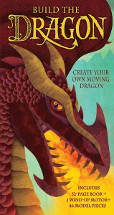
Build the Dragon by Dugald Steer
Ill. by Jonathan Woodward and Douglas Carrel. Quarto Books, 2017.
ISBN 9781925381702
(Age: 7+) Recommended. Dragons. Models. Build the dragon is
a fabulous kit that comprises of a book about dragons and a model of
a dragon comprising of 46 model pieces and 1 wind-up motor. It is
housed in a sturdy box and is must for lovers of dragons and people
who like to make models.
The book describes what a dragon is, dragon legends, and different
dragons from around the world, their magical powers and their
senses. It is very brightly coloured with very appealing
illustrations that complement the text. The reader will learn much
about the mythical creatures and from where they originate. There is
even information about the living dragon, the Komodo dragon. People
who enjoy reading tales of dragons will find that this book gives
lots of background information to the fantasy dragons that they are
familiar with from their stories.
The model is made from sturdy cardboard and has good instructions on
how to make it. Children will need to be able to read fairly
fluently to follow the guide, but they can always ask an adult to
help them make it. The moving parts of the completed dragon will
delight model lovers, young and old alike.
This would make an ideal gift for children and would keep them
occupied and away from screens for a considerable and enjoyable
amount of time.
Pat Pledger
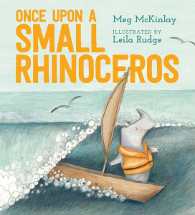
Once upon a small rhinoceros by Meg McKinlay
Ill. by Leila Rudge. Walker Books, 2017. ISBN 9781925126709 (Age: 3-8) Highly recommended. Themes: Determination, Adventure.
This tale is whimsical and gentle with soft, pencil illustrations in
muted colours that suit the style of the book perfectly. It is about
a rhinoceros named Lila who isn't content with just doing rhinoceros
things. She sees the boats that sail past on the river, bringing
with them exotic sights, sounds and smells and she dreams of seeing
the world beyond the mud and grass and trees that she calls home.
But the mud and grass and trees are everything a rhinoceros could
need says another rhinoceros. Lila agrees. It is. But still she
dreams. Finally, one day, she builds a boat.
Lila, with her human-like upright stance, contented smile and rosy
cheeks is such a likeable character. She is determined and
adventurous and absolutely refuses to be discouraged from her
mission, regardless of her lack of knowledge or experience. "You
can't row. Or steer. Or read a map" one rhino says. "I know" says
Lila. "You'll get lost" says another. "Perhaps" she says, as she
sails off around the bend wearing the bright orange life jacket she
found in the mud.
When reading this aloud it feels like you have to say the
mouth-twisting word rhinoceros or the even more gymnastic word
rhinoceroses one too many times, but this is minor critique for what
is a really rather perfect picture book. The illustrations of Lila's
travels are stunning, bringing to life little worlds that Lila
marvels in: the depths of the ocean, the rainforest and the city.
The page containing people from different cultures and walks of life
is a great discussion point. When Lila returns home most of the
rhinoceroses are content to hear her stories and then continue with
their normal lives. But in one rhinoceros, even smaller than
herself, she finds a similar dreamer.
This tale emphasises that you don't have to be big (or male) to step
outside of your comfort zone and to be an explorer and a pioneer.
Lila dreams and works hard to bring her dreams to fruition. She has
no help and no encouragement, but it doesn't deter her.
This isn't a unique story line for a picture book but it is a
particularly good one. Inspirational for young and old, male and
female.
Nicole Nelson
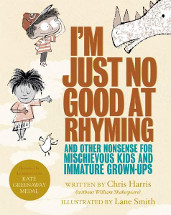
I'm just no good at rhyming: and other nonsense for mischievous kids and immature grown-ups by Chris Harris
Ill. by Lane Smith. Macmillan, 2017. ISBN 9781509881048
(Age: 4+) Recommended. Themes: Poetry. Humour. Word play. Read
aloud. Fun. Rhyming. Poetry books often linger on shelves but this
one will not. All it needs is someone to read out one of the poems
to an eager class, and the book will be taken away. An astute
teacher will see the possibilities of using such a book in the
classroom, as many of the poems present a template on which children
can invent further poems.
Many are just nonsensical, sure to elicit laughter from the
delighted listeners, some have marvelous word play, inviting
children to add their own piece of nonsense, while others describe a
very recognisable situation. Whatever poem found when opening this
large book, children will be intrigued, offering rhyming words,
working out just what the poet means, trying them out for
themselves.
The poem of the title will grab them as the poem lives up to its
title, having non-rhyming words at the end of each stanza, impelling
listeners to call out their own rhyming words. But when the poet
says he is good at metre, spelling and timing, children will learn
what these are as they read. Others like 'The hungry giraffe' are
simply fun, inviting children to learn the short poem and laugh out
loud at the preposterous rhyme in the last line, modeling the use of
this poem as a template for their own work, using made-up words to
complete the rhyme.
There are poems about bad words, and farms, animals and going out on
a Saturday night, poems about families and cities, snails and
teachers, all designed to make people laugh out loud and read them
over again.
'Under my dragon's wing', for example, encourages children to find
something that makes them feel safe, and use the metre of this poem
to write their own.
Nonsense poems abound, such as 'The incredible story of day the
glistening city of San Fransisco was saved from destruction by a
lowly snail', or 'Alphabet book' (by the laziest artist in the
world)
while some may be about a topic which encourages discussion like
'The loser's cheer' (and also a laugh!) and others are much longer,
like 'The shortest anaconda in the world', which reveals some
startling rhyming words.
The illustrations by award winning artist, Lane Smith, add to the
fun of the poems, often poking fun at the theme while adding to the
story. I love his doorman and the giraffe, while many other drawings
made me laugh out loud.
There is an index (good luck with that) and an outdex along with
short biographies of the two people responsible for the book.
I can imagine groups of children reading these out to each other,
giggling away at the outrageous rhymes and funny illustrations while
teachers will use them for classroom poetry readings and modeling
creative writing.
Fran Knight
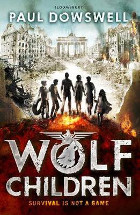
Wolf children by Paul Dowswell
Bloomsbury, 2017. ISBN 9781408858516
(Age: 13+) It is July 1945, Hitler's Third Reich has fallen, and
Berlin is in ruins. Living on the edge of survival in the cellar of
an abandoned hospital, Otto and his ragtag gang of kids have banded
together in the desperate, bombed-out city. The war may be over, but
danger lurks in the shadows of the wreckage.
Caught between invading armies, ruthless gangs and the constant
threat of starvation, Otto and his friends must learn to stay alive.
But the Nazi regime left psychological wounds that are slow to heal:
rifts arise in their little group and terrible secrets surface when
a sinister figure emerges from the darkness.
Dowsell has created a masterpiece that draws on themes such as
searching for the truth, friendship and survival against the odds.
After living through the horrors of war, the children are now trying
to find a life that resembles some sort of normalcy in
Russian-occupied Berlin. There are a number of strong characters in
the book, none more so than Ulrich. He is in constant turmoil
between the brainwashing he received in the Hitler Youth and the
reality of how he is now forced to live. Ulrich still clings to the
ideology of the 'Master Race' but, in reality he is beginning to
question this.
This is definitely a YA novel as it tackles some issues that would
not be suitable for readers younger than 13. It would be a positive
addition to the library collection on World War 2, particularly as
it exposes experiences of children on all sides.
Kathryn Schumacher
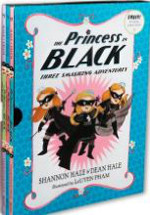
The princess in black: Three smashing adventures by Shannon and Dean Hale
Ill. by LeUyen Pham. Candlewick Press, 2017. ISBN
9780763697778
(Age: 6+) Recommended. Themes: Humour. Monsters. Adventure.
Superheroes. Getting a monster to return underground where it
belongs is not a task allocated to a pretty Princess in Pink,
Magnolia, replete with tinkering glass slippers and a tiara. But it
is just the right task for the Princess in Black, her alter ego, who
can change her clothes in an instant, and leap onto her charger, a
few minutes before a unicorn in the paddock calmly chewing the
grass. But things do not have quite the same ring as a superhero,
for the princess must change into her new guise in the broom closet,
slide down a channel built into the castle walls to meet her horse
outside the castle walls. Once on the go, she meets up with the goat
boy, Duff, trying to protect his goats from the blue monster which
has appeared above ground. It cannot remember just why it should not
go outside the underground cave where it belongs but soon recalls
the reason when the Princess in Back forces a reminder. While she is
away the nosey Duchess Wigtower snoops around her castle, adding
another layer to the story, with humorous results. The illustrations
add to the story, splitting up the text for newer readers, and
adding a level of visual literacy that is inviting and fun.
This series turns around the idea of superheroes, with Princess
Magnolia changing from her pink outfit to the black to defeat her
enemies. The princess in black is the first in the series,
followed by The Princess in black and the perfect princess party
and The Princess in black and the hungry bunny horde while
at the back of the book there are pictures of several more in the
series.
Each is funny, adventurous and involving. They will appeal to
younger new confident readers.
Fran Knight
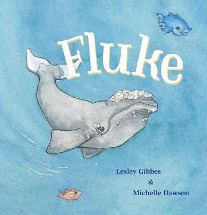
Fluke by Lesley Gibbes and Michelle Dawson
Working Title Press, 2017. ISBN 9781921504891
Under the shadow of the great harbour bridge a little southern right
whale is born. For weeks it stays and plays with its mother getting
stronger for the long journey south to the Antarctic waters,
delighting the people of Sydney who hadn't seen a pair like this for
many years. But one day a ferry's motor startles Fluke and he dives
deep to the bottom of the water where it is dark and murky and he
can no longer hear his mother calling.
The people of Sydney begin an anxious search for him knowing that
without her protection he will be easy prey for a shark...
Based on actual events, this is a charming story illustrated in a
palette as soft and gentle as both the text and the events
themselves. Like the humpbacks that are so prevalent down the
Humpback Highway at the moment, southern right whales - so-called
because early whalers believed them to be the 'right' whale to catch
because they were large, slow-moving, rich in oil and blubber and
floated when they were killed - were hunted almost to extinction in
the early 20th century and so the appearance of mum and bub in the
harbour brought both joy and hope. The endpapers provide a thumbnail
sketch of these wonderful creatures, adding an extra dimension to
the book.
Now that whale-hunting has taken on a whole new meaning and with
seeing a whale in the wild on many bucket lists making it a
sustainable tourist industry for many little coastal towns, learning
about them through stories like Fluke can only bring a greater
awareness and help to guarantee their revival and survival. The
whalers were an important part of our coastal history and
settlement, making them an important part of the history curriculum
but unlike a generation ago, their activities can now be scrutinised
through several lenses as students discuss and debate the
'rightness' of their endeavours. The use of books like Fluke would
bring another perspective to a webquest.
Teachers' notes are available
Loved it.
Barbara Braxton
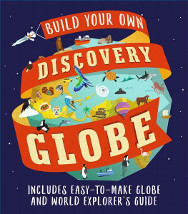
Discovery Globe: Build-Your-Own Globe Kit by Leon Gray
Ill. by Sarah Edmonds. Walker Books, 2017. ISBN 9781406378474
(Age: 7+) Highly recommended. Themes: Geography, Globes,
Exploration. A beautifully designed and constructed model of a world
globe comes complete with a book, A world explorer's guide, which
will give many happy and profitable hours of fun for any avid model
maker or person who is interested in the world and Geography. The explorer's guide is what the reader will find when the sturdy
box is first opened and on reading will discover many topics
including information about the earth, its biomes, water, natural
wonders, animals, megacities, sports and arts just to mention a few
in the easy to follow Contents page. Instructions are given how to
use The explorer's guide and how to make the globe. The globe itself
is made out of sturdy cardboard and will spin around. Adult
assistance will probably be needed when constructing the globe but
it is well worth spending the time to make it as it opens the doors
to much new and interesting information from natural wonders to
famous people and the book can then be used to find further
information.
Children will enjoy making the globe and spending time with a
helpful adult, learning lots of new information and skills along the
way. This would make a wonderful gift for the curious child and any
adult who enjoys model making will love it as well.
Pat Pledger
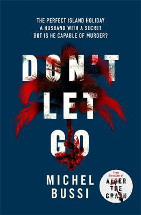
Don't let go by Michel Bussi
Weidenfeld and Nicolson, 2018. ISBN 9781474601795
(Age: secondary to adult) Recommended. Themes: Crime fiction,
Reunion, Murder, Tourism. Don't you love new settings for crime
fiction? Set on an island east of Mauritius in the Indian Ocean,
Reunion is a multi racial department of France, once home to many
French, lured there by tax concessions, as well as Indian, Muslim,
African and Creole inhabitants.
Martial is on holidays with his second wife, Liane and their
daughter, Sophie, but suddenly, Liane disappears. Everyone has seen
her walk through the lobby to the elevator in the up market resort,
but when Martial goes looking for her, she is nowhere to be found.
Theories abound, but the Chief Inspector, Aja Purvi, focusses on the
husband whose behaviour is odd to say the least. When she finds that
his son died in suspicious circumstances ten years before, things
begin to escalate, especially when Martial takes off with his young
daughter in tow. A police hunt ensues, made more impossible for
Purvi by the arrival of her superior from Saint-Denis, wanting to
put his stamp on the investigation. Her off sider, Christos further
complicates things when he tells his partner of the investigation
and she becomes involved, unravelling a thread which leads to her
death.
A police chase over parts of the island sees Martial planning his
escape with precision, even down to the arrival of a temperature
inversion bringing fog across the mountains, giving him protection
form spying eyes.
But not all is at it seems, as the narrative is told from several
perspectives, and Bussi keeps us guessing all the while with clues
as to what is actually going on.
I found the background to this cat and mouse story fascinating.
Reunion is not a place I had known about so to read about it as the
setting of this story held my interest, and had me checking
Wikipedia for more information.
Bussi puts in translations of some of the often used words for
people according to their backgrounds, and a map at the start is a
guide to identifying the places spoken of, although I sourced a more
detailed map on the Internet.
This is a translation, which may explain some of the awkward
expressions, but the characters are fully developed and interesting,
while the main story with its peaks and valleys is easily addictive.
Fran Knight
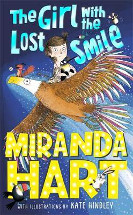
The girl with the lost smile by Miranda Hart
Ill. by Kate Hindley. Hachette, 2017. ISBN 9781444941364
(Age: 8+) Recommended. "Chloe Long has lost her smile. She's looked
everywhere for it. (Under her pillow. Under her bed. Under her nose.
Obviously.) She's tried everything to bring it back. (Her favourite
cake. Her favourite gran. Her favourite joke. Obviously.) But
nothing seems to be working!
Until one night, something utterly magical happens - and Chloe finds
herself on an adventure that is out of this world . . . "
Miranda Hart (you may be familiar with her from Call the Midwife),
has constructed a book that is certain to make you laugh and cry at
the same time. She takes us on a magical, adventurous journey that
celebrates the imagination and the strength of true friendship.
Although the book is quite long (361 pages), the text is fairly
spaced out and reasonably large.
There are still so many messages that can be taken away from this
book. Chloe, the main character, struggles with her own issues,
allowing herself to escape to her 'magic land' where she battles
'shadow bandits'. I believe this actually parallels with Chloe
fighting her own inner thoughts and worries. I think the author may
have quite cleverly intertwined some of her own childhood memories
into the storyline.
I can see children aged eight and up loving this heart-warming book
which has such a positive message. An added bonus are the gorgeous
illustrations by the very talented Kate Hindley interspersed
throughout the story. A welcome addition to the fantasy collection
that will very quickly become a favourite for many.
Kathryn Schumacher
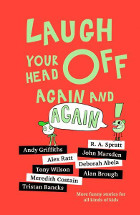
Laugh your head off again and again! : more funny stories for all kinds of kids by Andy Griffiths et al
Pan Macmillan Australia, 2017. ISBN 9781760553197
(Age: 8+) This contains stories by Andy Griffiths, R A Spratt, Alex
Ratt, John Marsden, Deborah Abela, Tony Wilson, Meredith Costain,
Alan Brough and Tristan Bancks. These authors' stories will make you
laugh your head off again and again! A scary shower, three twisty
little pigs, a choose your own adventure, a Halloween chicken, a
demonic clown, an unexpected gift, terrible twins, a famous dancing
dog and a running race like no other equals one hilarious book.
What is not to like about this book! With its neon orange cover and
lime green writing, the cover is sure to attract the attention of
many. This book contains nine stories by some of Australia's most
talented and loved children's authors.
At the end of the book I really like the biography about each author
and what they find funny. It will give the readers an insight into
the lives of the authors they love. With the psychedelic lime green
illustrations throughout the book they will certainly attract the
attention of the reader.
This will make a welcome addition to the humour or short story
section of the library and I think students from 8 years old and up
would love to read it. I also think it would make a fantastic read
aloud and I look forward to doing this with my students.
Kathryn Schumacher
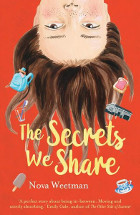
The secrets we share by Nova Weetman
UQP, 2017. ISBN 9780702259784
(Age: 11+) Highly recommended. Themes: High school. Friendship.
Depression. Fire. Beginning high school in the coming weeks, Clem
and her friends Ellie and Bridge are concerned about what to wear,
who they will share classes with and how they will cope with year
seven in such a different place. They spend time together in these
last few days, Ellie coming in as a new friend and so altering the
long term relationship between Bridge and Clem, while finding that
the two girls will be in the same home group, while Clem is by
herself, puts a further wedge between them. But Clem has a secret.
Her mother, Sarah, suffering from depression has returned home after
some months in care. They live in a tiny flat, waiting for their new
house to be built replacing their home which was burnt down twelve
months before after Mum left a candle burning.
Sarah's return means a recollection of past events, a change to the
easygoing single parent her father had become, a tension filling
the flat that was not there before.
Upstairs, Maggie has become a fast friend, one to whom Clem can turn
for help, but now she has her nephew, Matt staying, and he has a
secret too. Matt and Clem find common ground, Matt is a roofhopper
and introduces Clem into his world, while Clem runs when things
become too hard to unravel, pounding away until she can forget her
fears.
Insight into the effects of depression on a family is well presented
as Clem must deal with the very real anxiety of having an ill
parent, one who is prickly but trying hard to repair their
relationship. The situation is well handled, exposing the tension on
all sides, the fear they all have that things will not go as well as
they hope, exploring the relationship Clem has with her friends, who
are kept in the dark.
A sequel to the 2017 CBCA Notable listed book, The secrets we
keep (2016) this novel will be eagerly read by those following
Clem's story and those taking it up as a stand alone novel. It is an
involving story, taking the reader down unexpected roads.
Fran Knight
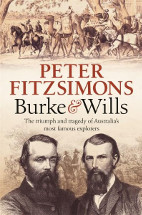
Burke and Wills : The triumph and tragedy of Australia's most famous explorers by Peter Fitzsimons
Hachette Australia, 2017. ISBN 9780733634109
(Age: Senior Secondary) Recommended. Supported by a research team,
Peter Fitzsimons has delved into the historical records related to
the Victorian Exploring Expedition that left Melbourne with
enthusiastic crowds and high hopes on 20th August 1860. The early
chapters of the book reveal a deeply flawed leader, Robert O'Hara
Burke, with no navigation or exploration experience and an impetuous
nature. The expedition was supplied with 20 tons of equipment 6
wagons, 23 horses and 26 camels, but much of the equipment was
useless and had to be abandoned on the journey north. Eventually the
food supply began to fail, there was insufficient knowledge to be
able to live off the land and local Aboriginal offers of help were
spurned. With William Wills as navigator, John King, and Charley
Gray, Burke decided to make a dash from their depot on Coopers Creek
to the Gulf coast. The difficulties of the journey slowed the
exhausted party down and they returned to the inadequate supply
depot, just a few hours too late. Only King survived with the help
of the local Aboriginal people.
The 700 page book explores the impetus for the expedition and also
examines the repercussions, including the search party, a Royal
Commission and Victoria's first State funeral. There have been a
number of earlier accounts of the tragic story but in his own
inimitable way, Peter Fitzsimmons brings the voices of the
participants to the fore in this version. The maps, photographs, and
drawings provide a valuable accompaniment to the story.
Paul Pledger