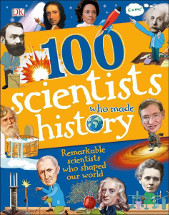
100 scientists who made history by Andrea Mills and Stella Caldwell
DK, 2018. ISBN 9780241304327
Throughout history there have been so many perceptive pioneers,
brilliant biologists, medical masterminds, clever chemists,
phenomenal physicists, incredible innovators and other scientific
superstars who have challenged the known to change our lives that to
choose just 100 of them must have been a taxing task.
Nevertheless, in this brand new release from DK, the achievements of
people as diverse as Aristotle, Alexander Fleming, Louis Pasteur,
Ernest Rutherford, Alan Turing and Edwin Hubble are all described in
typical DK format with it characteristic layout, top-quality
photography, bite-sized information and accessible language. But
there is so much (and so many more). Although not being of a
scientific bent, while many of the names of those in the clear
contents pages were familiar, there were as many that were not, and
sadly many of those not were women.
But the authors have included many women in the lists - who knew
that Hildegard of Bingen, aka the singing nun, born in 1098 could
have had such an impact on medical treatments through her study of
and writing about the medicinal uses of plants? Or that of five of
those credited with having such an influence on the development of
computing, three were women? Or that Mary Somerville correctly
predicted the existence of the planet Neptune in the early 19th
century and that there were many 19th century astronomers who were
female?
This is a wonderful book for everyone - not only because it will
introduce a new generation to those who discovered so much of what
we take for granted today - they didn't make history because they
became famous, they made the history we look back on so we can move
forward - but also to inspire - 'If them, why not me?' Challenge
your students to find another scientist who could have been included
and have them develop a page for them using the DK format as a
model.
I know a budding scientist who needs this book!
Barbara Braxton
36 questions that changed my mind about you by Vicki Grant
Hot Key Books, 2017. ISBN 9781471407086
(Age: Senior secondary) Highly recommended. Deciding to take part in
a psychological survey about discovering whether two participants
can get to know one another through asking and answering a series of
questions, Hildy, a high school student, 18 years old, intelligent,
and anxious because of her parents' worsening relationship, is
partnered with a young man, of a similar age and seemingly quite
different to her, with whom she will exchange answers to a series of
36 questions created to reveal their sociability, intelligence and
attractiveness to the other participant. Paul is doing it for the
money.
Their answers reveal many differences in their childhoods, family
and social circumstances. The questions are challenging and
personal, their answers revealing much about themselves. The
discussion generated gradually brings them together despite his
suspicion that she is 'out of his league'. The gentle flowering of
the relationship is captivating, and heart-warming, as we notice how
each offers the other an honest response to the questions, and
sometimes more emotional responses than they would have expected.
This is a well-constructed depiction of relationships in the modern
world, depicting the lives of two young people living in quite
different circumstances in the west coast of the USA. We are drawn
into their personal lives both through their question and answer
times and in Grant's narrative sections where she reveals more
detail about the two young people. The questions are intriguing and
challenging and their determination to reply honestly gradually
enables them to understand both themselves and their Q/A partner
better.
This is a delightful and intriguing new 'novel' about young people
and their relationships. I would highly recommend it for senior
school students, parents and teachers as both an unusual and
delightful introduction to how adolescents work out their place,
ambition, and how they wish to live in the modern world.
Elizabeth Bondar
48 Hours: The Vanishing by Gabrielle Lord
Scholastic, 2017. ISBN 9781743629758
(Age: 12+) "One kidnapping. One cold case. Two amateur
investigators. Only 48 hours to solve the crime . . . Jazz's best
friend Anika has been kidnapped! She can't call the cops, so Jazz
forges a shaky truce with her brilliant nemesis, Phoenix, to help
her investigate. Together, they uncover clues and crime scene
evidence. Sneaking into a forensic lab, they test DNA, fingerprints
and more, to piece the clues together. The results are shocking.
Could it really lead to a twenty-year-old murder case? In a race
against time, Jazz and Phoenix only have 48 HOURS to collect the
evidence, profile the kidnapper and find their schoolmate's
location, or Anika will die. The clock is ticking . . . (Publisher)
This is the first book in a series based around two inquisitive teen
detectives who must solve three intriguing yet dangerous crimes.
Jazz, the female lead character is obsessed with crime and solving
them. When her best friend, Anika, is kidnapped she thinks she is
the best person to find her. To make matters worse the friends were
having an argument, as friends often do, before Ankia was kidnapped.
As a result, Jazz feels terribly guilty. I absolutely loved this
book and found myself picking it up whenever I had the chance. The
lead characters are 14 so it is a read for an older audience. It is
action packed, with each page leaving you on the edge of your seat.
Persistence, determination, friendship and the ability to follow
things through will resonate with the reader.
A must read for both boys and girls 12 and up who love criminal
investigation, code breaking, forensics and kidnapping.
Kathryn Schumacher
How to get rid of a vampire by J. M. Erre
Bloomsbury, 2017. ISBN 9781846884221
(Age: 9+) "Zazie has just received a beautiful new notebook, and
decides to keep a diary. Brimming with imagination, she writes down
her impressions of her cat Roudoudou, her awful cousin Lucas and her
new teacher, Mr Labat - who, with his pale skin and blood-red lips,
must surely be a vampire! In order to save her life and those of her
classmates, Zazie must find a way to get rid of Mr Labat - and what
better way than by following the advice found in Bram Stoker's Dracula
. . ." (Publisher)
This is an entertaining read that will resonate with those with a
wacky sense of humour. The brave and likeable heroine, Zazie will
have readers falling in love with her as her imagination takes its
course. There is a slight Roald Dahl influence in the story with
Zazie making up some words of her own - something that certainly
appeals to many children. Many of the audience will be able to
connect with the lead character as she is always in trouble at
school and at home - simply because adults do not get her!
This is a funny book that would be a perfect fit for both boys and
girls aged nine plus. We know that many children love the magical
world of vampires and I am sure it will become popular with many.
Kathryn Schumacher
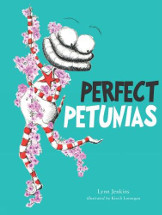
Perfect Petunias by Lynn Jenkins
Ill. by Kirrili Lonergan. EK Books, 2018. ISBN 9781925335583
Loppy LAC is very worried about not doing his homework well enough.
He is always focusing on what he hasn't done rather then what he
has, and he becomes very frustrated. So, his friend Curly teaches
him about how petunias grow - in lots of different, imperfect
directions that we can't control! Loppy learns that by trying to
control whether he makes mistakes or not it's as if he's always
trying to grow 'perfect' petunias. Sometimes he just needs to
accept that things go a certain way and to change his definition of
'perfect' to mean trying his absolute best.
This is the third in a series
to help Loppy the LAC (Little Anxious Creature) deal with his
anxieties, in this case not being satisfied with anything that he
sees as being less than perfect. Children like Loppy are present in
every class, either being afraid to start something in case it is
not perfect on the first attempt or giving up in tears, frustration
and even anger, so a story and strategies that help them focus on
the things that they have done well rather than the 'mistakes' they
have made can go a long way towards helping them accept themselves,
their activities and other people with all their imperfections.
Helping them to see the glass half-full, the silver lining, the
rainbow rather than the rain can lay the foundations for strong
mental and emotional health in the future. Developing a mantra of "I
can" rather than "I can't" is so important if they are to take risks
to try new things that will open up so many new worlds to them.
Barbara Braxton
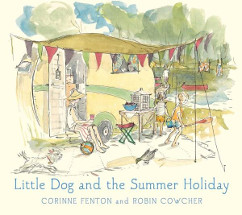
Little Dog and the summer holiday by Corinne Fenton
Ill. by Robin Cowcher. Walker Books, 2017. ISBN 9781925381160
(Age: 3-7) Highly recommended. Themes: Holidays, Dogs, Family Life.
Corinne Fenton and Robin Cowcher's delightful nostalgic story
continues in Little Dog and the Summer Holiday. Little Dog
and his family set off on an exciting caravan trip through Victoria
and New South Wales stopping at iconic places along the way. Their
destination is a caravan park in Sydney where they enjoy nights
playing with new friends. Little Dog enjoys chasing the other dogs
and experiencing all the new sights with his family. Jonathan and
Annie love to include their dog in all their experiences, at the
border crossing, in front of the Dog on the Tuckerbox and even on
the ferry to Manley.
"The long, lazy days of summer holidays waited like parcels in a
lucky dip." Fenton's story has a lyrical quality, with alliterative
and imaginative phrases conjuring up the special times the family
share. Each place they explore holds wonder and excitement: the
busyness of the city, a ride on the sparkling carousel at the Fun
Fair and the Three Sisters standing tall and proud in the Blue
Mountains.
Robin Cowcher's beautiful ink and watercolour paintings uncover a
time gone by when life was simpler, and families were happy in tiny
caravans packed full of holiday gear. Picturesque scenes are washed
with blues, sandy yellows and the colours of nature seamlessly
complimenting Corinne Fenton's story. So much is explained in the
little details, Mum's Brownie box camera, men dressed in suits even
on holiday, ladies dressed up with scarves and hats, old style
Holdens and the green and yellow double-decker buses crossing the
Sydney Harbour Bridge.
One piece bathing suits with ruched elastic, jellybean sandals and
picnics under shady beach umbrellas take me back to my childhood
memories in the 1960s. As the story is shared with a family or young
learners, question the similarities and differences between their
own experiences and those of Little Dog's family. Little Dog and
the Summer Holiday is a lovely introduction to Early Years
HASS, exploring Then and Now, Transport - changes over time and
family life in another era.
Rhyllis Bignell
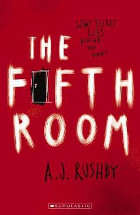
The Fifth Room by Allison Rushby
Scholastic, 2017. ISBN 9781742762548
(Age: 12+) Recommended. Themes: Science, Self experimentation,
Ethics, Secrets. Miri is asked to join a secret society which offers
four students the chance to self-experiment in order to push the
boundaries of medical research. When Miri discovers her boyfriend
Sheen is also a member of the group she must hide the fact that she
knows him, and when she uncovers the fact that there is a fifth
student, one she doesn't trust, experimenting in the fifth room at
the bunker, she begins to question just what is going on. Then
things begin to get out of hand and the group members have to decide
how far they will go with the experiments, and some are willing to
go further than others.
This is a very different plot to the one that I was expecting, and I
found it very intriguing. I was fascinated by the notion of
scientists experimenting on themselves to find out the limits of
medicine and willingly followed the experiments of the four students
as they put their theories to the test. The competition between the
students brings out the worst in some of them as they battle for the
large cash prize and status of having the best experiment. The four
characters are highly intelligent and competitive and must make some
difficult decisions about medical ethics. Miri narrates the story in
the first person and the tension builds to a dramatic climax and
some very unexpected twists and turns.
As well as a tense plot, Rushby has created believable characters
who have to examine their own motivations and work out how far they
are prepared to go to achieve fame and money in their scientific
field. Miri's relationships with her father and her best friend are
good and her feelings for Sheen, a most likeable young man, add a
touch of romance to the story.
This was a very readable psychological thriller which will appeal to
any student who likes an unusual and gripping plot and characters
that might not be trusted.
Pat Pledger
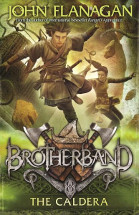
The Caldera by John Flanagan
The Brotherband series book 7. Random House Australia, 2017.
ISBN 9780857980137
(Age: 11+) Highly recommended. Themes: Survival, Rescue, Kidnapping,
Piracy, Team work, Sailing. Charged with the task of rescuing a
kidnapped Emperor from a far-flung volcanic island fortress, the
Brotherband (led by the extremely capable leader - Hal) are again
able to demonstrate their highly honed fighting and sailing skills.
This crew of mostly young Skandians is able to sail the small craft,
the Heron, with fearless expertise and superb teamwork. Despite
violent opposition from pirates and the elements, yet again the crew
take on a mission that will push them to the brink . . . but a life
depends on them acting quickly and putting the rescue mission before
their own safety.
John Flanagan writes with great flair to produce an action-packed
adventure that all readers will enjoy for its adrenaline rush and
wonderful introduction to the world of skilful sailing.
Note: the book also includes a bonus Ranger's Apprentice
short story. This is a surprise gift at the end.
Highly recommended for readers aged 11+ (even if you have not read
any of this series before book 7)
Carolyn Hull
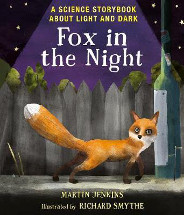
Fox in the night by Martin Jenkins and Richard Smythe
Walker Books, 2017. ISBN 9781406355154
(Age: 5-8) Subtitled: A Science Storybook About Light and Dark.
Fox is hungry so she emerges from her dark den to look for food only
to find it is still daylight outside. (It's dark in Fox's den
because the daylight doesn't reach inside.) When she does finally
emerge, it is night and she is even hungrier and so she ventures
into the nearby town in search of dinner. There she is helped by all
sorts of light sources to find what she needs - and to escape!
Science surrounds us - it is not limited to people in white coats in
sterile laboratories that television news crews choose to use to
report breakthroughs and in this story very young readers will not
only enjoy Fox's adventure but also learn about light, why it is
important and where it comes from as there are simple explanations
that match the storyline on each page.
It also includes an index, bibliography and extra questions and
experiments to get young readers thinking about the science behind
the story and for them to explore further - a perfect parent-child
activity to do together. It suggests that the child compares the
length of their shadow over a couple of hours and this is a great
activity to do with a class if you get them to trace each other's
shadow in chalk in the morning, noon and afternoon.
It teaches them so much about the sun's path as well as measurement.
This is the first in a new series from Walker and I look forward to
many more.
Barbara Braxton
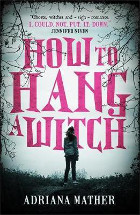
How to hang a witch by Adriana Mather
How to hang a witch Book 1. Walker Books, 2018. ISBN
9781406378795
(Age: 14+) Recommended. Themes: Witches. Ghosts. Salem (Mass.).
Trials. When Samantha Mather arrives to live in Salem,
Massachusetts, she finds herself at the centre of attention as the
descendant of Cotton Mather, one of the men who had been responsible
for the trials of the witches in the infamous Witch trials. A group
of teens directly descended from the original witches and called the
Descendants, are not happy that Samantha has come to town,
especially as terrible things start to happen around her. Sam too
has encountered Elijah, the ghost of a young man from the time of
the hangings and Jaxon the boy next door who is the only person who
has made an attempt to be friends.
The real strength of How to hang a witch is its fast pace,
and this makes it very difficult to put down. Sam lurches from one
catastrophe to another as things seem go wrong around her - she is
the only witness to the death of one of the Descendants and the only
person not to get a terrible rash at a party. She is blamed for all
the bad luck happening in the town and accused of being a witch. But
Sam is a strong, resilient, if sometimes unlikeable character and
with the ghost Elijah ably helping her, she perseveres with her
investigation of what is happening, knowing that she must turn all
the trouble around to save her father from his coma.
The note at the back of the book lets the reader know that the
author is a descendant of the original Cotton Mather and this adds
much interest to the story. She has made Salem with its many
cemeteries, old houses, woods and ghostly appearances feel very
spooky and readers who are interested in witches and the paranormal
will enjoy the spine-chilling exploits of the Descendants and want
to find out more about what really happened in Salem during the
original witch hunts.
Pat Pledger
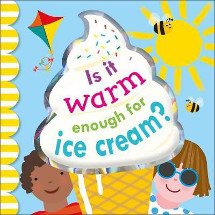
Is it warm enough for ice cream? by Violet Peto
Ill. by Victoria Palastanga. Dorling Kindersley, 2018. ISBN
9780241313053
(Age: 2-5) Board Book. Theme: Seasons. This bright, colourful board
book looks at each season and asks "Is it warm enough for ice
cream?". It is an English publication so some vocabulary and content
is not as meaningful for an Australian audience. For example, the
winter page shows snow and frozen ponds, which is only a reality for
a very small proportion of Australian children. The only season it
says is warm enough to eat ice cream is summer, when in reality it
is often warm enough to eat ice cream all year round in some parts
of Australia. There is some English vocabulary (ice lollies,
sledging) and although some are also found here the animals are
native to England (rabbits, squirrels, deer). Despite these slight
drawbacks for Australian readers, this is a handy introductory book about the different
seasons of the year and what they look, feel, sound, smell and taste
like. It is predominantly nature/science based (animals, plants,
weather, outdoor activities) which will help to build the vocabulary
of young children and make them more aware of what is happening
around them.
Simple pictures encourage pointing, labelling and discussion. The
pictures use a combination of drawings and photographs (especially
of animals, plants and flowers) to create realistic yet interesting
and varied visual spreads.
Nicole Nelson
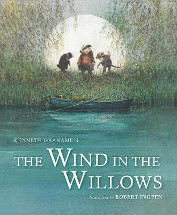
The wind in the willows by Kenneth Grahame
Ill. by Robert Ingpen. Walker, 2017. ISBN 9781760650247
Bored with his annual spring cleaning, Mole leaves his underground
home to explore his surroundings and discovers a small community of
other creatures living on the riverbank of a gentle English river.
His first new friend is Rat, and after a long lazy afternoon boating
down the river, Rat invites Mole to live with him. And then the
adventures begin as he meets Toad of Toad Hall and Badger.
This children's classic first published in 1908 has remained in
print in many guises for 110 years as well as being converted to
other media including stage, film and television. Now, an abridged
version beautifully illustrated by Robert Ingpen is available for
another generation to enjoy the adventures of these four friends in
Edwardian England.
Whether read aloud as a bedtime story, a perfect vehicle for
introducing young listeners to the concept of 'chapter books' where
the same characters feature in a complete story in each chapter, or
as a foray into longer books by the newly independent reader, timid
Mole, friendly Water Rat, imperious Badger and mischievous Toad will
find a new set of fans as yet another generation follows their fun
and frolics. Ingpen
himself has an impressive body of work including a range of
children's classics, his work was launched with the release of Colin
Thiele's Storm boy in 1974, and as the only Australian illustrator
to have won the Hans Christian Andersen Medal, his portfolio would
make an excellent introduction for studying illustration in
children's picture books.
"I just want to make pictures that help get messages across and tell
stories and, if children are involved, I want to be able to have
them maintain their natural imagination for as long as possible."
An exquisite addition to a personal or a library's collection.
Barbara Braxton
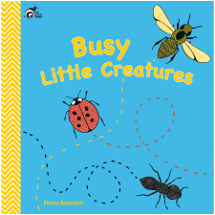
Busy little creatures by Fiona Bowden
Literacy Australia . Little Book Press, 2017. ISBN
9780994385345
From bees to beetle to butterflies, our world is full of busy little
creatures and ten of them are collected here in a book which not
only introduces them but also helps the very young reader explore
movement, colours, patterns, sizes and numbers. Perhaps they might
also become a detective as they create a chart of the creatures so
they can tick off each as it is discovered and maybe even add new
ones not featured in the book!
There could also be discussions about why people are dependent on
these minibeasts and how we need to protect them rather than squash
them, squirt them and otherwise kill them, as well as learning which
are friendly and which are not-so!
Barbara Braxton
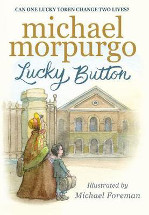
Lucky button by Michael Morpurgo
Ill. by Michael Foreman. Walker Books, 2017. ISBN 9781406371680
(Age: 10+) Highly recommended. Themes: Orphans, Foundling Hospital
(London), Illness, Bullying, Friendship, Schools. When Jonah is
bullied he takes refuge in the chapel in his school, once a
Foundling Hospital in the country, used after the London premises
became overcrowded. Here he meets the spirit of a foundling, named
Nat Hogarth, who loves to play the organ, a noise sometimes heard by
the students, giving rise to the story of ghosts of the children who
once lived there. Nat relates his life story to Jonah, telling the
reader about this astonishing place.
He tells of his time with foster parents then returned to the
hospital for his education before being apprenticed at sixteen
revealing the lives of these children, many of whom died while in
care, education subservient to trying to deal with disease and
malnutrition. Nat is sent to a country house where he is treated
poorly, but at his second place he meets the Mozart children with
whom he develops a long standing relationship. Readers will be
thrilled reading about the place music comes to take within Nat's
life, and how it parallels Jonah's life, augmenting the link between
the two. This is a charming tale of lives lived two hundred years
apart, being pulled together through a love of music. Its beautiful
cover and pages of illustrations will ensure the book is read from
cover to cover.
The Foundling Museum in London's Brunswick Square is a most
arresting place to visit, with art treasures from famous people,
Handel and Hogarth for example, who supported the work of the
Foundling Hospital, and memorabilia from the unfortunate mothers who
left their babies there. Set up in 1739 by sea captain, Thomas
Coram, it was the first charitable trust developed to support
homeless children, because its founder could not ignore the vast
numbers of children left on the streets. To this end he set up the
hospital with the help of wealthy supporters who donated art works
creating an art gallery unlike any other. The work of the children's
trust continued until 1954, and today supports children in a variety
of ways. More can be found about this startling place at
https://en.wikipedia.org/wiki/Foundling_Hospital and
the museum at https://foundlingmuseum.org.uk/
(Check 'About' to find information about the foundlings and what is
on display) The display of the tokens and mementoes left by the
relinquishing mothers will tear at your heart strings.
This museum, not well known on London's tourist trail is well worth
a visit and is near the Dickens' Museum. Dickens' portrayal of young
lives has parallels within the walls of the Foundling Hospital.
Fran Knight
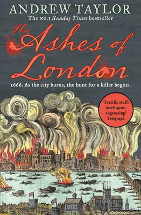
The ashes of London by Andrew Taylor
HarperCollins, 2017. ISBN 9780008207755
(Age: secondary to adult) Highly recommended. Themes: Great Fire of
London, Sir Christopher Wren, London, Murder, Restoration,
Commonwealth, Puritans. The year 1666 was already inauspicious
containing three sixes, the mark of Satan to some, making the Great
Fire of London a sign that things had not gone well after the
restoration of Charles 11.
Intrigues still survive with some regicides, those who killed
Charles 1 still at large, and undercurrents of the dissenting ideas
of Cromwell are still at play.
So when a body is found in the ruins of St Paul's, James Marwood,
working for Master Williamson, a real character, editor and
publisher of the London Gazette, is given the job of finding out who
the man is. A second body is found in the Fleet Ditch some days
later and Marwood links the two as they both had their thumbs tied
together behind their backs.
But Marwood's father was a Dissenter, and needs constant attention,
causing Marwood to take time out for his welfare. And when he tells
his son in one of his rambles that he has seen Tom Lovett, Marwood
tries to elicit more information from the old man.
Alongside this story runs another, that of Cat Lovett, Tom's
daughter, taken in by a self serving family after her father
disappeared. People are after him, his politics now out of fashion,
while she is betrothed to a man she does not care for, more
interested in her family property than her. When the son of the
house rapes her she escapes, throwing herself on the mercy of
another family, that of her manservant, Jem, and in their inn she
serves an architect working for Dr Christopher Wren on the plans to
rebuild London. Cat was brought up with a modern thinking aunt who
loved architecture and she developed in her niece some rare
interests and gifts, unusual for those days, so Cat takes a real
interest in the man's work, often helping him as palsy sets in. Told
to leave the inn where she has been working, Cat hides in various
places wanting to keep away from her father and his beliefs.
The political intrigue behind the story is fascinating, revealing
that the Restoration did not smooth over the fraught times of
killing a king or of having Cromwell's Commonwealth ruling Britain.
Monarchists are questioning the extravagance of Charles 11 and his
indebtedness to some of the wealthier men in Britain. Dissenters
cause alarm and those still at large after the execution of Charles
1 are still being hunted down.
The fathers of both Cat and Marwood were involved in the plot
against the king and Marwood is doing his best to help his father,
impeded by his growing dementia and ill health, while Cat's father
is being sought by the authorities for greater reasons that his
beliefs.
Against the converging of these two protagonists is the marvelous
rebuilding of London. Taylor's descriptions of the aftermath of the
fire are riveting, and following the characters as they make their
way through the streets of London makes for exciting reading. Ash
still covers the streets, homeless are everywhere, people wander
about still in shock, food is scarce, surveyors are trying to
establish a sense of boundary markers, and still the London Gazette
publishes its weekly list of the dead, now including the two unknown
men whose identities Marwood is seeking.
This is a most engrossing crime story set within a richly detailed
historical setting.
Fran Knight