Berbay Publishing, 2018. ISBN 9780994384133
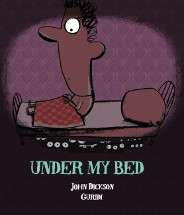
(Age: 7+) Highly recommended. Under my bed is a fun picture
book all about those monsters hiding in the dark places of a child's
bedroom. What if the monsters had a party? Would you be invited? It
is your room after all. Imagine lying in your bed while monsters
move around your room. Our main character is doing just that! He can
hear them making sandwiches and crushing snails. He can see the
shapes of their bodies in the dark but enough is enough. If he has
to lay here listening then he may as well join in! Will the monsters
let him? Under my bed is all about overcoming your fears because those
fears might actually be a lot of fun. The illustrations are cast in
shadows, making them seem scary in the dark. The white monster eyes
add to this but they aren't scary, they are fun, especially as you
read about what is going on. The story also rhymes, reading like a
poem but with the elements of a story. It is descriptive and
engaging, making it a great read aloud story for parents and in
classrooms. The rhyming element is great for older children learning
to write their own rhymes or if writing about their fears and
changing them to seem fun and harmless. Under my bed would also be good for the Child Protection
Curriculum, supporting children to talk about and identifying
feelings. This story is highly recommended for readers aged 7+.
Kylie Kempster
It's hard to love a tiger by Anna Pignataro
Scholastic, 2018. ISBN 9781743817582
(Age: 4+) Recommended. Themes: Tigers. Friendship. Difference. Pets.
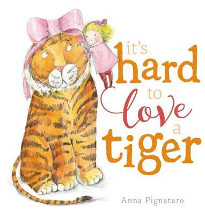
Our sweet heroine would love to have a tiger to love, just like the
one in the zoo. In pairs of rhyming lines, the story is laid out
from the first page, as the ominous word, 'but' appears along the
bottom. Turning the page the reader hears of the negative things
about owning a tiger, all in rhyme and all very funny, using
repetition, prediction and humour to involve and delight the
readers.
Walking down the street, she finds that others are rather worried
when the tiger greets them with a roar. Brushing his teeth at night
takes a lot of patience when he growls like a bear. Or trying to
love him when you are a pastry shop and he covers himself with a
sticky mess. And in the ballet class where he gallops rather
fetchingly in her pink tutu.
Each double page presents the tiger in a hilariously funny
situation, absolutely the opposite of what children will expect a
tiger to be.
It will be a neat segue into ideas about what a tiger really does
do, and where he lives and what he eats, using the places shown in
the book.
Colourful watercolour, pen and charcoal illustrations full of
movement and interest are on every page and its fun to watch the
expressions on the children's faces as they become quite
disheartened with having a tiger to stay. But by the end he is so
much fun, that everyone is delighted with having a tiger as a pet,
even with his animal friends popping around. Children will respond
with stories of their own pets and friends to this book filled with
fun and a delight to read aloud.
Fran Knight
Sweet adversity by Sheryl Gwyther
Angus and Robertson 2018. ISBN 9781460755105
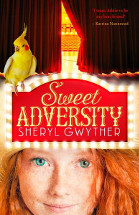
Themes: Acting. Friendship. Australian history. April 1930 finds 12
year-old Adversity McAllister in Emu Swamp Children's Home where her
parents left her temporarily while they sought work for their
theatrical troupe. She and her pet cockatiel Macbeth like to perform
for the other children and are often in trouble for flaunting the
rules. Matron Maddock tolerates Addie as she is good with the
younger children and she has an award winning voice which matron
aims to exploit. She tells Addie that her parents are dead and that
she is her guardian. The Depression has left many impoverished and
seeking work. Times are hard and the children in the home are poorly
fed and have to do many chores including work in the laundry which
has a faulty boiler. When Addie learns of a plan by Matron to sell
her to an entrepreneur who will make her perform she decides to run
away. The staff help her, providing food and a horse drawn caravan
for her escape. She gets as far as a nearby secret children's camp
where she is welcomed by some but not all and she has to move on,
finding a sympathetic inn owner who allows her to work for food and
care for her horse. Unfortunately the entrepreneur notices her and
she is kidnapped and taken back to the home. Money changes hands and
she is whisked off to Sydney but not before she picks up her friend
little orphaned Joe and manages to take him with her. Against the
backdrop of Sydney during the Depression, under the shadow of the
part completed Harbour Bridge Addie continues her adventures,
experiencing the excitement of performing on the stage while trying
to find the truth about her parents and escape from slavery.
Younger readers will enjoy this adventure with a strong heroine
courageously triumphing over corrupt people in power while looking
after her friends and sharing her love of the stage and performance.
Sue Speck
The way back from broken by Amber J. Keyser
Carolrhoda Lab, 2018. ISBN 9781541514881
(Age: 14+) Recommended. Themes: Sibling death. Grief. Wilderness.
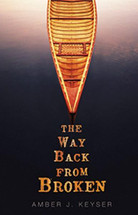
Survival. Rakmen's baby sister died and the family is working
through the tragedy in their own ways. He and his mother attend
weekly meetings at Promise House, a support group where the mothers
cry and the children do art therapy downstairs. His father won't go,
like others he goes to the bar and bottles up the grief. Rakmen
helps out with the other damaged kids, including some his age,
Molly, who survived a car crash that killed her sister, D'Veray and
D'Mareay, identical twins whose brother D'Shawn died of cancer.
Their shared experiences help them to understand each other, unlike
Rakmen's best friend Juan, who can't understand why he has lost
interest in sport, girls and the excitement of finishing school.
When his Biology teacher, Mrs Tatlas, turns up at the support group
consumed with grief over her stillborn son, Rakmen's mother
befriends her and he is thrust together with her young daughter
Jacey. His own parents are going through troubled times and so when
he is invited to spend the summer at a remote Canadian lake they ask
him to go, not only to look after Jacey and her mum but to give them
space to find a way forward. The lake is very remote and the
family's cabin run down but it is very beautiful and Mrs Tatlas,
Leah, decides on a canoe camping trip 'au large' in the wilderness.
The trip is very challenging but they gradually find a rhythm to
their days, paddling, carrying the canoe and setting up camp to
collapse exhausted at the end of the day, an escape from the
exhaustion of grief. When Leah breaks her ankle four days away from
anywhere Rakmen and Jacey have to go for help. Loaded with
responsibility Rakmen exceeds his own expectations and dramatically
opts for survival and the living, moving on from blaming himself for
his sister's loss.
This sensitive exploration of grief and healing acknowledges the
complexity of the issue; the triggers, the depression and volatile
behaviour, the self-blame, family breakdown and damage to
relationships caused by the death of a child. The finely drawn
description of the beautiful, scary and dangerous wilderness is a
real strength, powerfully asserting that life is larger than grief,
allowing the characters to discover resilience counteracting the
hopelessness at the start of the book. Recommended for students
looking for a serious read to engage the emotions or anyone dealing
with, or wishing to understand, aspects of grieving.
Sue Speck
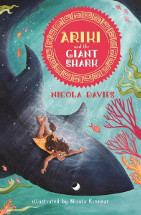
Ariki and the giant shark by Nicola Davies
Walker Books, 2018. ISBN 9781406369793
(Age: 8+) Highly recommended. Ariki is a young island girl with a
love for the sea. She has lived on her island her whole life but she
is still seen as a stranger because she wasn't born there. Ariki was
washed ashore as a toddler and has no knowledge of where she is
from. Ariki is also very different to the other islanders due to her
tattoos - they are dots and lines rather than lines and swirls. her
tattoos are also on the opposite side to other girls. The island is
suffering as the fish are not swimming which means no food. When the
nihui (sharks) gather in abundance and as an even larger shark
appears, the islanders believe they are under attack and must hunt
and kill this monster shark. Ariki thinks differently. Her tattoos
tingle when she is in the water with this creature. The cave
etchings she discovers, thanks to the younger children, show this
giant creature needs help from humans. Can Ariki, her friend Ipo,
her guardian Arohaka and eight children help this creature while the
rest of the island wants to destroy it?
"Ariki and the Giant Shark" is a beautiful island adventure and
story about being yourself and believing in your gifts. Ariki is an
excellent role model for young readers because she is strong,
adventurous and independent despite being called names and not
having a traditional family to care for her. The story is
descriptive and easy to read, making it a great read aloud story for
bedtime or even in the classroom. It is a story from another culture,
connecting it to learning about Australia's neighbours in Geography.
This book is highly recommended for independent readers aged 8+.
Kylie Kempster
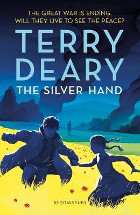
The Silver Hand by Terry Deary
Bloomsbury, 2018. ISBN 9781472929488
(Age: 11 and up) Recommended. Written by the extremely successful
Terry Deary of "Horrible Histories" fame, this book is sure to be as
successful.
"It's 1918 and the Great War is entering its final phase. France is
beginning to make small inroads against the Germans while the
Germans are not only continuing to suffer huge loses at the hands of
the French but the deadly Flu is also beginning to have a huge
impact. In northern France, young Aimee has just found out that her
mother is part of a spy network working with the British. After
reluctantly befriending Marius, a German boy who has been left
behind by his countrymen, she must try to help him get back behind
German lines while evading a traitor - the man with a silver hand,
she has helped to discover. " Publisher. Danger lurks at the turning
of every page and I frequently found myself holding my breath.
Deary has done a fantastic job of allowing the reader to get to know
the main characters and develop a close relationship with them. The
familiar hardships faced by so many during war time are experienced
and throw in the constant challenges of evading the silver handed
man, a spine-tingling story is experienced. It sheds light on the
fact that no one escaped from the war in France and this is quickly
discovered as Aimee travels through woods and the countryside. I
thoroughly enjoyed this historical fiction book and it is a must
have for the library. I will certainly be recommending it to a
number of students.
Kathryn Schumacher
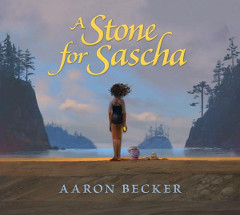
A stone for Sascha by Aaron Becker
Candlewick Press, 2018, ISBN 9780763665968
(Age: 8+) Recommended. Themes: Grief, Pets, Journeys, Wordless
stories. Aaron Becker's "A stone for Sascha" is a cinematic wordless
picture book that begins with the loss of family pet, Sascha the
dog. From the simple act of placing a golden stone on the grave, we
are transported across the world, across millennia, into epic world
events as we follow the stone's journey. Aaron Becker drew
inspiration from his time in Granada, Spain observing the history of
the buildings, where he observed churches built atop Roman ruins.
The maps on the endpapers reference the stone's travels from
Ethiopia 5000BCE then Babylon 600BCE, by sea and overland across
continents, Asia to China then across the Pacific Ocean to the San
Juan Islands. Becker's choice of dark, moody tones with bright
touches of yellow and white are visually appealing.
Without words, the pictures are evocative, connecting the reader
first with the little girl's grief, then with one toss of a stone
into the vast ocean, back in time to a meteor shower and the golden
stone's shattering landing. This turning point changes the story's
direction from deep in the prehistoric ocean, to tectonic plates
shifting, to the golden rock shard emerging in ancient Ethiopia.
Through wars, religious ceremonies, travels by land and sea, pirate
attacks this golden monument's purpose evolves and changes. After
the Chinese sculptor carves the bridge's capstone into a golden box
and stunning dragon the story continues edging closer and closer to
the San Juan Islands and the little girl's hands. Becker's message
of connectivity and the circle of life is beautifully portrayed.
"A stone for Sascha" is a picture book for older readers, one to be
shared across the generations, opening up conversations about the
passage of time, historic events and coping with grief. Becker's
paintings are sweeping landscapes, then slices of history, close-ups
and panoramic with an emotional depth shown through tone and light
and shade. With Becker's cinematic background, this wordless picture
book would translate beautifully into film.
Rhyllis Bignell
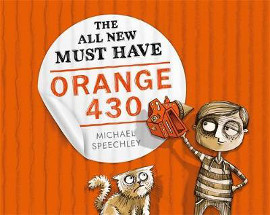
The all new must have Orange 430 by Michael Speechley
Penguin, 2018. ISBN 9780143788973
(Age: 6+) Recommended. Themes: Consumerism, Toys. Michael
Speechley's debut picture book "The All New Must Have Orange 430"
introduces young children to the outrageous consumerism that is part
of our everyday. We are overwhelmed with advertising, with children
particularly targeted and made to feel that life without the latest
electronic device, toy or outfit is not worth living. Speechley uses
dark, layered backgrounds with sepia images making up a heady mix of
brown, grey, orange and white to underscore his message. His
unassuming use of muted colour contrasts with the gaudiness of
advertising, of its use of technicolour to attract attention and
buyers.
Harvey cannot resist the advertising for this latest toy, the Orange
430. It has everything he will ever need, he is told, and it is
available now at his local shop for a price that cannot last. Harvey
searches his pockets, and his house, into all the corners, until he
finally has enough money and he races to the little shop to buy the
treasure. But when he gets home, he begins to question what he has
done. He looks at the toy from top to bottom, all which ways, but
cannot work out what to do with it. He tries it on his head, and in
the bath, he props up the wardrobe, then sees if the cat can make it
out, but all to no avail. His facial expressions will make the
reader laugh out loud, and when he comes to take back his purchase,
it is then that frustration comes thick and fast. There is a big
queue at the Useless Object International offices, and Harvey asks
the others what they did with their useless object. Using the toys'
boxes to play with is much more fun than anything the Orange 430
could achieve, so Harvey and his friends find that hopscotch, box
boat races and building box towers are enjoyable. Harvey's message
is that he's only going to save for useful stuff from now on, going
against the aims of Mr Ripoff president of the UIO factory.
"The All New Must Have Orange 430" picture book provides an
important insight for families and for classes into the effects of
advertising and consumerism in our world. Take notice of the signs
and labels in the background. The book encourages discussion about
the difference between needs and wants, responsibility with money
and the effects of advertising. A most important message for newly
arrived consumers at a loss to repel the overtures of advertisers,
this is an equally compelling book for all readers.
Fran Knight
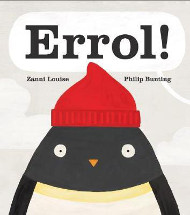
Errol! by Zanni Louise
Ill. by Philip Bunting. Scholastic, 2018. ISBN 9781742766300
(Age: 3+) Recommended. Themes: Humour. Penguins. Mothers. Read
aloud. A little penguin with an independent mind does not budge when
his mother instructs him to come. He stays where he is when she
calls his name again, and remains quietly still when she gives him a
warning, counting one, two, three. Exasperated she takes her
shopping trolley and leaves.
This most recognisable of incidents will tickle the hearts of all
readers as they identify the similarity between themselves and the
penguin.
All children will have heard the mum calling out their name, getting
louder each time it is ignored, and the counting to three pervades
every household as a child is asked to do something they do not want
to do.
In this book, the penguin disappears under the falling snow, only
his beanie left on the surface. Mum, of course, returns only this
time her calling Errol, sounds different as concern and worry creep
in as she is unable to find her son. Her sorrow will melt the hearts
of the readers as she lies on the ice and snow, clutching her son's
beanie.
But we see what has happened to him, and when he comes back to the
surface, he instructs his mother in the same way that she has
instructed him, but she does not need telling as he did, and before
he gets to the number three, she sweeps him into her arms.
This is a loving story of the relationship between a child and its
mother. She is trying vainly to get him to follow her instructions,
but he remains defiant, and in so doing sees the impact of his
defiance on the mother who loves him.
This will be a great read aloud, as each time the word 'Errol'
appears, a different stress can be put upon the word, reflecting the
anguish of the mother. Bunting has made wonderful use of a plain
background, with only a few main colours making up the images of mum
and the baby penguin. They stand out, drawing the eye to look at the
passage of time through the passing clouds.
Fran Knight
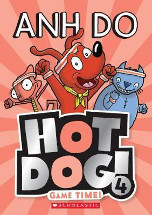
Game time by Anh Do and Dan McGuiness
Hot Dog series. Scholastic, 2018, ISBN 9781760279035
(Age: 5-8) Themes: Dogs. Friends. Sportsmanship. Anh Do's popular Hot
Dog series returns with another exciting story Game time.
Comedian, artist and storyteller Anh Do's story is a tale of being a
good friend and is filled with jokes, humourous larks and silly
situations.
Kevin's mother is a doctor who lives and works helping sick animals
on faraway Rainbow Island. Kevin really misses her, so his friends
try to lift his spirits. They cook his favourite foods and even
dress up as a donut and hot dog, but nothing works. When they visit
the park there's a poster announcing a Game Day competition with the
winners receiving a trip to Rainbow Island. The trio work together;
they need skill, speed and strength to compete in a series of games
and win the first prize. They're up against some tough competition:
a fierce team of bulldogs, Team Bulldog; Team Mud-Pie, three
mud-loving pigs; and Team Ocean, three sporty penguins. Hot Dog's
entered in the Long Jump and Archery, and he spends his time
leapfrogging and shooting arrows at apples held by Kevin. Lizzie
practises her judo moves on poor Kevin and improves her rowing
skills by speedily escaping from a menacing shark. Kev creatively
hones his skills in preparation for the Weightlifting, Javelin and
Gymnastics.
Finally, it is Game Day, and the three friends are prepared and
ready to do their best. Each game is uniquely challenging and
provide plenty of spills and thrills. Lizzie twists her giraffe
opponent into a knot in the judo and bravely battles a tiny crab to
win her event. Kevin, Lizzie and Hot Dog each choose good
sportsmanship over winning and these qualities help them in the end.
Just right for young readers, Game time is attractively
presented with a flamboyant fluoro orange bright designs, bold
accents and engaging text styles and sizes. Dan McGuiness' humorous
cartoons showcase Hot Dog and his friends, Kevin the cat's sporty
outfits and Lizzie the Lizard's silly antics, sports skills and
friendly rivalry.
Rhyllis Bignell
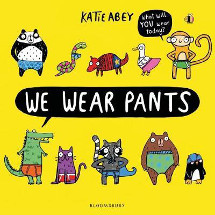
We wear pants by Katie Abey
Bloomsbury, 2018. ISBN 9781408893609
(Age: 2-6) Recommended. Themes: Clothing. Humour. Katie Abey's We
wear pants is an enjoyable and colourful picture book showing a
broad range of animals wearing an interesting array of people
clothes and shoes. Across a double-page spread we are first invited
to view quirky animals wearing a range of pants: giraffe's neck is
festooned with 'pant-tastic' undies, crocodile's looking snappy in
his nappy, while blue monkey dances in his tartan pants! With speech
bubbles filled with questions and comments, text placed up, down and
around the quirky carton animals, this is humorous book to explore.
While Aussie kids will question the use of wellies, they'll soon see
splashing elephants, a narwhal with a gum boot on its horn, even an
octopus wearing eight wellies having a lot of fun. There is one
character who chooses to remain an individual throughout, yellow
monkey wears something different each time. Abey encourages the
reader to find the biggest hat, the tiniest fish and check out the
range of diverse hats for different seasons. Colourful coats are fun
to wear on the bus, in the rain or sharing a bench with friends. The
fun continues with animals wearing shoes, socks, scarves, t-shirts,
glasses and pyjamas.
Abey's cartoon animal characters are engaging, follow the characters
throughout and observe their antics, especially the cheeky monkey.
Share with a young child, discussing the questions, the silly
situations and crazy ways these animals wear human clothing. Finally
check out their fashion styles when they all get dressed, there's a
fire-fighter alligator, a giraffe in multi-coloured scarves and a
prancing pony in jeans and a red shirt. We wear pants is
entertaining, use Abey's style to create new pictures of animals
dressed as humans.
Rhyllis Bignell
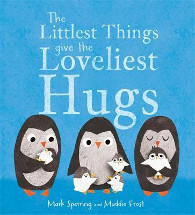
The littlest things give the loveliest hugs by Mark Sperring
Orchard Books, 2018. ISBN 9781408338049
(Age: 2+) Highly recommended. The littlest things give the
loveliest hugs is a beautifully illustrated picture book about
hugs. Each page is bright and detailed, depicting different animals
hugging and snuggling their children. From elephants to foxes to
koalas, this book is ready to be part of a child's nightly bedtime
routine. Even before reading the rhyming sentences, children and
their carers will be busy discussing all of the details in each
illustration. Children can discover where the different animals are
found, make observations about animal families and learn about their
appearance - great Science links.
The rhyming sentences are all about cuddles and snuggles and it
reads like a poem. The rhyming couplets can help children identify
rhyming words, supporting older children to create their own
couplets. The content is aimed at younger children and is highly
recommended for children aged 2+ and younger readers aged 5+.
Kylie Kempster
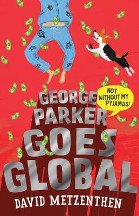
George Parker goes global by David Metzenthen
Allen and Unwin, 2018. ISBN 9781760523466
(Age: 10-14) Recommended. Themes: Travel, Humour, Adventure. Madcap
mayhem, hi-jinks and hilarious rescues, treacherous travel and crazy
disguises makes "George Parker goes global" a fantastically fun
novel for confident readers who like a fast-paced story. David
Metzenthen throws everything into the mix and comes up with an
international adventure and two unlikely characters whose lives have
little in common.
The catalyst for super-nerd George Parker's international adventure
begins with a disastrous half-mohawk haircut from Maddylyne the
local hairdresser. Back at Tapley Grove Academy super-rich Chase
Landon-Bond befriends George and insists they team up to rescue
Chase's sister imprisoned in a New York clinic. Luckily, the teens
can still travel in their private jets, access funds and enjoy a
wealthy lifestyle, well for a while anyway! Things drastically
change when Chase's parents go into hiding because they've lost
hundreds of millions of dollars of their clients' funds.
George comes from a different background, his parents are scientists
who are researching uses for moon rocks in a Swiss laboratory, and
they've left George safely behind at school. George's phobias, rigid
codes of conduct and eccentricities are tested at every turn.
Accompanied by Amy the little dog George rescues, their first
destination is New York, and fortunately, they have the use of the
Landon-Bond's private jet. Chase relies on George's deductive powers
and creativity to release Isobel from the hospital. With touches of
philanthropy, some of Chase's family wealth is put to good use,
sponsoring two hundred African children.
George's penchant for crazy disguises and his ability to think
creatively help the trio travel from New York to London as a part of
the cruise ship entertainment. Chased by some rather ineffective
criminals, they are pursued to France where they lurch from one
dangerous situation to the next. Impossible, impractical, unusual
and clever, each scene seems funnier than the last, especially when
influenced by George's ever-increasing coffee addiction. Do they
find their way home and how will the problems relating to the lack
of funds be solved?
David Metzenthen has created a crazy cast of characters in this
globe-trotting adventure that is amazingly far-fetched, filled with
laugh out loud humour and huge doses of silliness. "George Parker
goes Global" also explores issues surrounding the use and misuse of
wealth, the acceptance of people's difference and valuing
friendships.
Rhyllis Bignell
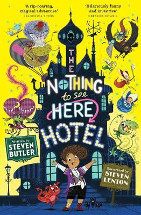
The nothing to see here hotel by Steven Butler
Ill. by Steven Lenton. Simon and Schuster, 2018. ISBN 9781471163838
(Age: 8-11) Recommended. Themes: Fantasy; Hotels: Magic. In a
rollicking and amusing way, Steven Butler has created a fantasy
holiday resort for magical creatures that can only be described as
disgustingly spectacular. The resort is filled with magical and
fantasy oddities, all hosted by Frankie Banister and his family (A
family that has a befuddled, hybrid-ish troll heritage, with some
human qualities too!) The normally smelly and idiosyncratic (and
invisible to normal folk) hotel is turned upside-down (not
literally) when a rather royal goblin decides to make a visit and
creates instant chaos, leading to holes in walls, hand-to-hand
fights, and piratical attacks. All in a day's work in the hotel
industry for the fantasy world!
Written and illustrated in a very humourous style, the author even
talks to his readers in digressions that poke fun at his own family
and at the action that is taking place. It is no wonder that the
book cover includes recommendations from "Tom Gates" author, Liz
Pichon as it will appeal to readers of her books for its silliness.
Certainly not "Harry Potter"-esque in the quality of the fantasy
writing, but absolutely light-hearted and warm imaginary nonsense
that will appeal to young readers.
Recommended for readers aged 8-11
Carolyn Hull
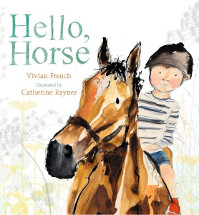
Hello horse by Vivian French
Ill. by Catherine Rayner. Walker Books, 2018 ISBN 9781406349948
(Age: 4+) Highly recommended. Themes: Horses, Overcoming fear,
Confidence. Through an afternoon spent with Shannon the horse owned
by the illustrator of this lovely story, a child learns to overcome
her fear of horses, and learns to ride.
With little steps, Catherine introduces the child to her horse,
Shannon, a horse she has owned for twenty years. The child is given
a carrot to feed the horse, reminded to place it flat on her hand so
the horse can tell what is carrot and what is fingers. She is then
allowed to lead the horse around the paddock, brush and groom her,
and finally to ride her. Each little step brings the child closer to
becoming a friend of the horse, riding her and feeling confident
with the large animal.
French's words tell us of the afternoon with the horse, telling the
reader of why things are done, giving background to the way the
horse is treated, and instructing the reader in the ways of a horse.
So on the pages where the horse is groomed, for example the reader
will not only see what is being done, and read in the story of the
child and Catherine doing this to the horse, but there is
information at the bottom of the page in a different font which
tells the reader the facts of the undertaking and h why it is done.
These facts are on most pages and an index at the end of the story
allows the reader to quickly find the page again.
This beautifully presented picture book with illustrations that will
make every reader want to go out and pat the nearest horse, has a
double page at the end which contains the index, a short piece of
factual information about the horse and its owner, and a reference
to more information along with small illustrations about the brushes
used for grooming.
Readers will love picking up this book, seeing the child take little
steps to overcoming her fear of the horse, and in this way the
reader may equate the role of little steps in overcoming others
worries they may have.
Fran Knight