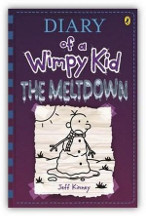
Diary of a Wimpy Kid book 13. Penguin, 2018. ISBN
9780143309352
(Age: 8-12) Themes: Friendship, Competition, Community Life, Climate
Change. Jeff Kinney's popular series returns in the thirteenth
instalment The Meltdown. Greg Heffley's diary focuses on the
huge winter storm that results in heavy snow falls and school
closures. When Greg's mom forces him to play outside, it's time for
epic snowball fights, neighbourhood battles and plenty of fun.
Greg's self-deprecating diary entries help the reader see the world
through his eyes, with humorous asides and plenty of family and
school drama. Greg's imagination is fun to read, thinking about how
cold his ancestors were because they didn't have thermal underwear
and even sheltering in his Gramma's basement and having to wear her
clothes. Kinney's cartoon illustrations add to the fun as well,
there's snow boots melted to the fireplace, epic snowball battles
and pizza box snowshoes. The diary contains comments about the
effects of climate change, the final cartoon shows cyborg Greg
playing cards with a robot as an atom bomb explodes outside the
window.
Greg's diary begins in January, which is unseasonably warm. His
brain is fried and he's forgotten to write his International
Showcase country project owing to the heat from the school furnace
frying his brain! At home things are always interesting: mom's no
screens on the weekends force Greg out into his neighbourhood to
play. Surrey Street is fraught with danger, problems with neighbours
and the upper and lower sections constantly at war with each other.
February brings heavy snowfalls and school closures that sees an
epic snowball fight complete with snow forts, flags and kids who
collaborate to bring the other side down. There's even an
entrepreneurial neighbour, Mitchell Pickett, who's selling pre-made
snowballs, icicles, snowball launchers and sloppy specials to all
the participants. Fortification and castle building add interest to
Greg's diary entries.
Fans of The Diary of a Wimpy Kid series will enjoy The
Meltdown; it delivers all the wry humour, funny situations and
social commentary they enjoy.
Rhyllis Bignell
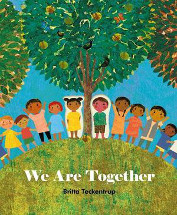
We are together by Britta Teckentrup
Little Tiger, 2018. ISBN 9781848576582
'On our own we're special, And we can chase our dream.
But when we join up, hand in hand, Together we're a team.'
This is the message of this story - the power of one, but the
even greater power of many. Starting with being content with
one's own company flying a kite, it grows to embrace others in our
lives, known or not-yet, so whether it's being caught in a storm or
being passionate about a cause, the support and strength found in
the love and friendship of others alongside us is cause for joy and
celebration.
If ever we're lonely, we'll just say out loud: Let's all stand
together, one big happy crowd!
The cover is intriguing with cutouts peeking through to just two of
the children on the stunning endpapers showing children of all
nationalities and ethnicities, and as each page is turned the
cutouts increase revealing an ever-widening circle of children
capturing the innate way they have of making friends regardless of
any external differences.
It provides an opportunity to talk about not only receiving a
helping hand but also extending one, valuing and sharing the things
we do well personally while respecting and trying the things others
can do. It emphasises that while we are individuals, humans are also
dependent on others - no man is an island - and that co-operation,
collaboration and company are essential elements of our well-being.
Barbara Braxton
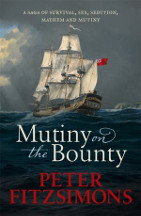
Mutiny on the Bounty by Peter Fitzsimons
Hachette, 2018. ISBN 9780733634116
(Age: Senior students - Adult) Recommended. Mutiny on the Bounty
tells the amazing story of strong personalities, intrigue and high
adventure in the South Pacific.
Captain William Bligh was appointed to take his ship and crew, to
the island paradise, Tahiti, where they were to collect breadfruit
for transplanting in the West Indies. After five months of carefree
living the crew was reluctant to leave. William Bligh's changed
behaviour towards and eventual persecution of his protege, the
popular leader, Fletcher Christian, resulted in the crew mutiny and
the banishment of Bligh and 18 others to an open boat. In a
remarkable feat of navigation and endurance the small boat was
navigated to Timor. Meanwhile, Fletcher Christian sailed back to
Tahiti. The mutineers were well aware that they would be wanted men.
Most remained on Tahiti but Christian and eight compatriots along
with Tahitian men and women sailed off in search of a secret hiding
place. Eventually they discovered Pitcairn Island, where they
proceeded to settle, populate, quarrel and murder.
Peter Fitzsimmonds has based his book (613 pages) on the work of
earlier researchers, and detailed quotes from primary sources such
as Bligh's logbook. Incidents are flavoured through diary notes
converted to conversation and assumed thoughts or motivations
discussed during the main developments. The ship and settings are
described in detail with drawings, pictures and maps to support the
narrative. Suspense is maintained through simultaneous accounts of
the actions by both factions in different parts of the world. Some
readers might take issue with the accuracy of the accounts of the
mayhem on Pitcairn Island. However, the author gives a strong
flavour of how events probably occurred. An amazing story that is
still gripping over two hundred years later.
Paul Pledger
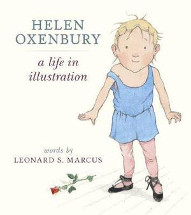
Helen Oxenbury: A life in illustration by Leonard S. Marcus
Walker Books, 2018. ISBN 9781406357943
(Age: 11-Adult) Highly recommended. What a joy it was to discover
this fascinating account of the life of Helen Oxenbury, written in
an easy to read manner by Marcus, a distinguished children's
literature critic. From the very beginning when the reader glimpses
a rich brown red door at the top of the stairs, then is shown all
the accoutrements of an artist, brushes, pens and crayons, it is
evident that this is a book to be savoured and treasured, one to
share with other people who love art and with children who have
adored the illustrations in many of Helen Oxenbury's books.
The book is divided into spans of years, giving information about
Helen's childhood and early training as an artist in the period from
1938-1957, then the book is divided into decades following the
important events of her life. It is illustrated with beautiful
photographs that bring Helen to life for the reader as well as
containing many gorgeous illustrations from her books. Anyone who
has been involved with reading to young children will recognise the
wonderful pictures from We are going on a bear hunt, to Ten
little fingers ten little toes and will be filled with
nostalgia for the lovely times of reading aloud and sharing these
books. Helen's understanding and love for children is evident in her
delightful drawings of toddlers and babies and her empathy for young
mothers is also very obvious.
It is easy to read the book from cover to cover as Helen's life and
the growth of the publishing industry is described. And it is also
wonderful to let the pages just drop open to see what gorgeous
illustration might appear.
This beautifully designed book is a fascinating biography of a very
warm and talented illustrator and one that could grace any home
where art is valued, while being a valuable addition to any library.
A video is available.
Pat Pledger
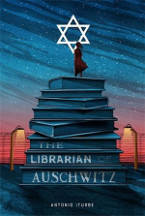
The librarian of Auschwitz by Antonio Iturbe
Translated by Lilit Zekulin Thwaites. Pan Macmillan, 2018. ISBN
9781250217677
(Age: 14+) Recommended. Historical fiction. Based on a true story,
this novel recounts the life of Dita, a 14 year old Jewish Czech
girl, sent with her mother and father by the Nazis in Prague, first
to the Jewish ghetto of Terezin, and then to the Auschwitz
extermination camp. There, in Block 31, she becomes the librarian,
guardian of a secret library of eight books, a strange assortment
that has been secreted into the camp one by one: there is an atlas,
a book of geometry, H. G. Wells' history of the world, a Russian
grammar, a French novel, a Russian novel, Freud's treatise on
psychoanalytic therapy and a disreputable Czech publication The
adventures of the good soldier Svejk. The books are forbidden,
and they become the most valuable link with another world, the world
of literature and education. Dita literally guards them with her
life.
Life in Auschwitz is miserable and fearful. The school that their
inspirational leader Fredy Hirsch has set up in Block 31 is
threatened at any moment by discovery by the Nazis. The cruel and
heartless Dr Josef Mengele has Dita in his sights, he is tracking
her every move. Afraid, Dita doesn't know who to trust - is it truly
as the eccentric Professor Morgenstern says, your best friend is
only yourself?
Despite all the horrors she experiences, Dita is a survivor, and in
this story Iturbe captures her unique spirit, her courage in the
face of the worst evils, and her determination not to be beaten. The
book includes other truly brave people, a reminder of the strengths
of ordinary people living in the worst of times.
In the end this is an uplifting book, a reminder of the importance
of literature and ideas, and of empathy and shared human experience.
Young readers and adults would equally enjoy it.
Helen Eddy
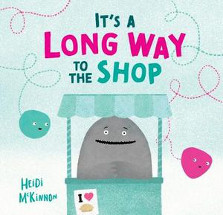
It's a long way to the shop by Heidi McKinnon
Scholastic, 2018. ISBN 9781742998855
(Age: 4+) Highly recommended. Humour. Adventure. Overcoming
obstacles. Determination. Persistence. Readers will just love
working out how these two rocks can make it to the shop. After all
they don't have legs or wings, or flippers, but they make it across
the field, the river and the mountain with the help of other
creatures.
Right from the start, they know it is a long way to the shop. The
blue rock continually questions the red rock about how they can get
across the field, climb so high or swim the river. Each time, the
blue rock answers 'we fly' or 'we swim' but each time the blue rock
responds with an insurmountable problem. But they do make it to the
shop, some adventures happening along the way that press them
forward: a goat picking them up in its mouth, then spitting them
out, a bird taking them up to its nest, a person skimming them
across the water.
Children will laugh out loud at how they are moved, despite their
obvious inability to move of their own accord. And when they get to
the shop, another problem occurs! The shop is a sausage roll shop,
and it is waiting for them on the counter, but how can they get it
down to eat it? Children will love working out what they or others
can do to assist them.
The pared back illustrations using only a few colours are most
entertaining, as they show the determination of the two rocks to
achieve their goal. Children will love the blue text from the blue
rock, and the red text from the red rock, encouraging them to join
in when it is read to them. Children and adults will laugh at the
insinuation of rock and roll into the story: the tale is about
rocks, the title parodies a famous rock classic, 'It's a long way to
the top', and they attend a rock concert. Heidi McKinnon, a
Melbourne based graphic designer published her first book late year,
I
just ate my friend, a very funny understated look at
friendship. You can read more about her at www.heidimckinnon.com
Fran Knight
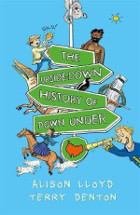
The upside-down history of down under by Alison Lloyd
Ill. by Terry Denton. Penguin Random House Australia, 2018. ISBN
9780143788669.
(Age: 9+) Alison Lloyd has undertaken the daunting task of writing
an overview of 200 million years of Australian history from Gondwana
to Federation. She has also played on the concept of the continent
'down-under' to highlight what she calls the 'ups and downs, ins and
outs of Australia's story.'
Within a broadly chronological narrative, the author has outlined
the major themes of Australia's past. These range from the
continental drift and the arrival of Aboriginal people, to European
exploration, the convict system, frontier conflict, pastoralism, the
gold rushes, women's rights, trade unions and the formation of the
Commonwealth of Australia. The challenge of briefly outlining these
complex themes has been largely overcome by the inclusion of
intriguing details, quizzes, timelines, quotes from historical
documents and nineteenth-century pictures. Terry Denton's
entertaining pen-and-ink illustrations complement the humorous
headings, references to modern culture and colloquial writing style.
Lloyd has sought advice from librarians and Indigenous advisors, and
sourced information and ideas from the works of professional
historians. A detailed table of contents compensates for the
publication of the index on the author's website rather than in the
book. A bibliography and notes for teachers can also be found
online.
Some young people may not be aware of the formerly common reference
to Australia as the country 'down-under'. The author explains this
Eurocentric concept, then uses it to make two points about
Australian history. The first is that it has both positive and
negative aspects. The second, more contentious, suggestion is that
the country formed from colonies is still in the process of turning
itself 'the right way up.'
Alison Lloyd's The upside-down history of down under can take
readers on a historical journey that is informative, engaging and
thought-provoking.
Elizabeth Bor
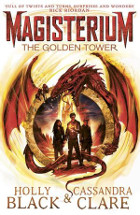
The golden tower by Holly Black and Cassandra Clare
Magisterium book 5. Scholastic, 2018. ISBN 9780552567756
(Age: 10-12) Recommended. Themes: Fantasy. Coming of age. Magic. The
final book in the series, The golden tower brings to an end
the adventures of Callum Hunt as he navigates his way through the
corridors of his school, the Magisterium. Callum has had a hard time
battling chaos, evil and the mage Constantine Madden and in this
book he is faced with the even more difficult task of stopping Alex
from manipulating the Magisterium for his own evil ends.
This book is a satisfying conclusion to the series. Callum is still
battling the distrust of his fellow school mates, but he resists the
urge to take off with Alistair, his father, and hide. Instead he
works with Tamara and Aaron to bring down Alex and make his world a
better place. Callum and his friends have to work together as a team
and share problem solving techniques for the good of the community.
The growth of his maturity and that of his colleagues is evident as
events that are difficult to control take over the life of the
school.
This was a fast paced story with enough action to keep the reader
engrossed. It is a series that primary school children who like
fantasy are likely to enjoy.
Pat Pledger
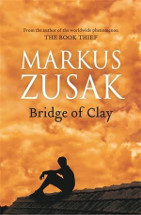
Bridge of Clay by Markus Zusak
Pan Macmillan, 2018. ISBN 9781760559922
(Age: Adolescent - Adult) Recommended. With a story that is based on
the deep and abiding love of a family, this book plunges us deeply
into the world of the Carey family in a Melbourne suburb near one of
the great horse racing tracks. The five sons are educated at the
local school, but their home education is deeply embedded in the
Greek classics, with even their pets being named after the great
Greek heroic figures. This is a story that packs an enormous punch,
just as the boys do so often in their home, even though they are
surrounded by love and care. The book is suitable for older
adolescents, and certainly is a great read for adults.
Zusak has chosen a storyline that takes the reader through the years
of the boys youth, through the loss of their mother to illness,
their father's occasional abandonment, their loving care of their
somewhat unusual pets, and the animals that are ever-present in
their lives, especially the mule. All the names of the animals
represent the qualities that the boys attribute to their furry
friends, and this is the key to their shared set of values and
beliefs that holds them together when their mother dies and their
father appears to abandon them.
Choosing to weave his story deep in the suburbs of Melbourne, Zusak
takes us back and forth in time so that we have to construct the
storyline as we work to place each chapter in its right time. When
their father leaves them, after his wife's death, the boys fight and
play, read and build, but never stop supporting each other and find
ways to cope, in their inimitable style. The father is not a bad
figure but is grieving so deeply that he cannot stay with his sons.
Yet they forgive him!
Place matters in this text, and the story is set in different places
that re-appear throughout the narrative. We get to know The
surrounds, the bridge over the deep valley that they work to
construct, the racetrack and the racing horses, and the animals'
shelters at home. Clay's bridge, the shelters for the animals, their
home, the race track and local area are all deeply reflective of
this family. The mixing-up of the timeline appears to be reflective
of the more important issue of the deep and abiding love they share,
and of their memory of a loving mother who educated them in the best
of the ancient Greek values, of loyalty, goodness, and generosity,
all in the face of almost constant threats of disaster. This is a
long story, and is one that needs concentration to build its place
in time, and yet it is utterly captivating. It is hard to put down,
to let the boys go when the end comes, but we leave them with a deep
feeling of gratitude that although we have spent so much time with
them, we are sad that the narrative has ended. It is hard to believe
that this is not a true story, and it is likely that we might well
posit its essential truths as pertinent to our being human, and be
all the better as people for having read this wonderful novel. Bridge of Clay is suitable for adolescent and adult reading.
Elizabeth Bondar
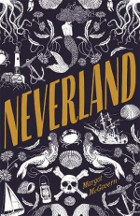
Neverland by Margot McGovern
Penguin Random House Australia, 2018. ISBN 9780143787846
(Age: Young Adult 15+) Recommended. Kit Learmonth arrives at The
Residence, a boarding school for damaged teens. She is too sick for
regular school but not sick enough to be institutionalised. Her
psychiatrist uncle Doc and Dr Ward care for her and the other
students living there. The Residence is Kit's former home. A grand
home on an island with a lighthouse, caves, cliffs and swimming
beaches. Kit grew up on the island with her esteemed writer father
and her mother. Her childhood memories are vivid and fanciful. She
and her father lived in an imaginary world of pirates, mermaids,
monsters, treasures and seafaring voyages of Odysseus. She lived in
a make believe world straight from the pages of her father's
bestselling book Kingdom by the Sea, her favourite book.
Returning to The Residence is difficult for Kit; she hardly
recognises the place and has to deal with her past memories and her
parents' tragic death. She self-harms and looks for ways to comfort
herself with drugs and alcohol, all banned from The Residence yet
smuggled in. Kit has some close friends and together they have a
goal to win the School's Cup, the annual sailing race. With
Alastair, Rohan and Gypsy by her side, she manages group therapy,
studies, training for sailing and gets up to mischief on night time
adventures. They nickname The Residence 'Neverland' and play out
imaginary and fantastical scenarios as a way to escape real life. At
times, their friendships are strained and difficult, as all struggle
with their own demons.
The title of the novel makes me think of Peter Pan's Neverland. Kit
Learmonth is like Peter Pan, stuck on an island and does not grow
up. Kit lives her life stuck in her idealised past blocking out the
truth and trauma of the day her parents died. Neverland is an engaging and emotional read. McGovern deals
with the challenges of adolescent mental health issues in a very
sensitive and refreshing way. She deals with issues of depression,
eating disorders, and self-harm without romanticising them. The
character development is sincere and balanced enabling the reader to
experience real empathy and compassion for each. McGovern has been
successful in writing a novel that is a more positive representation
of the issues that face young adults today.
Sandra Ciccarello
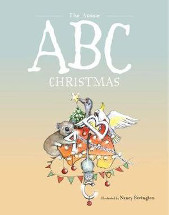
The Aussie ABC Christmas by Nancy Bevington
New Frontier Publishing, 2018. ISBN 9781925594256
(Age: 4+) Themes: Christmas, ABC, Alphabet book, Humour, Australia.
Replicating what many teachers ask their classes to do at Christmas,
this ABC book offers a few different words to align with the
alphabet. Many letters are combined with easily identifiable
Christmas words: 'carols', 'milk for Santa', ' reindeer' and so on,
while others such as 'angel', 'gifts', ' holiday', 'beach', 'joy'
etc, are words associated with other times of the year, rather than
specifically Christmas words. So readers will have an interesting
slant on what words actually are Christmassy, and I think astute
teachers will take advantage of the words offered to winkle out just
what Christmas means to the people in their class. The book lends
itself to offerings from all the students in the class, being
inclusive and wide ranging about what Christmas means when you live
in Australia. For children born elsewhere the opportunity is given
here for them to share what Christmas means to them and what words
best represent their Christmas, for those born in a different
household, the opportunity is there to share again what Christmas
means to their family.
What I have learnt over the years is that Christmas is different for
every family, each having their own traditions and ideas, customs
and food, whether you were born here or not, born into a religious
family or into one where Christmas has no religious affiliations at
all, whether you are in a family of two or a whole heap, each is
different. And while this nostalgic book attempts to show the common
things about an Australian Christmas, it is what is left out that
might be more important for many children.
Fran Knight
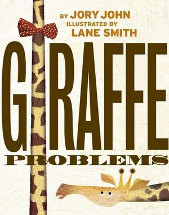
Giraffe problems by Jory John
Ill. by Lane Smith. Walker Books, 2018. ISBN 9781406383164
(Age: 5-8) Themes: Differences, Individual Characteristics. The book
begins with Edward the giraffe telling us his problem: 'I feel bad
about my neck. I do. I can't help it. It's too long. Too bendy . . .
Too . . . necky.' He tell us all the ways he has tried to hide it or
dress it up. All the other animals seem to have glorious, perfect
necks. But his makes him want to hide until the sun sets. His tirade
of self-loathing is just ending when he accidentally rests his
cumbersome neck on a turtle. Cyrus the turtle then begins telling
Edward about his own neck problems: 'I've been admiring your neck
from afar. Oh, how I wish my neck looked like yours! I'd get so much
done in a day'. And so he continues on his own little tirade. The
story is told with dry humour, making fun of their extreme vanity
and how focused they are on their own problem. The funniest part of
the book is when turtle tells us, using very descriptive
story-telling, of how he has waited for a week under a banana tree
for a piece of fruit to fall to the ground so he could 'sample its
sweetness and nourish myself in the process'. 'You want a banana
from a tree?' says Edward. 'That's what I said, yes'. Plunk, down
one comes. So, Cyrus praises Edward's neck and Edward waxes lyrical
about Cyrus's neck and they dress themselves up with bowties. 'I
feel good about our necks, Edward'. 'Thank you, Cyrus. For once, so
do I. Yes, for once, so do I . . . '
Lane Smith (It's a Book, The Stinky Cheese Man) has
used textured illustrations which are perfectly suited to the
animals and natural setting within this story and the
character-driven narrative. The colours used are mostly earthy
browns, yellows and greens. The reader can tell which animal is
speaking because of their individualised text style and colour; this
is a clever technique and it is always clear who is speaking, if not
from the content or placement within the picture then from the
typeface. This has a nice moral about accepting ourselves as we are
and celebrating what makes us unique. It is also about recognising
difference and how we can make use of those differences to work
together.
Nicole Nelson
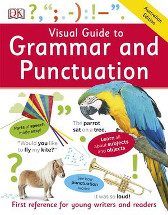
Visual guide to grammar and punctuation by DK Publishing
Australian edition. DK, 2018. ISBN 9780143794998
(Age 7+) Highly recommended. Themes: Grammar. Punctuation. How
exciting to find an excellent book showing commonly used grammar and
punctuation in a way that is easy to understand both for children
and for adults who may be uncertain about different aspects of the
English language. The book has an extensive Table of Contents, with
an introduction, instructions on how to use the book and definitions
of grammar and punctuation. It is then divided into the following
sections: Parts of speech; Sentences, phrases and clauses;
Punctuation. The pages have different coloured text boxes and all
are illustrated in many colours.
Although aimed at a primary school age group, I found the clear,
concise explanations and the supporting illustrations to be very
helpful in answering any vexed problem about punctuation. For
example the use of semicolons to join two ideas together in a
sentence is often a problem for writers as the semicolons are often
left out and no conjunction is added to join the sentences together.
The one page devoted to semicolons gives excellent examples of when
to use them in sentences, as well as showing their use to separate
different things in a list. Apostrophes often can be problematic but
their use is clearly illustrated. The use of 'Its' or 'it's' can
provide a dilemma for some writers, and the two page spread
illustrating this is excellent. These are only two examples from a
well-organised and lively guide.
This book would be a boon to any aspiring writer and would make a
fabulous reference book for all the family. It would also be
exceptionally useful in the classroom and library.
Pat Pledger
Foundational fictions in South Australian history edited by Carolyn Collins and Paul Sendziuk
Wakefield Press, 2018. ISBN 9781743056066
(Age: Senior secondary - Adult) Recommended. Foundational
fictions investigates the myths that South Australians hold
dear about their state. Is it really true that South Australia was a
more enlightened settlement free of the 'convict stain'? Were the SA
settlers kinder to the Aboriginal inhabitants? Did the settlement
live up to the ideals of the Letters Patent and the Proclamation at
the old gum tree? Was SA established according to principles that
set it apart from the other states? Or is it all just beautiful
lies?
As the famous quote goes, 'history is written by the victors'. This
collection of essays examines many of the commonly held beliefs
about the history of South Australia. All South Australians would
like to believe the good stories about their ancestors, the myths
that have been passed on. Some do draw on original facts, but many
have been embellished or even completely reworked to cover over the
things we would prefer not to examine too closely.
Most interesting reading is author Lucy Treloar's response to Inge
Clendinnen's 2006 critique of Kate Grenville's novel 'The secret
river'. Treloar posits that history is greater than just the facts.
Historical fiction may offer an emotional truth that allows people
to enter into the experience of others, ponder what they felt, and
consider how they may have acted in their place. There is a place
for both - the historian allows us to examine the records of past
events, the facts, the snippets in newspapers and diaries; the
historical fiction writer allows us to enter that world and
reimagine it for ourselves.
Another writer, Jane Lydon, researching the record of bushman George
Hamilton, examines how even writers of the past era may change their
world view over time and reinvent or embellish their own records of
the past.
These are all very interesting questions for the student of history
to ponder. Foundational fictions brings together some key
(mis)conceptions about South Australia and allows the reader to
reinvestigate the past record and query just who makes history, and
how history is passed down to successive generations. This book
would be a really useful resource for developing students'
understanding of the historical concepts proposed by the Australian
history curriculum: 'evidence, continuity and change, cause and
effect, significance, perspectives, empathy and contestability'.
Helen Eddy
The Bad Guys: Episode 8: Superbad by Aaron Blabey
Scholastic, 2018. ISBN 9781760279509
(Age: 6+) Highly recommended. Themes: Humour. Adventure.
Superheroes. The Bad Guys return with superpowers that will delight
their fans as they chuckle their way through another hilarious
adventure. Yes, the Bad Guys have acquired super powers but they
appear to have defects that make for a most amusing read.
Although Superbad follows on from Episode 7, readers will
have no problem identifying the different main characters and newly
independent readers will love the sparse text and graphic novel
format. Older readers don't miss out either - the over-the-top
illustrations have enormous appeal for young and old. Imagine the
drawing of Agent Hogwild, atop a motorcycle, being chased by two
police cars, depicted with all the humour and ability of an artist
of Blabey's calibre!
Books from The Bad Guys series consistently appear on
Children's Choice awards like YABBA, and this is a testimony to
their appeal for the targeted audience.
Pat Pledger