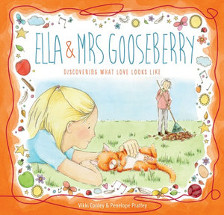
Ella and Mrs Gooseberry by Vikki Conley and Penelope Pratley
EK Books, 2019. ISBN: 9781925335255.
(Age: 4+) Themes: Old age, Friendship, Neighbours, Caring, love,
Family. With one in four Australians living alone, the impetus to
write this book was to remind people about their neighbours and
their need for love and companionship. Ella is aware that Mrs
Gooseberry next door slams the front door and does not return her
ball if it goes into her yard. But when she watches the old woman in
her backyard she talks to her chickens and smiles picking the
tomatoes from the vines. Ella asks her mother why Mrs Gooseberry can
be so different. Mum's reasoning is that she has lost her love. With
that Ella asks a variety of people what love is: her ballet teacher,
her gran, her teacher and her mother all giving various answers that
include warmth, caring and kindness.
Each of these answers will encourage the readers to think about what
they think love is, and add answers of their own.
Ella tries to work out a response for herself and when her gran's
cat has kittens she has an idea. She puts one of the kittens in a
box on Mrs Gooseberry's front verandah.
The reaction of the old lady to the kitten is just what Ella
expected as she hears the two talking to each other and sees the
woman with the cat on her knees in the back garden.
Over the next few pages we see Mrs Gooseberry doing all the things
that Ella's questioning elicited from people: dancing like a bird,
singing, sparkling, sharing food, and having sweet dreams both day
and night. Mrs Gooseberry is happy and radiates love. A neat
resolution.
Through her kindness Ella and her family have brought love back to
their next door neighbour and found a new friend.
This earnest book could provide a platform for discussions about
love and kindness, neighbours, loneliness and friendship.
Fran Knight
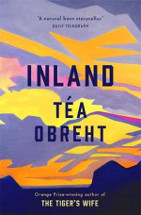
Inland by Tea Obreht
Hachette, 2019. ISBN: 9780297867074.
(Age: 16+) Highly recommended. Themes: Historical fiction, Survival,
Drought, Cameleers, Ghosts, Trust, Relationships. Set in the harsh
drought ridden country of 1890's southwest America, Obrecht's Inland
tells two stories that gradually draw closer together, both set in
harsh inhospitable environments, with people struggling to make an
existence, dealing with loneliness and ghosts of people dead.
Outlaw, Lurie, described as a 'hirsute Levantine' on the wanted
posters, travels for a while with a band of cameleers attached to a
US military expedition into the desert but pursuit by the relentless
Marshal Berger sees him once again finding his own way, but this
time with a strange companion for whom he feels a growing
attachment.
The other story is one day in the life of homesteader Nora. With her
husband gone to find water, and her two adult sons disappearing
early in the morning, she is left with her anxious child Toby, a
wheelchair-bound mother-in-law, and young helpmate, Josie, who
communicates with the spirit world. With only the last dregs of
water to contend with the scorching heat, Nora has to stand guard
against hostile outsiders, and now, a phantom wild beast that has
put fear into Josie and Toby.
Both Lurie and Nora are tough individuals each dealing with ghosts
of the past. For Lurie it is past companions he continues to see and
who infect him with their needs; for Nora it is the ghost of her
daughter, dead from heat stroke many years ago. Both have to contend
with loneliness, hardship, and distrust of others. Their stories are
a journey of self-enlightenment and exploration of the human need
for trust and companionship. The reader is drawn into the two
stories, wondering how they will eventually come together. The twist
at the end makes for an unforgettable ending.
It is a panoramic novel, each chapter written with a different
voice, the language rich and poetic, evoking another time and place.
It has many of the elements of the American western but is highly
original in weaving in the little known history of the U.S. Camel
Cavalry Corp, and the mix of Middle Eastern migrants, Mexicans, and
Indians. It is a good reminder that America, like Australia, has
always been a multicultural mix of people.
Helen Eddy
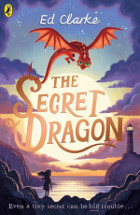
The secret dragon by Ed Clarke
Puffin, 2019. ISBN: 9780241360514. 239p.
(Age: 9+) Highly recommended. Themes: Fantasy. If life is a paradox,
then The Secret Dragon is duplicitous to its core. Mari
wants to be a palaeontologist like her father, who was tragically
struck by lightning when she was a toddler. Her mother, Rhian, is
not academically minded but invested in the living animals on their
farm. Mari finds the dragon egg after the new vet's son, Dylan, sets
off a landslide near her dig on the cliffs. Inside, is the stuff of
folklore, a living red Gwiber or Wyvern, which Mari christens
'Gwebe'. The Gwiber is also conflicted - affectionate and
troublesome. Mari thinks about making her father proud and naming
her momentous find in his honour - Pterodactyl Jonathani. She
deceives her mother and wags school in order to discuss the
discovery with Professor Griff Griffiths, a palaeontologist working
in children's television.
With Dylan as her assistant, Mari learns to connect to her own
mammalian wisdom. Yet paradoxically, it is Dylan who is taken in by
Ffion's charms, allowing their classmate to steal Gwebe from Dylan's
shed. Tension between mum and daughter mounts when Dylan's dad,
Gareth asks her mum out on a date. Rhian feels 6 years is long
enough for Mari to get used to the idea of replacing her father.
But, more lies surface . . .
The book captures the inevitable tension between different types of
people and their motivations. Professor Griff turns out to be other
than he seems and Dylan helps Mari to choose between the living
dragon or her prospective career. When Mari sneers that being
popular means both wanting to be like everyone else before being
collectively mean to someone different, she echoes the nuances of
the human paradox in Clarke's book. This is a novel ideal for group
study. It ably demonstrates that very little is what it seems.
Ed Clarke is a film and TV producer versed in adult drama, but we
eagerly await his next children's adventure, The Order of the
Dragon, due in 2020. The 10 fossil facts appended, are mostly
devoted to Clarke's inspiration, Mary Anning - the first person to
find a 'sea dragon'(Plesiosaurus) skeleton. It was so strange at the
time, it was thought to be fake. You see, in the best novels, the
circle closes for the reader's plenitude.
Deborah Robins
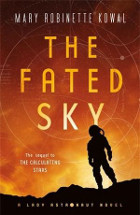
The fated sky by Mary Robinette Kowal
Lady Astronaut book 2. Tor Books, 2018. ISBN: 9780765398949.
(Age: Adult - Senior secondary) Recommended. Themes: Science
fiction, Women astronauts, Space colonies, Mathematicians, Gender
stereotyping, Racism. Fans of the award winning The
Calculating Stars will devour The fated sky
which is set a couple of years later. Lady Astronaut Elma York is
now living on a colony on the Moon and may have the chance to be
part of a trip to Mars. After an asteroid devastated Earth it had
became imperative for new worlds to be discovered, and Elma is
determined to be part of that journey. Along with 13 other
astronauts of differing race and nationalities, she is assigned to
the Martian mission and sets out into space.
Kowal examines what it would be like to live and work together in a
space vehicle, where the Captain doesn't believe that women should
be allowed into space, and where a South African man doesn't trust
his non-white companions. This examination of gender stereotyping
and racist attitudes as well as the dangers of the voyage, make for
a breathtaking and thought provoking read in this alternative
history. It is fascinating to ponder what would have happened if the
NASA space program had continued in the 60s, and what effects the
racism and sexism so evident then would have had. The fated sky, like The calculating stars, is sure to
be on many short lists and award lists and readers will hope for a
third book, while looking out the short story, The lady
astronaut of Mars (2014), which was the catalyst for the
series.
Pat Pledger
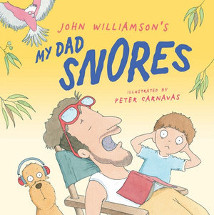
My dad snores by John Williamson
Illus. by Peter Carnavas. Puffin Books, 2019. ISBN: 9780143793793.
(Age: 4+) Highly recommended. Themes: Snoring, Fathers, Family. From
the pen of well known Australian writer, musician and entertainer,
John Williamson, comes this wonderfully inviting read aloud about
fathers and snoring.
All children will recognise someone in their family with snores so
loud they keep the house awake and drown out the television.
Readers will love reading the rhyming lines ending with the rhyming
phrases, What are we going to do?
Your dad, does he snore too?
This repeated pair of lines invites the readers to share stories
from their experiences, and laugh at the familiarity of seeing
another family so afflicted.
Each page brims with an inviting easily read text, begging to be
read aloud, asking children to come in with the repeated refrain,
while getting a kick out of the illustrations.
We see dad snoring through doors and walls, mum kicking him to get
him to stop. We see him compared to a steam train, thunder and rain,
an old school bus, and while the house rattles and shakes, he hisses
like a brown snake or a dinosaur.
The family tries a number of remedies to halt the noise, putting a
peg on his nose, wearing ear muffs, putting pillows over their
heads, but he laughs, not seeing the problem at all. Even taking a
film of him snoring does not have any effect. Eventually the family
works out a solution and the image of the sleep deprived family
hammering in the tent pegs at the bottom of the garden will satisfy
all readers that a way to fix the problem has been found.
Carnavas' illustrations hit the mark. I loved reading the book
again, spying the looks on the faces as I turned the pages, seeing
the animals included in the snore affected family, and helping with
the resolution at the end.
I love the endpapers initially showing five frazzled galahs unable
to roost because of the noise, while the last endpaper shows them
happily asleep on the chimney.
This is an enjoyable read for families and classes as Father's Day
approaches but its universal theme of solving a universal problem
will be lauded.
Fran Knight
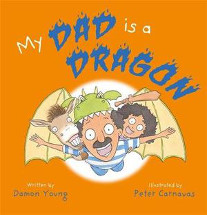
My dad is a dragon by Damon Young
Illus. by Peter Carnavas. UQP, 2019. ISBN: 9780702260490.
(Age: 4+) Recommended. Themes: Humour, Fathers, Dragons. With a
series of rhyming pairs of lines Young describes an overview of
various fathers and what they do in their families. From dads who
collect cars or stockpile sneakers, collect swords, scimitars and
sabres, my dad is a dragon who collects chocolate gold.
Then some dads have pencils to design bridges or trolleys for
fridges, or wear a special suit to collect honey, while my dad is a
dragon who loves to sing.
On again, to dads who shriek 'shiver' or 'yow' or why' my dad is a
dragon with blazing chilli breath.
Each set of rhyming lines introduces the reader to a range of what
dads do, ending with 'my dad is a dragon' raising the expectations
of the reader.
They will love reading of the variousness of fathers' roles within
the family, and have fun sharing what their fathers do. The repeated
lines will evoke a response as the children turn the page to read
for themselves: 'but my dad is a dragon . . . and laugh out loud at
the offered line.
The next set of lines refers to food, with some dads grabbing the
potatoes from a hotpot, or the pork bun form the table spinner, or
pinch the sprinkles from the top of a birthday cake, but my dad is a
dragon, with smoky charcoal steaks.
And on the tale goes until we find out why dad is a dragon, and all
is well as the dragon folds his wings around his offspring and they
fall asleep.
Carnavas' ink and watercolour illustrations are always a treat,
evoking laughs from the reading audience, and recognition from the
adults, reflecting the variety of fathers and the work they do in
the home. I always admire the expressions Carnavas gets on his
faces: a few lines and he has them happy, struggling, abashed, in
control (or not), sad, worried or glad.
This is the sixth book in the series from UQP, including My
Nanna is a Ninja, My
pop is a pirate, My mum is a magician, My
sister is a superhero and My
brother is a beast, written and illustrated by Young and
Carnavas. Teacher's
notes are available.
Fran Knight
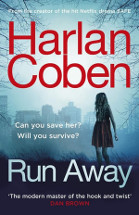
Run away by Harlan Coben
Cornerstone, 2019. ISBN: 9781784751173.
(Age: 16+) Recommended for lovers of thrillers. Themes: Mystery,
Drug addiction, Fathers. An exciting stand-alone thriller, Run
away grabs the reader right from the first page and with many
twists and hooks, keeps up the momentum until the unexpected end.
Simon Greene's daughter Paige has disappeared. A drug addict, she
has an abusive partner. Simon continually searches for her and one
day he believes that he has spotted her in Central Park. She runs
and following her trail leads Simon to danger and things that he
could not have imagined.
Harlan Coben is a master at hooking the reader in and keeping the
suspense and tension going until the dramatic conclusion. Coben's
portrayal of the father who just can't give up on his daughter, even
after her abusive boyfriend is found dead, is very effective.
Simon's steps to find Paige and to find out who is the murderer, are
vividly described and make it very difficult to put the book down.
The dark side of the drug world is a dangerous place for him to
venture into and this background makes the story even more
thrilling. Run away kept me guessing until the end and although all the clues
are there when you know what has happened, they weren't obvious to
me while reading. Verdict: An exciting thriller that was hard to put
down and easy to read as it was a stand-alone.
Pat Pledger
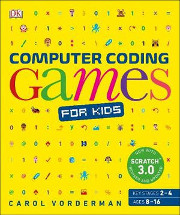
Computer coding games for kids by Carol Vorderman
Dorling Kindersley, 2019. ISBN: 9780241317747.
(Age: 8-16) Themes: Computer programming, Programming languages,
Computer games - design and construction. Computer coding
projects for kids presents a visually appealing step by step
guide to computer programming for kids, beginning with the
playability components that make a fantastic computer game,
characters, mechanics, objects, rules, goals, controls difficulty
levels and the game world. Computer games range span across
different genres - traditional, combat, role playing or puzzles. By
developing understandings of how coding works, the basics of Scratch
3.0 and sourcing the program, we are introduced to the first game
Star Hunter. With clear instructions, screen grabs, easy to follow
instructions and little pixelated characters providing helpful
hints, young programmers will soon achieve success.
Computer coding concepts are also explained from using coordinates,
looping, Boolean expressions and writing strings of coding. In the
Scratch section, there are progressively longer games to program.
Cheese Chase is a maze game where Mimi the Mouse tries to avoid the
beetles and ghosts on her journey to find the cheese. Jumpy Monkey's
mission is to jump and eat all the bananas. In the second section,
the Python language is introduced, utilising the same format while
building on the concepts learned in the Scratch chapters.
Dorling Kindersley publications are always visually appealing and
realistically written to suit the target audience. Each computer
game is precisely broken down into easy to understand steps, with
plenty of tips and concepts explained. Computer programming for
kids has been revised from the 2015 edition to bring the
coding up-to-date with Scratch 3.0. Just right for young techies
keen to begin programming and for those who enjoy the challenges of
mastering more complex gaming techniques.
Rhyllis Bignell
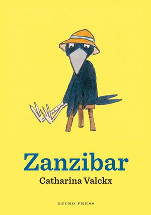
Zanzibar by Catherina Valckx
Gecko Press, 2019. ISBN: 9781776572564. 65p
(Age: 7+) Early Chapter Book. Zanzibar is an ordinary, contented
crow who unfortunately begins to believe that he is lacking in some
way. Achille LeBlab is to blame. As the special correspondent to the
'Voices of the Forest' newspaper, he is seeking interesting
subjects to write about. He tells Zanzibar that apart from his name,
there is absolutely nothing special about him.
Without rhyme or reason, Zanzibar reaches the very arbitrary but
specific belief that his special talent is the ability to lift a
dromedary in the air with one wing.
The quest for an Arabian camel begins and he tells Paulette the mole
his intentions. Sidi, the Fennec fox, helps him to find a very thin
camel called Cheb. Madam Adelle is a moth yet the postman is a
Seagull, named Monsieur Seagull. It seems only animals with jobs
have surnames and these describe their species, or their occupation,
since the lizard reporter is Monsieur LeBlab.
But will Zanzibar's belief in his ability be justified and will
Monsieur LeBlab want to write a story about an incredible feat?
Indeed, where is the evidence?
Historically, crows were trouble and not extraordinary. Nearly 200
years ago, the Indian crow was introduced to the island of Zanzibar
but spread to the mainland where it very quickly became a pest.
Coincidentally, 100 yrs ago, George Bateman translated an East
African folktale about a clever crow in his collection, Zanzibar
Tales. Science has decided, they are actually extremely good
problem solvers.
Thus, the retro look and feel of this children's book hints at the
kind of story we will read. But Valckx's Zanzibar is naive,
more like the characters in enchanting French classics such as Babar,
where animals seem to be concerned with one dimensional
circumstances before reaching a simple conclusion. And so . . . we
discover that it is never too late to do something incredible.
Learn more about this Dutch author.
Deborah Robins
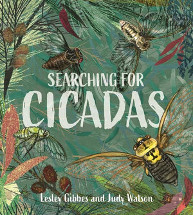
Searching for cicadas by Lesley Gibbes and Judy Watson
Nature Storybooks. Walker Books, 2019. ISBN: 9781922244420.
(Age: 5+) Highly recommended. Themes: Cicadas, Environment,
Observation, Grandparents. An older man and his grandson go cicada
watching each summer. The pair pack their sleeping bags and tent and
walk down to the Apex Reserve where they camp with others to observe
the insects. They look out for the insects called surprisingly,
Double Drummers, Yellow Mondays, Green Grocers and Floury Bakers.
Each cicada has a strong body and six legs and two pairs of wings
that fold back. The boy's excitement is obvious. This year he wants
to spot a Black Prince, a cicada rarely seen.
Beautifully told, the pages have text in two different fonts: one is
a more formal font which outlines the story of the boy and his
grandfather, while the other more casual font gives information
about the cicadas. In this way, as with all the wonderful books in
the Nature Storybooks series, the reader can enjoy the story
and read the facts as well.
On each page the pair is depicted strolling to the park, setting up
their tent, waiting for the dark when they get their torches out to
search for the cicadas.
The illustrations rendered first in pencil, brush ad ink, use a
monotype technique before all is transferred to Photoshop for
assemblage and colour. And the finished product is stunning. Readers
will pore over the pages looking at the incredible detail included
on each page, the depiction of Australian plants producing a chorus
of wows amongst the children, while the detailed cicada will draw
entreaties to go out and see them for themselves.
The relationship between grandpa and grandson is beautifully
presented and the subtle layering of community gives an extra warm
moment for the readers. What the people are doing is not common and
so will encourage others to look out for these themselves, to
observe, to research, to wonder. A beautifully arresting book with
an index, and extra information about the cicadas, author and
illustrator on the last pages. Classroom
ideas are available.
Fran Knight
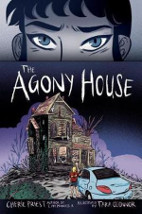
The agony house by Cherie Priest
Illus. by Tara O'Connor. Arthur A. Levine Books, 2018. ISBN:
9780545934299.
(Age: 12+) Recommended. YALSA Quick Pick for Reluctant Young Adult
Readers. Themes: Ghosts, Horror. With a clever graphic/novel hybrid
The Agony House provides chills and thrills for the teen
reader. Seventeen-year-old Denise Farber, her mom, and her
stepfather are trying to renovate the Argonne House, a very old run
down house in New Orleans, but ghosts inhabiting the house are not
happy. Denise finds an old comic book in the attic, starring feisty
Lucida Might, crime fighter and it may have clues to an old crime
and the reason that horrifying incidents are happening in the
'Agony' house.
The gripping composition of this combination of types, graphic and
novel, make it quite difficult to put down. O'Connor's illustrations
from the comic and stand-alone pictures all stand out in blue, while
the text from Priest is engrossing and easy to read. Denise is a
determined heroine, very able in confronting not only ghosts but
opposition to the renovation from her neighbourhood. The agony house is a memorable ghost story that fans of ghost
stories and the supernatural are sure to enjoy.
Pat Pledger
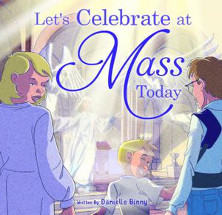
Let's celebrate at Mass today by Danielle Binny
Little Steps, 2019. ISBN: 9781925545814.
(Age: 3-6) Danielle Binny provides a simple but complete picture of
the celebration of Mass. A little boy goes to church with his
parents and baby sibling. Starting with a friendly wink on the front
cover, he explains to the reader just what happens when he goes to
Mass. He blesses himself with holy water, saying the traditional
words, 'In the name of the father, the Son and the Holy Spirit,
Amen', then goes on to sit with his family following the actions of
the priest with details of what is happening.
As well as giving readers a vivid picture of the ceremony of Mass,
Binny shows a loving and caring family and a welcoming and diverse
community in the church. The pictures of the father, carefully
holding the baby to his chest are heart-warming. The little boy is
handled gently by his mother, knowing that he must whisper if he
needs to say something and when everyone gives a handshake and a
smile for the sign of peace.
A glossary at the back of the book completes the picture of Mass.
The book would be very useful when looking at different religious
ceremonies giving young readers a clear picture of what happens at
Mass and for those who are Catholic, will emphasise the importance
of Mass for their faith.
Pat Pledger
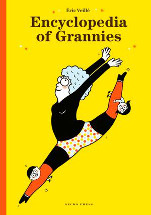
Encyclopedia of grannies by Eric Veille
Gecko Press, 2019. ISBN: 9781776572434.
(Age: 4+) Themes: Humour, Grandmothers, Diversity, Expectations.
With a tongue placed firmly in the cheek, this overview of what to
expect from a grandmother will encourage howls of recognition
alongside surprises for the unwary as a huge array of behaviours are
attributed to the grandmothers of the world.
The board book type of publication will be able to ward off rough
wear and tear as many young children will want to read of their
exploits and share what their grannies do. From the front hard cover
showing a grannie in her tights springing across the page her two
grandchildren hanging onto a leg each, readers will respond with
smiles and lots of laughter. This is not what a grandmother is
expected to do.
Opening the book, a page is devoted to the general sort of
grandmother, then their ages, and what to call them. And over the
pages, more unusual behaviour is shown: knitting, flexibility,
vocabulary, their cats, the way they use buses, how they travel and
so on, each different page alive with humorous comments about how
they live and expounds the idea that they are knowledgable, clever,
fond of cats, certainly fond of their grandchildren and live lives
full of interest and variety. Not to be underestimated, and
certainly not ignored.
Funny illustrations serve to highlight the text, and readers will
have fun reading the small boxes of text on each page to see how it
fits with the theme. This book will serve to be a great starting off
point for discussions about grandparents as part of the family.
Fran Knight
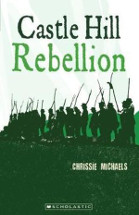
Castle Hill Rebellion by Chrissie Michaels
My Australian Story. Scholastic, 2019. ISBN: 9781742991863.
pbk., 236 pgs.
(Age: 10+) Themes: Australian History, convicts, Castle Hill,
Sydney. A little known Australian event comes to life in the latest
My Australian Story series, Castle Hill Rebellion. It
was a great history lesson for me because I had never heard of this
uprising. Castle Hill Rebellion is told through the eyes of young
12-year-old Jonathan Joseph Daley.
Castle Hill rebellion was a rebellion against colonial authority of
New South Wales in the Castle Hill area, in Sydney. It is a story of
the first and only convict uprising in 1804 which was suppressed
under martial law. Oh those redcoats were nasty.
Joe tells us the story of his life as a convict in Australia through
journal entries. Joe is a quiet shepherd boy and we learn of his
harsh life, especially against some of the other boys. Along with
his friend Pat and Kitt we learn of their hardships and how they
unwillingly become embroiled in a plot to overthrow their captors
and return to Ireland.
I can see how readers will be drawn into the adventures of Castle
Hill. A great book on Australian history with connections to the
Australian Curriculum. Historical notes can also be found towards
the back of the book and resources
from the National Museum Australia are available.
Maria Komninos
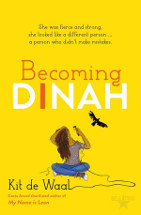
Becoming Dinah by Kit de Waal
Orion Children's Books, 2019. ISBN: 9781510105706. 243p., pbk.
(Age guide: 13+) Highly recommended. Who doesn't love a road trip
novel? This is not a standard coming of age story but a fresh take
on a much-loved classic. Kit de Waal uses the road trip to chart the
journey from one state of being to another, using flashbacks to
explain the main characters' pasts and how they came to be where
they are. The author takes Melville's Moby Dick and brings
it into the current age, casting Ishmael as a girl and Ahab as the
former leader of the defunct New Bedford Fellowship. Both are in
pain and both are obsessed - Ishmael/Dinah struggling with sexual
identity and coming of age; Ahab with the pain of a life he
cherished in ruins. We join Dinah and Ahab as they traverse the
countryside in The Pequod, an old VW camper, in an attempt to
retrieve Ahab's stolen van, and we feel the darkness and confusion
that has taken over their lives. Their obsessions define the story
and are quite heartbreakingly relatable and tragic. This is a novel
about love and loss and isolation; about looking back and the
process of rebirth in moving forward. It is about finding out who
you are . . . finding your tribe. Given the variety of themes -
obsession, sexual identity, isolation, personal growth as well as
being a retelling of Moby Dick, this book could be used in
the classroom as a class text or as an independent reading novel to
explore a number of ideas.
Gaye Howe