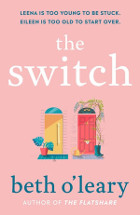
Quercus 2020. ISBN: 9781787475007.
(Age: Adult) Leena has a job she loves, lives in a trendy flat in
Shoreditch, London, which she shares with flatmates Martha, Yaz and
Fitz. But since the death from cancer of her sister, Carla, she has
been having panic attacks and making mistakes at work. She feels
horror and shame when her boss insists she take two months leave.
Leena is close to her 79 year old grandmother Eileen who lives in
Hamleigh-in-Harkdale. When Leena visits her she finds a list of
unattached men in the small village; Eileen is looking for a new
relationship since husband Wade left her. Leena suggests an online
dating service but there are not many local entries for the older
age group. London offers many more and from this is born the idea of
swapping places while Leena is on leave. Eileen agrees, partly for a
bit of fun but also to break down the barriers between Leena and her
mum Marian, who lives nearby. She has also been struggling to cope
since Carla's death and mother and daughter have barely spoken. So
as Eileen embraces London life Leena sets out to fill her place in
everything from Neighbourhood Watch meetings, dog walking, visiting
Marian and organising the local May festival.
As we follow the narrative, alternating between the point of view of
overachiever Leena and pragmatic Eileen the value of a change of
perspective becomes apparent. The characters are funny and engaging
and the comedy lightens the messages about caring for one another,
the importance of family, acknowledging grief and of course finding
love. A light read for women.
Sue Speck
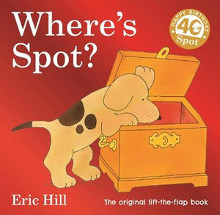
Where's Spot? by Eric Hill
Spot the Dog. Puffin, 2020. ISBN: 9780241446850. Board book.
(Age: 0+) Highly recommended. With a gorgeous ruby cover to
celebrate 40 years since the publication of this classic picture
book, young and old alike will delight in the simple story of Sally
trying to find Spot the little puppy. She looks in all sorts of
places, under the stairs, in a box, under the rug, but Spot is not
there. Instead she finds an array of smiling creatures, a crocodile,
a snake, a bear, and a hippopotamus until she finally finds him and
gives him his dinner.
The gentle refrain of "Is he in the . . . "; "Is he under the . . .
" will be one that children can repeat along with the reader and
then shout out a resounding "No." There will be opportunities for
children to play hide and seek themselves and peek-a-boo after
reading the story. The simple repetition and large print will also
help emerging readers as they repeat familiar pages.
The pages are sturdy and the lift-the-flaps are big enough for
little fingers to handle. What makes it so special are the big
images of Sally the dog, outlined in black and the vivid colours
that children are sure to enjoy.
This is a lovely book that will bring back memories to the
generations who have read it aloud to children. Now their children
have the opportunity to read it to their children as a board book
and grandparents will be overjoyed to bring back memories with this
gift to their young grandchildren as well.
Pat Pledger
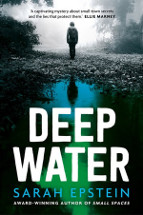
Deep water by Sarah Epstein
Allen & Unwin, 2020. ISBN: 9781760877286.
(Age: 14+) Recommended. Chloe misses her friend Henry and is
determined to solve the mystery of his disappearance. Following a
violent storm one night, the only clue to Henry's whereabouts is
his mountain bike leaning against the train station wall. Did he
just leave, as he once hinted he might do, or did something
terrible happen to him?
Epstein's novel switches between Chloe narrating in the present, and
past snippets of Henry's online messages with a mysterious friend,
and chapters about Henry's brother Mason in the lead-up to the
eventful night. Both Henry and Mason suffer from abuse by their
alcoholic mother Ivy. The early scenes depicting their home life are
so ugly, with no insight into any redeeming characteristics for
their mother, that some readers may find it hard to engage with the
narrative, but once past those pages, the mystery about Henry's
disappearance, and the clues that Chloe unearths, leads the reader
on a twisting path of suspicion and conjecture that holds our
attention until the last pages.
Chloe's detective work points to Mason; and we know that Mason
himself is afraid of his own anger. Is he a product of his parents -
son of an abusive mother and a criminal father: is he bad, empty,
worthless? Is he set on a path that he cannot change?
Chloe and her circle of friends gradually uncover the events of the
night of the big storm, there are many misleading clues and red
herrings that Chloe determinedly investigates one after another. No
adult seems willing to help. Suspicions turn from one person to
another, but most suspicious of all is Mason, the boy within their
friendship group. Chloe does not give up, until suddenly she finds
herself confronting a danger she had not predicted.
This is an engaging mystery thriller that readers of this genre will
thoroughly enjoy. Teacher's
notes are available. Themes: Murder, Mystery, Child abuse, Anger management.
Helen Eddy
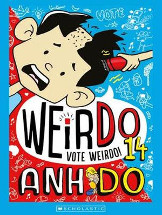
Weirdo 14: Vote Weirdo! by Anh Do
Illus. by Jules Faber. Scholastic, 2020. ISBN: 9781743836668.
(Age: 7-9) Weirdo 14: Vote Weirdo! is the latest
entertaining story in the Anh Do series and begins with Weir Do and
his classmates choosing students to run for Class Captain. Weir Do,
Bella Allen and Hans Some are nominated for a number of different
reasons. Weir Do rushes home to tell his family but discovers his
father has bought hair clippers. His father is a serial collector of
junk and this time the consequences for Weir are highly embarrassing
especially as he is about to begin his campaign for Class Captain.
Fortunately Henry and his father are able to help Weir Do cover up
the slightly awkward problem. The campaign involves creating
posters, presenting three ways to improve the school and giving a
speech to the class. Bella and Weir Do complete this admirably but
Hans Some with his sky writing campaign, egocentric ways to improve
the school for himself and parent written speech misses the mark. An
unfortunate event with a gust of wind ends Weir Do's chances of
winning but in the end everyone is satisfied.
The illustrations by Jules Faber create added interest in the story
and the bright blue theme begins with the cover and continues
throughout the book. This fourteenth book in the series is perfect
for those younger students discovering chapter books, reluctant
readers or just for those children who can relate to a light,
humorous and quick read. Themes: Humour, Friends, School, Family,
Recycling, Voting.
Kathryn Beilby
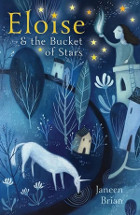
Eloise and the bucket of stars by Janeen Brian
Walker Books, 2020. ISBN: 9781760651879.
(Age: 10+) Highly recommended. Eloise Pail lives in a soulless
place, the Children of Paradise Orphanage, rivalling Jane Eyre's
Lowood Institution for cruelty and privation.
Nearly thirteen she is burdened with many of the tasks to keep the
place running by the vindictive head nun, Sister Hortense. A nastier
protagonist is hard to find, and readers will squirm seeing the ways
Sister Hortense makes Eloise's life miserable. Eloise longs for a
family, but knows nothing of her background. Her name has been given
her by the institution, her surname Pail from the bucket in which
she arrived at the orphanage as a baby in 1807.
She goes to the village each day to fetch water and always stops to
talk to the blacksmith's horse. She dreams of what a family might be
like while talking to the stars at night, her only friends. But
Hortense seems to have a second sense about Eloise's veering from
her duties and is quick to punish.
One day in the village Mr Jackson, the smithy gives her a piece of
paper to decipher with a drawing of a unicorn on it. Already
punished by Sister Hortense for telling the younger orphans a story
about unicorns, Eloise keeps the stories to herself, writing them on
a scroll she keeps on her person.
When a new girl, Janie Pritchard arrives at the orphanage Eloise
takes a long time to trust her. She watches Eloise, asking
questions, and Eloise finds that like her, she watches for shooting
stars, said to be ridden by unicorns. When a busker snatches the
blacksmith's paper from her grasp, Eloise is at a loss to remember
what was written, but the dying spinach in the vegetable patch
points to the veracity of the words, telling of something happening
at the next full moon. And just when the girls are beginning to
trust each other and share what they know, Janie is adopted by a
family on a distant farm. But the full moon approaches.
Brian has written an engrossing, multi layered story about Eloise, a
character all readers will admire and love as she battles with her
situation. The cold, loveless background bristles with injustice,
and the magical turn of the story will further beguile readers'
imaginations. What a cracker of a story. Teacher's
notes are available. Themes: Family, Magic, Belonging,
Orphanages, Abuse.
Fran Knight
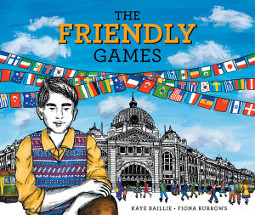
The friendly games by Kaye Baillie
Illus. by Fiona Burrows. MidnightSun Publishing, 2020. ISBN:
9781925227642.
(Age: 5+) A motherless boy called John Wing was taken into a
welcoming children's home where he had many other children to play
with and everyone was invited to each other's birthday party. At
eight he was adopted and missed the friends he had at the children's
home. New to his school he checked out all the sports he could find,
but instead of choosing one to learn, he found out about the Opening
Ceremonies at the Olympic Games. He was enthralled, but could not
understand why there was no big closing ceremony. He read all he
could about the Olympic Games, especially when it happened to be in
Melbourne in 1956. He loved watching the bunting and the lights, and
loved the way ordinary people joined in, especially when taking in
some of the athletes to their homes. John read all he could, even
the articles about boycotting and fights between the athletes, and
was concerned that this was what people would remember, not the
friendliness of the games, which was the aim. So he wrote a letter.
He heard nothing back from his letter writing, but at the end of the
games he was amazed to see the athletes all together just as he had
suggested, celebrating the closing of the Friendly Games.
A wonderful tribute to the power of just one person, The
friendly games shows how one boy wrote a letter which made a
significant change to the direction of the Olympic Games, and
instead of the Melbourne Games being known for the politics which
divided some teams, is known forever as the Friendly Games.
An author's note at the end of the story fills out the background on
which this picture book is based, and gives more detail about John's
life.
This book would be useful when talking about the Olympic Games, but
the illustrations of Melbourne and the spirit which surrounded the
city at that time may have been better served as photos. There are
some apt touches, with John watching TV in a shop front, TV only
just getting to Australia in that year, and the images in the
streets of Melbourne. Themes: Olympic Games (Melbourne), The
Friendly Games, Sport, Migration.
Fran Knight
Rules for being a girl by Candace Bushnell & Katie Cotugno
HarperCollins, 2020. ISBN: 9781529036084. 293pp.
(Age: 15+) Highly Commended. Marin & Chloe are friends who both
have crushes on Mr Beckett (Bex), their hip, young English Teacher.
Marin's boyfriend, Jacob, is the school Jock but she often stays
late after school, working on the school newspaper with Bex. Marin
aspires to a career in journalism at Brown University but after
accepting a ride home via Bex's house, the plot quickly becomes a
cautionary tale. Naively, Marin is certainly not prepared for what
happens when Bex crosses the line.
The upside to Bex's unapologetic betrayal of trust, if there is one,
is Marin's awakening to the feminist perspective. Marin, already
critical of the gender inequities in the school dress code,
identifies more gaps in resources and expectations between the two
genders. Jacob struggles to support the 'new' Marin, who pens a
cathartic editorial about the confusion and double standards
experienced by young women, entitled "The Rules for Being a Girl".
"Don't be one of those girls who can't eat pizza. You're getting the
milk shake too? Whoa. Have you gained weight? Don't get so skinny
your curves disappear. Don't get so curvy you aren't skinny. Don't
take up too much space. It's just about your health . . . ." (page
81)
When Marin confides in Chloe, she is jealous rather than supportive.
Principal DioGuardi also accepts Bex's account. For much of the
story, Marin turns to Gray, a boy who admired her editorial and
joined the feminist book club, to navigate the sexist policies the
students are subjected to. Despite his temporary triumph, Bex is
angry that Marin would seek to harm his career by snitching. He
sinks to new lows to hurt Marin for "breaking the rules". A true
heroine, Marin overcomes the devastating setback and teaches her own
lesson - one that will chasten both Mr Beckett and Principal
DioGuardi.
An impressive snapshot of a typical High School culture, Bushnell
and Cotugno have created a worthy role model and guide in Marin. Her
journey and her pivotal "Rules for Being a Girl" editorial, should
be mandatory reading for all teenage girls.
Deborah Robins
Peta Lyre's rating normal by Anna Whateley
Allen & Unwin, 2020. ISBN: 9781760525309. 237p.
(Age: 14+) Highly recommended. Peta & Jeb have been friends
since childhood. Now they both attend a Queensland technical college
on the wrong side of the tracks. Peta has an Autism Spectrum
disorder. Although high functioning, it takes only a few pages for
the reader to appreciate the privilege of being inside this
narrator's head. After certain events, Peta's thoughts and often the
rote "rules to fit in", given to her by her therapist, provide
detailed insight into living with invisible disabilities denoted by
letters of the alphabet - ASD, ADHD etc.
Although it is the assumption, the students are not the problem.
Like every teen, they flounder to work through their respective
physical, cognitive, familial or social disadvantages with varied
success. Peta lives with an understanding aunt as Jeb deals with an
abusive father. Sam is the new girl. Her family is 'normal' but she
has 'baggage' too. When the three new friends go on the school trip
to the snow fields, sharing the dorms with private school students,
the relationship between Peta and Samantha is explored. But Peta is
not the only one who has communication problems. The author skates
across many of the insecurities and identity forming rituals of
adolescence faced by Sam, Jeb and the other students.
The ski trip opportunity helps Peta and Jeb identify their life
pathways but not before Jeb and Sam learn that Peta can take care of
herself - that Peta's awkwardness does not make her needy or
incapable. Peta proves that she can be more extraordinary without
the rules; that her strengths, including her intense focus and
honesty, are not deal breakers for everyone but her closest friends.
It may be confronting to witness Peta's reliance on medication and
readers will commiserate with Peta's lows. Above all, we are
exhilarated for her, when she demonstrates that she can be
accomplished not only in spite of, but because of her
idiosyncracies. Everyone, particularly teachers would be enriched by
her inner story. Teacher's notes, a trailer and interview are
available from the publisher.
Deborah Robins
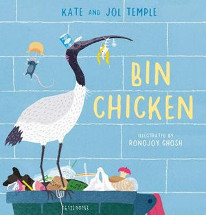
Bin chicken by Kate and Jol Temple
Illus. by Ronojoy Ghosh. Scholastic, 2020. ISBN: 9781743830048.
(Age: 4+) Highly recommended. The term 'bin chicken' is new to me,
but looking it up on google, I was amazed at how well grounded the
term is. And the urbanisation of the Australian White Ibis is a
problem almost Australia wide, beginning in the late 1970's.
As the ibis rummages through the waste we leave behind, a splendid
opportunity is offered by the author to point out how much we throw
away, and for classes to undertake some work about recycling.
But this book uses humour to tell its readers about the ibis and its
strength, pushing aside the bullies and keeping on what she is
doing. The verse story shows us the detractors: the sparrow, pigeon,
seagull and crow, all picketing the ibis to stop giving birds a bad
name. But Ibis carries on doing what she does: diving into trash
cans, rummaging through dumpsters, swimming through rubbish, taking
home odds and sods to its nest where her chicks are schooled into
the life led by an urban iris.
The verse encourages readers to predict the rhyming words, and learn
some of the stanzas, enabling them to read it along with the
teacher, or read it for themselves. The lists of items found in the
trash cans, dumpsters and lying around on the street will be added
to by the readers, encouraging them to look out for waste left
behind.
The digital illustrations add humour and background to the story and
students will laugh at the antics of the other birds as they picket
the ibis, call it names and deride its lifestyle. I love the rat,
Ibis' only friend, as it supports the efforts of the ibis, keeping
close by. Readers will love searching for Rat on each page, and
laugh at the array of waste found by Ibis and Rat.
Despite all the rubbish thrown at her by other birds, the bullying
by the quartet, Ibis comes out on top, building her nest, caring for
her chicks, teaching them to scavenge as she does. They are
survivors. Themes: Birds, Ibis, Rubbish, Scavenging, Waste, Verse, Read
aloud.
Fran Knight
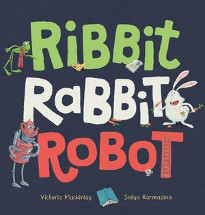
Ribbit, rabbit, robot by Victoria Mackinlay
Illus. by Sofya Karmazina. Omnibus (Scholastic) 2020. ISBN:
9781743834060.
(Age: 4+) Highly recommended. Three friends, a rabbit, frog and a
robot work in an antique store. When the frog pulls a book from a
pile of books, a lamp falls on his head. Rub it, say the robot and
the rabbit, and rub it, the frog does. Out of the lamp pops a genie
with instructions about what to wish for, warning them not to be
mean. Both the rabbit and the robot are quick to use their wishes,
but the frog takes his magnifying glass to look closely at the fine
print. Rabbit has wished for another rabbit while the robot has been
given a robotic dog, but both are dissatisfied and want to grab the
lamp for themselves. Mayhem follows as the three battle for the
lamp, taking them across the sea in a canoe, over the fields in
bicycles, then in tractors, until they ascend in hot air balloons.
Each page sees another scramble of the words robot, rabbit and ribbit
as the author delightfully plays with the readers. Children will
laugh out loud at the variations of these words, wondering what will
come next. And the luminous illustrations full of movement and
detail will add to their enjoyment.
Finally the trio rockets into space with the lamp, until the frog,
still intrigued by the words at the end of the scroll, uses a
fishing line to grab the lamp from the robot.
His selflessness is rewarded while the selfishness of the rabbit and
the robot see their wishes undone.
This is a wonderful play on words which will have children amused
and entertained, wondering about the word variations. The
illustrations are meant to be pored over, searching through a myriad
of detail as the trio cavorts over water, seas, fields and space,
while the fabulous antique shop is full of wonders. The strong
message of being unselfish will resonate with the readers as they
laugh with the mayhem caused by the greed of the rabbit and robot.
Themes: Robots, Rabbits, Frogs, Selfishness, Genie, Wishes.
Fran Knight
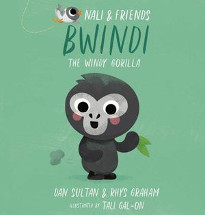
Nali and friends: Bwindi the windy gorilla by Dan Sultan and Rhys Graham
Illus. by Tali Gal-on. Scholastic, 2020. ISBN: 9781743836378.
(Age: 4+) Recommended. Melbourne performer Dan Sultan has joined
Rhys Graham and artist Tali Gal-on to produce a great sing-along
book about farts. But watch out it is catching!
Part way through her world-wide adventure, Nali meets Bwindi, a very
windy gorilla. Nali and her family have settled for the night in a
tree; mum and dad, great grandmother, Nali and her sister all tuck
their heads under their wings to sleep but Nali is astonished to
hear the loudest of noises. Flying down to the ground to
investigate, she finds a baby gorilla, chewing on some leaves.
Nali is concerned and asks him about the noise she has heard. Bwindi
reassures her that the noise was him, and when she again asks if his
parents are concerned, finds that his parents often keep each other
awake with their noises, as they have much larger bottoms than he.
They laugh and talk together until Bwindi comes to miss her family
in the tree so flies up to be with them.
Dan Sultan's ARIA award winning album, Nali and friends, has
an offshoot with this story of Bwindi, so well suited for classes
and children to discuss their bottoms and why they make the noise
they make.
Perfect for discussions about health and hygiene, but also about
family and friendship. Bwindi the windy gorilla will make friends
with all those children who read the book.
And join along with Dan as he sings the song on YouTube.
Themes: Animals, Farting.
Fran Knight
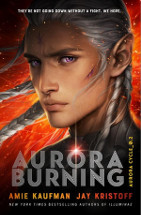
Aurora burning by Amie Kaufman and Jay Kristoff
The Aurora Cycle book 2. Allen & Unwin 2020. ISBN:
9781760295745.
(Age: Teens) Highly recommended. Following Aurora
rising Aurora Legion's Squad 312 is back trying the save
the galaxy from being overtaken by an ancient hive-like alien. Led
by the meticulous Tyler and grieving for Cat, the team is determined
to find the black box from the space ship, Hadfield, where Aurora
had been asleep for two centuries. Adventures abound as the group
evades pursuers and meets Kal's long lost sister, a Syldrathi
commander. Aurora is determined to learn how to master her powers
and use herself as the Trigger for the weapon that the ancients have
left.
Written in alternating chapters from the six team members, Kaufman
and Kristoff do a sterling job of describing the feelings and skills
of the main characters, who may appear to be stereotypes (Tyler, the
buff blond leader, Kaliis, the pointy eared, very tall and handsome
elf-like creature) but are people that the reader begins to know
very well. Interspersed with some very comic dialogue, especially
from Scarlett, the diplomat in the group, the novel bounds along
with breathtaking speed and high octane action. There are ship
heists, gun fights, space war and fight after fight, with enough
clashes and skirmishes to satisfy an adventure junkie.
Short chapters with the name of the character narrating at the
beginning of each also help to keep the reader engrossed. Then there
is a totally compelling cliff-hanger of an ending that made me
search to see if there was another book to come (there is,
thankfully).
Kaufman and Kristoff have succeeded in writing a fantastic second
book in the series. The Aurora Cycle books are sure to leap
off the shelves, and the gorgeous cover on Aurora burning,
featuring Kal, is another enticement for readers to pick up the
book.
Pat Pledger
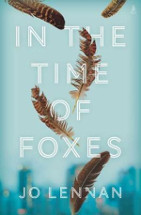
In the time of foxes by Jo Lennan
Scribner, 2020. ISBN: 9781760855697.
(Age: 16+) Recommended. Foxes are survivors; they've adapted to the
urban environment. They are reknown for being cunning and predatory.
In the first story in this collection by Jo Lennan, Nina has a Fox
Situation - they have created a 'breeding earth' in a hollowed tree
stump at the bottom of her garden and have become a nuisance to her
family and neighbours, with the exception of her young son Ronnie
who loves to watch their antics through the window. It's a problem
that Nina struggles to find a humane solution to, just as at the
same time she is coming to terms with her mother's dementia and how
best to care for her.
The foxes in the first story are there, wild and free, and
persistent. Other stories also tell of some kind of encounter with a
fox, but it is not always the animal itself, it may be a charming
man with a silver mane of hair, or someone clever and dangerous. Or
a person coming to understand the hidden cunning within themselves.
All of the stories are insightful about relationships, the struggle
between the apparent and the hidden, or the outward and the
interior. And, as the publisher's blurb says, each narrative is a
compressed novel.
They are very interesting stories; locations vary from London,
Sydney, Tokyo, Hong Kong, even a station on Mars. They tell of
relationships between parents and children, couples, friends, and
childhood companions. And in the background somewhere there is
always a fox.
Themes: Nature vs civilisation, Life and death, Friendships,
Rivalry, Self-understanding.
Helen Eddy
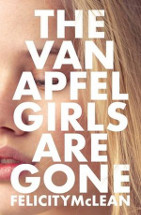
The Van Apfel girls are gone by Felicity McLean
HarperCollins, 2019. ISBN: 9781460755068.
(Age: Adult - Senior secondary) Highly recommended. Tikka Molloy was
11 when the Van Apfel girls, Hannah, Cordelia and Ruth disappear,
the mystery of their disappearance remaining unsolved. Recounted in
the voice of the young Tikka, the reader is taken to a hot
Australian town set on a smelly river. The three girls disappear
during a Showstopper concert held by the school, during a skit that
Tikka has made up as a diversion for their running away. But they
don't find Tikka's sister Laura who has money for them and nobody
knows where they have gone. Weeks of searching does not solve the
mystery, even though the girls' father is questioned extensively, as
is Cordelia's teacher.
When Tikka comes back as an adult to be with Laura who has cancer,
she is still haunted by memories of what happened and still often
thinks that she sees Cordie as an adult, striding away, blond hair
bobbing. She questions whether she and Laura should have told the
police that the girls were planning to run away, and even her father
feels that he should have done more to stop the domestic violence
that Mr Van Apfel used to dominate his family.
The story brings back all the heat of an Australian summer, the
swimming in the backyard pools, the casual jealousy of younger
siblings for their older sisters, the smell of the river and the end
of term school concert. Tikka's childhood comes alive as she
describes in her precocious and innocent voice, what happened that
summer. The fear that the girls felt as they watched Mr Van Apfel
threaten his daughters and poorly understood sexual undertones
pervade the story as rumours circulate about Cordie's teacher,
leaving the reader wondering who was responsible for the girls'
disappearance. Indeed McLean leaves that mystery open to the
reader's own interpretation, rather like the mystery in Picnic
at Hanging Rock.
Part mystery and part coming of age story, this is a story to be
savoured and discussed. An essay by Felicity Mclean is available here.
Pat Pledger
The giant and the sea by Trent Jamieson
Illus. by Rovina Cai. Hachette, 2020. ISBN: 9780734418876.
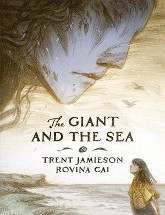
(Age: All) Highly recommended. This eye-catching large format
picture book will not be left long on the shelves. A giant peers
down at the young girl in the bottom right hand corner of the cover,
watching what she will do. She is not telling her anything but from
her expression, her shaded eyes, the down turned mouth, the plea is
there and once opening the book readers will see what her plea is
about. The words, 'the sea is rising' are repeated through the book,
firstly to make the child aware of the danger which will engulf them
all when the sea does rise, and then repeated by the child as she
tries to warn others of the dangers the giant has predicted, and
again at the end when the words come full circle, the situation no
different than before.
A fable for the modern reader, the book promotes discussion about
climate change, of standing up for what you believe in, of the
possibility of hope.
The giant tells the child that the reason for the seas rising is the
machine and tells her to get the people in the city to shut it down.
But they are adamant that the machine is of great benefit, and
feelings are polarised, so much so that people with banners march on
the giant, telling her to go away. When the seas do rise, it is the
giant that comes and saves the girl and her family along with some
others from the town. They rebuild their town on higher ground and
the giant keeps watching the sea until one day she tells a young boy
on the shore, 'the sea is rising'.
And so the cycle starts again. Children will come to see that change
needs to happen for the seas not to rise, and be aware that strength
is needed to overcome the doubters.
The strong illustrative technique of Rovina Cai will excite the
readers. The mix of graphite, crayon resist and wash means I wanted
to touch each page, feel the child's hair, touch the rising sea,
feel the power of the machines undermining the town. The gothic
power of her drawings sweep across the pages, taking the eye with
them as the water rises, the machines steam and whirr, the people
stampede towards the giant, while her sparing use of colour adds
texture and passion to her atmospheric pages. Themes: Climate
change, Environment, Prediction, Future, Inundation.
Fran Knight