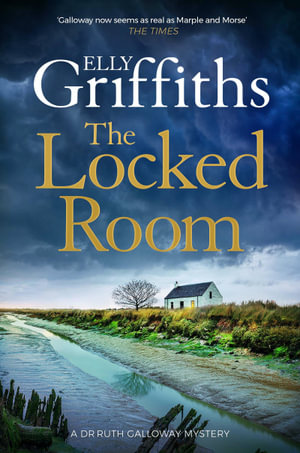
The Locked Room is Number 14 in The Ruth Galloway series, and Elly Griffiths still manages to produce an intriguing mystery and some very interesting historical details about the medieval plague, all set within the COVID-19 pandemic. When Ruth is clearing out her mother’s effects, she comes across a photo of her cottage, with the words ‘Dawn 1963’ written on the back. Coming back to Norfolk she is determined to find out why her mother had a picture of the place, but Covid erupts, and she finds herself organising course work for her university students, via Zoom, and trying to home school her daughter Kate. Meanwhile Nelson has become suspicious about a suicide which does not feel right, and the team finds a series of suicides that family members find very difficult to believe. Add in a mysterious ghost called The Grey Lady, bricked into a house during the plague, a new neighbour, Zoe, whom Ruth is drawn to and the ramifications of Covid, and readers will be drawn into this mystery.
Griffiths exploration of life during Covid will be familiar to all her readers, who will identify with the loneliness and difficulties of working from home and teaching a young child. The awful anxiety of having a loved one come down with the virus is vividly told when Cathbad is its victim. Police procedures during lockdown are described as well and Nelson finds himself at home alone while Michelle is in Blackpool with their son, and this provides an opportunity for Nelson and Ruth to develop their relationship.
The links between The Grey Lady, the apparent suicides of women, her new neighbour Zoe, a woman locked underground and the body that Ruth has excavated are all tied together with some enthralling twists in a dramatic and dangerous climax. Readers like me who love this series will be longing for the next book. Griffiths does give enough background for the book to be a stand-alone for readers new to the series. This includes a page summary of each of the main characters at the back of the book. However, the series is well worth the effort to start from the beginning with The crossing places, winner of the Mary Higgins Clark Award 2011.
Themes Murder, COVID, Detectives.
Pat Pledger
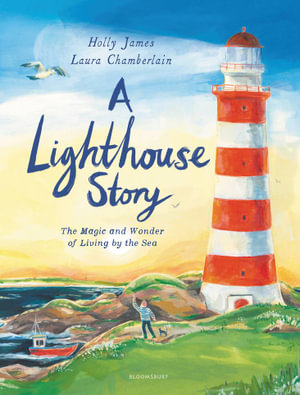
A lighthouse story by Holly James and Laura Chamberlain
When Eva goes to stay with her grandfather, she is excited. He lives and works on a lighthouse, so her days are spent helping him with his chores, watching the swirling sea around the little island and listening to his stories. Through their days together, the reader absorbs a great deal of information about the lighthouse, why it is there, what is its purpose and how it is run, while at the end of this stunning book are a number of pages giving more factual information: the lighthouse keeper’s handbook, famous lighthouses of the world, a look at modern lighthouses and a sideways plan of what is in a lighthouse.
Eva has to be taken to the island on a boat, an adventure in it itself as she watches the lighthouse come closer, its red stripes standing out against the blue sea. She helps Grandad clean the lens so that sailors can see it in the dark, she reads his daily journal of the weather, helps turn on the foghorn when it becomes foggy. When she has some spare time she loves walking over the rocks, checking the rock pools, watching the birds, spying the seals and watching the shiny scales of fish darting about near the shore.
But at night when it is dark, she loves looking at the stars and seeing the constellations that Grandad picks out. One night it becomes stormy and after Grandad checks the light they go downstairs to the safe and warm room at the bottom of the lighthouse and he reads her stories about bravery and courage. The tale of Grace Darling encapsulates these qualities as Grace and her father venture out one stormy night to rescue people after their ship founders.
What a tale to read snuggled up against grandfather on a cold wet and windy night. The story of Grace Darling contrasts with the story of Eva and her Grandad, one where she is on holiday helping her grandfather with the daily chores, enjoying herself, but hearing about the tougher lives led by lighthouse keepers in the past and the work they were expected to do.
A wonderful read, children will thrill at the idea of holidaying on a lighthouse but be made aware that places like these have an important role to play in keeping shipping safe.
The stunning illustrations show enticing detail of island life and the lighthouse and its work. Children will love poring over the detail, relishing the huge amount of information given both in the images and text. They will be able to fill in Granddad’s daily diary watching the different skies with an array of clouds and weather. The sea is absorbing with its changes of colour and temperament, enabling young children to see how the sea can be both inviting and playful then treacherous and dangerous.
Themes Islands, Sea, Lighthouses, Grandfathers.
Fran Knight
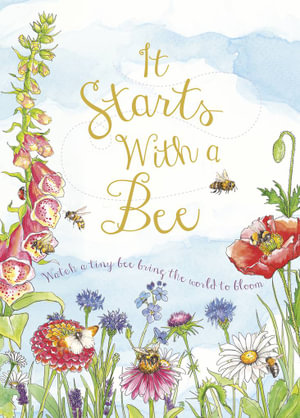
It starts with a bee by Jennie Weber
Murdoch Books, 2022. ISBN: 9780711270336.
Slowly, slowly we are beginning to understand how critical bees are to our survival, and yet how endangered they are becoming, so any book for young readers that helps them understand the crucial role that bees play has to be an important addition to any collection.
Using rhyming text and delicate illustration the reader is taken on a journey through the seasons from winter to autumn showing how a garden is pollinated and thus blooms to be beautiful flowers, fruits and vegetables bringing both joy and food to our lives, culminating in a magnificent three-page spread summarising the essential elements of the process. As well, it shows how bees work together with each other and other insects creating an interdependent eco-system which we must protect.
Although created by an English illustrator who believes " if people are amazed by the natural world, then they will be less likely to destroy it." so that there is a "English country garden" feel to it, many of the plants featured are very familiar to young Australian readers, making its message as important here as it is anywhere. It is an ideal complement to books like Holly, the Honeybee Dancing Star and Bee Detectives (with its focus on Australian species), all with their strong message of not just conservation but how simple it is for even our youngest readers to ensure their safety and survival.
Themes Bees.
Barbara Braxton
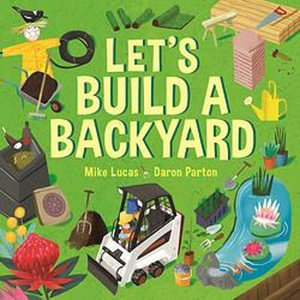
Let's build a backyard by Mike Lucas and Daron Parton
Let’s Build A Backyard is the newly published companion book to Let’s Build A House, both written by South Australian author Mike Lucas. This latest release is a lively and busy account of a time spent in the backyard of the father and his young daughter from the first book, working together to create a very special place.
From the very beginning of this delightful and energetic book the young reader will enjoy the action that the clever rhyming words impart. Each step of the building a backyard journey is labelled clearly, followed by the short rhyme, and with three action words highlighted across a double page spread.
Mix in some compost. Use your fork to turn, turn, turn. A little help from all the worms. Watch them wriggle, see them squirm. Squirm! Squirm! Squirm!
The bright and colourful illustrations by Daron Parton complement the text perfectly and showcase the steps needed to create the new garden. This book has a very welcome and gentle introduction to the sustainable theme for young children with mention of looking after a tree, making a possum box and a bee hotel, installing sprinklers, creating a vegetable patch, as well as adding compost.
This is a perfect book to read aloud to young children and engage them in the story by allowing them the opportunity to do the actions as it is read. A welcome addition to a home, school or public library.
Random House Children's Books, 2022. ISBN: 9780593178867. (Age:9+) Highly recommended.
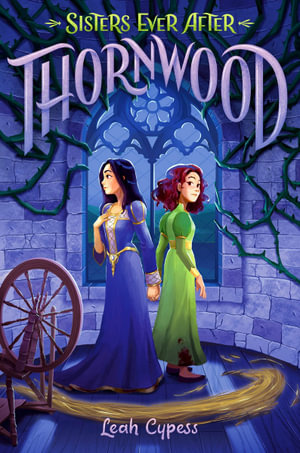
Thornwood is an intriguing retelling of The sleeping beauty and is one of my favourite genres. It is told from the viewpoint of Briony, the younger sister of Rosalin, who has been cursed from birth by a wicked fairy. She is destined to prick her finger on a spindle and fall into a 100-year sleep and will not be awakened until a prince kisses her. When Briony wakes up she is in the castle’s tower and everyone else is still fast asleep. Then she spots a handsome stranger kiss her sister, but questions arise about Varian. Why is the castle still surrounded by thorns, allowing no one in or out? Briony is determined to find a way to break the spell and rescue everyone in the castle - but no one has ever listened to the little sister.
Told in the first person by Briony, the narrative flows along smoothly, often with snarky asides by Briony which add wit and humour to the story. All the characters are fully fleshed out, and the sibling rivalry and love between the two sisters is a highlight of the tale. Briony is not a haughty princess and the friendship between her and Edwin, a boy who was so bullied in his village that he preferred to come to the castle and sleep for one hundred years, is another high point. Briony needs to use all her skills and cunning to work out how to be rid of the thorny forest that hems them all in and Cypess’s vivid writing ensures that the reader is fully invested in the story.
This is a fun read that will appeal to all fans of fairy tale retellings, although it is aimed at a middle-school audience. Readers will, like me, come away with a smile on their faces, at the surprise way Cypess ends her story and will want to read more books by this author. Other retellings like Book of a thousand days by Shannon Hale and Beauty by Robin McKinley are sure to appeal as well.
Themes Fairy tale retelling, Siblings, Problem solving.
Pat Pledger
How to spell catastrophe by Fiona Wood
Pan Macmillan, 2022. ISBN: 9781760984908. (Age:12+) Recommended.
How to spell catastrophe is the debut middle-grade novel by YA Australian author and screenwriter Fiona Wood. Like Nova Weetman's The edge of thirteen this book will be a popular choice for girls aged from 10 years as they grapple with bodily changes, hormones, friendship woes and other struggles and delights of the Middle Years of schooling. With the greatest of sensitivity, it is suggested that this book is really for girls. When talking about it with classes, it was suggested that boys could be interested only if they wanted to know more about girls... and this suggestion was met with much foot shuffling and bashful camaraderie. It is noted however that Wood dedicated this book to two boys. Perhaps she has in mind, a readership of boys who are more aware of the issues concerning girls.
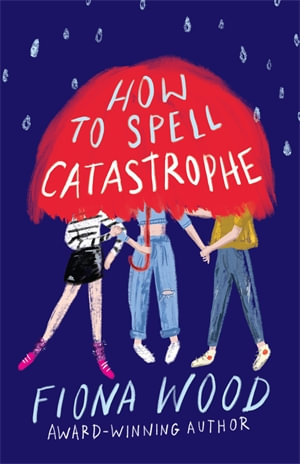
Wood goes, through the first person voice of Nell, to places that girls on the brink of adolescence fear and probably don't care to talk about even with their friends. How to spell catastrophe is therefore a comforting and instructive book for every pre-teen and tween age girl. Similar to the cover of The edge of thirteen, the cover of How to spell catastrophe suggests the feminine nature of the contents. Astred Hicks, Sydney-based graphic and freelance book designer, has created a cover featuring three girls sheltering and supporting one another under a large, red umbrella against a dark blue background complete with rather oversized raindrops. Rather appropriate!
The text is very accessible to the reader. Woods has the teenage vernacular down pat. Poor Nell McPherson, a grade sixer, is our protagonist and the reader sees life through her eyes as she copes with all the worries of the world. Nell states in the prologue. 'I'm still more of a worrier than a warrior.' She keeps a diary so the narrative is interspersed with her notes that appear to be kept in a spiral bound notebook and are about various catastrophes and the solutions to them. Occasionally, we read the contents of text conversations. She loves words and occasionally she chooses a word that is appropriate to her situation, defines it, puts her problem into writing, plans, gives her week a 'fruit ranking' and writes down what she is grateful for. Openly she talks about how she has seen a psychologist all her life when she needs help with strategising and coping with the worries that stem from the death of her father when she was two. This frank and open writing about seeking specialist help with social/ emotional/ thinking skills normalises what still can be a no-no subject in some places. This too is a comfort for the large and growing group of young people who we know are struggling with anxiety.
How to spell catastrophe is a novel that delivers, through the voice of Nell, much warmth and good advice. It's full of humour and looks at life through an optimistic lens. The adults in the book, from the teacher, Alex, to the parents are real and good characters. Wood has created such an authentic view of the current typical year 6 classroom and the interactions within, one wonders whether she has been a fly on the wall. The battle that Nell takes on re climate activism and the role models that she admires constitute another contemporary component of this story.
This is my dad by Dimity Powell and Nicky Johnston
EK Books, 2022. ISBN: 9781922539076. (Age:4 - 8)
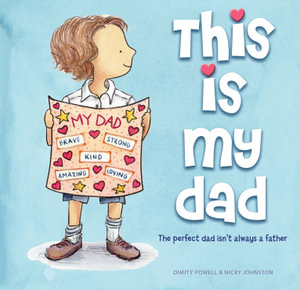
Leo's teacher announces that the class's next focus for Show and Tell will be their fathers and while this excites the other children, Leo's tummy belly-flopped. And did another one when Harper asks if their dads can come and share the experience. Because that can be all well and good for some kids, but what if you don't have a dad? And have never known one? 'How can I celebrate someone I've never met?'
So while his children's author mother hunts dragons and arrests aliens and rescues her characters from all sorts of predicaments, Leo hunts through the family photos for something he's not going to find. And then he has an idea...
Back in the day, teachers would celebrate events like Mother's Day and Father's Day with card and gift-making and all sorts of other activities almost without thought - it's just what was done. We didn't really give a lot of consideration to the Leos because two-parent families were the norm - it was rare to have students without that the traditional family structure. But that was back in the day, and now we recognise that families are as individual as the people in them and we cannot take anything for granted. Clearly Miss Reilly didn't get the memo and so this is a timely, important look into the anxiety that an announcement such as hers can make, how carefully we have to tread and how we need to change our focus so that our students are not marginalised or become anxious when what to them is 'normal', becomes apparently not-so.
This is a book to share with a class whenever one of those traditional celebrations rolls around, or the curriculum demands a focus on families. Apart from resonating with many of the children themselves, it could be a time to examine Leo's feelings when Miss Reilly made her announcement. Why did his tummy do a belly-flop? They could also look at the strategies that Leo employed to try to solve his problems. Why couldn't he just tell Miss Reilly he doesn't have a dad? Is he ashamed, angry, embarrassed? But even better, an astute teacher could involve the students in finding a big-picture question that embraces everyone's circumstances. Perhaps something that looks at the ties that bind a group of people into a family unit, rather than its physical structure and perhaps even comparing that to animal families. More able students might like to consider whether a wedding ring makes a family, and delve into the traditions and purposes of marriages, including cultural aspects.
While the structure of a family becomes more and more diverse and accepted, and the kids themselves don't look sideways at two mums, two dads, no mum, no dad and every variation in between which also reaches into the extended families, Leo's story is a reminder that, nevertheless, we need to tread carefully and between Powell's writing and Johnston's illustrations, we not only have a great heads-up for teachers but also a book which appears to be for littlies but which can enable older students to examine their own perspectives at arm's length, perhaps even reflect on their own situations and how that has shaped them.
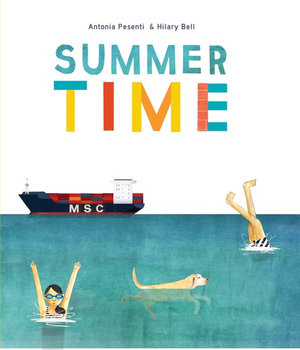
Author combination Antonia Pesenti and Hilary Bell have written a creative and ingenious book about summer holidays. From the bold endpapers featuring a different analogue time front and back, to the collage-style brightly coloured full page illustrations, this book will remind the older reader of summer holidays past. Reminders of waiting an hour to swim after eating lunch, swooping magpies, charcoal black sausages on the barbecue, mozzie bites, bushfires, eating mangoes and Neapolitan ice-cream, these are all memories for many living in Australia. The use of highlighted time words including forever, eternity, instant, ages and evening, will provide primary school teachers with the perfect book to use an as introduction to a unit of work on Time. The rhyming text is both cleverly constructed and complex, and the book will be best shared with between an adult and child.
Themes Summer, Time, Holidays, Memories.
Kathryn Beilby
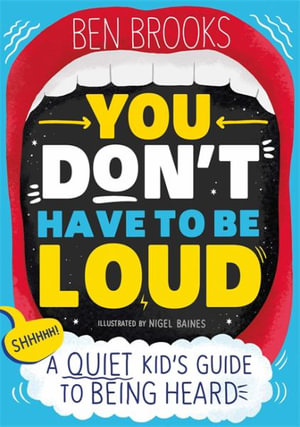
You don't have to be loud: A quiet kid’s guide to being heard by Ben Brooks
Hachette, 2022. ISBN: 9781526362872. (Age:9 - 12)
Ben Brooks, well known author of the popular Stories For Boys Who Dare to Be Different, Stories For Boys Who Dare to be Different 2, and Stories For Kids Who Dare to be Different has written this latest book for those children who do not always feel comfortable speaking to others and who would rather be alone than with company. The author has used personal experiences and feelings from his own life to share with readers. He breaks down what ‘shy’ and ‘quiet’ mean and gives examples of people with similar traits who have quietly achieved amazing things.
You Don’t Have to be Loud is begins with an introductory chapter: You’re Not Alone and the quote, 'Quiet people have the loudest minds.' (Stephen Hawking). The author reveals that he was always a quiet child, and this led to him doing some strange things. He admits he is less shy now as an adult but is perfectly comfortable being the quiet person in the room. There are seven chapters in this book with the headings: What is Shyness?, Everyone’s Different, Practice Makes Perfect, Everyone Belongs Somewhere, Your Time Online, The Glory of Being Alone and You Don’t Have to Be Loud. Each chapter has extensive information and anecdotes to share but it is cleverly interspersed around humorous images, large bold fonts, bright orange borders and features, as well quotes and important sayings. In the final pages there are lists of resources, references, as well as a comprehensive index.
The wisdom and ideas shared by Brooks in this book are considerable and may prove to be a challenge for some readers but with adult guidance and support for those who require it, there is much to be shared and learnt.
Themes Wellbeing, Personal Issues, Self-awareness, Self-esteem, Mental Health, Social Interactions.
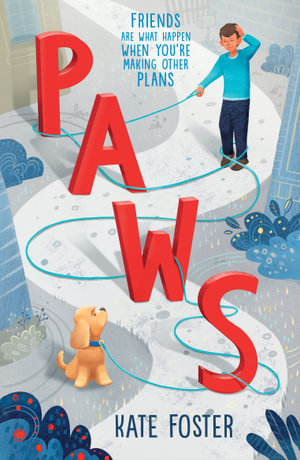
Paws is an easy to read heart-warming book about Alex, an eleven-year-old autistic boy looking for a best friend before he goes to high school. He loves dogs and his best friend is his cockapoo dog called Kevin. I wish I had a Kevin, and I am not a dog person. Give me a cat any day. Kevin was so cool and cute and helped Alex so much. Every kid should have a Kevin. Anyone that loves dogs would really love this book.
Kate Foster has done a brilliant job getting me as a reader to see the internal struggles that Alex goes through every day to understand social and emotional cues. No autistic child is the same and this is one story of how Alex sees the world and the obstacles he goes through to belong.
Alex is in his last year of primary school and thinks he needs to make a best friend before he goes to high school so he has a friend there with him. Alex is obsessed by dogs and PAWS the Dog Show is coming to town. And what better way to make a best friend but by entering a competition and winning a trophy. You can always get a best friend if you have a trophy. The fun Alex has with Kevin is cute.
I found Paws a great book about caring and inclusion and how people can be your friend without you knowing it. It shows the struggles a boy like Alex has at school and how he tries to copes.
I think Paws is a great book to read as a class and go through the discussion questions at the end of the book. The questions that Foster included at the end of the book would be greatly appreciated by teachers.
Themes Autism, Friendship, Dogs.
Maria Komninos
Saving the butterfly by Helen Cooper and Gill Smith
Walker Books, 2022. ISBN: 9781406397208.
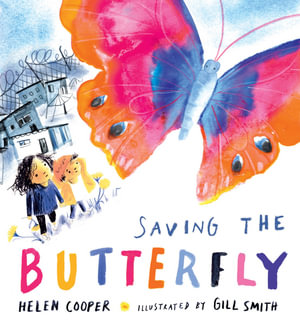
Older sister and younger brother have fled their homeland, the only two to survive the perilous boat trip to safer waters, where helping hands gave them sanctuary. And even though they had nothing from before, except each other, older sister said they were lucky because they could have lost so much more.
But while younger brother didn't think about that for long and began to make new friends and learn new things, older sister dwelt in the past - she felt she shouldn't forget and gradually a shadow fell over her mind, as dark and gloomy as their meagre surrounds. Until one day, younger brother captures a butterfly and brings it home. 'Set it free!' cries the older sister, but in its panic it bashes into the walls... Eventually it tires and settles on her hand and doesn't leave, as though it senses her pain. Older sister knows what she must do but does she have the courage...
This is a poignant story, sadly a repeat of so many times when people have had to flee their homes, and even today, it is happening again... It reminds us that there is so much more to starting again than the relief of reaching a safe harbour. Matching the lyrical text are stunning illustrations whose palette mirrors the mood perfectly, contrasting the darkness of older sister's thoughts and feelings with the hope offered by the bright butterfly.
With so many of our students having found themselves in the predicament of both older sister and younger brother, this is an insight into that long period of adjustment, the grief and fear that must be worked through, and the changes that must be made so we can be more sensitive to the needs of these children. It is so much more than just a story about refugees.
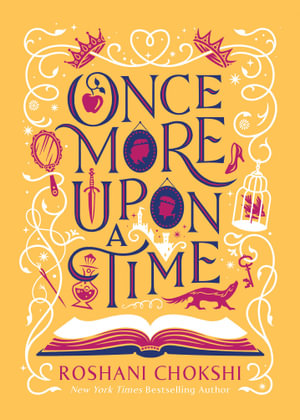
I am a fan of retellings of fairy tales and was immediately drawn to this slim hard back novella, a story about a princess named Imelda and a prince named Ambrose, who are married for a day and a night. Imelda is poisoned and the only way she can be saved is by forfeiting their love. Then a meeting with the witch who have cursed them, gives them the opportunity to regain that love. Facing many adventures including a beaver, strange landscapes, cannibals and a wicked fairy, the pair begin to get to know each other again.
A short book, Once more upon a time was just what I needed to get out of a reading slump as well as leaving me feeling happy and relaxed. The introduction of a talking cloak that thinks he is a horse adds many laugh aloud moments with his sharp and witty dialogue. The struggles that both Ambrose and Imelda face as their feelings grow give a contemporary feel to the fairy tale. Imelda does not want to be tied down. As one of The Twelve Dancing Princesses she has faced that with the magic slippers that her father had made them wear, and she wants to be free without the obligation of love. Ambrose, the middle brother, must learn to trust love, after being disappointed by his family.
This was a feel-good story, yet with enough adventure and danger to keep me glued to the page as Imelda and Ambrose strove to gain the potion that the witch demanded. There are many small gems of wisdom for the reader to ponder, including in the Epilogue: 'The king and queen did not live happily, but hopefully, ever after.'
Themes Fariy tale retelling, Love.
Pat Pledger
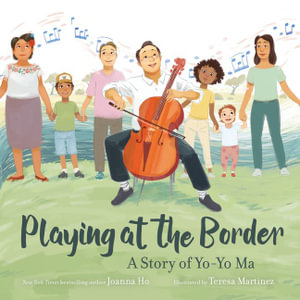
Playing at the border by Joanna Ho and Teresa Martinez
HarperCollins, ISBN: 9780062994547.
'Feet planted on the soil of one nation, eyes gazing at the shores of another, Yo-Yo Ma played a solo accompanied by an orchestra of wind and water.'
On April 13, 2019, on the US banks of the Rio Grande he played a piece of music hundreds of years old to an audience on the opposite banks in Mexico to show that building bridges is so much better than building walls.
But this is more than just a story of one man playing a cello alone to be heard by a few - this is the story of a renowned cellist, himself a blend of cultures as he was born to Chinese parents in France and raised in the US. Because his fingers were too small for a double bass, as a little child he chose the cello - and its particular blend of international origins is woven into both the story and the music. And from its strings comes the music dancing 'over rocks and rivers and walls into the sky', born in Germany 300 years before, lost, then found in Spain, and renewed in the US to unite those who had once been one but who were now separated...
Connecting cultures and countries through music was Yo-Yo Ma's ambition when he began the Bach Project in 2018, reviving the rare cello solos which 'create the sound of harmonising melodies on one instrument' there was a much symbolism as there was entertainment on that day in 2019 when the people of two nations momentarily joined together again, in defiance of the rhetoric and actions of the then POTUS. And in Johanna Ho's text, which is as lyrical as the music itself, we discover that there were many more than just two nations involved in making it happen.
As the clock ticks around, and pages are pulled off the calendar, it seems no time at all when a favourite that surely was just released yesterday, celebrates an important anniversary. Recently it was the 120th anniversary of Peter Rabbit, this time it's Bruce Whatley's The Ugliest Dog in the World. Surely it's not 30 years since I first heard the hoot of children's laughter as they pored over the hilarious text and illustrations in this classic! I particularly remember the kids labelling the 'lady next door' as Ms ... (a colleague) 'because she looks just like her!' Out of the mouths of babes, and, in this case, some things can't be unheard - even 30 years on.
This is the perfect book for teaching this generation about 'beauty being in the eye of the beholder', that everyone views the same thing differently, and that body image really doesn't matter. And even if the dog doesn't meet the standards for Crufts, it still brings love and joy to its owner and that's all that matters.
Only the best books endure, and this is one of those.
Themes Dogs, Body Image.
Barbara Braxton
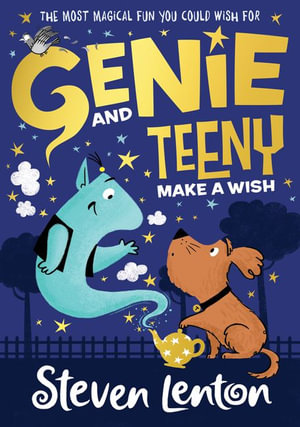
Genie and Teeny Make a Wish by Steve Lenton
HarperCollins, 2021. ISBN: 9780008408206.
Grant the genie is like most other genies because he lives in a lamp and is magical, but because he gets his words mixed up his wishes often go wrong. So when he conjures up a large snake instead of a birthday cake for Queen Mizelda, he is literally tossed out of Genie Land. His lamp lands on Earth but it so bashed and battered he has to find a new home - which he eventually does, in an old teapot.
Grant is very lonely until he meets the puppy, Teeny. Then Genie and Teeny are kidnapped by the evil purple-loving Lavinia Lavender, and find themselves on-course for a rollercoaster of an adventure - when all they really want is a place to call home.
This is the first in a new series of adventures that is perfect for those just starting out reading novels. There is an invisible narrator who speaks directly to the reader inviting them into the story as well as all the textual supports of short chapters, larger and more varied fonts, and plenty of illustrations. And being a series the promise of more adventures to come is a bonus.